


Is 2026 the Right Time to Launch a Healthcare Startup? The short answer: yes — and the window is narrowing.
Global digital health startups raised $14.2 billion in 2025 alone, with AI-focused companies capturing over 50% of total funding. The US will spend $6.8 trillion on healthcare by 2030. India's Ayushman Bharat scheme has enrolled over 500 million beneficiaries, creating an unprecedented infrastructure for digital health innovation.
The aftermath of the COVID-19 pandemic and the global aging population have permanently restructured healthcare. Patients now expect digital-first care. Clinicians are drowning in documentation. Insurance companies are bleeding due to inefficient billing. Every one of these pain points is a validated startup opportunity.
Whether you are a startup founder building your first product, an enterprise CXO evaluating digital health investments, or a tech entrepreneur looking for a sector with durable demand and societal impact, this guide is written for you.

What Is a Healthcare Startup?
A healthcare startup is a new business venture that applies technology, data, or novel service models to improve health outcomes, reduce care costs, or enhance clinical efficiency. Unlike consumer apps or SaaS tools, healthcare startups operate at the intersection of three high-stakes domains: clinical validity, regulatory compliance, and market adoption.
This intersection is both the moat and the minefield. Regulatory barriers keep out casual competitors. Clinical validity requirements demand real evidence. But once cleared, the defensibility of a compliant, outcome-proven healthcare product is enormous.
Three defining characteristics separate healthcare startups from other tech ventures:
- Compliance is a core product feature, not a legal formality. HIPAA (US), CDSCO, and India's DPDP Act are not optional — they are the price of entry.
- Sales cycles are long. Hospital procurement typically runs 9 to 18 months. Build your runway accordingly.
- Trust is the hardest asset to build and the easiest to destroy. One data breach or adverse outcome can end a healthcare startup faster than any market downturn.
The 2026 Healthcare Market Opportunity — US & India
Innovation without market validation is a high-stakes gamble. Understanding the market before you choose your idea is not optional; it is the difference between building into a tailwind and swimming against the tide.
Our comprehensive Healthcare Software Development Services bridge the gap between a visionary idea and a market-ready digital health solution
United States Healthcare Market
The United States spends more on healthcare per capita than any other nation. Key data points every founder needs to know:
- US healthcare expenditure: $4.9 trillion in 2023, projected to reach $6.8 trillion by 2030 (CMS, 2024)
- Digital health VC investment: $14.2 billion raised in 2025 — AI solutions captured 50%+ of all deal volume (CB Insights, 2025)
- Telehealth market: $851 billion globally by 2032 at 25.7% CAGR (Allied Market Research, 2024)
- Medical billing outsourcing: $16.9 billion by 2033 at 12.5% CAGR — driven by coding complexity and AI-assisted claims
- Remote patient monitoring (RPM): A $175.1 billion global market by 2032 — the "silver tsunami" aging population is the core driver
The US market rewards compliance-first, outcome-proven products. Founders who bypass regulatory shortcuts and invest in clinical validation consistently outperform those who optimize for speed alone.
India Healthcare Market
India represents the world's largest underserved healthcare market by population, with one of the fastest-growing digital infrastructure layers to match:
- Ayushman Bharat Digital Mission (ABDM): 500+ million beneficiaries enrolled, creating a unified health ID infrastructure that makes interoperability viable for the first time
- Digital health market CAGR: 27.4% through 2030 — second only to China in Asia-Pacific
- Specialist access gap: 60% of India's population lacks access to specialist care — telemedicine and AI diagnostics address this directly
- Startup India ecosystem: 100,000+ DPIIT-recognized startups, SIDBI seed fund access, and PM-JAY creating revenue streams for health tech firms
- AYUSH digital opportunity: Yoga, Ayurveda, and traditional medicine apps are a $4.4 billion addressable market growing at 22% CAGR
Tips:- Healthcare software development costs in India are 40-60% lower than comparable US development teams — making India both a target market AND a cost-efficient development base for US-market products. VLink's dual-shore teams in Connecticut (US) and India enable this model.
25+ Profitable Healthcare Business Ideas for Startups in 2026
These ideas are ranked by opportunity size, technical feasibility, and MQL (marketing qualified lead) generation potential for a B2B technology vendor like VLink. Each idea includes the ICP pain point it solves, compliance requirements, and VLink's specific capability.
Here are 25+ profitable healthcare business ideas for 2026, categorized by market demand:

Category 1: AI, Data & Diagnostics (Highest ROI Potential)
1. AI-Driven Diagnostic Tools
AI diagnostic platforms analyze medical imaging, patient records, and lab data to improve early disease detection accuracy by up to 40% (Stanford Medicine, 2024). This is the highest-stakes and highest-reward category in healthtech.
ICP Pain Point: Clinicians spend 34% of their time on documentation and data review (AMA, 2024). AI that reduces diagnostic workload wins immediate clinical adoption.
- Compliance: FDA 510(k) clearance (US); CDSCO Medical Device Rules 2017 (India)
- VLink capability: We develop scalable, compliant AI diagnostic software with medical imaging integration and audit trail architecture
- Market size: Global AI in healthcare — $45.2 billion by 2026 (MarketsandMarkets)
2. Medical Billing Automation & AI-Powered RCM
US hospitals lose $262 billion annually to billing errors and claim denials (Advisory Board, 2024). An AI system that predicts claim denial before submission and auto-corrects coding errors pays for itself in weeks.
ICP Pain Point: Revenue Cycle Management (RCM) teams are overwhelmed — the average claim denial rate is 12.2% (HFMA, 2024). Every 1% reduction in denials is millions in recovered revenue.
- Compliance: HIPAA; ICD-10/CPT code standards; payer-specific EDI formats
- Market size: US medical billing outsourcing market — $16.9 billion by 2033
- India angle: Apollo Hospitals and Fortis are actively seeking RCM automation; the Indian private hospital sector processes 400M+ claims annually
3. Predictive Analytics for Hospital Operations
Hospital readmission costs the US healthcare system $26 billion annually (CMS, 2024). Predictive analytics platforms that forecast patient risk, optimize bed allocation, and flag at-risk patients before discharge are in active procurement across health systems.
- Target buyer: CFOs and CMOs at mid-size health systems (250-600 beds)
- Revenue model: Annual SaaS license ($80K-$400K/year per hospital)
- VLink capability: VLink built a hybrid healthcare mobile application using Apache Cordova that manages patient data, prescriptions, and medical records across online and offline environments
Category 2: Telehealth & Remote Care
4. Telemedicine Platform
Telehealth is no longer a pandemic workaround — it is a permanent layer of care delivery. The global telehealth market will reach $851 billion by 2032 at 25.7% CAGR. Teladoc Health processed 5.3 million virtual visits in 2024 alone.
What founders get wrong: building a feature-complete product before validating a revenue model. The three proven telehealth business models are: (1) B2C subscription (patients pay monthly), (2) B2B SaaS (employers or insurers pay per employee), (3) B2B2C (hospitals white-label your platform).
- Startup cost range: $100K-$500K (US); ₹84L-₹4.2Cr (India)
- VLink case study: We built an online consultation platform allowing patients to search online doctors' consultations by specialty, schedule appointments, and receive video/phone/chat consultations — with AI and IoT integration
5. Remote Patient Monitoring (RPM)
The aging-in-place megatrend is driving RPM from a niche product to a mainstream care model. 4.5 million Americans receive home healthcare annually. RPM platforms that connect wearables, biosensors, and care teams reduce hospital readmissions by up to 38% (CMS pilot data, 2023).
ICP Pain Point: Families of elderly patients cannot bridge the 24-hour care gap. The hospital of the future is the home — and the technology that makes that possible is RPM.
- CMS Reimbursement: RPM qualifies for Medicare reimbursement (CPT codes 99453, 99454, 99457, 99458) — creating a direct revenue model for clinical customers
- India angle: ASHA workers and ANMs can use RPM devices to extend specialist monitoring to Tier 2/3 cities — a massive underserved market
6. Mental Health Technology Platform
Mental health is the fastest-growing healthtech subcategory. 23% of adults are currently in therapy; 43% plan to start within 12 months (APA Survey, 2024). The total addressable market for digital mental health is $19.4 billion by 2027.
Key insight: the most successful mental health apps (Headspace, BetterHelp, Calm) win on behavior design, not clinical protocols. Your UX team is as important as your clinical advisor.
- VR mental health apps: Oxford VR uses VR to treat anxiety disorders and phobias through immersive exposure therapy — a clinical use case with FDA Breakthrough Device designation potential
- B2B mental health: Employee Assistance Programs (EAPs) are a $7.8 billion US market actively buying digital mental health solutions
7. Chronic Disease Management Platform
Chronic conditions (diabetes, hypertension, COPD) account for 90% of US healthcare spending ($3.8 trillion annually). Digital therapeutic platforms that help patients self-manage chronic conditions while feeding data to care teams reduce expensive interventions significantly.
- FDA-cleared DTx (Digital Therapeutics): A growing regulatory category that enables prescription-grade apps
- India's chronic disease load: 77 million diabetics in India — the world's second largest diabetic population — creating massive demand for low-cost digital management tools
Category 3: Health Records, Compliance & IT
8. Electronic Health Record (EHR) & Medical Records Management
Healthcare data breaches cost an average of $10.9 million per incident — the highest of any industry (IBM Security, 2024). EHR systems that combine HIPAA-compliant architecture with user-friendly clinical workflows are in active procurement at small and mid-size practices that cannot afford Epic or Cerner.
- US opportunity: 900,000+ physician practices in the US — the majority on outdated or paper systems
- India opportunity: ABDM mandates digital health records integration — every new clinic needs a compliant EHR system
- VLink capability: VLink built a medical records Healthcare mobile application development using Apache Cordova — supporting prescription management, lab reports, allergy tracking, with full online/offline capability
9. Healthcare IT Managed Services
Healthcare data breaches increased 93% from 2018 to 2023 (HHS OCR, 2024). Managed IT services for healthcare — covering HIPAA-compliant infrastructure, 24/7 SOC monitoring, and EHR integration support — are among the most recession-resistant healthcare startups.
- Target buyer: Community hospitals, urgent care chains, and specialty clinics (100-500 employees)
- Revenue model: Monthly retainer ($8K-$40K/month per facility)
- Compliance: HIPAA Security Rule, NIST Cybersecurity Framework, SOC 2 Type II
10. Medical Transcription & AI Voice Documentation
Physicians spend 4.5 hours per day on documentation — more than they spend with patients (AMA, 2024). AI-powered ambient clinical documentation tools that transcribe patient encounters in real-time (like Nuance DAX, Suki, and Abridge) are the fastest-growing clinical AI category in 2026.
- Startup cost: $20K-$100K for a transcription service; $200K-$800K for an AI ambient documentation platform
- Revenue model: Per-encounter fee ($0.08-$0.25) or monthly SaaS license
Category 4: Consumer Health & Wellness
11. Online Pharmacy & Medication Management Platform
The US online pharmacy market will reach $130.5 billion by 2029 at 7.65% CAGR. India's generic drug e-pharmacy market is growing at 18% annually, driven by the Jan Aushadhi scheme and mobile-first consumers in Tier 2 cities.
- US model: PillPack (now Amazon Pharmacy) delivers pre-sorted medication packets — demonstrating the logistics-plus-convenience model
- India model: 1mg, PharmEasy, and NetMeds have proven the market — the opportunity is in specialty therapeutics and chronic disease-specific pharmacies
- Compliance: DEA Schedule II requirements (US); CDSCO e-pharmacy regulations (India)
12. Health & Wellness App
Preventive care is the fastest-growing consumer health category. Apps that help users track fitness, manage nutrition, monitor sleep, and support mental well-being command $3.7 billion in annual consumer spending (Sensor Tower, 2024). MyFitnessPal, Whoop, and Oura have demonstrated multi-billion-dollar valuations at scale.
- Differentiation path: Vertical focus (women's health, metabolic health, sleep optimization) beats general wellness every time
- B2B wellness: Employer wellness programs are a $62.6 billion US market — selling direct-to-employer avoids the consumer CAC problem
13. Home Healthcare Platform
Approximately 82% of US home healthcare agencies are for-profit. The market for in-home care coordination — matching verified nurses, PTs, and OTs with post-surgical or chronically ill patients — is structurally underserved by technology.
- LHC Group model: Offers skilled nursing, physical therapy, and hospice — demonstrating the full service spectrum
- Tech angle: An Uber-for-nurses platform (on-demand verified RN matching) is the highest-urgency gap in this category
14. Drug Rehabilitation Technology Platform
The US opioid crisis costs $78.5 billion annually in healthcare, lost productivity, and law enforcement costs (NIH, 2024). Digital MAT (Medication-Assisted Treatment) platforms and telehealth-enabled substance use disorder (SUD) programs are in active state procurement across all 50 US states.
- Revenue model: State Medicaid contracts (most reliable), employer EAP contracts, or direct-to-patient subscription
- Example: inRecovery — a comprehensive platform enabling drug rehab centers to manage patient care without overburdening clinical staff
15. Medical Supply Chain Platform
The global medical supply market will reach $800 billion by 2027. Supply chain disruptions (highlighted by COVID-19 PPE shortages) have accelerated demand for transparent, real-time inventory management platforms that connect suppliers and healthcare providers.
16. Alternative & Integrative Medicine Platform
The global alternative and complementary medicine market is projected to be $1,489 billion by 2033. In the US, 38% of adults use some form of complementary medicine (NCCIH). In India, the AYUSH ministry oversees a $4.4 billion formal sector.
17. Medical Tourism Coordination Platform
Medical tourism is a $50+ billion global industry. India treats 700,000+ medical tourists annually (NABH, 2024), primarily from Southeast Asia, Africa, and the Middle East. Technology that coordinates end-to-end medical travel (clinical scheduling, visa assistance, accommodation, post-care follow-up) addresses a structurally fragmented market.
18. Healthcare Professional Attire & Supplies E-Commerce
FIGS recorded $151.7 million in revenue in Q3 2025 alone — proving that healthcare professional apparel is a high-margin, recurring-purchase, brand-loyal category. An eCommerce tech stack platform targeting nurses, physicians, and hospital administrators for scrubs, PPE, and medical accessories requires minimal regulatory overhead.
19. Autism & Neurodevelopmental Support Platform
Autism affects 1 in 44 children globally (CDC, 2024). Digital ABA (Applied Behavior Analysis) therapy platforms, parent training apps, and teletherapy tools are in active procurement by schools, insurance companies, and state Medicaid programs.
20. Assisted Living & Senior Care Technology
By 2030, one in six people globally will be over 60. Assisted living management software — covering resident scheduling, medication management, family communication, and compliance reporting — is a $47 billion US market opportunity.
21. Medical Waste Management Technology
Improper medical waste disposal causes 320,000+ needlestick injuries annually (WHO). Regulatory pressure from the EPA and state health departments creates compliance-driven procurement for tracking and compliance software in this category.
22. NFMT (Neuromuscular Function & Muscle Training) Platform
Physical rehabilitation technology is evolving rapidly. AI-driven NFMT platforms that provide remote monitoring, real-time feedback, and personalized exercise adjustment are gaining traction in post-surgical recovery and sports medicine markets.
23. Nurse Concierge & Care Navigation Platform
Hospital readmission within 30 days costs Medicare $26 billion annually. Nurse concierge platforms that provide post-discharge care coordination, appointment follow-up, and medication adherence support address one of CMS's highest-priority cost reduction targets.
24. Healthcare Blogging & Patient Education Platform
Healthline Media generates $500M+ in annual revenue from health content — the most direct proof that patient education is a scalable business. AI-assisted health content platforms that combine medical accuracy with consumer reach are the lowest-cost healthcare startup category.
25. Online Medical Consultancy
Virtual second opinion platforms and specialist consultation networks are filling the gap between primary care and specialist access. In India, where specialist density is 0.8 per 1,000 vs 2.5 in the US, this gap is both larger and more urgent.
VLink built an online consultation application enabling doctor search by specialty, video/phone/chat consultations, and AI-enhanced patient-provider matching.
Strategy Note for 2026:- The most successful startups are currently focusing on "Hybrid Care" models that combine slick digital apps with physical touchpoints. Investors are currently rotating toward resilient, recurring revenue assets, particularly those serving the aging population and corporate well-being sectors.

Startup Cost Guide: US vs India Comparison Table
One of the most common founder mistakes is underestimating the total cost of launch. The table below provides realistic estimates for 12 of the most popular healthcare startup categories — covering development, compliance, legal, and initial marketing:
Healthcare Startup Idea | US Startup Cost (USD) | India Startup Cost (INR) | Time to Market | Potential ROI |
AI Diagnostic Tool | $500K - $5M+ | ₹4.2Cr - ₹42Cr | 12-24 months | Very High (8-15x revenue) |
Telemedicine Platform | $100K - $500K | ₹84L - ₹4.2Cr | 3-8 months | High (70%+ gross margin) |
Remote Patient Monitoring (RPM) | $150K - $800K | ₹1.26Cr - ₹6.7Cr | 6-12 months | Very High |
Mental Health App (VR/Digital) | $200K - $1M | ₹1.68Cr - ₹8.4Cr | 6-12 months | High |
Medical Billing Software | $100K - $400K | ₹84L - ₹3.36Cr | 4-8 months | High (recurring SaaS) |
EHR / Medical Records Platform | $150K - $700K | ₹1.26Cr - ₹5.88Cr | 6-12 months | High |
Online Pharmacy Platform | $200K - $1M | ₹1.68Cr - ₹8.4Cr | 6-12 months | High |
Healthcare IT Managed Services | $50K - $200K | ₹42L - ₹1.68Cr | 2-4 months | Moderate-High |
Online Medical Consultancy | $50K - $200K | ₹42L - ₹1.68Cr | 2-4 months | Moderate-High |
Health & Wellness App | $100K - $400K | ₹84L - ₹3.36Cr | 3-6 months | High |
Medical Transcription Service | $20K - $100K | ₹17L - ₹84L | 1-3 months | Moderate |
Healthcare Blogging/Content | $5K - $20K | ₹4.2L - ₹17L | <1 month | Moderate (long-term) |
Note:- India costs are 40-60% lower for equivalent development quality. Compliance and legal costs in both markets are non-negotiable — never cut here. US costs include HIPAA assessment ($15K-$50K), FDA submission if applicable, and cyber liability insurance.
How to Start a Healthcare Business in 2026: The 6-Step VLink Framework
Every successful healthcare startup we have built at VLink — across 100+ healthcare software projects — follows a variation of this framework. The order matters. Founders who skip Step 2 (compliance) invariably rebuild in Step 4 at 3x the cost.

Step 1: Identify and Validate a Real Clinical Problem
Conduct 30+ structured interviews with clinicians, patients, or hospital administrators. Do not accept "this sounds like a good idea" — seek evidence of active workarounds (spreadsheets, whiteboards, manual processes) that signal a real, unmet need.
- Tools: Jobs-to-be-Done interview framework, Google Trends for symptom query volume, CB Insights for funded competitor mapping
- Success signal: Three independent clinical users describe the same workaround in their own words
Step 2: Define Your Compliance Architecture Before Writing Code
Regulatory compliance in healthcare is not a legal department problem — it is a product architecture decision. Build HIPAA-compliant data handling, role-based access control, audit trails, and encryption from Sprint 1, not Sprint 12.
- US path: HIPAA Privacy + Security Rule; FDA 510(k) if your product makes clinical decisions; ONC certification if you handle EHR data
- India path: CDSCO Medical Device Rules 2017 for diagnostic tools; DPDP Act 2023 for any personal health data; NABH if you operate clinical facilities
Step 3: Build a Compliance-First MVP in 90 Days
Scope your MVP to solve the single most acute problem identified in Step 1. Resist feature creep. A HIPAA-compliant, single-function MVP launched in 90 days beats a 12-month full-featured product launch every time in the healthcare market.
- Recommended tech stack: React/Node.js (frontend/API), AWS GovCloud or Azure Government (HIPAA-eligible hosting), PostgreSQL with field-level encryption
- VLink's 90-day MVP program: Architecture + design + development + HIPAA assessment in a fixed-scope engagement
Step 4: Secure a Clinical Pilot Partner
A signed Letter of Intent (LOI) from one healthcare provider is worth more than $1M in funding when approaching investors. Approach 10 healthcare providers; target a signed 60-day pilot with outcome measurement built in.
For the pilot success metric, define 3 measurable outcomes (e.g., 25% reduction in documentation time, 15% reduction in missed appointments, 10% increase in medication adherence)
Step 5: Apply for Funding with Outcome Data
US funding pathway: YCombinator (S25/W26 batches open), a16z Bio fund, Rock Health, StartX. India funding pathway: Startup India DPIIT recognition → SIDBI Healthcare Fund → Inventus Capital / Accel India.
For the pitch deck, anchor lead with the outcome data from your pilot, not the technology. Investors fund outcomes, not features.
Step 6: Scale with Certification-Backed Infrastructure
Before scaling to 10,000+ users, obtain ISO 27001 certification and begin SOC 2 Type II audit readiness. These are table-stakes requirements for hospital enterprise procurement and Series A investor due diligence.
Overcoming the 5 Biggest Healthcare Startup Challenges in 2026
VLink has helped founders navigate every one of these barriers across 100+ healthcare product builds. Here is the reality of each challenge — and the path through it.
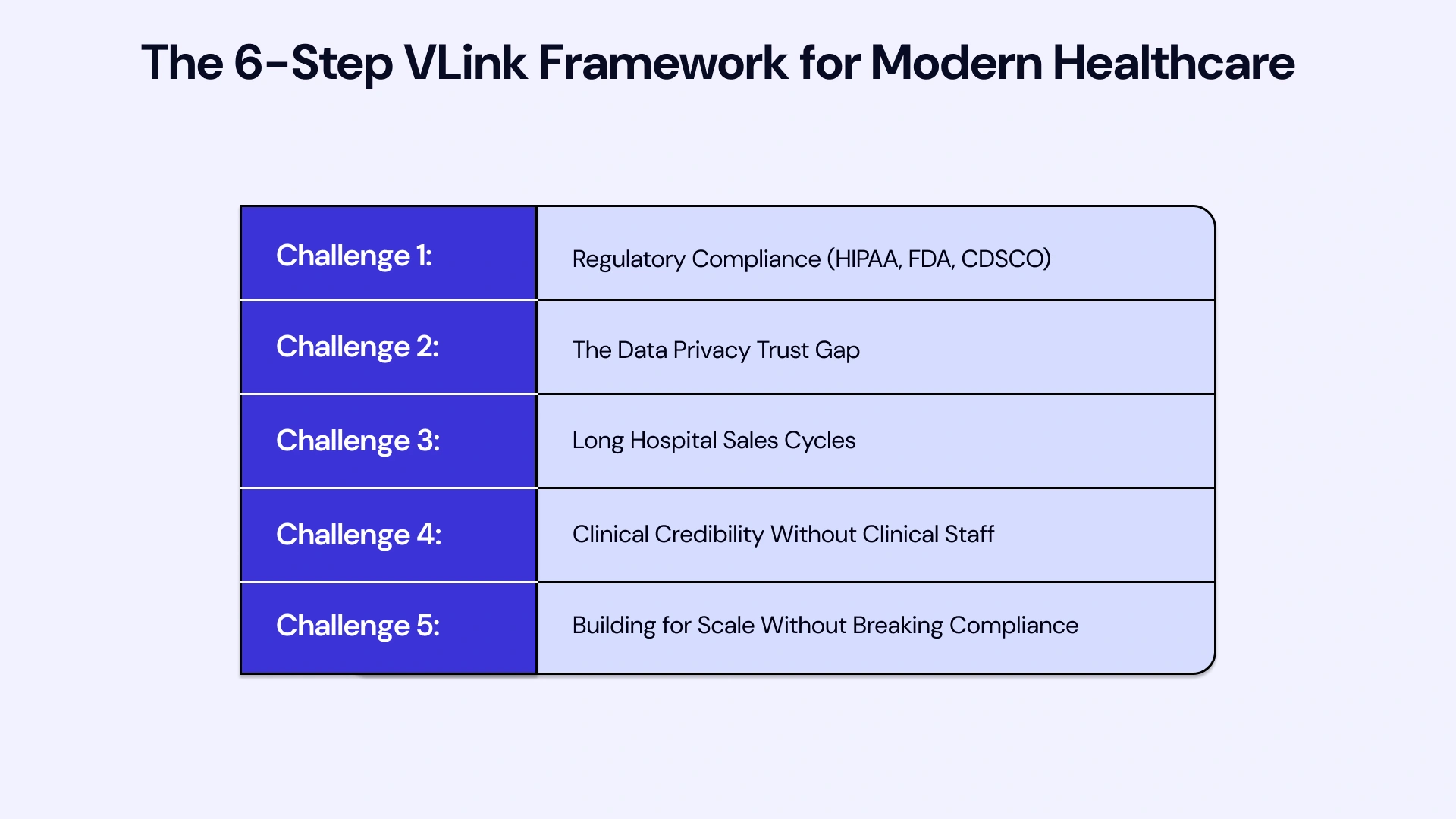
Challenge 1: Regulatory Compliance (HIPAA, FDA, CDSCO)
The barrier: 80% of healthcare startup failures cite regulatory complexity as a contributing factor (Rock Health, 2024). HIPAA fines range from $100 to $50,000 per violation. FDA 510(k) review averages 177 days.
The path through: Appoint a compliance officer in the first 10 hires. Use HIPAA-eligible cloud infrastructure from day one. For India, engage a CDSCO regulatory consultant before product design begins.
Challenge 2: The Data Privacy Trust Gap
Healthcare data breaches cost $10.9 million per incident — 3x higher than the cross-industry average (IBM, 2024). Patients are increasingly aware of data misuse. Startups that build "privacy by design" as a product differentiator — not a compliance checkbox — win trust faster.
Framework: Privacy by Design (PbD) — data minimization, purpose limitation, end-to-end encryption, user consent controls, and breach notification protocols baked into architecture from Sprint 1.
Challenge 3: Long Hospital Sales Cycles
Hospital procurement runs 9-18 months from first conversation to signed contract. The fastest path to revenue is not enterprise hospitals — it is independent physician practices (IPAs), urgent care chains, and specialty clinics, which can sign in 30-60 days.
Challenge 4: Clinical Credibility Without Clinical Staff
Investors and hospital buyers ask the same question: "Who validated this clinically?" Founders without clinical backgrounds should: (1) appoint a Clinical Advisory Board (CAB) of 3-5 practicing clinicians, (2) publish a pilot outcomes paper in a peer-reviewed journal, (3) pursue FDA Breakthrough Device designation if applicable — the designation itself signals clinical credibility.
Challenge 5: Building for Scale Without Breaking Compliance
Scaling a healthcare product introduces new compliance requirements: Business Associate Agreements (BAAs) with every vendor, state-specific telehealth licensure (50 US states have different rules), and interoperability mandates (HL7 FHIR APIs required for Medicare-reimbursed digital health since 2021).
India-Specific Healthcare Startup Opportunities in 2026
India is not simply a cheaper version of the US market — it is a fundamentally different healthcare system with unique structural gaps and government infrastructure that creates opportunities unavailable anywhere else in the world.
- Ayushman Bharat Digital Mission (ABDM): ABHA (Ayushman Bharat Health Account) IDs have been issued to 600M+ Indians. Any digital health product that integrates with ABHA gains instant access to a pre-enrolled national patient network.
- PM-JAY (Pradhan Mantri Jan Arogya Yojana): The world's largest government health insurance scheme covers 500M+ beneficiaries for secondary and tertiary hospitalization — creating a B2G revenue opportunity for hospital management software and claims automation.
- AYUSH Digital Opportunity: The Ministry of AYUSH manages a $4.4 billion sector (yoga, Ayurveda, Unani, Siddha, Homeopathy). Digital therapy apps, teleconsultation for AYUSH practitioners, and exportable wellness content are high-growth niches with minimal Western-market competition.
- Tier 2 & 3 City Healthcare Gap: 65% of India's population lives in cities with fewer than 500,000 people — and most lack specialist access. Vernacular-language telemedicine apps, AI-powered triage in regional languages, and low-bandwidth-optimized telehealth platforms address this gap.
- Jan Aushadhi Generic Pharmacy Network: 10,000+ Jan Aushadhi Kendras across India sell generics at 50-90% below branded prices. An e-commerce layer connecting consumers to this network — with prescription management and home delivery — is a structurally underserved opportunity.

Transforming Healthcare Business Ideas into Reality with VLink
VLink is not a generic software development company. We are a healthcare software engineering firm with a track record of building compliant, fundable healthcare products for clients across the US and India.
The numbers behind that statement:
- 50+ custom healthcare software solutions built for global clients
- $150M+ in client funding raised using VLink-built products as the core technology demonstration
- Dual-shore delivery: US dedicated teams in Connecticut and Massachusetts for client-side partnership; India-based engineering for cost-efficient development
- Compliance expertise: HIPAA, FDA 510(k), CDSCO, DPDP, HL7 FHIR, SOC 2
Conclusion
With over 25 profitable paths laid out, the question is no longer if you should enter the healthcare market, but where you can make the most significant impact. As we move through 2026, the most successful startups won't just offer a service; they will solve specific friction points in the patient journey using AI, real-time data, and seamless UX.
Whether you've chosen to disrupt telemedicine, launch an AI-driven diagnostic tool, or streamline medical logistics, your success depends on a robust digital foundation. To turn one of these 25+ ideas into a scalable reality, partnering with an experienced tech ally is non-negotiable. VLink provides the specialized healthcare software development services needed to navigate the complexities of 2026’s tech landscape, ensuring your startup is secure, compliant, and ready to lead.
Ready to turn one of these 25+ ideas into 2026’s breakout healthcare success? Ideas are just the beginning—execution is everything. At VLink, we provide the technical backbone to help you build, deploy, and scale with clinical precision. Connect with our experts today, and let’s start building.

Vice President & Global Head of Digital, VLink Inc.
Amitabh is the Vice President and Global Head of Digital at VLink Inc., with over 20 years of leadership experience in IT strategy, digital transformation, and emerging technologies.

 Shivisha Patel