

The restaurant industry stands at a transformative crossroads. With 60% of millennials having used chatbots, and 70% reporting positive experiences, the hospitality sector is witnessing a fundamental shift in customer expectations. Today's diners demand instant gratification—they want reservations confirmed in seconds, menu queries answered immediately, and orders placed without friction.
For restaurant owners and hospitality leaders, the question is no longer whether to implement restaurant AI chatbot solutions, but how quickly you can deploy them to stay competitive.
This comprehensive guide explores how AI chatbots for restaurant reservations, AI chatbots for restaurant food ordering, and intelligent conversational AI systems can revolutionize your restaurant operations, drive revenue growth, and deliver exceptional customer experiences that keep guests returning. Great food deserves great UX—restaurant app UX covers menus, ordering, payments, and loyalty programs.
What Are Restaurant AI Chatbot Solutions?
Restaurant AI chatbot solutions are intelligent, conversational virtual assistants explicitly designed for the hospitality industry. Unlike basic automated response systems, modern AI chatbots for restaurants leverage advanced technologies, including Natural Language Processing (NLP), Machine Learning (ML), and Large Language Models (LLMs) to understand customer intent, engage in human-like conversations, and execute complex tasks autonomously.
An AI chatbot for restaurant support automation can handle reservations, order placement, menu inquiries, delivery tracking, and customer service with remarkable efficiency. But their capabilities extend far beyond customer-facing interactions.
These sophisticated conversational AI systems for restaurant customer service—powered by expert AI development services—support internal operations such as employee scheduling, inventory management, and staff training, making them indispensable tools for modern restaurant management.
Key Components of Restaurant Chatbot Technology
- Natural Language Understanding (NLU): An AI chatbot for menu recommendations interprets customer queries in natural, conversational language—whether someone asks "Do you have gluten-free pasta?" or "Got any GF options?"—and understands intent, providing accurate dietary information.
- Multi-Channel Integration: Modern multilingual AI chatbots for restaurants operate seamlessly across websites, mobile apps, Facebook Messenger, WhatsApp, Instagram, and SMS, meeting customers on their preferred platforms with AI that learns customer preferences.
- Smart Learning Capabilities: AI chatbot with personalized dining recommendations continuously improves through machine learning, becoming more accurate and efficient with each customer interaction, adapting to seasonal trends and customer preferences.
- Real-Time Data Synchronization: AI chatbots integrated with POS systems, reservation platforms, delivery platforms, and kitchen management systems deliver accurate, up-to-date information across your entire technology stack.
The Business Case: Why Restaurant Owners Are Investing in AI Chatbots
The financial argument for restaurant AI chatbot solutions is compelling. The average ROI for chatbots is about 1,275%, primarily from support cost savings alone. For an industry operating on notoriously thin margins, this represents a game-changing opportunity that directly addresses the cost concerns of restaurant AI chatbot solutions.
Quantifiable Cost Savings
The US could save $23 billion by automating 30% of contact center staff tasks with chatbots. When translated to restaurant operations, this automation reduces the burden on front-of-house staff, allowing them to focus on delivering memorable in-person dining experiences rather than answering repetitive phone calls.
In 2024, 30% of restaurants have shifted to chatbots for automated customer interactions, and early adopters who are examining the benefits of AI chatbot solutions for restaurants are already reaping rewards. Restaurants implementing chatbot technology report:
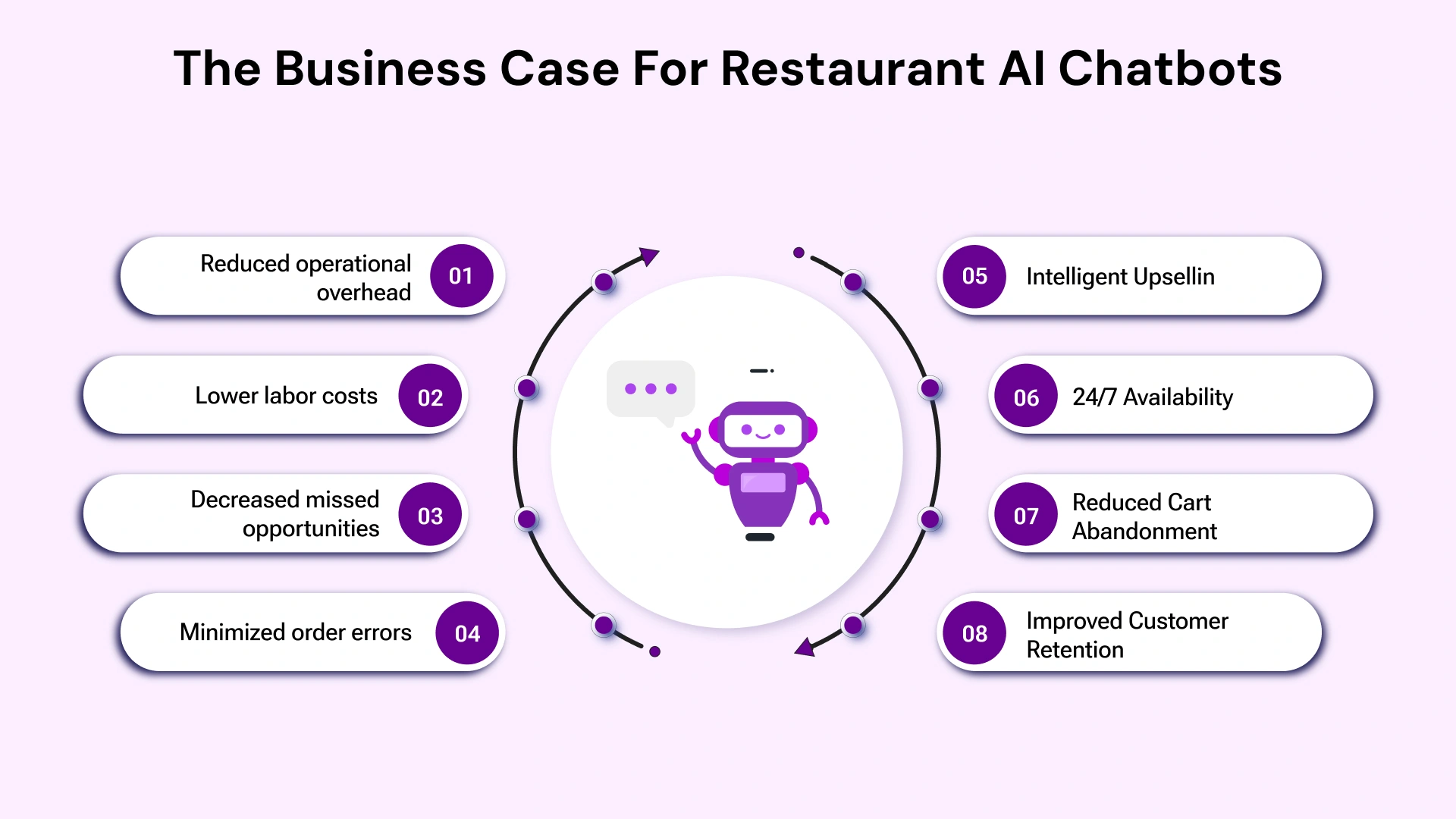
- Reduced operational overhead by eliminating the need for dedicated phone staff during peak hours
- Lower labor costs without compromising service quality through an AI chatbot for table booking automation
- Decreased missed opportunities from unanswered calls or busy signals
- Minimized order errors through standardized digital processes powered by an AI chatbot for restaurant food ordering
Revenue Generation Opportunities
Beyond addressing cost considerations for restaurant AI chatbot solutions, these systems actively drive revenue growth. The median increase in order value stands at about 20% for online stores that implemented chatbots after only 7 days of use.
But, how do AI chatbots with upselling and cross-selling increase revenue? For this, we need to:
- Intelligent Upselling: An AI chatbot that learns customer preferences suggests complementary items, premium upgrades, or special promotions at precisely the right moment in the customer journey, based on previous orders.
- 24/7 Availability: Restaurants capture orders and reservations around the clock through an AI chatbot for restaurant food ordering, even when physical locations are closed, maximizing revenue opportunities.
- Reduced Cart Abandonment: E-commerce businesses recover 23% more abandoned carts using AI chatbot follow-up sequences, a strategy equally applicable to online restaurant ordering systems.
- Improved Customer Retention: Customers who interact with conversational AI for restaurant customer service show a 25% higher lifetime value, driven by higher satisfaction and retention rates.
Core Use Cases: How Restaurants Deploy AI Chatbots
Restaurant AI chatbot solutions address multiple operational challenges across customer-facing and back-office functions. Let's explore the most impactful applications of AI chatbot trends in hospitality.
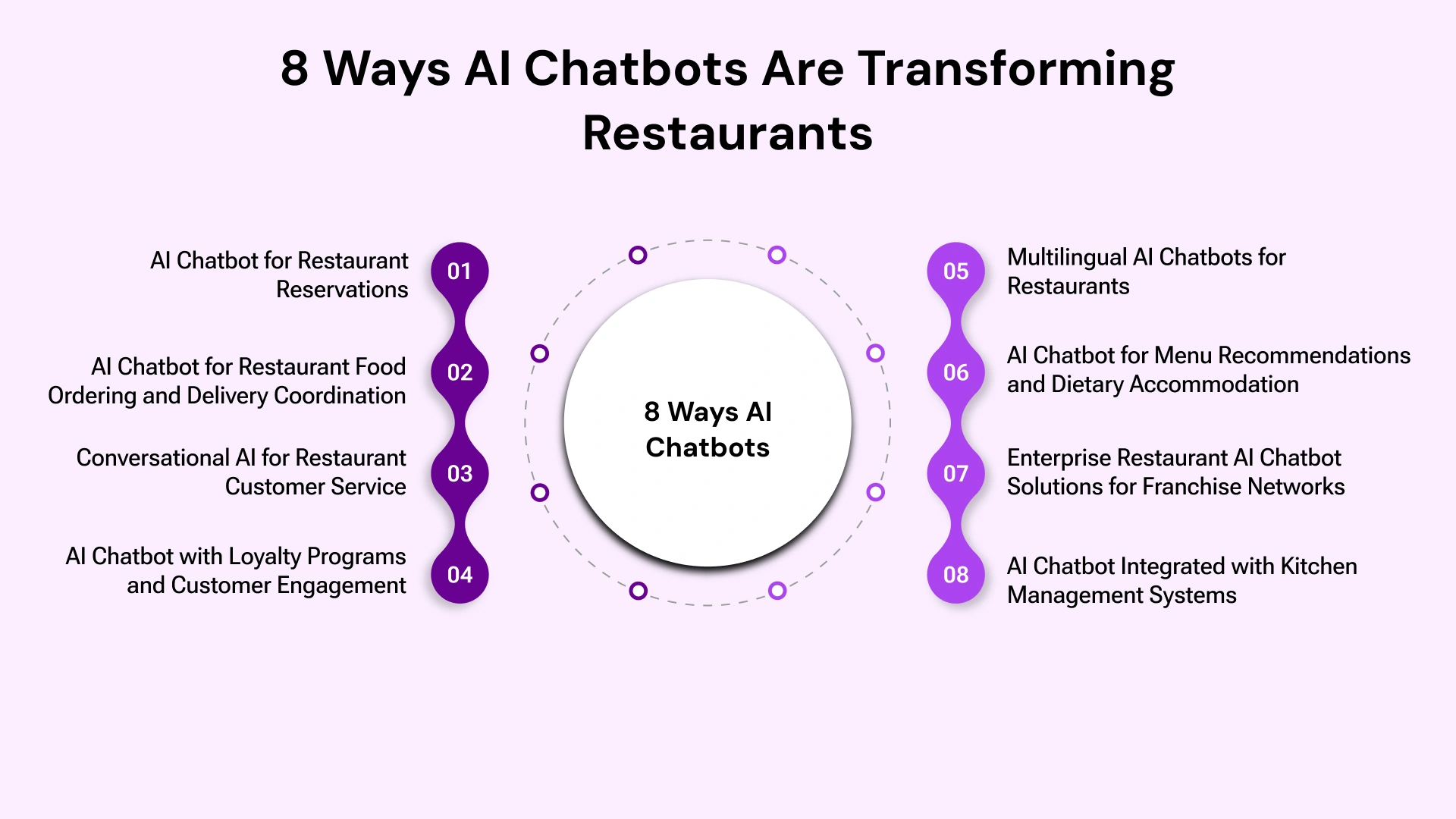
1. AI Chatbot for Restaurant Reservations
According to a Drift report on chatbots, 33% of people prefer using an AI chatbot for restaurant reservations over traditional methods. This preference stems from the convenience factor—customers can make reservations instantly without waiting on hold or navigating complicated booking systems.
How AI Chatbot for Table Booking Automation Works:
- Customers initiate conversations through your website, Facebook page, or WhatsApp
- The AI chatbot integrated with reservation platforms checks real-time table availability
- It offers available time slots and captures guest preferences (dietary restrictions, special occasions, seating preferences)
- Instant confirmation is sent with calendar integration and reminder notifications
- Automated reminders reduce no-shows through an AI chatbot for restaurant support automation
Business Impact:
- Zero missed reservation opportunities from unanswered phones
- Reduced no-show rates through automated reminders
- Freed-up staff to focus on in-house guest service
- Captured customer data for an AI chatbot with personalized dining recommendations
2. AI Chatbot for Restaurant Food Ordering and Delivery Coordination
The online food ordering market has exploded, and customers expect frictionless digital ordering experiences—an AI chatbot for restaurant food ordering streamlines this entire process from menu browsing to delivery tracking.
Capabilities Include:
- Interactive menu presentation with an AI chatbot for menu recommendations
- Ingredient customization and dietary accommodation
- Order modification and repeat ordering with an AI chatbot with customer preference learning
- Multiple payment method integration
- Real-time order status updates through an AI chatbot integrated with delivery platforms
- Proactive communication about delays or issues
Real-World Success:
KFC India launched a WhatsApp chatbot to simplify ordering, allowing customers to view full menus, select items with tap-to-select functionality, and receive location-based outlet suggestions for pickup or delivery. This approach met customers where they already spent time, eliminating app download friction.
3. Conversational AI for Restaurant Customer Service
74% of internet users prefer interacting with chatbots when seeking answers to straightforward questions. For restaurants, this translates to immediate responses via an AI chatbot for automated support with queries about operating hours, menu items, parking, dress codes, allergen information, and more.
Support Features:
- Operating hours and location information
- Menu details, including ingredients, allergens, and nutritional data via an AI chatbot for menu recommendations
- Pricing and special offers
- Event hosting capabilities and private dining options
- Gift card purchases and loyalty program information through enterprise restaurant AI chatbot solutions
- Order status and issue resolution via an AI chatbot integrated with CRM systems
The 24/7 Advantage:
64% of consumers find 24/7 availability to be the most helpful feature of a chatbot. This round-the-clock accessibility is particularly valuable for restaurants, where potential customers often browse menus and make dining decisions outside traditional business hours.
4. AI Chatbot with Loyalty Programs and Customer Engagement
Restaurant chatbots excel at managing loyalty programs, keeping customers engaged, and driving repeat business through AI-powered customer preference learning.
Loyalty Features:
- Automatic point tracking and balance updates via an AI chatbot integrated with CRM systems
- Reward redemption reminders and suggestions
- An AI chatbot with personalized dining recommendations based on dining history
- Birthday and anniversary promotions
- Exclusive chatbot-only deals
- Gamified experiences that increase engagement
A coffee shop can use an AI chatbot integrated with POS systems to inform customers when they've earned a free drink, with reminders via WhatsApp or SMS, increasing reward redemptions and repeat visits.
5. Multilingual AI Chatbots for Restaurants
In cosmopolitan markets or tourist destinations, language barriers can limit business potential. Multilingual AI chatbots for restaurants communicate in the customer's preferred language, making interactions smooth and inclusive for a diverse audience, and most chatbot platforms automatically support 80+ languages.
6. AI Chatbot for Menu Recommendations and Dietary Accommodation
An AI chatbot for menu recommendations provides instant ingredient details and alternative dish suggestions to customers with dietary restrictions. This personalized guidance, powered by an AI chatbot that offers tailored dining recommendations, enhances the dining experience and demonstrates genuine care for customer needs.
Recommendation Engine Capabilities:
- Dietary restriction filtering (vegetarian, vegan, gluten-free, nut-free, halal, kosher)
- Allergen warnings and ingredient disclosure
- Pairing suggestions with an AI chatbot with upselling and cross-selling (wine with entrées, sides with mains)
- Popular dish highlights and chef recommendations
- AI chatbot with personalized dining recommendations based on previous orders
7. Enterprise Restaurant AI Chatbot Solutions for Franchise Networks
AI chatbot for franchise restaurants enables multi-location management with centralized control, brand consistency across locations, location-specific menu and pricing, unified customer data across franchises, and scalable deployment through cloud restaurant AI chatbot solutions.
Benefits for Restaurant Chains:
- Consistent customer experience across all locations
- Centralized analytics and performance monitoring
- Simplified menu updates and promotional campaigns
- Reduced training costs for franchise owners
8. AI Chatbot Integrated with Kitchen Management Systems
Beyond customer interactions, an AI chatbot integrated with kitchen management systems optimizes back-office operations, streamlining order flow, inventory tracking, and preparation timing.
Internal Use Cases:
- Shift schedule access and swap requests
- Policy and procedure queries
- Training module delivery
- Inventory alerts through an AI chatbot integrated with kitchen management systems
- Kitchen communication and order coordination
Key Benefits of Restaurant AI Chatbot Solutions
In an industry where margins are razor-thin and guest expectations are at an all-time high, AI chatbot solutions serve as the ultimate operational multiplier. Here is why they are becoming the backbone of successful restaurant groups.
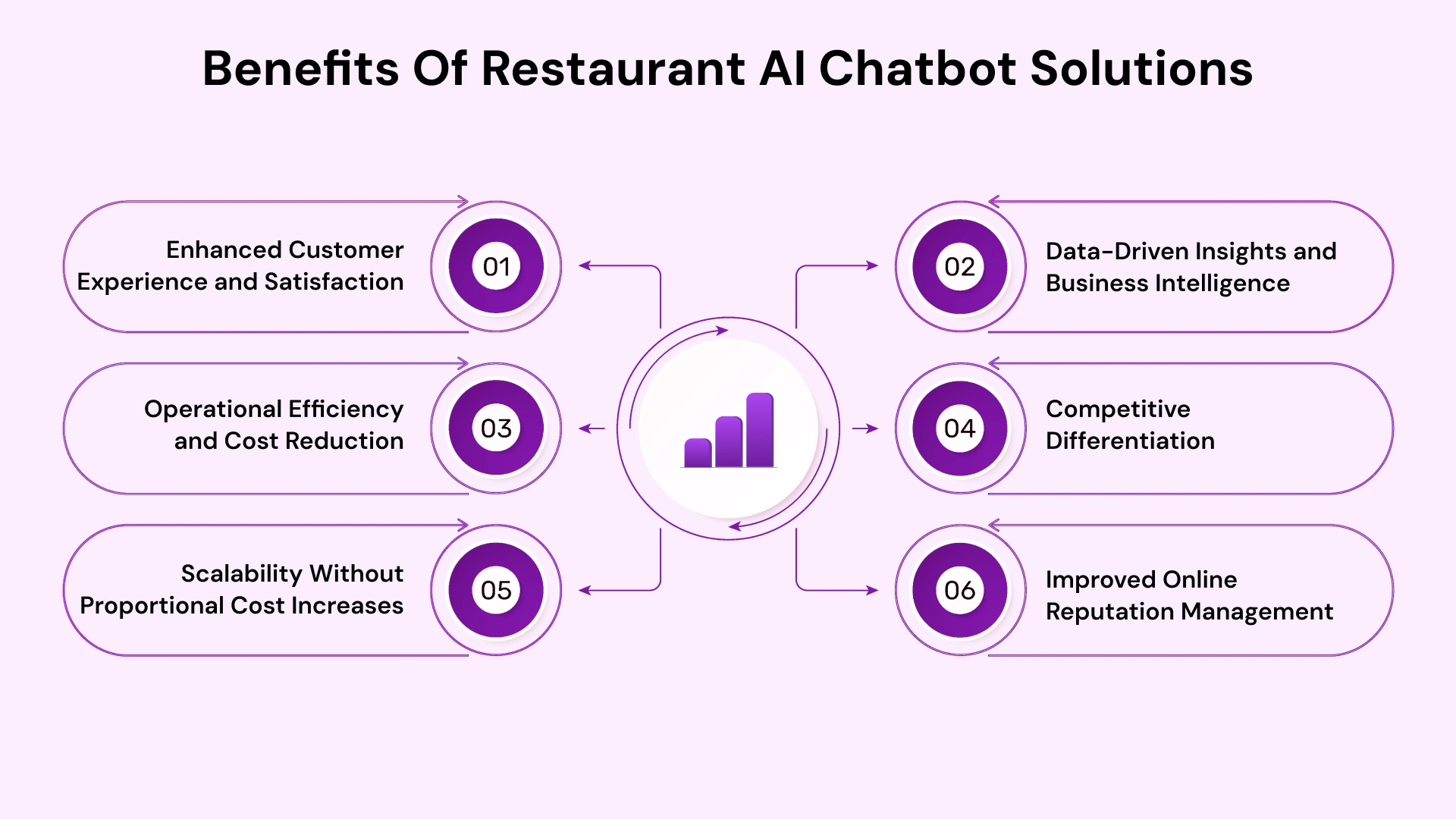
1. Enhanced Customer Experience and Satisfaction
80% of customers who have used chatbots report a positive experience. This satisfaction stems from immediate responses, accurate information, and the convenience of self-service options powered by conversational AI for restaurant customer service.
Customer Experience Improvements:
- Instant Gratification: No waiting on hold or navigating phone menus
- Consistent Quality: Every interaction delivers the same high standard
- Personalization at Scale: AI chatbot with customer preference learning remembers preferences and order history
- Reduced Friction: Fewer steps from inquiry to completed transaction
- Accessibility: Service available during off-hours in multiple languages via multilingual AI chatbots for restaurants
48% of people prioritize a chatbot's ability to resolve issues over the chatbot's personality, reinforcing that effectiveness trumps novelty.
2. Operational Efficiency and Cost Reduction
90% of businesses report significant improvements in complaint resolution speed after implementing chatbot solutions. For restaurants, this efficiency translates directly into improved margins and a better understanding of how restaurant AI chatbots work.
Efficiency Gains:
- Reduced phone volume frees staff for in-person service
- Automated routine tasks through an AI chatbot for restaurant support automation eliminate redundant work
- Fewer order errors via an AI chatbot for restaurant food ordering means less food waste
- Streamlined reservations through an AI chatbot for table booking automation reduces conflicts
- Data capture happens automatically through an AI chatbot integrated with CRM systems
3. Scalability Without Proportional Cost Increases
Traditional restaurant operations face a direct relationship between customer volume and staffing requirements. AI-driven restaurant automation breaks this model. The statistical user sends four inquiries to the bot during one chat session, yet the chatbot handles multiple conversations simultaneously without degradation in quality.
Whether your restaurant serves 50 customers or 5,000 on any given day, cloud restaurant AI chatbot solutions scale effortlessly to meet demand without additional labor costs, making the restaurant AI chatbot solutions cost proposition even more attractive.
4. Data-Driven Insights and Business Intelligence
Every chatbot interaction, powered by AI and integrated with CRM systems, generates valuable data. Restaurant owners gain unprecedented insights into:
- Most frequently asked questions and pain points
- Popular menu items through an AI chatbot for menu recommendations data
- Peak inquiry and ordering times
- Customer preferences via an AI chatbot with customer preference learning
- Conversion rates from inquiry to reservation/order
- Service bottlenecks and improvement opportunities
This intelligence informs menu development, marketing strategies, staffing decisions, and operational improvements for AI chatbots in the restaurant industry.
5. Competitive Differentiation
In 2024, 30% of restaurants have shifted to chatbots for automated customer interactions. Early adopters of next-gen AI solutions for restaurants gain a competitive advantage through superior customer experience, operational efficiency, and a modern brand perception. Restaurants without chatbot capabilities increasingly appear outdated to tech-savvy diners seeking the best AI chatbot development for restaurants.
6. Improved Online Reputation Management
An AI chatbot integrated with CRM systems can automatically prompt customers to leave feedback on third-party websites and end chats by sending customer satisfaction surveys to track service quality. Proactive feedback collection leads to more positive reviews and provides early warning of service issues.
Implementation Strategies: Getting Started with Restaurant Chatbots
To implement AI successfully, you shouldn't just "turn it on" and hope for the best. A botched rollout can frustrate hungry guests and confuse your staff. Instead, think of it like opening a new location: you need a soft launch, a clear menu of services, and a scaling plan.
Here is a strategic roadmap for integrating AI chatbots into your restaurant operations.
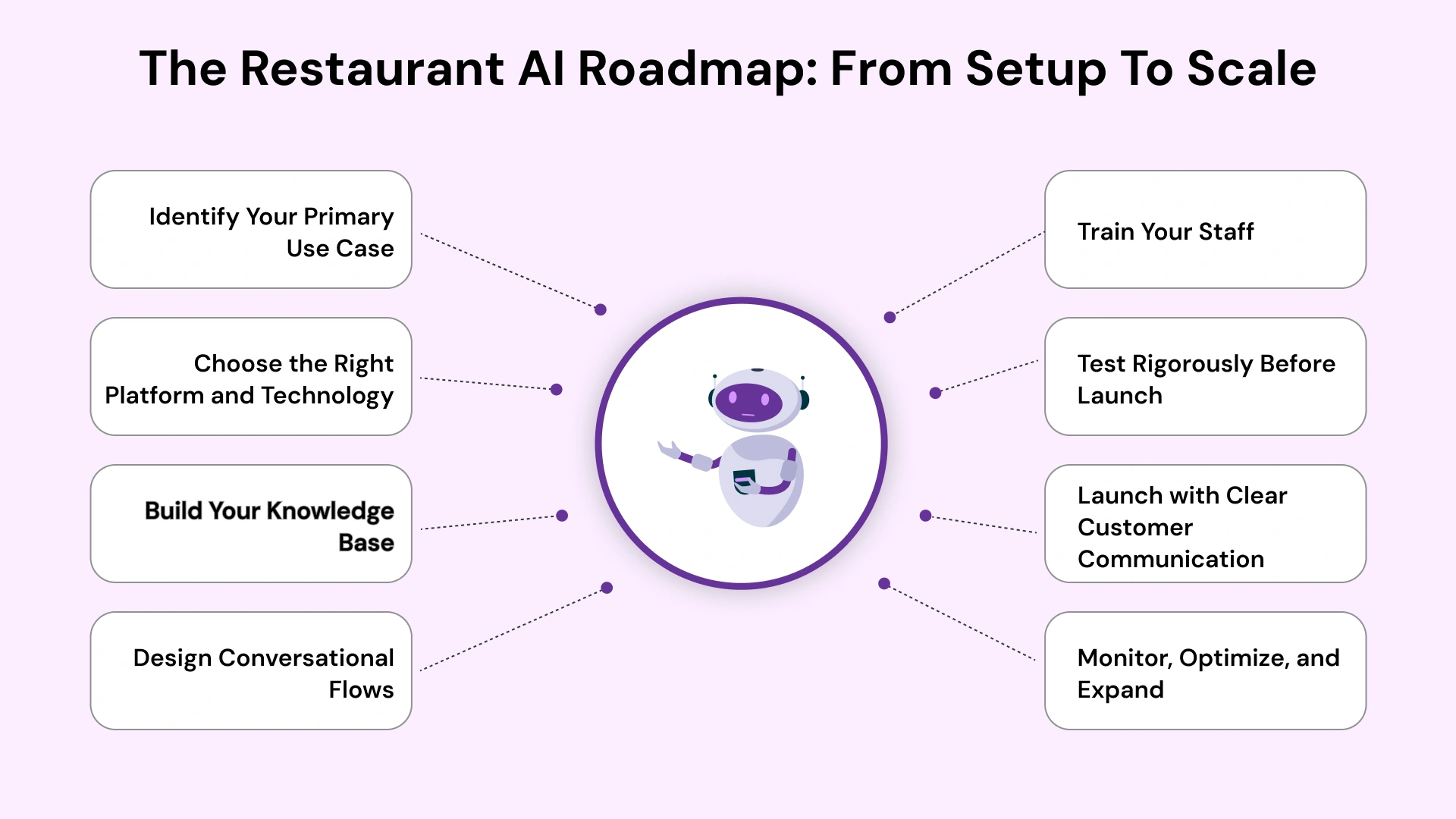
Identify Your Primary Use Case
Start by identifying your restaurant's most pressing pain points examining what restaurant AI chatbot solutions are:
- Are missed calls costing you reservations? Consider an AI chatbot for restaurant reservations
- Is phone ordering overwhelming your staff during peak hours? Deploy an AI chatbot for restaurant food ordering
- Do customers frequently ask the same basic questions? Implement an AI chatbot for restaurant support automation
- Could online ordering capture more revenue? Use an AI chatbot integrated with delivery platforms
- Do language barriers limit your customer base? Adopt multilingual AI chatbots for restaurants
Focus your initial chatbot deployment on solving your most impactful challenge rather than trying to automate everything simultaneously.
Choose the Right Platform and Technology
When evaluating custom restaurant AI chatbot development versus template solutions, consider these factors based on how restaurant AI chatbots work:
- No-Code vs. Custom Development: No-code platforms that use chatbot development for restaurant templates enable restaurant owners without technical expertise to build and deploy chatbots quickly. Best AI chatbot development for restaurants through custom approaches provides greater flexibility but requires programming expertise and higher investment.
- Integration Capabilities: Ensure your chosen platform offers an AI chatbot integrated with POS systems, reservation platforms, delivery platforms, and kitchen management systems for comprehensive connectivity.
- Multi-Channel Support: Select solutions that operate across customers' preferred communication channels—website, mobile app, social media platforms, and messaging apps —and examine AI chatbot trends in hospitality.
- AI Sophistication: Modern chatbots powered by advanced language models understand context, handle complex queries, and engage in natural conversations. Evaluate the platform's natural language understanding capabilities when comparing next-gen AI solutions for restaurants.
- Analytics and Reporting: Robust analytics help you measure performance, identify opportunities for improvement, and calculate ROI, addressing concerns about the cost of restaurant AI chatbot solutions.
Build Your Knowledge Base
Your chatbot's effectiveness depends on the quality and comprehensiveness of its knowledge base. Invest time in creating detailed information about:
- Complete menu with descriptions, ingredients, allergens, and pricing for an AI chatbot for menu recommendations
- Operating hours, including holidays and special events
- Location details, parking information, and accessibility chatbot features
- Reservation policies and procedures for an AI chatbot for table booking automation
- Ordering options and delivery areas for an AI chatbot integrated with delivery platforms
- Common customer questions and accurate responses
- Promotional offers and loyalty program details
Design Conversational Flows
Map out the primary customer journeys your chatbot will support based on what your restaurant AI chatbot solution's capabilities are:
- AI chatbot for restaurant reservations booking flow
- An AI chatbot for the restaurant food ordering process
- Menu inquiry and an AI chatbot for menu recommendations
- Delivery tracking updates through an AI chatbot integrated with delivery platforms
- Loyalty program interactions via an AI chatbot integrated with CRM systems
- Customer service escalation procedures
Create conversational scripts that feel natural, guide users efficiently, and include appropriate error handling for unexpected inputs.
Train Your Staff
Your human team needs to understand how restaurant AI chatbots work, when chatbots escalate to human agents, and how to seamlessly take over conversations when required. Train staff to:
- Monitor chatbot performance and identify issues
- Handle escalated conversations with full context
- Provide feedback for chatbot improvement
- Promote chatbot usage to customers
- Troubleshoot common technical issues
Test Rigorously Before Launch
Before deploying your chatbot to customers, conduct comprehensive testing:
- Test all conversational flows and edge cases
- Verify integrations with the AI chatbot integrated with POS systems and reservation platforms
- Ensure accurate information across all knowledge base entries
- Test on all target channels and devices
- Conduct user acceptance testing with staff and friendly customers
Launch with Clear Customer Communication
Announce your chatbot launch through email marketing, social media, website banners, and in-restaurant signage. Educate customers about:
- Where to find the chatbot (website, Facebook, WhatsApp)
- What tasks can the AI chatbot for restaurant support automation help with
- How to escalate to human support if needed
- The benefits they'll experience
Monitor, Optimize, and Expand
After launch, continuously improve your chatbot through:
- Regular analysis of conversation logs to identify gaps
- Customer feedback collection and implementation
- Performance metrics tracking (resolution rate, customer satisfaction, conversion rate)
- Knowledge base updates as the menu and policies change
- Expansion to additional use cases as you prove ROI
Real-World Success Stories: Restaurants Winning with Chatbots
To move beyond theory, it helps to look at how industry leaders and independent groups are using AI chatbots to solve real-world problems. These success stories highlight the shift from "experimental tech" to "essential operations.
1. Domino’s: The "Dom" Effect
Domino’s transitioned from a pizza company to a tech powerhouse by launching "Dom," an AI-powered ordering assistant.
- The Strategy: Integrated across Facebook Messenger, Apple Business Chat, and SMS, allowing for "Emoji Ordering."
- The Win: Approximately 50% of all digital orders now flow through their chatbot. By reducing friction, they saw a 29% increase in online revenue and a 70% reduction in query resolution time.
2. Pizza Hut: Social Commerce Mastery
Pizza Hut focused on meeting customers where they spend their time: social media and messaging apps.
- The Strategy: Deployed an AI chatbot for Facebook Messenger and Twitter (X) that handles the entire transaction—from menu browsing to checkout—without the user leaving the app.
- The Win: They reported a 2x higher conversion rate compared to their traditional website. Additionally, personalized upsell prompts within the chat increased the Average Order Value (AOV) by 15%.
3. KFC India: Automating Customer Care
KFC India scaled its operations by leveraging AI to handle the massive volume of customer interactions across a diverse customer base.
- The Strategy: Implemented an omnichannel AI solution (including WhatsApp and web) to manage order tracking, store locating, and instant complaint resolution.
- The Win: The AI maintains a 95% accuracy rate in demand forecasting and order processing. This has significantly reduced kitchen errors and freed up human staff to focus on food quality rather than administrative "where is my order?" calls.
4. Wingstop: The Voice AI Specialist
Wingstop tackled the "busy phone" problem by deploying a sophisticated conversational AI voice-bot to handle incoming calls.
- The Strategy: Their AI answers the phone, understands natural language (in both English and Spanish), and takes orders directly into the POS.
- The Win: The AI currently handles 10% of all phone orders autonomously. Because the bot always asks, "Would you like a side of ranch or a large drink?" it consistently out-sells human employees, driving higher margins on every call.
Key Takeaways from These Leaders
| Brand | Platform | Standout Benefit |
| Domino's | Multi-channel | High Digital Volume (50% of orders) |
| Pizza Hut | Social Media | Highest Conversion (2x vs. Website) |
| KFC India | WhatsApp/Web | Operational Efficiency (95% accuracy) |
| Wingstop | Voice AI | Consistent Upselling (Higher AOV than staff) |
Best Practices for Maximum ROI in Restaurant Chatbot Solutions
To achieve the highest returns, AI should be treated as a strategic asset rather than a simple plug-and-play tool. Success lies in the perfect blend of technical precision and human hospitality, ensuring the technology enhances the guest journey without losing the personal touch.
- Keep It Simple and User-Focused: A confused customer is a lost customer—menus, bookings, and orders should take fewer than three clicks. Design your AI chatbot to automate table booking and ordering flows for maximum efficiency, eliminating unnecessary steps.
- Personalize the Experience: Smart bots using an AI chatbot with customer preference learning remember customer preferences, greet users by name, and suggest favorite dishes through an AI chatbot with personalized dining recommendations.
- Provide Seamless Human Escalation: 40% of web users are indifferent to whether they are served by bots or human agents, as long as they receive the customer support they need. Ensure your conversational AI for restaurant customer service recognizes when issues require human intervention.
- Optimize for Mobile: The best AI chatbot development for restaurants prioritizes mobile optimization, recognizing that most customers interact via smartphones. Test extensively on various mobile devices to ensure fast loading and easy navigation.
- Leverage Multiple Channels Strategically: There are currently more than 300,000 chatbots in operation on Facebook Messenger alone. Deploy your multilingual AI chatbots for restaurants where your customers already spend time—on your website, Facebook, Instagram, WhatsApp, and SMS.
- Continuously Update and Improve: Keep your chatbot's knowledge base fresh by analyzing conversations to spot gaps or areas for improvement, with customer feedback as a goldmine for identifying where tweaks are needed most for AI chatbot trends in hospitality.
- Set Realistic Expectations: While next-gen AI solutions for restaurants are robust, they're not perfect. Be transparent with customers about the chatbot's capabilities, provide easy paths to human support, and continuously expand the bot's capabilities.
Measuring Success: Key Performance Indicators
To justify your investment in restaurant AI chatbot solutions cost and optimize performance, track these critical metrics:
Customer Service Metrics
- Response Time: Average time from customer inquiry to first response
- Resolution Rate: Percentage of queries resolved without human intervention
- Customer Satisfaction Score (CSAT): Post-interaction satisfaction ratings
- Escalation Rate: Percentage of conversations requiring human takeover
Operational Efficiency Metrics
- Call Volume Reduction: Decrease in phone inquiries
- Staff Time Savings: Hours freed for other tasks
- Order Accuracy Rate: Percentage of error-free orders via AI chatbot for restaurant food ordering
- Processing Speed: Time from inquiry to completed reservation/order
Revenue Impact Metrics
- Conversion Rate: Percentage of inquiries resulting in reservations/orders
- Average Order Value: Revenue per transaction with an AI chatbot with upselling and cross-selling
- Customer Lifetime Value: Total value of customers using the chatbot
- Cart Recovery Rate: Percentage of abandoned orders recovered
Technical Performance Metrics
- Uptime: Chatbot availability percentage
- Understanding Accuracy: Percentage of correctly interpreted queries
- Integration Reliability: Success rate of the AI chatbot integrated with POS systems connections
Common Challenges in Restaurant Chatbot Solutions
While the benefits are substantial, restaurants often face these key obstacles during implementation.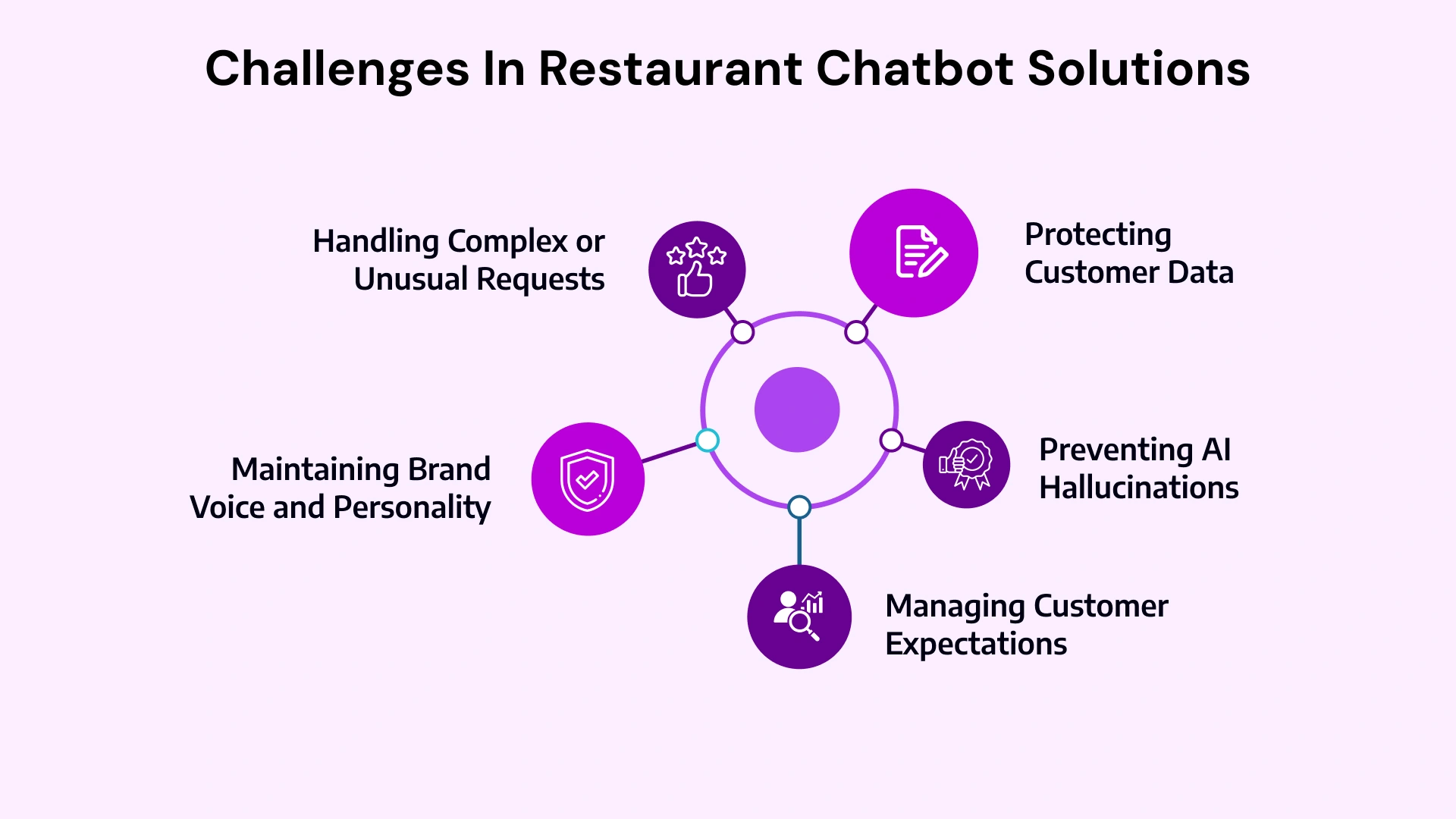
Handling Complex or Unusual Requests
Not every customer inquiry fits neatly into predefined categories. Design your AI chatbot for restaurant support automation to:
- Recognize when it doesn't understand
- Ask clarifying questions
- Gracefully escalate to humans when appropriate
- Learn from escalated conversations to improve future handling
Maintaining Brand Voice and Personality
Your chatbot represents your restaurant brand. Ensure its tone, language, and personality align with your establishment's identity—whether you're a fine-dining restaurant, a casual family eatery, or a trendy fast-casual concept.
Protecting Customer Data
Restaurant chatbots handle sensitive information, including payment details, contact information, and dining preferences, via AI integrated with CRM systems. Implement robust security measures:
- End-to-end encryption for all communications
- PCI compliance for payment processing
- GDPR and regional privacy regulation adherence
- Regular security audits and updates
- Clear privacy policies that customers can understand
Preventing AI Hallucinations
Modern AI chatbots occasionally generate plausible-sounding but incorrect information. Mitigate this risk by:
- Grounding responses in verified knowledge bases
- Regular auditing of chatbot responses
- Clear disclaimers about information accuracy
- Easy correction mechanisms
- Human oversight of critical information categories
Managing Customer Expectations
Some customers prefer human interaction. Respect these preferences by:
- Always offering clear paths to human support
- Never forcing chatbot usage
- Training staff to provide excellent service to all customers
- Using chatbots to enhance rather than replace human service
Future of Restaurant AI Chatbots: Emerging Trends
The "standard" chatbot is evolving into a comprehensive digital concierge. Here are the top trends that will define the next 12 months.
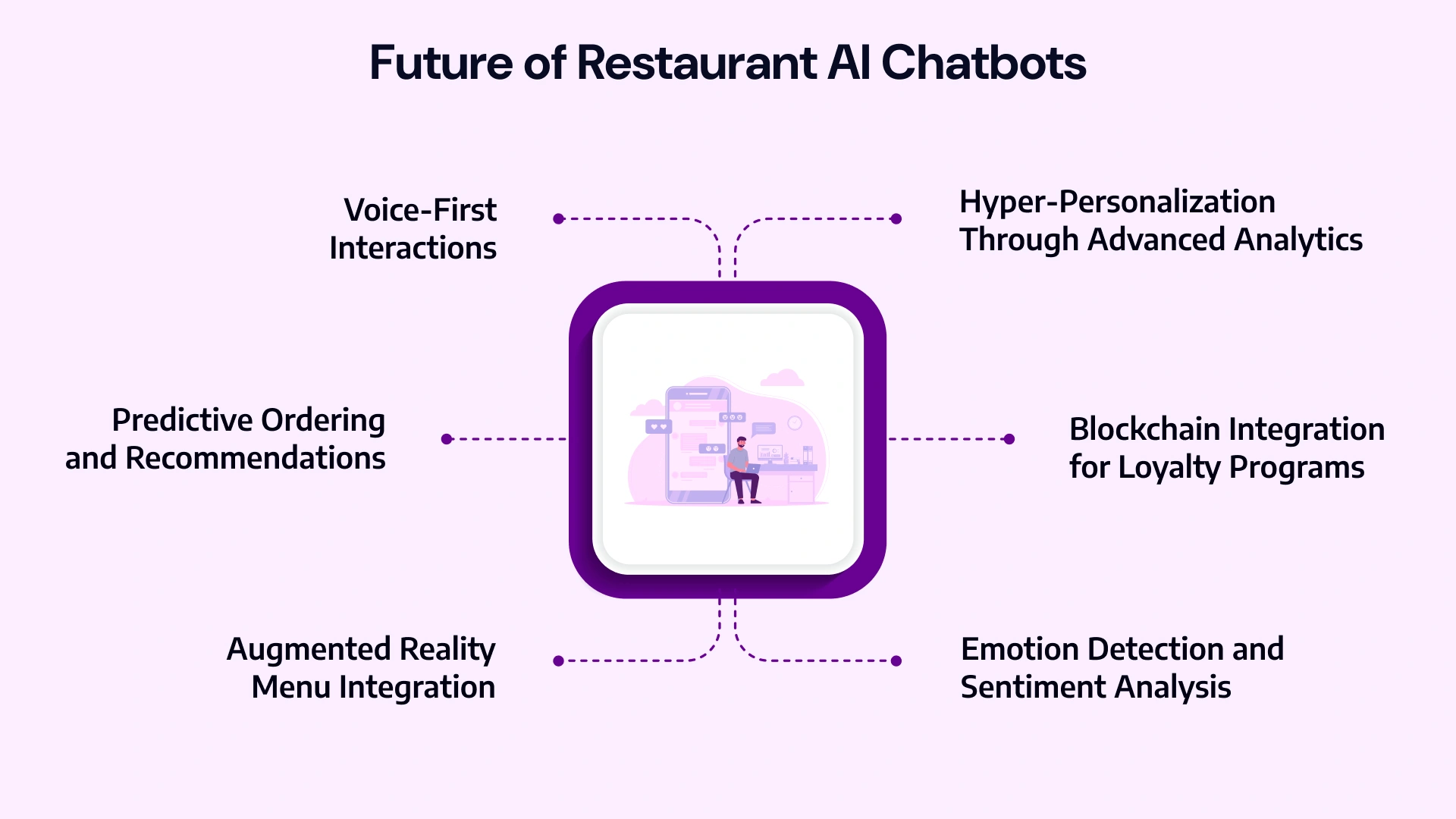
Voice-First Interactions
The number of voice search users is projected to reach 125.2 million by 2024. Voice-enabled AI chatbots for the restaurant industry will allow customers to place orders, make reservations, and get information hands-free, particularly valuable for mobile users and accessibility.
Predictive Ordering and Recommendations
An advanced AI chatbot with personalized dining recommendations will analyze customer behavior patterns, seasonal trends, and individual preferences to suggest orders before customers even ask proactively.
Augmented Reality Menu Integration
The future of restaurant AI chatbots may integrate AR capabilities, allowing customers to visualize dishes on their table through smartphone cameras before ordering, reducing ordering uncertainty and increasing satisfaction.
Hyper-Personalization Through Advanced Analytics
As AI becomes more sophisticated, an AI chatbot with customer preference learning will deliver increasingly personalized experiences based on comprehensive customer data, including dietary preferences, previous orders, spending patterns, special occasions, and real-time context.
Blockchain Integration for Loyalty Programs
Blockchain technology could enable an AI chatbot integrated with CRM systems to manage cross-restaurant loyalty programs, cryptocurrency payments, and verified reviews, creating new ecosystem possibilities for enterprise restaurant AI chatbot solutions.
Emotion Detection and Sentiment Analysis
Next-generation conversational AI for restaurant customer service will detect customer emotions through text analysis and voice tone, adjusting responses accordingly to provide empathetic, context-appropriate service.
Leverage VLink Expertise for Restaurant Chatbot Solutions
Implementing restaurant AI chatbot development solutions requires technical expertise, industry knowledge, and strategic vision. VLink specializes in developing custom AI-powered chatbot solutions tailored specifically for the hospitality sector. Our comprehensive restaurant chatbot services include:
- Custom Chatbot Development: We build sophisticated conversational AI solutions tailored to your unique restaurant concept, offering the best AI chatbot development for restaurants, including an AI chatbot for restaurant reservations, food ordering, and menu recommendations. Our chatbots integrate seamlessly with your existing technology stack.
- Multi-Platform Deployment: VLink ensures your multilingual AI chatbots for restaurants operate flawlessly across websites, mobile apps, Facebook Messenger, WhatsApp, Instagram, SMS, and emerging messaging platforms, so they meet your customers wherever they prefer to engage.
- AI Training and Optimization: Our dedicated team develops comprehensive knowledge bases, trains natural language models on restaurant-specific terminology for an AI chatbot with customer-preference learning, and continuously optimizes chatbot performance using real-world conversation data.
- Integration Services: We connect your chatbot ecosystem, including AI chatbots integrated with POS systems, reservation platforms, delivery platforms, kitchen management systems, and CRM systems—ensuring seamless data flow across your technology stack.
- Enterprise Solutions: For restaurant chains and franchise networks, we provide enterprise restaurant AI chatbot solutions and cloud-based AI chatbots for franchise restaurants, with centralized management, brand consistency, and scalable deployment.
- Ongoing Support and Enhancement: Restaurant needs evolve—menus change, promotions launch, and new locations open. VLink provides continuous support, regular updates, and feature enhancements to keep your AI chatbot for restaurant support automation current and effective.
- Analytics and ROI Tracking: We implement robust analytics frameworks to measure chatbot performance, customer satisfaction, operational efficiency, and revenue impact, providing clear visibility into your investment returns and addressing concerns about the cost of restaurant AI chatbot solutions.
- Compliance and Security: VLink ensures your restaurant chatbot meets all relevant data protection regulations, payment security standards, and accessibility requirements, protecting both your business and your customers.
- Staff Training Programs: We equip your team with the knowledge and skills to leverage AI-driven restaurant automation capabilities effectively, monitor performance, and provide seamless human support when needed.
With VLink's expertise in next-gen AI solutions for restaurants, your restaurant can deploy cutting-edge AI chatbot solutions that drive growth, enhance customer experiences, and improve operational efficiency. Our proven track record in AI chatbots for the restaurant industry ensures you benefit from best practices, avoid common pitfalls, and achieve measurable results quickly.
Conclusion: The Competitive Imperative of Restaurant AI Chatbots
The evidence is overwhelming: restaurant AI chatbot solutions represent not just an operational enhancement, but a competitive necessity for the modern hospitality industry. Over 70% of customers say they feel more loyal to brands that respond instantly to their needs, and AI chatbots deliver precisely this immediate, personalized service at scale.
The financial case is equally compelling. With an average ROI of 1,275% and median order value increases of 20%, restaurant chatbots deliver a measurable bottom-line impact that directly improves profitability while addressing restaurant AI chatbot solutions cost concerns through significant operational savings.
But most importantly, conversational AI for restaurant customer service fundamentally enhances the customer experience. From an AI chatbot for restaurant reservations to an AI chatbot for restaurant food ordering, from multilingual AI chatbots for restaurants to an AI chatbot with personalized dining recommendations—these technologies eliminate frustration, reduce friction, and create consistently excellent interactions that build loyalty and drive repeat business.
The restaurants that thrive in the coming years will be those that embrace next-gen AI solutions as a strategic advantage, using AI-driven restaurant automation to deliver superior experiences, operate more efficiently, and grow more profitably than ever thought possible.
Ready to transform your restaurant operations with AI chatbot technology? Contact VLink today for a comprehensive consultation and discover how our restaurant AI chatbot solutions can drive your business forward with custom restaurant AI chatbot development, an AI chatbot with upselling and cross-selling capabilities, and an AI chatbot with personalized dining recommendations tailored to your unique needs.

Vice President, Strategy – VLink Inc.
Sambhavi Gopalakrishnan is the Vice President of Strategy at VLink Inc., bringing over a decade of experience in IT leadership, project implementation, and strategic growth. She possesses a strong foundation in technical project management and pre-sales, driving innovation and business transformation at VLink.

 Shivisha Patel