


The banking sector is currently witnessing a tectonic shift. For the last decade, the mandate was "digitization"—moving customers from branches to apps. That mission is largely accomplished. Now, the mandate is "humanization." How do you bring the empathy, context, and intelligence of a human branch manager into a mobile screen?
The answer lies in the next generation of AI chatbots for banks.
For CTOs and CXOs, this is not just a trend; it is a race for relevance. AI for banking chatbots has graduated from a "nice-to-have" innovation project to a critical layer of banking infrastructure. It is the only scalable way to meet modern customers' demand for instant, 24/7, hyper-personalized financial guidance.
Banking customers expect 24/7 support—conversational AI for banking handles balance inquiries, transactions, and fraud alerts.
In this extensive guide, we will move beyond the buzzwords. We will explore the strategic architecture, critical use cases, development roadmaps, and the real ROI of AI chatbot development for banking. Whether you are looking to build a custom banking chatbot or integrate a platform solution, this is your blueprint.
Chatbots streamline loan applications - loan processing chatbot for banks handles document collection, status updates, and FAQ.
What is an AI Chatbot for Banks?
To build a strategy, we must first define the tool. What is an AI chatbot for banks?
At its core, a banking AI-enabled chatbot is an intelligent virtual assistant that leverages Natural Language Processing (NLP), Machine Learning (ML), and predictive analytics to simulate human conversation. Unlike traditional software that requires users to learn the interface (clicking menus, finding tabs), these chatbots understand the user's natural language.
However, for a CTO, the definition goes deeper. It is an orchestration layer. It sits between the user interface (mobile app, website, WhatsApp) and your Core Banking System (CBS). It translates a user's messy, unstructured request ("How much did I spend on Starbucks last week?") into a structured SQL query, executes the query, and returns the results as a conversational response.
The Evolution: From Scripts to Intelligence
To understand the market for AI chatbot solutions for banks, you must distinguish between the generations of technology:
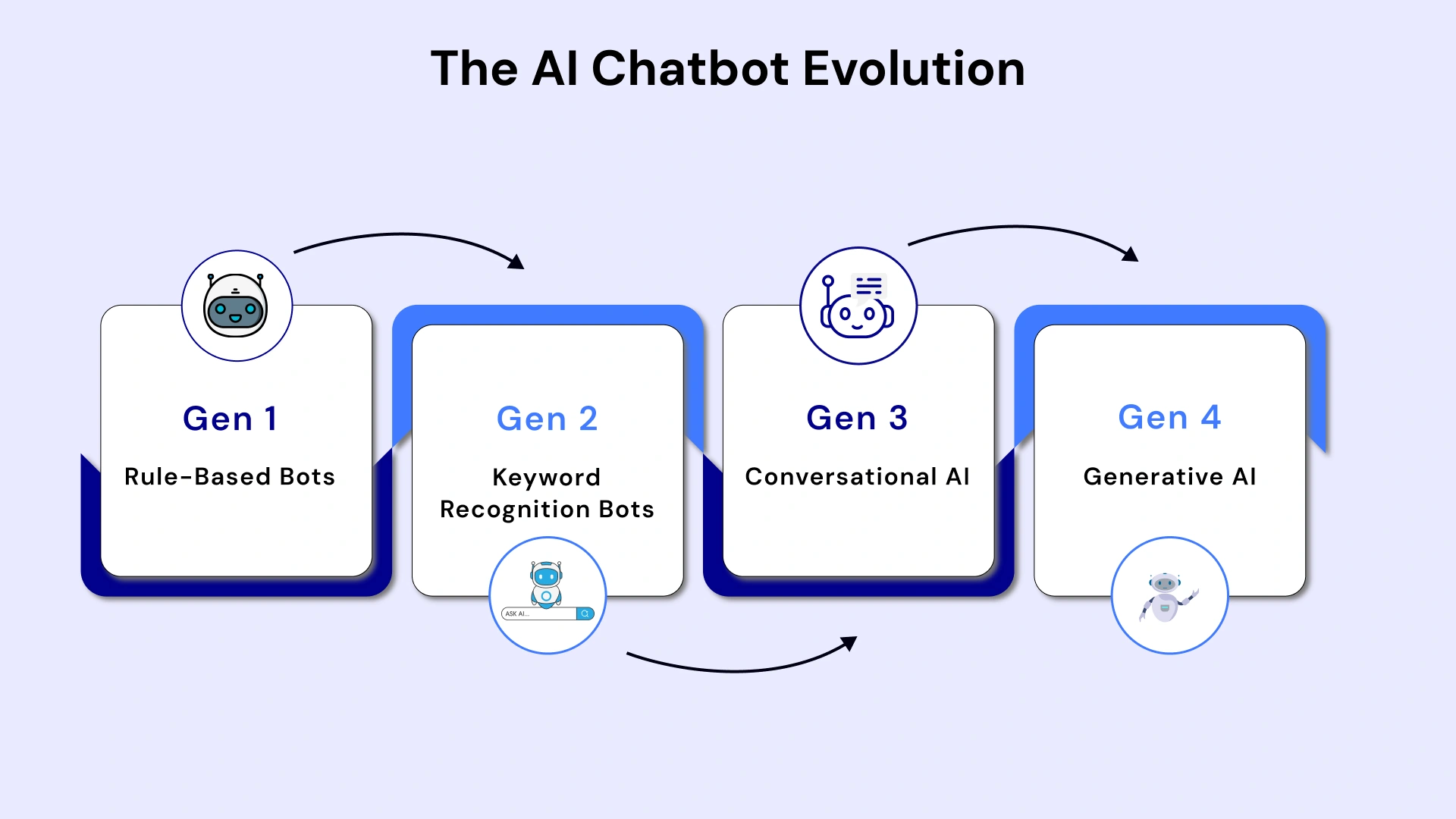
Gen 1: Rule-Based Bots (The Button Clickers): These are essentially decision trees. They are rigid and easily broken. If a user types a sentence instead of clicking a button, the bot fails.
Gen 2: Keyword Recognition Bots: These could identify "Balance" or "Transfer" but lacked context.
Gen 3: Conversational AI (The Current Standard): These bots understand intent, sentiment, and context. They can handle non-linear conversations.
Gen 4: Generative AI (The Future): Powered by LLMs, these bots can generate original answers, summarize complex documents, and offer advisory services.
Note:- Understanding types of banking chatbots is the first step in deciding what your institution needs. Are you building a simple FAQ bot or a fully integrated financial assistant?
The Strategic Role of Conversational AI in Banking
The role of conversational AI in banking is often misunderstood as merely a cost-cutting measure for customer support. While cost reduction is a massive benefit, the strategic value lies in data utilization and customer intimacy.
1. The "Middle of the Funnel" (MOFU) Engine
Banking products are complex. Customers often drop off during the research phase (MOFU). A static website cannot answer the question, "Is this credit card right for my travel habits?" Conversational AI for banking can. It acts as a consultant, nurturing leads by answering specific questions in real-time, significantly boosting conversion rates for loans and credit cards.
2. Operational Resilience
During crises (like the COVID-19 pandemic or banking outages), call center volumes spike to unmanageable levels. AI automation for banks provides an elastic buffer. An AI system does not get tired, it does not need breaks, and it can scale from 100 to 100,000 concurrent chats instantly.
3. Hyper-Personalization at Scale
Banks possess a treasure trove of data. AI-powered banking chatbot solutions unlock this data. Instead of sending a generic email about car loans, the chatbot can analyze transaction data and say: "I noticed your car insurance payment has increased. Are you looking for a new vehicle? We have a pre-approved auto loan rate of 4.5% for you."
How Banks Use AI Chatbots: Critical Use Cases in BFSI
The utility of this technology spans the entire customer lifecycle. Here is a deep dive into how banks use AI chatbots to drive value.
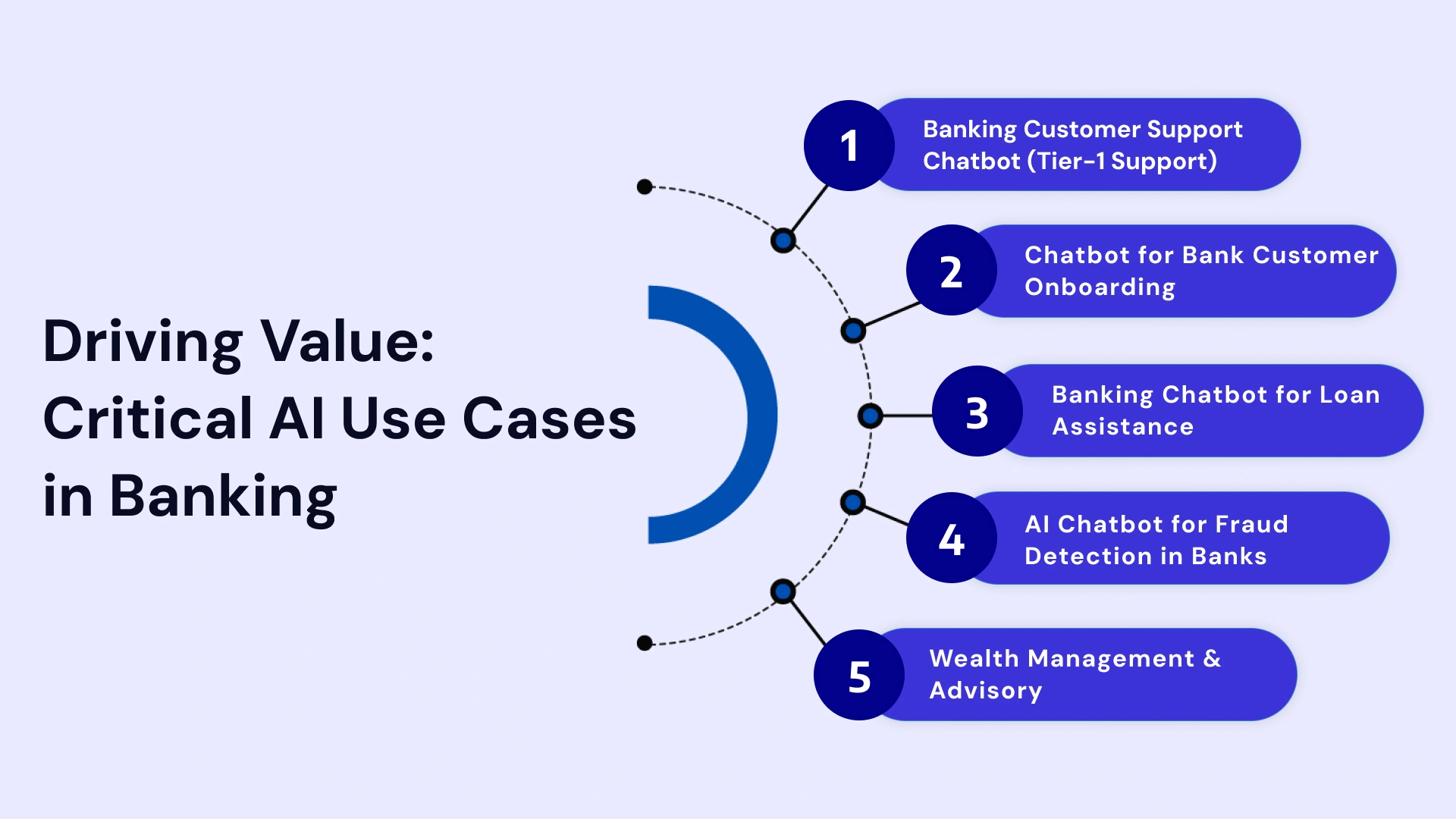
1. Banking Customer Support Chatbot (Tier-1 Support)
This is the most common entry point. A banking customer support chatbot handles the high-volume, low-complexity tasks that clog up call center lines.
- Account Management: Resetting pins, unblocking cards, updating addresses.
- Transaction Queries: "Show me my last five transactions."
- Status Checks: "Where is my replacement card?"
- Impact: By automating these processes, banks can reduce human agent involvement by 30-50%, allowing staff to focus on complex, empathy-driven issues.
2. Chatbot for Bank Customer Onboarding
The "Drop-off" rate during digital account opening is a major pain point. A chatbot for bank customer onboarding acts as a digital hand-holder.
- e-KYC Assistance: The bot can guide the user to take a photo of their ID correctly.
- Form Filling: Instead of a long static form, the bot asks questions one by one ("What is your date of birth?"), which feels less overwhelming.
- Real-time Compliance: It can answer questions like, "Why do you need my SSN?" instantly to alleviate trust concerns.
3. Banking Chatbot for Loan Assistance
Loan origination is complex. A banking chatbot for loan assistance streamlines the application process.
- Eligibility Check: "Based on your income of $5,000/month, you qualify for a $20,000 personal loan."
- EMI Calculation: Interactive calculators within the chat window.
- Document Collection: Users can upload payslips directly into the chat interface for OCR processing.
4. AI Chatbot for Fraud Detection in Banks
Speed is the only defense against fraud. An AI chatbot for bank fraud detection shifts the dynamic from reactive to proactive.
- Scenario: A transaction is attempted in a different country.
- Action: The chatbot immediately pushes a notification to the user's mobile banking app: "We detected a swipe in London. Is this you?"
- Resolution: If the user clicks "No," the bot instantly blocks the card and issues a new one, all without human intervention.
5. Wealth Management & Advisory
AI in banking customer service is evolving into advisory.
- Portfolio Insights: "Your portfolio is down 2% today due to tech sector volatility."
- Savings Nudges: "You have $2,000 excess in your checking account. Would you like to move it to a high-yield savings account?"
Features That Define the Best AI Chatbot Solutions for Banks
When you are scouting for the best AI chatbot solutions for banks or writing a Request for Proposal (RFP) for custom banking chatbot development, specific features are non-negotiable.
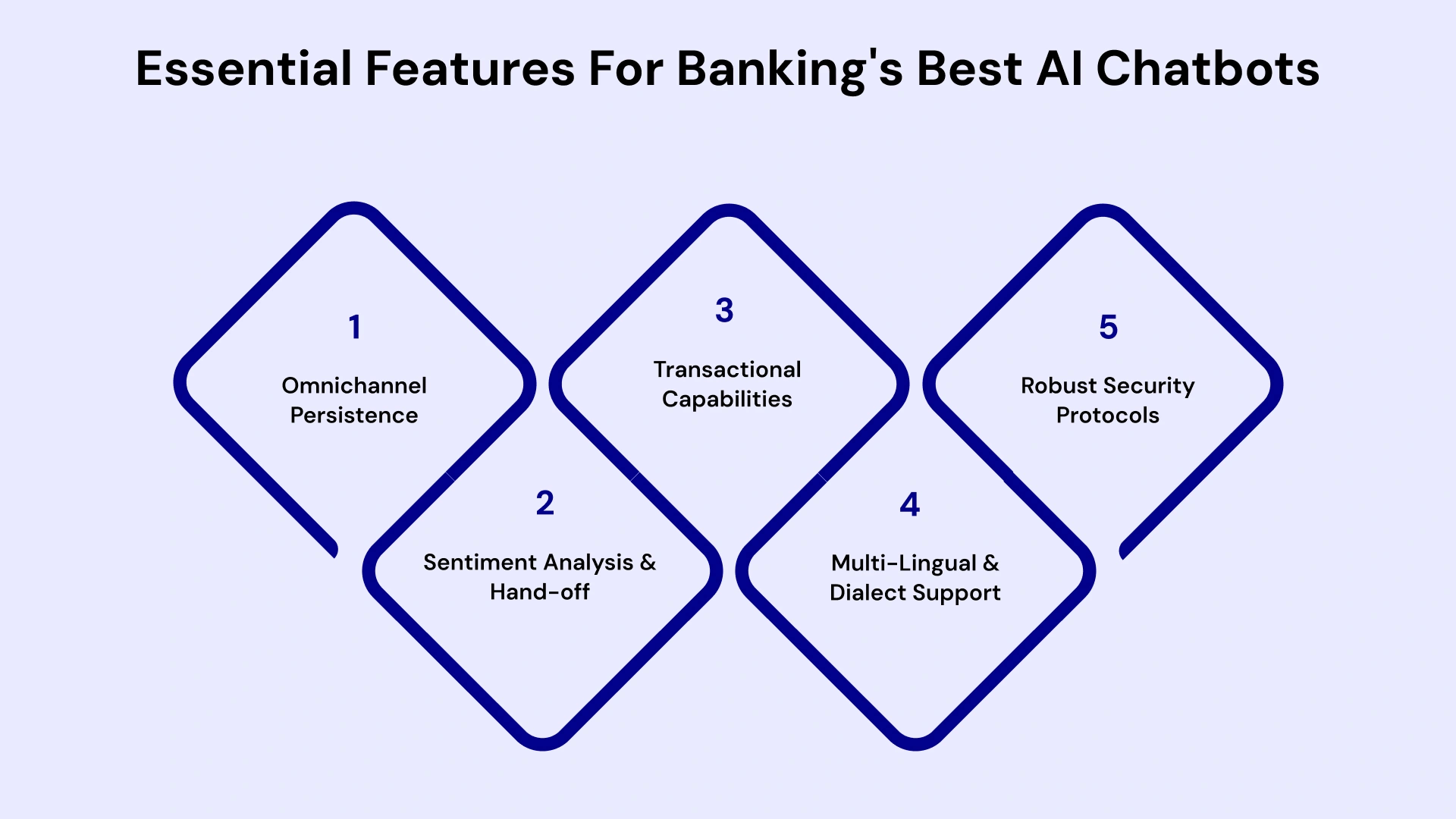
1. Omnichannel Persistence
The user journey is non-linear. A customer might start a query on the website and finish it on the mobile app. The context must travel with them. Chatbots for mobile banking apps, web portals, WhatsApp, and social media must all share a single "brain" or backend history.
2. Sentiment Analysis & Hand-off
AI chatbot features for banks must include emotional intelligence. If a user types, "I am angry, you charged me twice!", the NLP engine must detect 'Anger' and 'High Urgency'. The bot should immediately apologize and route the chat to a senior human agent, passing along the transcript so the user doesn't have to repeat themselves.
3. Transactional Capabilities
Information is good; action is better. The best bots don't just say "Here is how you transfer money"; they say "Who do you want to transfer to?" and execute the API call securely. This requires deep AI chatbot integration for BFSI core systems.
4. Multi-Lingual & Dialect Support
In global banking or diverse regions (like India or the EU), supporting only English is insufficient. The AI must understand local dialects, slang, and mixed languages (e.g., "Hinglish" or "Spanglish") to serve the demographic truly.
5. Robust Security Protocols
AI chatbot for secure banking transactions features must include:
- Biometric Authentication: confirming identity via Face ID or fingerprint before revealing balances.
- End-to-End Encryption: protecting data in transit.
- PII Redaction: ensuring sensitive data (like full account numbers) isn't stored in plain text in chat logs.

The Development Roadmap: Buy vs. Build
One of the biggest decisions a CTO faces is whether to subscribe to a SaaS platform or invest in developing a custom banking chatbot.
Option A: SaaS / Platform Solutions
- Pros: Faster time-to-market, lower upfront costs, pre-trained banking intents.
- Cons: Less flexibility, data privacy concerns (shared cloud), difficulty integrating with legacy mainframes.
Option B: Custom Banking Chatbot Development
- Pros: Complete control over data, IP ownership, bespoke integration with custom legacy systems, brand-specific persona.
- Cons: Higher upfront investment, longer development time.
For most Tier-1 and Tier-2 banks, banking chatbot development services that offer a hybrid approach (using the best LLMs but building custom middleware and security layers) are the ideal path.
The Development Lifecycle
- Discovery: Analyzing call center logs to find top intents.
- Design: Creating the "Persona" of the bot. Is it formal? Friendly?
- Training: Feeding the AI with historical data to understand industry jargon.
- Integration: Connecting the bot to APIs (Core Banking, CRM, Payment Gateways).
- Testing: Rigorous security testing and User Acceptance Testing (UAT).
- Deployment: Rolling out to a small user group first.
How AI Chatbots Improve Banking Customer Experience
There are various ways chatbots are making banks smarter. The benefits of AI chatbots in banking are highly measurable. This isn't just about soft improvements like 'experience'; it's about achieving quantifiable business metrics.
1. Zero Wait Time
The number one driver of customer dissatisfaction is hold time. Chatbots eliminate this. How AI chatbots improve banking customer experience is primarily by respecting the customer's time.
2. 24/7 Availability
Money never sleeps, and neither should the bank. Whether it's a lost card at 3 AM on a Saturday or a wire transfer needed on a holiday, the bot is there.
3. Consistent Accuracy
Humans have bad days; software doesn't. A chatbot provides the correct, compliance-approved answer 100% of the time (assuming correct programming), reducing the risk of misinformation.
4. Educational Value
Many customers are embarrassed to ask "dumb" questions to a human (e.g., "What is an overdraft fee?"). They are comfortable asking a bot. This improves financial literacy and deepens engagement.
Challenges in AI Chatbot Deployment for Financial Institutions
To ensure a balanced view, we must address the hurdles in AI chatbot deployment for financial institutions.
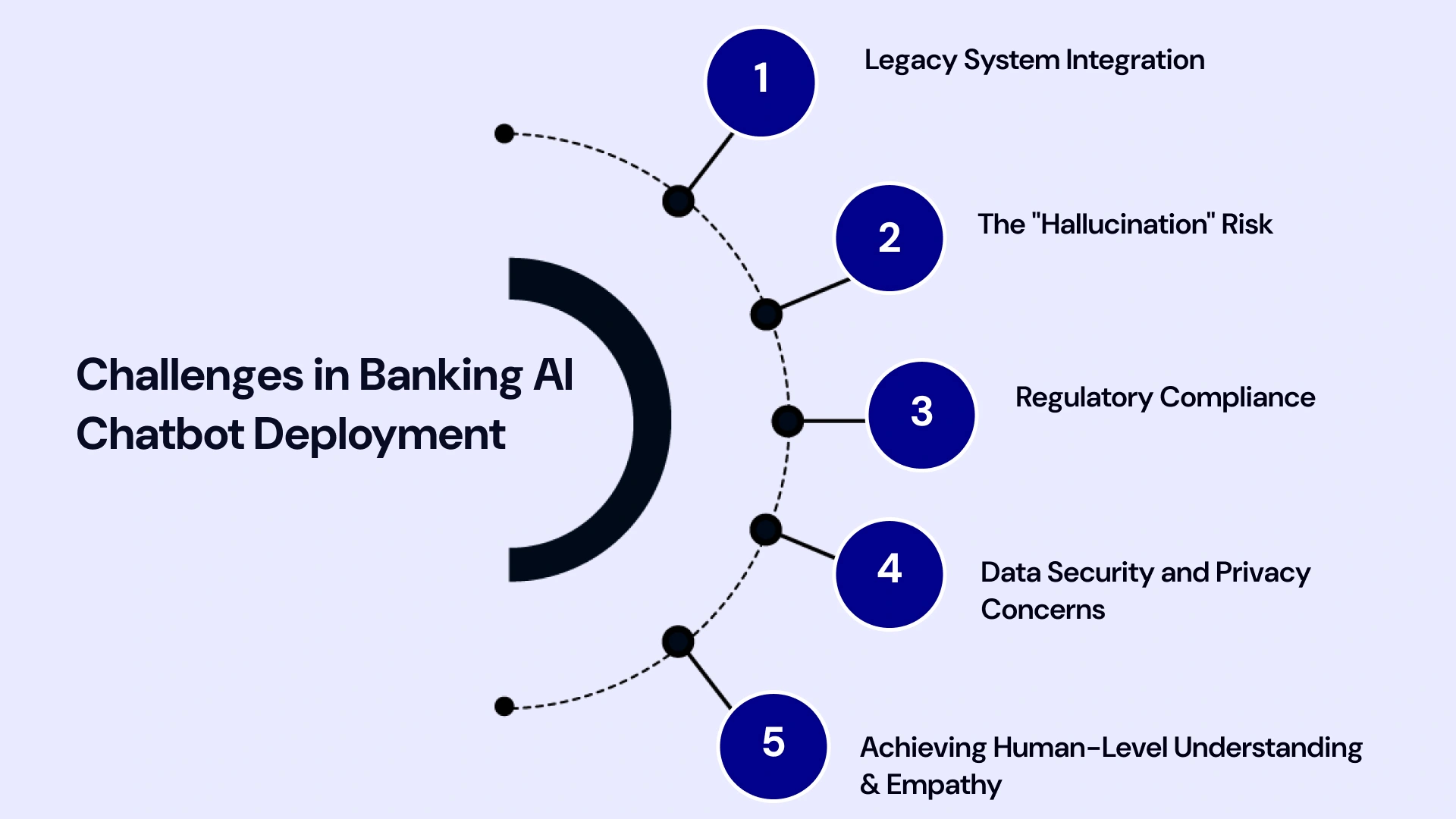
- Legacy System Integration: Many banks run on decades-old mainframes (COBOL era). Building modern RESTful APIs to interact with these systems is a significant challenge for banking chatbot development services.
- The "Hallucination" Risk: Generative AI can sometimes confidently state false information (hallucinations). In banking, telling a user they have $10,000 when they have $10 is catastrophic. Strict "Guardrails" and "Human-in-the-Loop" verification are required.
- Regulatory Compliance: GDPR, CCPA, PCI-DSS—the alphabet soup of compliance is strict. AI chatbot integration for BFSI must ensure that data handling complies with all local and international regulations.
- Data Security and Privacy Concerns: Handling sensitive financial and personal information (PII) requires ironclad security protocols. The chatbot system must be protected against injection attacks and unauthorized access, demanding advanced encryption and strict data masking, especially when integrating with core banking systems.
- Achieving Human-Level Understanding and Empathy: While technical functions are straightforward, customers often require sophisticated emotional intelligence to address complex issues such as fraud or loan denials. Getting the AI to handle nuanced, multi-turn conversations and maintain brand trust without sounding robotic is a significant barrier to widespread customer adoption.
Future Outlook: AI Chatbot Trends in BFSI
What does the future hold? Here are the top AI chatbot trends in BFSI:
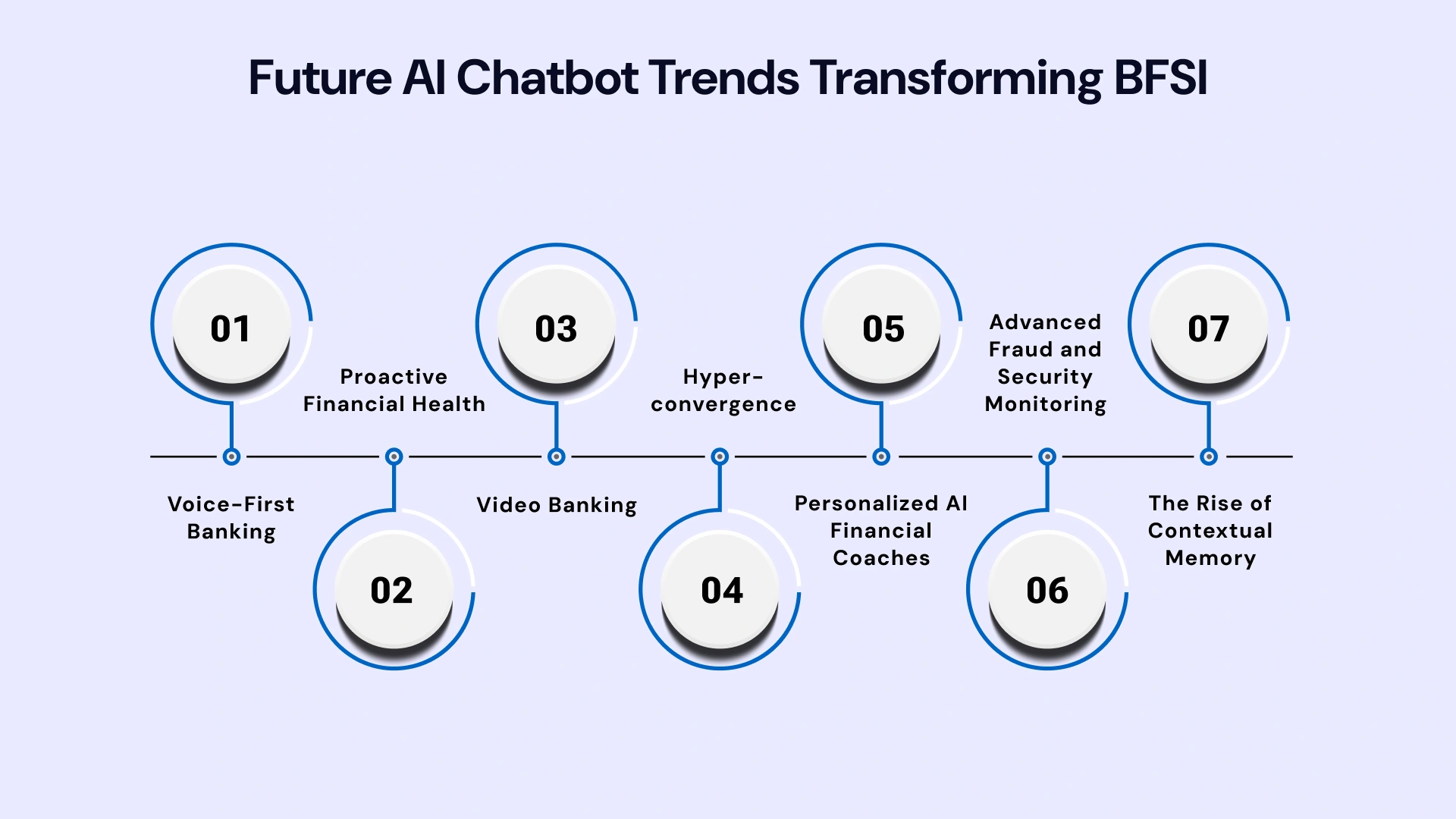
- Voice-First Banking: As smart speakers proliferate, digital banking chatbot solutions will move from text to voice. "Hey Google, pay my electric bill."
- Proactive Financial Health: Bots will evolve from reactive (answering questions) to proactive (preventing problems). "You are about to overdraft; I recommend transferring $50 from savings."
- Video Banking: AI avatars that look and speak like humans for a "face-to-face" experience in a digital branch.
- Hyper-convergence: The merging of AI automation for banks with chatbots, where the bot doesn't just talk, but performs complex RPA (Robotic Process Automation) tasks in the background.
- Personalized AI Financial Coaches: Instead of static advice, bots will act as dedicated, continuously learning financial advisors. They will analyze a user's entire financial profile (spending, income, goals) across accounts to offer highly tailored, complex investment, saving, and budgeting strategies, making sophisticated advice accessible to all customer tiers.
- Advanced Fraud and Security Monitoring: Chatbots will be integrated directly with real-time security systems. If a suspicious transaction occurs, the bot will immediately contact the customer via chat/voice to verify the activity, using conversational context to quickly confirm or flag the activity as fraudulent, significantly reducing resolution time.
- The Rise of Contextual Memory: Future chatbots will possess sophisticated long-term memory. They won't just remember the current session, but your entire history with the bank—previous questions, complaints, life events, and financial status—allowing for seamless, personalized, and frustration-free interactions across multiple channels (phone, app, website).
The Investment: Cost of AI Chatbot Development for Banks
For the C-Suite, the bottom line matters. What is the cost of AI chatbot development for banks?
The cost varies significantly based on complexity:
Bot Level | Description | Estimated Cost Range |
Basic Bot | FAQ, Rule-based, No Core Integration | $20,000 - $40,000 |
Mid-Range Bot | NLP-based, Limited Integration (Balance checks) | $50,000 - $100,000 |
Enterprise Bot | Generative AI, Full Core Banking Integration, Omnichannel, High Security | $150,000 - $500,000+ |
Note: These are development costs. Ongoing maintenance, server costs, and API fees are separate. While the upfront cost of custom banking chatbot development is significant, the ROI is typically realized within 12-18 months through reduced support costs and increased sales conversion rates.
Leverage VLink Expertise for Banking AI Chatbot Development
Moving from strategy to successful execution requires an expert partner with deep financial domain knowledge, robust AI Development Services, and a focus on compliance. VLink specializes in creating secure, intelligent, and ROI-driven conversational AI solutions for the BFSI sector.
1. Custom AI Development Services & Architecture Design
We design your AI-enabled chatbot from the ground up, aligning it with your bank's core systems and business KPIs (e.g., boosting sales and enhancing customer LTV).
- Strategic Consulting: Identifying and prioritizing high-impact use cases like loan pre-qualification and employee assistance desks.
- Secure Architecture: Designing a scalable platform with secure API gateways to ensure seamless, protected integration with your Core Banking Systems (CBS) and CRM.
2. Intelligent Virtual Assistants for Banking Automation
Our solutions are more than simple bots; they are Intelligent Virtual Assistants that drive real-time automation and hyper-personalization across all channels.
- Conversational AI Excellence: Utilizing advanced NLP and domain-specific training for accurate intent recognition in financial vocabulary (e.g., KYC, mortgage).
- Omnichannel Deployment: Ensuring a unified, context-aware experience across mobile apps, web, WhatsApp, and voice channels, enabling 24/7 service.
- AI for Banking Automation: Automating routine, high-volume tasks like balance inquiries, fund transfers, and fraud alerts to reduce operational costs by up to 60%.
3. Compliance and Security-First AI Chatbot Development
For the BFSI sector, trust is paramount. Our development process embeds security and compliance from day one, adhering to global standards like PCI DSS and GDPR.
- Audit-Ready Logging: Implementing comprehensive, auditable logs for every interaction, ensuring transparency and accountability for regulatory reviews.
- Fraud Detection Integration: Building proactive features that monitor transactions in real-time, flag suspicious activity, and guide customers on security best practices.
- Security Protocols: Employing encryption (TLS 1.2+, AES-256) and secure hosting (VPC) to protect sensitive Personal Identifiable Information (PII) and financial data.
4. MLOps and Continuous Optimization for ROI
Our dedicated team ensures your AI asset continues to deliver maximum value by establishing a framework for performance monitoring and continuous learning.
- Defining Success Metrics: Tracking tangible KPIs like Deflection Rate, First Contact Resolution (FCR), and reduced Average Handle Time (AHT) to prove continuous ROI.
- Model Maintenance: Establishing MLOps pipelines to monitor for model drift and automatically retrain the AI models, keeping the chatbot accurate and relevant as customer behavior changes.
Conclusion: The Time to Act is Now
The question is no longer if you should build an AI chatbot for banks, but how fast you can deploy one that is secure, intelligent, and customer-centric.
We are witnessing the "Uber-ization" of banking. Customers expect seamless, instant, and intelligent interactions. A well-executed chatbot strategy transforms your bank from a utility provider into a true financial partner—one that is always awake, always helpful, and always secure.
However, execution is everything. A poorly designed bot is worse than no bot at all. It damages trust. You need a partner who understands not just the code, but the compliance; not just the AI, but the accountancy.
Are you ready to transform your customer experience and lead the BFSI sector?
Our team specializes in high-end AI chatbot development for the banking industry, delivering secure, compliant, and intelligent solutions for the world's leading financial institutions. We don't just build bots; we create digital workforces. Contact our AI experts today to schedule a consultation!

Vice President, Strategy – VLink Inc.
Sambhavi Gopalakrishnan is the Vice President of Strategy at VLink Inc., bringing over a decade of experience in IT leadership, project implementation, and strategic growth. She possesses a strong foundation in technical project management and pre-sales, driving innovation and business transformation at VLink.

 Shivisha Patel