


Introduction - Why the Middle East Is Entering a Doller 1B+ AI Growth Phase
This isn't speculative growth. It's government-mandated acceleration.
The UAE's National AI Strategy 2031 and Saudi Arabia's Vision 2030 have moved beyond policy documents into executable roadmaps. Project Transcendence—Saudi Arabia's $100 billion initiative—signals intent to build a national AI champion rivaling global tech giants. For CTOs and VP Engineering leaders in the region, the mandate is clear: adoption is no longer optional.
But the real accelerator isn't traditional AI. It's generative AI.
A leading UAE telecom operator recently cut model deployment time by 40% using GenAI orchestration—proof that enterprise AI transformation in the Middle East is delivering measurable returns.
For enterprises exploring AI adoption in Middle East businesses, the question has shifted from "should we invest?" to "how do we scale before competitors do?"
The Enterprise AI Landscape in the Middle East (2025)
Understanding the current AI maturity across the GCC is essential before exploring specific generative AI use cases for enterprises. The landscape in 2025 reveals a region primed for exponential growth.
Government-Led Acceleration
Regional governments aren't just enabling AI—they're building it.
The UAE National AI Strategy 2031 positions the country to become a global AI hub by embedding artificial intelligence across government services, healthcare, transportation, and energy. Abu Dhabi's investment in Jais, an Arabic-first large language model, represents the commitment to AI sovereignty.
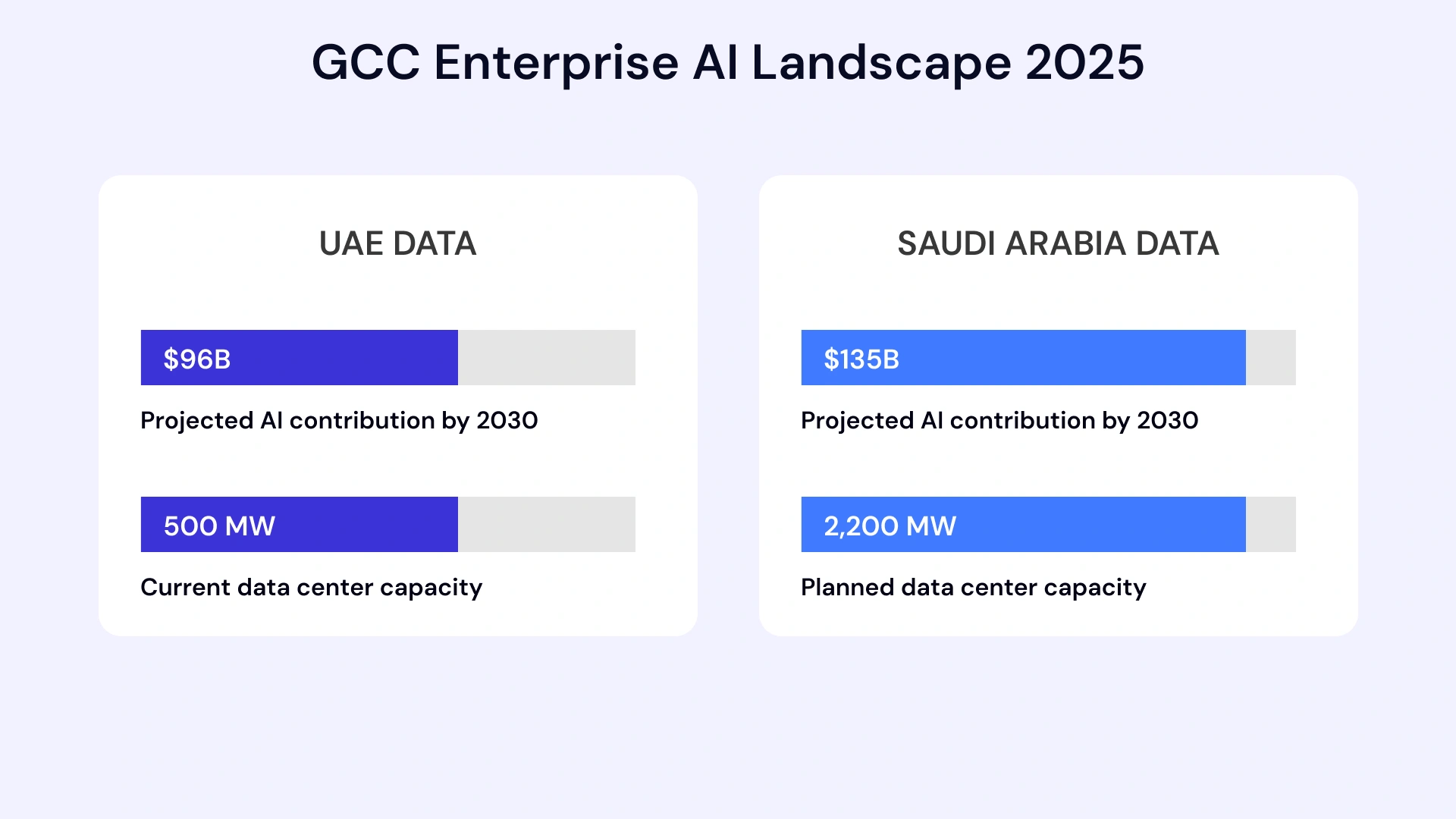
Saudi Arabia's Vision 2030 AI ecosystem extends beyond technology investment. The Kingdom plans to add 2,200 MW of data center capacity—dwarfing the UAE's approximately 500 MW—to become the region's AI compute hub. This infrastructure buildout is fueled by access to cheap energy, making KSA an increasingly attractive destination for AI workloads.
Qatar's national AI initiatives complement this regional push, focusing on smart city applications and financial services automation.
Enterprise Adoption Patterns
High AI spending sectors in the Middle East include energy, banking, telecommunications, retail, and public sector organizations. These industries share common characteristics: large data volumes, complex operational workflows, and regulatory environments demanding precision.
However, barriers persist. Data fragmentation across legacy systems, integration complexity with existing enterprise architecture, and compliance requirements specific to UAE and KSA jurisdictions slow deployment timelines.
The 5 Enterprise Use Cases Driving Doller 1B+ Growth
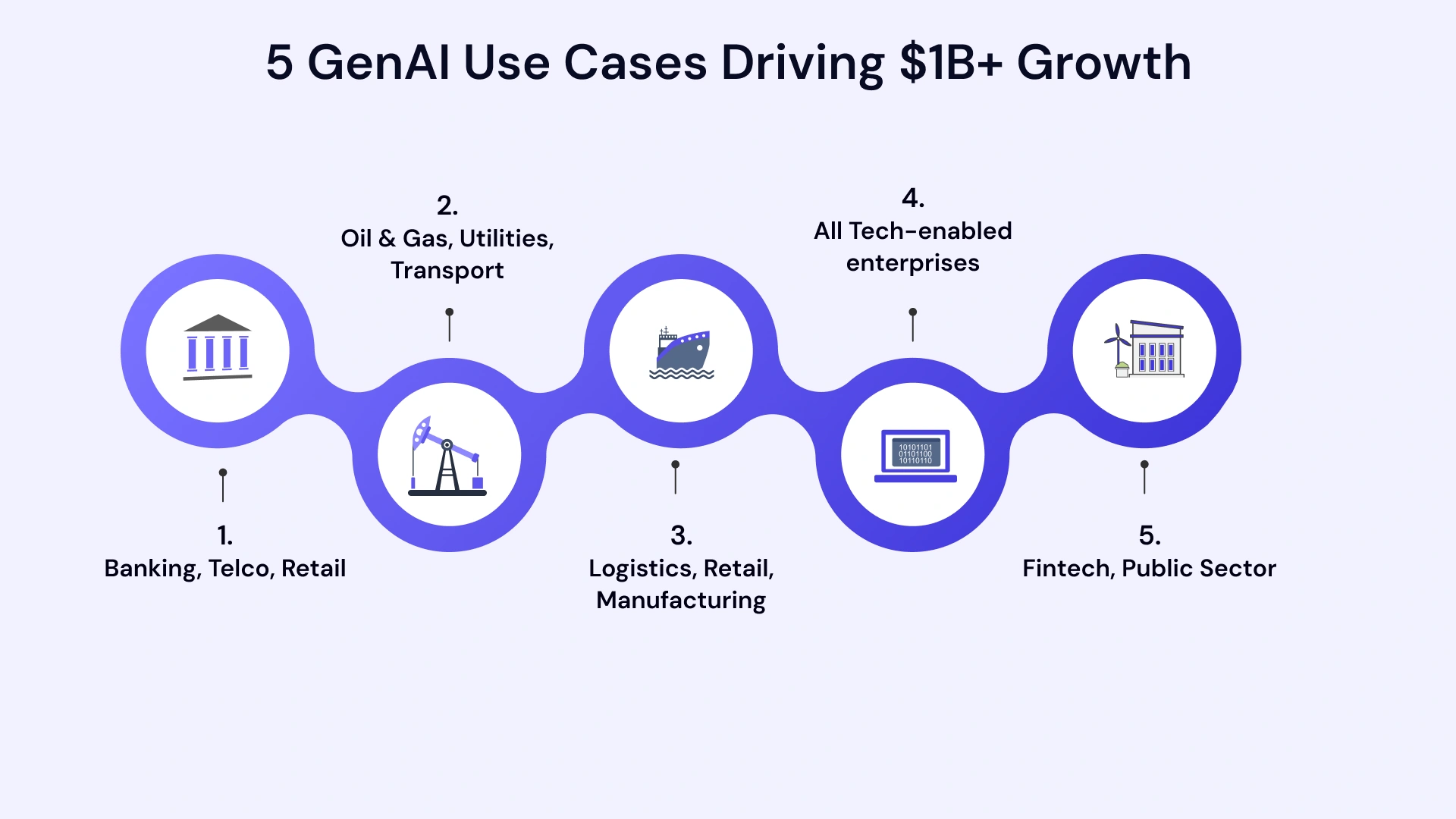
These five generative AI enterprise use cases represent the highest-impact applications currently driving measurable value across UAE and Saudi Arabia. Each addresses specific pain points familiar to CTOs and engineering leaders navigating AI transformation strategies for Middle East enterprises.
1. AI-Powered Customer Experience Automation (Banking, Telco, Retail)
Customer support in regional banking often struggles with the switch between Modern Standard Arabic (MSA) and local dialects like Khaleeji, Najdi, or Hejazi. Standard Western models frequently fail at these nuances, creating friction in customer interactions.
The GenAI solution deploys intelligent virtual agents, NLU bots, and knowledge assistants fine-tuned on local language patterns. Rather than simple chatbots, these systems use Retrieval-Augmented Generation (RAG) architectures to deliver contextually accurate responses.
Impact metrics are compelling. Enterprises report 20–30% reduction in support costs through automation. A major Saudi bank automated 60% of frequently asked questions using GenAI combined with RAG pipelines, processing queries in customers' specific dialects.
For organizations scaling AI in banking and finance Middle East operations, customer experience automation offers the fastest path to measurable ROI. Teams leveraging VLink's AI Development Services often implement dialect-aware knowledge assistants as their first production deployment.
2. Predictive Maintenance & Operations Optimization (Oil & Gas, Utilities, Transport)
Unplanned downtime in refineries or desalination plants costs millions per day. Traditional preventive maintenance schedules—based on equipment age or manufacturer recommendations—fail to account for actual operating conditions.
Generative AI enables a shift from preventive to "generative predictive" maintenance. These models ingest decades of sensor data, maintenance logs (often in handwritten Arabic and English notes), and seismic data to generate maintenance schedules and predict failure modes before they occur.
3. AI-Enhanced Supply Chain & Logistics Intelligence
Geopolitical instability—particularly disruptions to Red Sea shipping routes—demands instant adaptability from logistics operators. Static supply chain models cannot respond to the velocity of change.
GenAI enables scenario planning agents that simulate millions of supply chain disruption scenarios and generate instant rerouting strategies. These systems predict port congestion, anticipate tariff changes, and optimize inventory positioning across regional distribution networks.
Impact metrics demonstrate the value. Enterprises report inventory accuracy improvements of 25% and logistics cost reductions of 8–12%. A Dubai logistics operator using GenAI for route simulation reduced response time to supply chain disruptions from days to hours.

4. Workforce Productivity & Code Acceleration with GenAI
Developer productivity represents one of the most accessible generative AI applications in enterprises. Engineering teams spend significant time on repetitive tasks: writing boilerplate code, documenting APIs, debugging legacy systems, and retrieving information from internal knowledge bases.
GenAI-powered developer copilots, process automation tools, and knowledge retrieval systems deliver measurable productivity gains. Research indicates 20–45% productivity lift across development workflows when properly implemented.
The decision framework for engineering leaders centers on three options: Build custom models from scratch, integrate existing foundation models via APIs, or fine-tune open-source models on proprietary codebases. Each approach carries different cost, control, and security trade-offs.
5. AI for Risk, Compliance & Fraud Detection (Banking, Fintech, Public Sector)
Regulatory compliance in UAE and Saudi Arabia demands precision. Manual compliance workflows—reviewing documents for regulatory alignment, monitoring transactions for fraud indicators, and managing AML requirements—consume significant operational resources.
LLM-driven document intelligence transforms compliance operations. These systems process regulatory documents, extract relevant requirements, and map them against organizational practices. RAG pipelines enable compliance teams to query policy databases in natural language.
Fraud detection applications leverage anomaly detection models trained on regional transaction patterns. A UAE fintech reduced false positives by 30% using AI-powered fraud detection, improving both customer experience and operational efficiency.
Decision-Making Framework: How GCC Enterprises Should Prioritize AI Use Cases
For CXOs and engineering leaders, standard adoption playbooks fail because they ignore the unique requirements of the Middle East market—particularly data sovereignty. This localized framework addresses regional realities.
Step 1 — Business Value Matrix
Not all AI use cases deliver equal value. Start by scoring potential applications on two dimensions: business impact and implementation feasibility. High-impact, high-feasibility use cases belong in the first implementation wave.
| Use Case | Business Impact | Feasibility | Priority |
| Customer Experience | High | High | Wave 1 |
| Compliance Automation | High | High | Wave 1 |
| Predictive Maintenance | High | Medium | Wave 2 |
| Supply Chain Intelligence | High | Medium | Wave 2 |
| Developer Productivity | Medium | High | Wave 1 |
Step 2 — Data Readiness & Governance Assessment
Data residency requirements in the UAE and Saudi Arabia shape every AI deployment decision. Classify enterprise data into three categories: Public, Confidential, and Top Secret (National Security). Determine which data must stay on-premise or within local cloud regions.
Oracle KSA, Microsoft UAE North, and Google Cloud's regional offerings now enable sovereign cloud deployments that satisfy regulatory requirements. GDPR alignment for enterprises operating across European and Middle Eastern markets adds complexity.
Step 3 — Build, Buy, or Partner Decision Model
Custom LLM development offers maximum control but requires substantial investment. Fine-tuning open-source models—such as Jais (UAE) or AceGPT (KSA/KAUST)—balances customization with cost efficiency. API-based solutions from global providers deliver fastest time-to-value but may conflict with data sovereignty requirements.
Step 4 — Pilot-to-Scale Roadmap
Move from chatbots that answer questions to agents that execute actions—filing tickets, running SQL queries, or processing transactions. Measure time saved per process, not just model accuracy. Cost-per-output metrics enable comparison across implementation approaches.
MLOps and LLMOps infrastructure investments early in the journey prevent technical debt accumulation that stalls scaling efforts.

PAA Section - Expert Answers to What CXOs Are Asking
What is driving AI growth in the Middle East?
Government investment leads the acceleration. Saudi Arabia's $100 billion Project Transcendence and the UAE's National AI Strategy 2031 provide infrastructure, funding, and regulatory frameworks supporting enterprise adoption. Additionally, regional enterprises face competitive pressure to match global efficiency standards.
Which industries in the GCC benefit the most from Generative AI?
Energy, banking, telecommunications, and logistics capture the largest value pools. Energy and utilities benefit from predictive maintenance. Banking leverages customer experience automation and fraud detection. Logistics operators deploy supply chain scenario planning for resilience. Plan your AI roadmap—enterprise AI strategy consulting for GenAI adoption.
How are UAE and KSA enterprises implementing GenAI securely?
Data sovereignty requirements shape implementation architecture. Enterprises use sovereign cloud deployments from Oracle, Microsoft, and Google Cloud with regional data centers. Arabic-first LLMs like Jais and AceGPT enable localized intelligence while keeping data within borders.
What are the biggest challenges in enterprise AI adoption in the Middle East?
Data fragmentation across legacy systems creates the primary technical barrier. Integration complexity extends deployment timelines. Talent scarcity—particularly for ML engineers with regional expertise—constrains scaling efforts. Regulatory compliance requirements add implementation overhead.
How should CTOs build an AI adoption roadmap?
Start with a sovereignty assessment classifying data sensitivity levels. Prioritize use cases using a business value matrix. Select foundation models aligned with data residency requirements. Structure pilots to measure time-saved rather than just accuracy. Invest in MLOps infrastructure early.
Case Studies Snapshot - Real Middle East Enterprise Wins
UAE Banking: GenAI Knowledge Assistant
A leading UAE bank deployed a GenAI-powered knowledge assistant for customer service representatives. The system uses RAG architecture to retrieve accurate information from policy documents. Customer query resolution time decreased by 35%, while first-contact resolution rates increased by 22%.
Saudi Energy: Predictive Maintenance Transformation
A major Saudi energy operator implemented AI-powered predictive maintenance across refinery operations. The system analyzes sensor data, maintenance logs, and equipment specifications to predict failure modes. Unplanned downtime reduced by 18%, generating estimated annual savings exceeding $50 million.
Dubai Retail: Demand Forecasting Intelligence
Challenges and Risk Considerations for AI in the Middle East
Balanced perspective strengthens credibility with technical leaders evaluating AI investments. Understanding risks enables mitigation planning.
Data Residency Requirements
UAE and Saudi Arabia enforce strict data localization requirements for certain data categories. Enterprises must map data flows across AI pipelines to ensure compliance. Cloud provider selection must prioritize regional data center availability.
Hallucinations & Model Governance
Generative AI models produce plausible but incorrect outputs. High-stakes applications—regulatory compliance, financial advice, medical information—require human-in-the-loop validation workflows. Governance frameworks must define acceptable error rates and escalation procedures.
Vendor Lock-in Considerations
Foundation model selection creates long-term dependencies. Enterprises should evaluate portability requirements, fine-tuning data ownership, and exit strategies before committing to platform investments.
LLMOps Complexities
Operating large language models in production introduces infrastructure challenges distinct from traditional ML. Token cost management, prompt versioning, evaluation pipeline design, and model performance monitoring require dedicated tooling.
Cost Optimization Strategies
Conclusion - GCC Enterprises That Act Now Will Lead the Next Doller 1B Wave
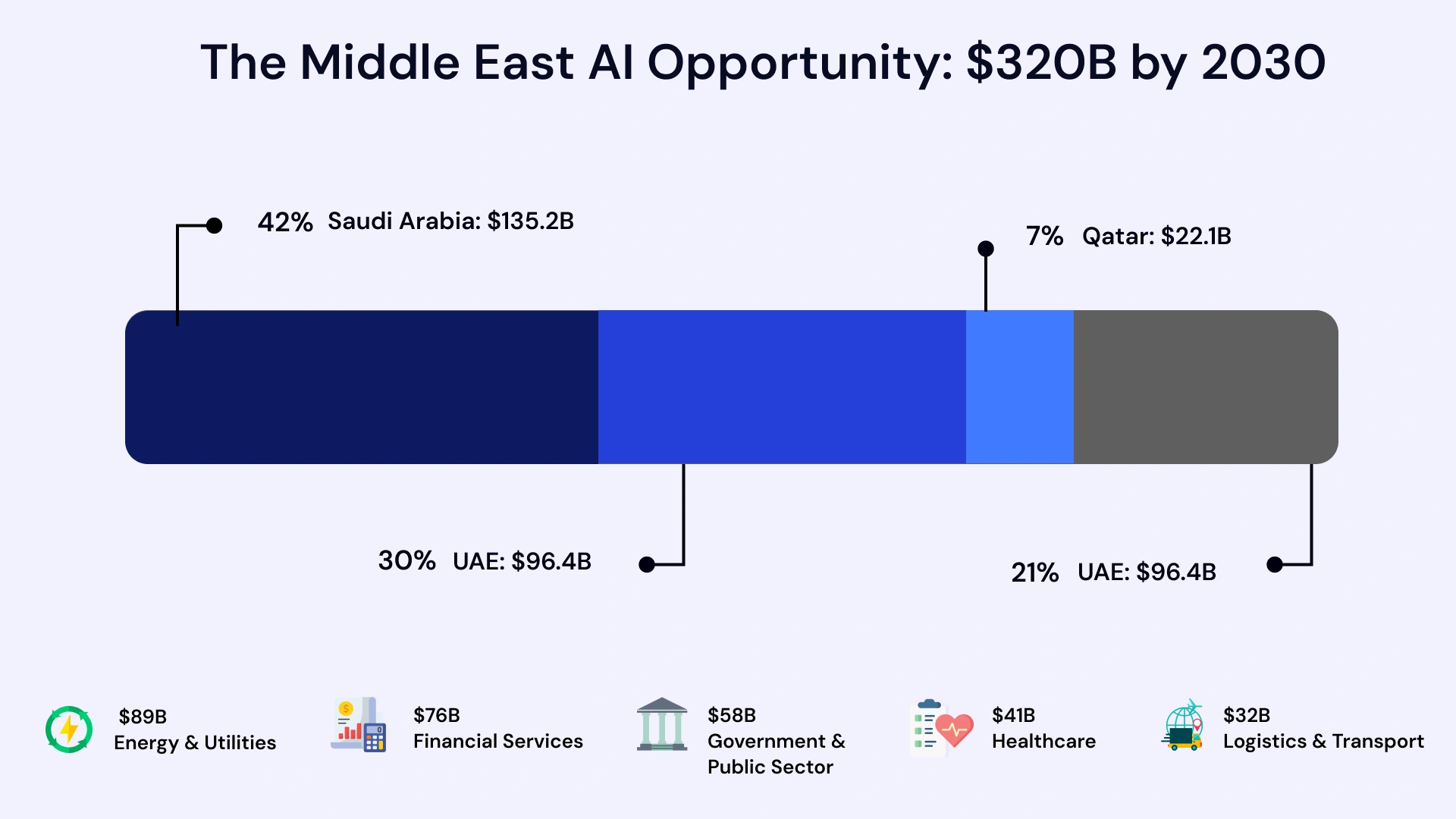
The Middle East AI market represents a $320 billion opportunity by 2030. Generative AI accelerates that timeline by creating net-new value rather than merely optimizing existing processes.
The five enterprise use cases detailed in this analysis—customer experience automation, predictive maintenance, supply chain intelligence, developer productivity, and compliance automation—represent proven paths to measurable returns. Enterprises already deploying these applications report cost reductions of 15–30% and productivity gains of 20–45%.
The competitive window is narrowing. While 80% of GCC organizations feel pressure to adopt AI, only a fraction generates meaningful earnings from these investments. The gap between intent and execution determines market position.
For CTOs and engineering leaders in the UAE and Saudi Arabia, the path forward requires three immediate actions: assess data sovereignty requirements, prioritize use cases using a business value matrix, and structure pilots to measure time-saved rather than just accuracy.
Early movers will capture disproportionate value. Enterprises that delay will compete for diminishing differentiation opportunities.

Vice President, Strategy – VLink Inc.
Sambhavi Gopalakrishnan is the Vice President of Strategy at VLink Inc., bringing over a decade of experience in IT leadership, project implementation, and strategic growth. She possesses a strong foundation in technical project management and pre-sales, driving innovation and business transformation at VLink.

 Shivisha Patel