


Priya Menon is the VP Engineering at a Dubai-based digital financial services group operating under a CBUAE payment service provider licence. Following a strategic decision to launch a proprietary mobile wallet and lending platform ahead of the group’s next funding round, she has been tasked with building a realistic development budget for board approval. Her challenge is not a shortage of vendor quotes — it is the wide variance between them, ranging from AED 180,000 to AED 900,000 for ostensibly similar feature sets. Her 90-day mandate is to produce a feature-level cost model that justifies the investment and identifies the build sequence that delivers the highest return on the earliest capital.
This guide provides a structured breakdown of fintech app development cost in Dubai by feature, complexity tier, regulatory obligation, and team model. It is written for CTOs, GMs of IT, and VP Engineering leads who need to produce a defensible budget, not a marketing estimate.

Why Dubai Is the Middle East’s Premier FinTech Development Market
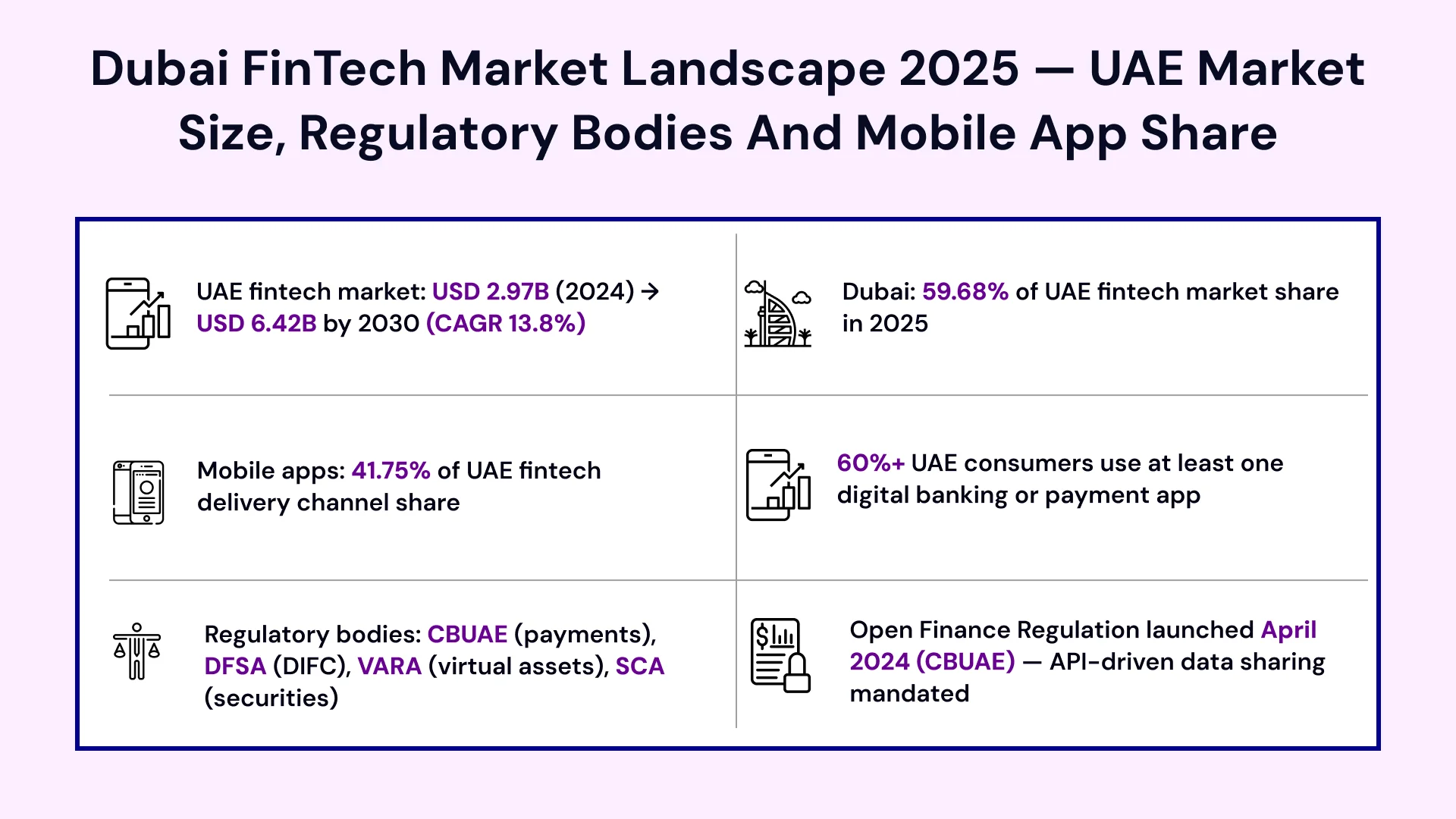
For CTOs building fintech applications in Dubai, this regulatory density is not an obstacle. It is a product specification. Every compliance requirement — KYC, AML, CBUAE Open Finance API integration, PCI DSS card data handling — maps directly to a development module with a defined scope and cost range. Understanding that map before committing to a vendor is the single most effective cost control lever available.
What Determines FinTech App Development Cost in Dubai
The final cost to build a fintech app in Dubai is determined by five structural variables. Understanding each before issuing an RFP prevents scope misalignment and budget overrun.
1. Application Complexity and Feature Scope
A digital wallet with peer-to-peer payments, KYC onboarding, and a transaction history costs substantially less than a full neobanking platform with lending origination, credit scoring, open banking API connectivity, and multi-currency support. Feature scope is the primary cost driver. Scoping at the feature level — rather than the product level — is the prerequisite to any accurate estimate.
2. Platform Strategy: Native, Cross-Platform, or Web
Building separate native applications for iOS and Android increases development cost by 30–40% compared to a cross-platform approach using Flutter or React Native. For fintech applications requiring biometric authentication, hardware security module (HSM) integration, or NFC-based contactless payments, native development often delivers better security performance. Cross-platform frameworks are appropriate for feature-parity MVPs where time-to-market takes priority over platform optimisation.
3. Security Architecture Depth
Fintech apps in Dubai cannot treat security as a feature to add post-launch. End-to-end encryption, biometric authentication, device binding, certificate pinning, and jailbreak/root detection are architectural requirements. These controls increase total cost by 20–30% above a standard mobile app build. Penetration testing, mandatory under UAE cybersecurity standards for financial applications, adds AED 15,000–40,000 per engagement depending on attack surface scope.
4. Regulatory Compliance Modules
Compliance with CBUAE payment service provider licensing conditions, DFSA requirements for DIFC-based entities, AML/CFT transaction monitoring, and PDPL data handling obligations require dedicated development effort. These are not optional enhancements — they are launch prerequisites for any licensed fintech operation in the UAE.
5. Third-Party Integration Complexity
Every payment gateway integration (Checkout.com, Stripe, Network International, Telr), banking API connection, credit bureau feed, or government identity platform (UAE Pass) adds development hours and ongoing maintenance cost. The number of integration touchpoints is a reliable proxy for project complexity.
FinTech App Cost by Complexity Tier: MVP to Enterprise
Fintech app development cost in Dubai typically ranges from AED 257,000 to AED 880,000 (approximately USD 70,000 to USD 240,000) for mobile banking, investment, and digital wallet applications (VLink, 2025). The table below maps this range against three delivery tiers.
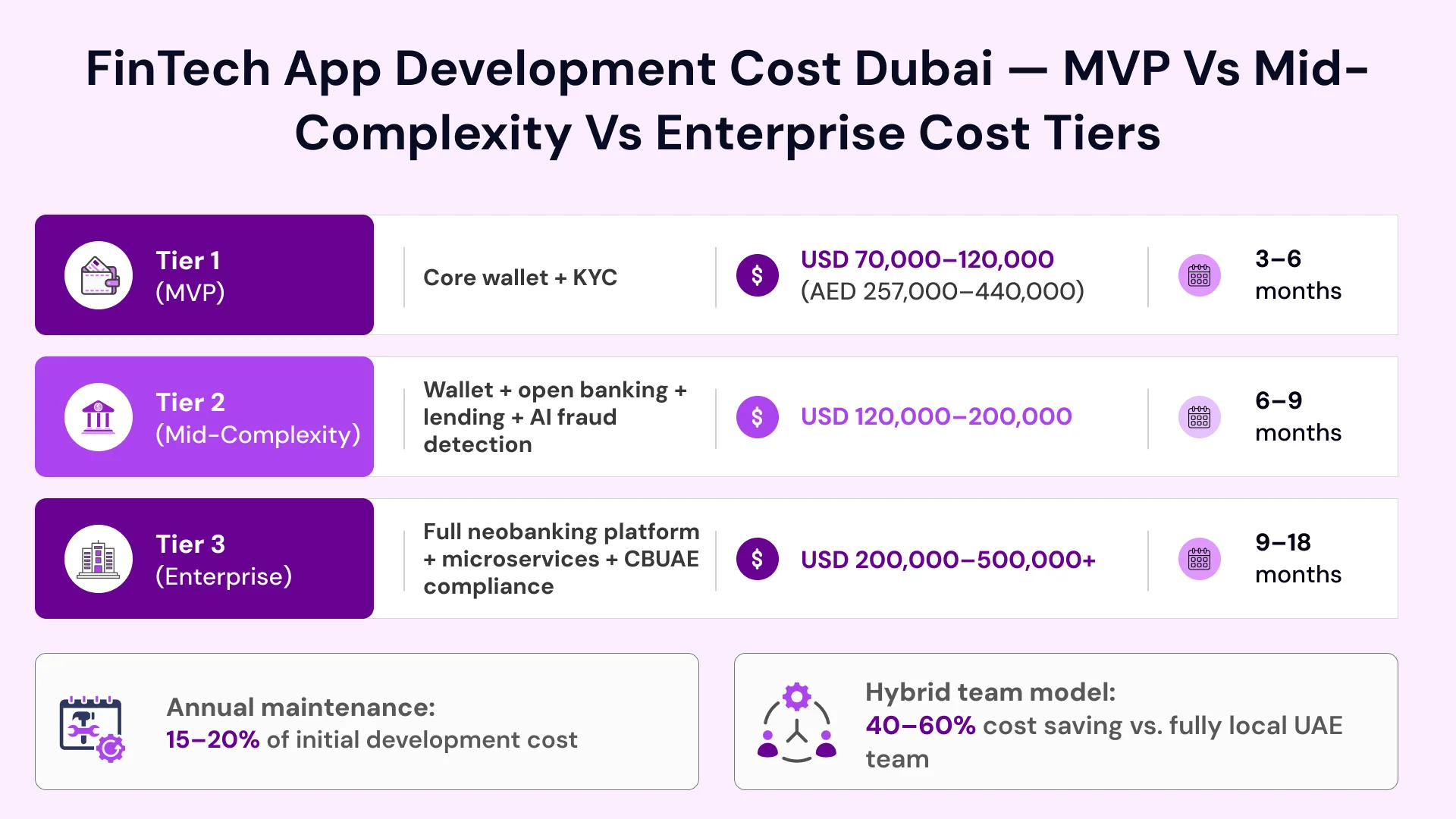
FinTech App Development Cost in Dubai — Tier Overview
| Tier | Description | Estimated Cost (USD) | Estimated Cost (AED) | Timeline |
| MVP / Proof of Concept | Core wallet or payment feature, KYC onboarding, basic transaction history, single platform | $70,000–$120,000 | AED 257,000–440,000 | 3–6 months |
| Mid-Complexity Platform | Multi-feature wallet, open banking APIs, lending module, AI fraud detection, bilingual UI | $120,000–$200,000 | AED 440,000–734,000 | 6–9 months |
| Enterprise / Full Platform | Neobank or multi-product fintech, microservices architecture, SAMA/CBUAE full compliance, AI/ML risk engine | $200,000–$500,000+ | AED 734,000+ | 9–18 months |
Annual maintenance and support should be budgeted at 15–20% of the initial development cost. For a USD 150,000 platform, that is USD 22,500–30,000 per year, covering security patches, OS compatibility updates, third-party API version management, and regulatory change implementation.
Feature-Level Cost Breakdown: What Each Module Actually Costs
The per-feature cost model below is derived from Dubai market rates and validated against published enterprise fintech development benchmarks. Costs assume a Dubai-managed development team with offshore engineering execution, which is the most common and cost-effective model for UAE-based fintech builds.
FinTech App Development — Feature-Level Cost Breakdown (Dubai Market, 2025)
| Feature / Module | What It Covers | Cost Range (USD) | Cost Range (AED) |
| Discovery and Architecture | Requirements, technical specification, architecture design, compliance mapping | $15,000–$25,000 | AED 55,000–92,000 |
| UI/UX Design | User flows, wireframes, Arabic-English bilingual RTL interface, prototyping, design system | $15,000–$50,000 | AED 55,000–184,000 |
| User Onboarding and KYC | Digital identity verification, UAE Pass / Emirates ID integration, document OCR, liveness detection, AML screening | $20,000–$45,000 | AED 73,000–165,000 |
| Payment Gateway Integration | Checkout.com, Telr, Network International, or Stripe; multi-currency, refund flows, PCI DSS tokenisation | $15,000–$35,000 | AED 55,000–128,000 |
| Digital Wallet Core | Account creation, balance management, P2P transfers, QR payments, transaction history, push notifications | $25,000–$60,000 | AED 92,000–220,000 |
| Biometric Authentication | Face ID, fingerprint, device binding, liveness check, fallback PIN/OTP | $20,000–$30,000 | AED 73,000–110,000 |
| AI Fraud Detection | ML-based transaction scoring, behavioural analytics, rule engine, real-time alert system | $30,000–$80,000 | AED 110,000–294,000 |
| Open Banking / API Connectivity | CBUAE Open Finance API, bank account aggregation, account information services, payment initiation | $25,000–$50,000 | AED 92,000–184,000 |
| Lending and Credit Module | Loan origination, credit scoring (bureau + alternative data), repayment scheduling, collections flow | $40,000–$90,000 | AED 147,000–330,000 |
| Admin and Compliance Dashboard | Back-office portal, transaction monitoring, regulatory reporting, case management, audit trail | $20,000–$45,000 | AED 73,000–165,000 |
| Security and Compliance Infrastructure | End-to-end encryption, certificate pinning, jailbreak detection, penetration testing, PDPL data handling | $25,000–$60,000 | AED 92,000–220,000 |
| Cloud Infrastructure and DevOps | AWS / Azure / GCP KSA-compliant hosting, CI/CD pipelines, auto-scaling, monitoring, DR setup | $15,000–$35,000 | AED 55,000–128,000 |
KYC integration cost for a fintech app in Dubai is one of the most underestimated line items in initial budget submissions. UAE Pass biometric verification, Emirates ID API integration, and third-party liveness detection SDKs (Onfido, Sumsub, iProov) each carry separate licensing costs on top of development time. Budget USD 20,000–45,000 for a production-grade KYC module that satisfies CBUAE onboarding standards.

For payment gateway integration in a Dubai fintech app, the choice of provider directly affects both development cost and long-term transaction economics. Checkout.com and Network International carry the deepest UAE banking relationships and UAE-specific payment scheme support. Stripe is available in the UAE but with a narrower acquiring network for local currency settlement. Plan USD 15,000–35,000 for initial integration and USD 5,000–10,000 per additional gateway.
Dubai’s Regulatory Requirements and Their Direct Impact on Budget
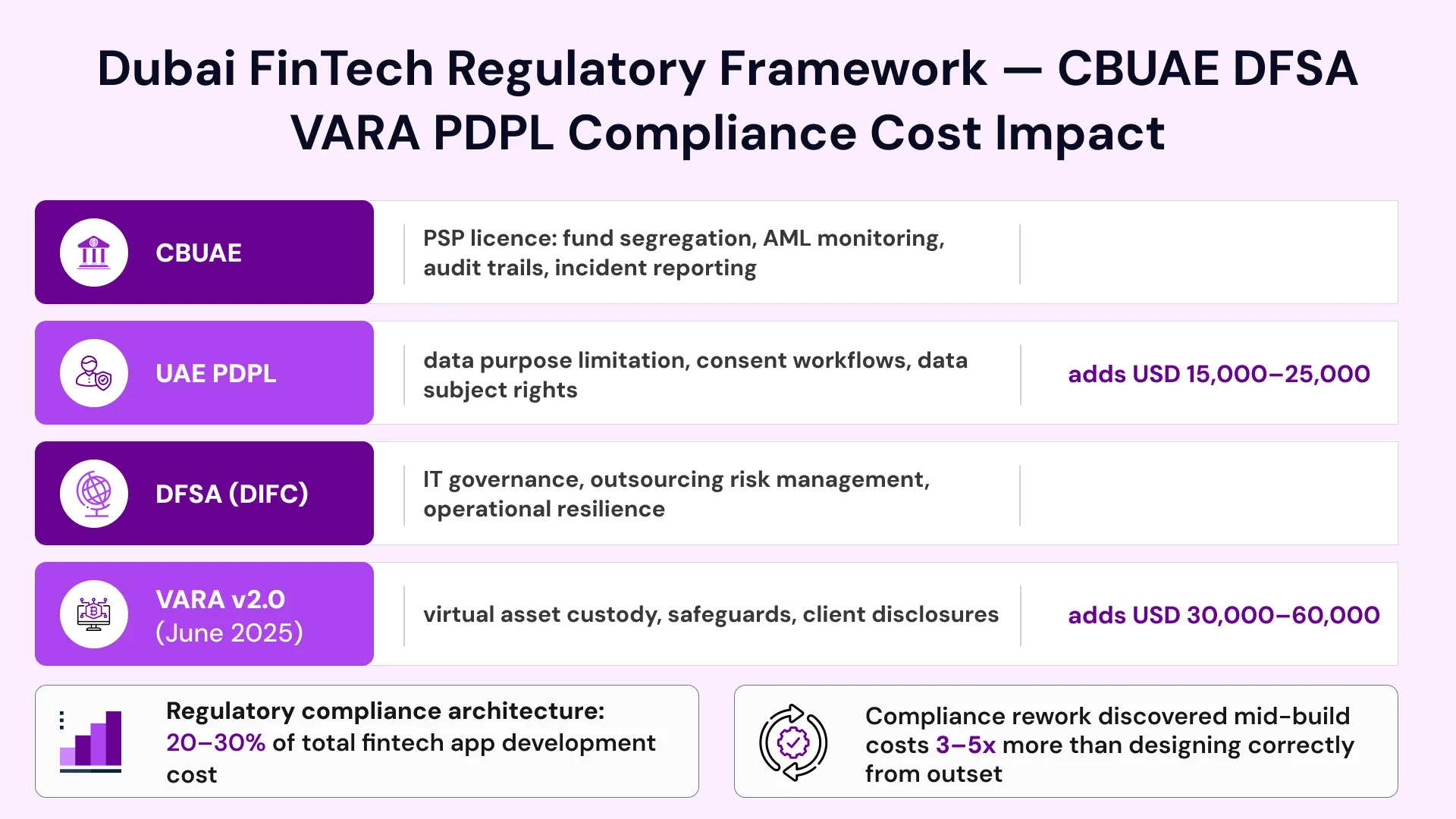
The regulatory framework governing fintech applications in Dubai operates across multiple bodies. A CTO building a payment app must satisfy CBUAE licensing conditions, UAE PDPL data handling requirements, and potentially DFSA rules if the entity operates from DIFC. Getting compliance architecture wrong at the design stage is the most expensive mistake in fintech development — rearchitecting a live system post-audit costs three to five times more than building correctly from the outset.
CBUAE Payment Service Provider Licence
Stored value facilities and payment service providers require CBUAE licensing. The technical architecture of the app must demonstrate segregation of customer funds, transaction audit trails, AML monitoring, and incident reporting capabilities. These requirements translate to specific backend modules that must be in scope from day one.
UAE PDPL Data Handling
The UAE Personal Data Protection Law requires that data collection is purpose-limited, consent-managed, and subject to data subject rights workflows. For fintech applications collecting biometric data, financial transaction history, and identity documents, PDPL compliance requires specific data classification, storage architecture, and deletion workflow engineering. Budget an additional USD 15,000–25,000 for PDPL-specific development if not addressed at architecture design stage.
DFSA and DIFC Requirements
Fintech entities operating from DIFC are subject to DFSA supervision, which includes IT governance requirements, outsourcing risk management, and operational resilience standards. DFSA-regulated applications require independent IT audit capabilities and evidence of business continuity architecture. These obligations add to both development and ongoing infrastructure cost.
VARA Virtual Asset Regulations
Applications handling virtual assets in Dubai are subject to VARA’s Activity-Based Rulebooks (Version 2.0, June 2025). Crypto wallet and exchange functionality requires specific custody, market safeguard, and client disclosure capabilities to be embedded in the application. VARA-compliant virtual asset feature development adds USD 30,000–60,000 to standard fintech app budgets.
Developer Rates and Team Models in Dubai
Developer hourly rates in the UAE range from USD 60 to USD 100 per hour for Dubai-based teams, depending on seniority and specialisation (Sapphire Solutions, 2026). A senior fintech engineer or security architect commands the upper end of this range. Offshore development teams in Eastern Europe or South Asia typically charge USD 20–40 per hour for equivalent skill sets.
Developer Hourly Rates by Team Model — Dubai FinTech Projects
| Team Model | Hourly Rate (USD) | Best For | Risk Considerations |
| Dubai-based agency (full-service) | $80–$120 | Regulatory-sensitive projects; local compliance expertise | Higher cost; may subcontract offshore |
| Dubai product lead + offshore engineers | $60–$100 (lead); $20–$40 (offshore) | Cost-efficiency with UAE regulatory oversight | Coordination overhead; timezone management |
| Dedicated offshore team | $20–$40 | Feature development for non-regulated modules | IP protection; quality assurance complexity |
| Staff augmentation via UAE-based partner | $70–$90 per developer | Scaling an existing in-house team | Onboarding time; knowledge transfer requirements |
The hybrid model — a Dubai-based CTO or technical product lead with an offshore engineering team — delivers 40–60% cost savings compared to a fully local build, without compromising on regulatory knowledge or architectural quality. This model is the standard for funded UAE fintech startups and mid-market enterprises managing development budgets above AED 300,000.
Cost Optimisation Strategies for Dubai FinTech CTOs
A structured cost optimisation approach can reduce fintech app development cost by 25–40% without compromising on compliance architecture or product quality.
Start With a Focused MVP
An MVP that proves payment flow, KYC onboarding, and core wallet functionality can be delivered in 3–6 months at USD 70,000–120,000. This allows the product to enter the CBUAE regulatory sandbox, generate real transaction data, and support the next funding round before committing to enterprise-grade feature expansion. The MVP approach reduces initial outlay by 30–50% compared to a full-scope build.
Use Third-Party APIs for Non-Differentiating Features
AI fraud detection, KYC verification, and credit bureau connectivity are available as API-first services. Integrating Stripe Radar for fraud, Sumsub for KYC, or Al Etihad Credit Bureau for credit data costs a fraction of building equivalent capabilities from scratch. Reserve custom development investment for features that encode your competitive advantage. For deeper context on digital wallet architecture and build economics, review the analysis of the cost to build a Digital Wallet app like Payit, which covers UAE-specific wallet feature economics in detail.
Build for Arabic-English Bilingual from Day One
Retrofitting Arabic right-to-left (RTL) UI support into an app designed in English adds 20–30% to design rework cost and delays launch. Dubai’s diverse user base requires Arabic and English support as a baseline. Designing bilingual from the first wireframe eliminates this cost entirely.
Plan Annual Maintenance in the Initial Budget
The most common fintech app budget failure in Dubai is treating the launch cost as the total cost. Annual maintenance averages 15–20% of the initial development investment. A USD 150,000 platform requires USD 22,500–30,000 per year in maintenance. Factor this into the three-year total cost of ownership model presented to the board.
Selecting the right Mobile app development company in dubai with a verified track record in fintech compliance, CBUAE regulatory architecture, and Arabic-English bilingual delivery is the highest-leverage procurement decision in any Dubai fintech build programme.
How VLink Delivers FinTech App Development in Dubai
VLink provides end-to-end fintech app development for Dubai and UAE enterprises, covering digital wallets, payment platforms, lending applications, and neobanking products. Our Dubai practice combines in-market regulatory knowledge of CBUAE, DFSA, VARA, and UAE PDPL with engineering teams specialised in secure mobile application architecture (fintech solutions Dubai).
Our fintech development engagements in Dubai begin with a discovery and compliance mapping phase that produces a feature-level cost model, a regulatory architecture brief, and a phased delivery plan before any engineering sprint begins. This approach eliminates the most common source of budget overrun: compliance rework discovered mid-development.
- Custom fintech app development: full-stack delivery from architecture design to post-launch managed support.
- KYC/AML module development: UAE Pass, Emirates ID, Onfido and Sumsub integration, CBUAE-compliant onboarding flows.
- Payment gateway integration: Checkout.com, Network International, Telr, and Stripe with PCI DSS tokenisation architecture.
- AI fraud detection: ML-based behavioural scoring integrated with real-time transaction monitoring and AML alerting.
- Bilingual UI/UX: Arabic-English RTL design system built for Dubai’s diverse consumer and enterprise user base.
VLink has delivered financial software development for clients across BFSI, payments, and digital lending sectors in the UAE and broader GCC. Our engagement model supports both full product delivery and staff augmentation for enterprises building in-house fintech engineering capability.
To commission a feature-level cost estimate for your Dubai fintech application, engage VLink’s advisory team.

Conclusion
FinTech app development cost in Dubai is not a single number. It is a function of feature scope, regulatory compliance obligations, platform strategy, team model, and post-launch maintenance commitment. A basic digital wallet MVP built by a hybrid team can deliver production-ready capability for USD 70,000–120,000. A full neobanking platform with AI fraud detection, lending origination, and CBUAE Open Finance API connectivity requires USD 200,000–500,000+ and 9–18 months of structured delivery.
The feature-level cost model in this guide gives Dubai CTOs and VP Engineering leads the analytical structure to build a board-defensible budget, sequence the build for maximum early return, and avoid the regulatory rework costs that eliminate margin on poorly scoped fintech projects.
To commission a detailed feature-level cost estimate and regulatory architecture review for your Dubai fintech application, contact VLink’s Dubai advisory team at vlinkinfo.com/about-us/contact-us.

Global Delivery Manager, VLink Inc.
Shivisha Patel serves as the Global Delivery Manager at VLink Inc., bringing a wealth of experience in program delivery and management, particularly in the insurance and banking sectors. She has a robust technical background with deep expertise in WebSphere MQ, WTX, IIB, middleware, and enterprise system integration.

 Shivisha Patel