

In today's rapidly evolving workplace, employee engagement has become the cornerstone of organizational success. Yet, as companies scale, maintaining meaningful connections with every team member becomes increasingly challenging.
This shift represents what McKinsey calls "superagency"—empowering employees with AI tools that amplify their capabilities rather than replace them. The traditional approaches to employee engagement—quarterly surveys, annual reviews, and periodic check-ins—simply can't keep pace with the dynamic needs of modern workforces.
Enter the Employee Engagement AI Chatbot: an intelligent, always-available solution that transforms how organizations connect with, support, and empower their people at scale. These sophisticated conversational interfaces are revolutionizing HR operations, turning fragmented engagement initiatives into seamless, personalized experiences that adapt to each employee's unique journey.
For HR leaders, talent management executives, and organizational development professionals, the question is no longer whether to adopt AI chatbots for employee engagement, but how to implement them strategically to create measurable impact.
This comprehensive guide walks you through everything you need to know about leveraging AI chatbots to build a thriving workplace culture, from foundational concepts to advanced implementation strategies that drive real business results.
Understanding Employee Engagement AI Chatbots: Beyond Basic Automation
An employee engagement AI chatbot is far more than a simple question-and-answer tool. It's an intelligent conversational agent powered by advanced natural language processing (NLP), machine learning, and increasingly, generative AI capabilities that enable it to understand context, learn from interactions, and provide increasingly sophisticated support to employees across their entire lifecycle with your organization.
These chatbots serve as virtual HR assistants, employee advocates, and engagement facilitators, all rolled into a single accessible interface. They operate 24/7 across multiple channels—Slack, Microsoft Teams, company intranets, mobile apps, and even SMS—meeting employees where they already work and communicate. Unlike traditional HR portals that require navigation through complex menus and documentation, AI-powered employee engagement platforms deliver instant, conversational responses that feel natural and intuitive.
The sophistication of modern HR chatbot solutions lies in their ability to handle increasingly complex scenarios. Early iterations focused primarily on answering frequently asked questions about benefits, policies, and procedures. Today's advanced systems can conduct pulse surveys, facilitate onboarding processes, recommend learning resources, identify burnout indicators, connect employees with relevant colleagues, and even provide coaching insights—all while learning from each interaction to improve future responses.
What distinguishes truly effective conversational AI for employee engagement from basic chatbots is their contextual intelligence. These systems understand not just what an employee is asking, but the underlying intent, emotional tone, and broader context of their situation.
Through specialized AI Development Services, chatbots do more than just link to parental leave policies. Instead of providing dry documentation, an advanced AI recognizes the life event, offers congratulations, and provides a personalized checklist. It goes beyond the query by connecting the employee with internal parent networks and proactively following up, turning a routine HR task into a supportive journey.
The Technology Stack Behind Advanced Engagement Chatbots
Understanding the technical foundation helps HR leaders make informed decisions when evaluating AI chatbot implementation options. Modern employee engagement chatbots typically integrate several key technologies:
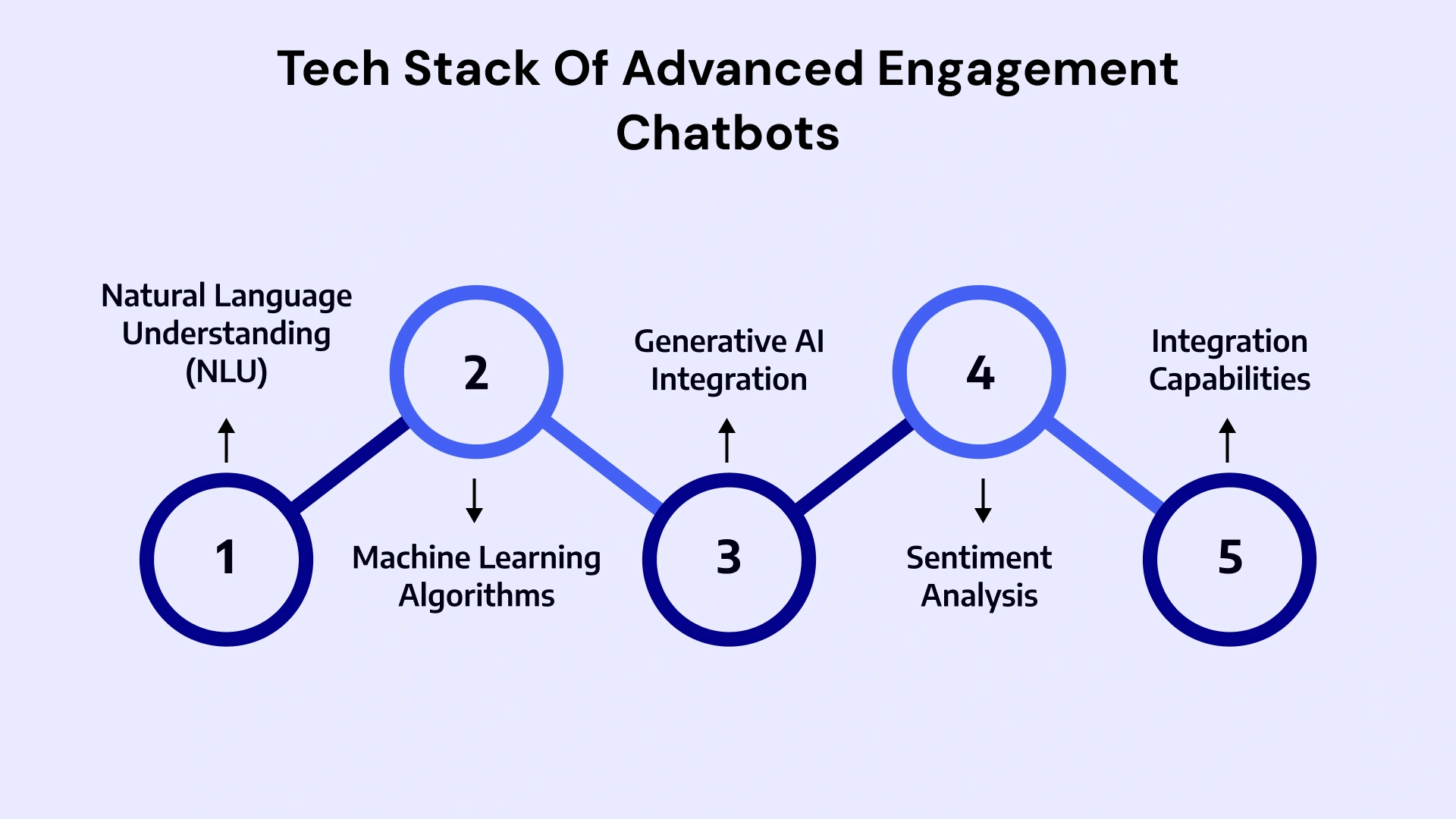
- Natural Language Understanding (NLU) enables the chatbot to comprehend employee queries regardless of how they're phrased, including slang, abbreviations, and industry-specific terminology. This capability ensures that employees receive accurate responses whether they ask "How many PTO days do I have?" or "Can you check my vacation balance?"
- Machine Learning Algorithms allow the chatbot to continuously improve its responses based on interaction patterns, feedback, and outcomes. Over time, the system becomes more accurate at predicting employee needs and proactively providing relevant suggestions.
- Generative AI Integration represents the latest evolution, enabling chatbots to create personalized content, draft communications, summarize lengthy policies into digestible insights, and even generate customized learning paths based on individual career goals and skill gaps.
- Sentiment Analysis helps the chatbot detect emotional undertones in employee communications, allowing it to escalate sensitive issues to human HR professionals when appropriate and adjust its tone to match the employee's emotional state.
- Integration Capabilities connect the chatbot with existing HR systems—HRIS platforms, learning management systems, performance management tools, and communication platforms—creating a unified employee experience that eliminates the need to switch between multiple applications.
The Business Case: Why Employee Engagement AI Chatbots Matter Now
The imperative for workplace engagement automation has never been stronger, driven by converging forces that make traditional engagement approaches increasingly insufficient.
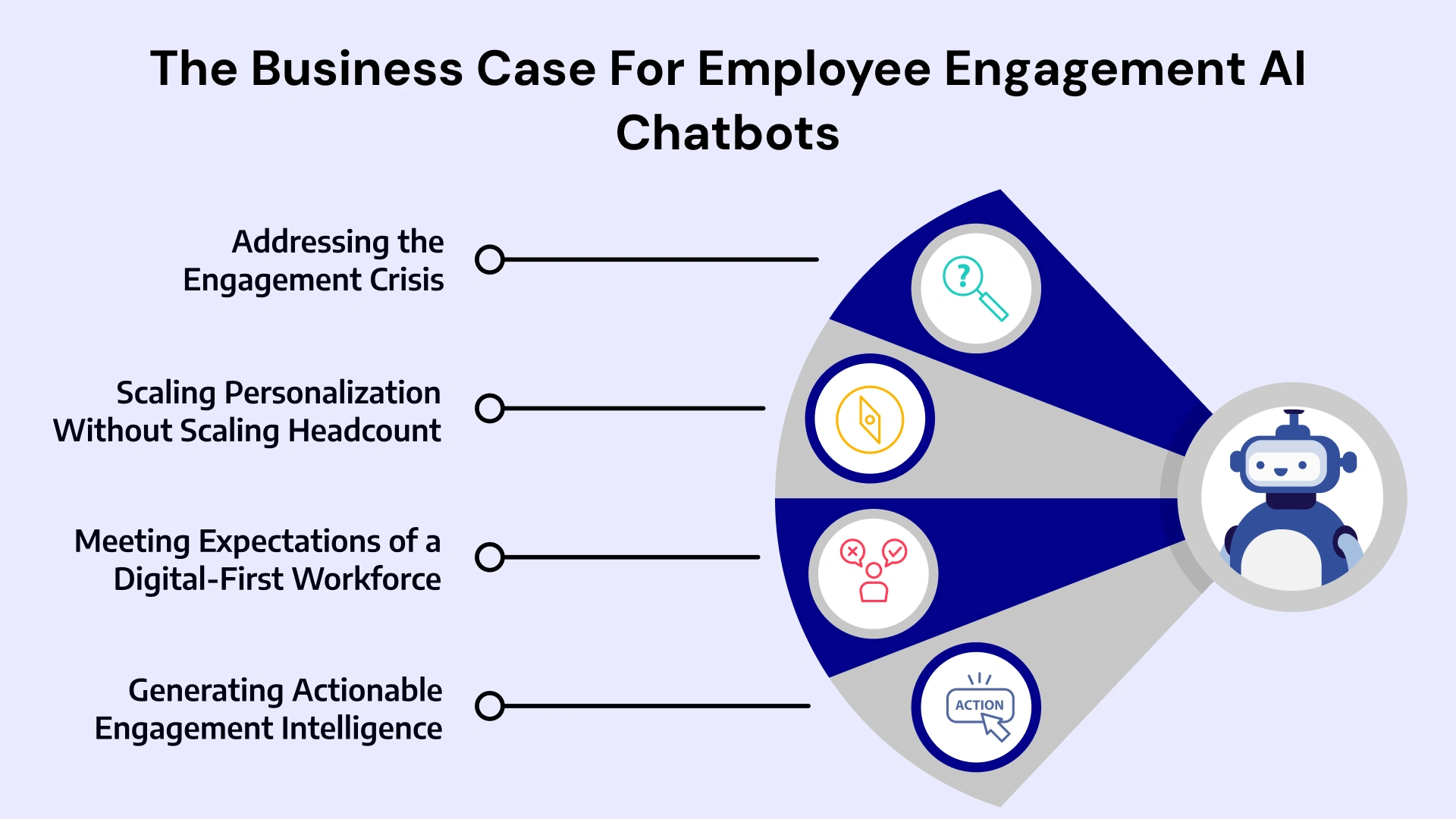
Addressing the Engagement Crisis
Global employee engagement rates remain stubbornly low. Gallup's research consistently shows that only around 32% of employees in the United States report being engaged at work, with even lower numbers globally. This disengagement translates directly into turnover costs, reduced productivity, lower customer satisfaction, and diminished innovation. Organizations lose an estimated $8.8 trillion annually due to low engagement and productivity, according to Gallup's State of the Global Workplace report.
AI-driven employee experience solutions address this crisis by removing friction from everyday work interactions. When employees can instantly resolve questions, access resources, and receive personalized support without navigating bureaucratic processes, their satisfaction and engagement naturally increase. The immediate gratification of having questions answered in seconds rather than days creates positive reinforcement that builds trust in organizational systems.
Scaling Personalization Without Scaling Headcount
As organizations grow, maintaining personalized employee experiences becomes exponentially more challenging. A ten-person HR team might provide exceptional individual attention to 500 employees, but when supporting 5,000 employees, it inevitably experiences significant dilution of service quality. Employee engagement chatbot solutions solve this scaling challenge by providing personalized interactions to unlimited employees simultaneously, without requiring proportional increases in HR staff.
This scalability doesn't mean depersonalization. Modern chatbots leverage employee data—preferences, history, role, location, career stage—to customize every interaction. The chatbot remembers previous conversations, understands context from connected systems, and delivers recommendations tailored to each individual's unique situation. It's mass personalization at a scale human teams simply cannot achieve.
Meeting Expectations of a Digital-First Workforce
Today's employees, particularly younger generations, expect consumer-grade digital experiences in their workplace tools. They're accustomed to asking Alexa or Siri for information, getting instant customer service through chatbots, and receiving personalized recommendations from Netflix and Spotify. When workplace systems feel clunky, bureaucratic, or time-consuming by comparison, it creates friction that diminishes engagement.
Intelligent employee assistance through AI chatbots aligns workplace experiences with the seamless, conversational interfaces employees use in their personal lives. This familiarity reduces friction, shortens learning curves, and increases adoption rates dramatically compared to traditional enterprise software.
Generating Actionable Engagement Intelligence
Beyond solving immediate employee needs, AI employee engagement tools generate unprecedented volumes of valuable data. Every interaction provides insights into what employees are struggling with, what information they're seeking, which policies create confusion, and where organizational processes create friction.
This aggregated intelligence enables HR leaders to identify systemic issues, prioritize initiatives based on actual employee needs rather than assumptions, measure engagement trends in real-time rather than quarterly, and predict potential problems before they escalate. The chatbot serves as a continuous pulse survey, capturing authentic employee concerns expressed naturally rather than through structured questionnaire responses that may be biased or incomplete.
Key Features of High-Performance Employee Engagement AI Chatbots
Not all HR chatbot platforms deliver equal value. Understanding the essential capabilities separates solutions that drive meaningful engagement improvements from those that simply automate basic Q&A.
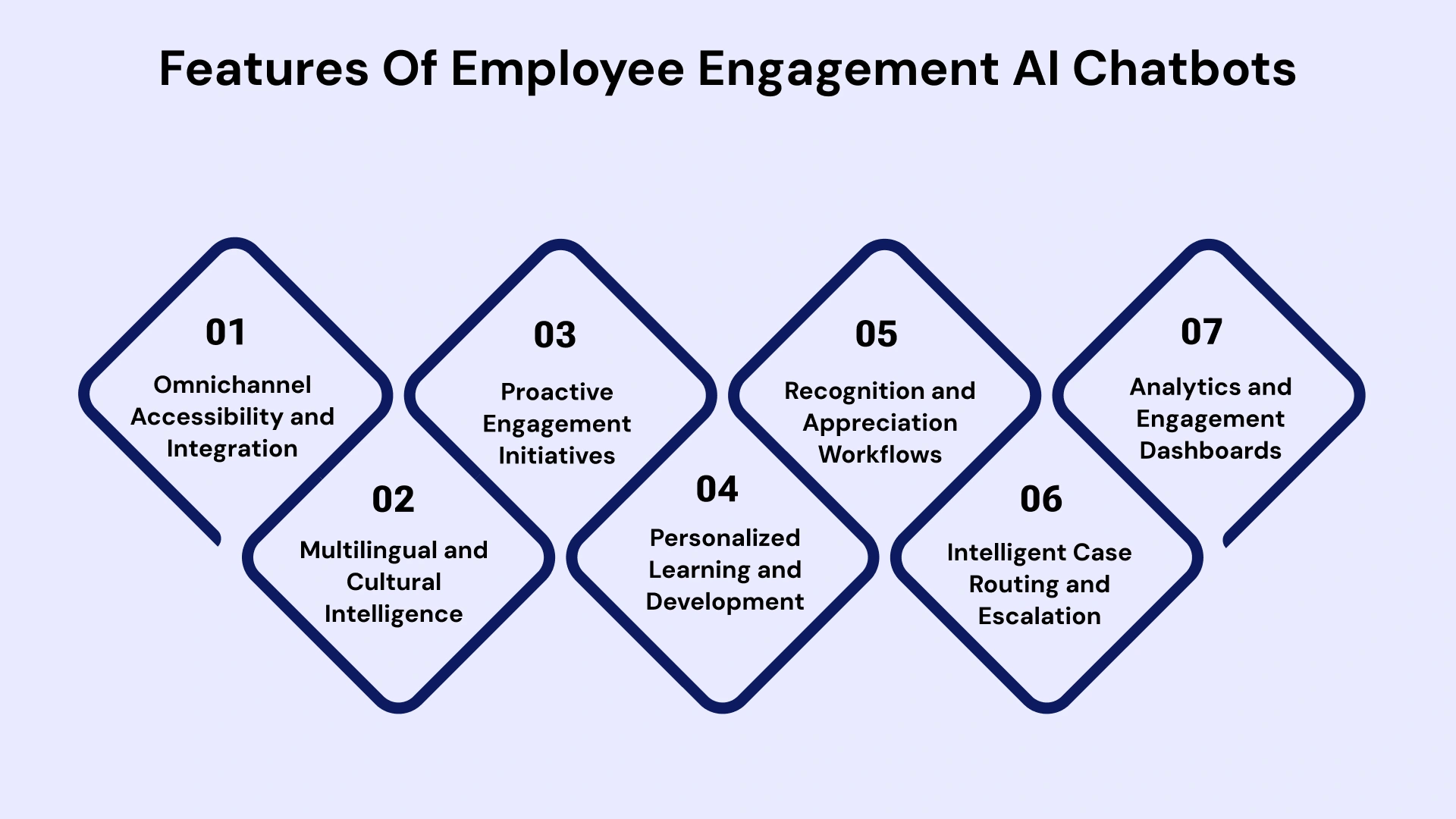
Omnichannel Accessibility and Integration
Effective employee engagement automation requires meeting employees where they already work. The best chatbots integrate seamlessly with communication tools employees use daily—Slack, Microsoft Teams, Google Chat, WhatsApp, email, and dedicated mobile apps. This omnichannel presence ensures employees can access support without context-switching to separate applications.
Beyond communication channels, deep integration with core HR systems creates a unified experience. The chatbot should connect with your HRIS for employee data, your learning management system for training recommendations, your performance management platform for goal tracking, your benefits administration system for enrollment support, and your scheduling tools for time-off management. These integrations transform the chatbot from an information source into an action hub where employees can complete transactions conversationally.
Multilingual and Cultural Intelligence
Global organizations require AI-powered workplace engagement solutions that transcend language barriers. Advanced chatbots support dozens of languages, automatically detecting an employee's preferred language and responding accordingly.
But accurate cultural intelligence goes beyond translation—it includes understanding regional workplace norms, compliance requirements, holidays, benefits structures, and communication styles that vary across geographies.
This capability ensures consistent engagement experiences across distributed workforces while respecting local context and requirements.
Proactive Engagement Initiatives
The most impactful employee engagement AI solutions don't wait for employees to ask questions—they proactively initiate valuable interactions. This includes sending personalized onboarding checklists to new hires, reminding employees of upcoming benefits enrollment deadlines, checking in with team members who haven't taken a vacation recently, sharing relevant learning opportunities aligned with career goals, recognizing work anniversaries and achievements, and conducting pulse surveys at optimal times based on individual engagement patterns.
This proactive approach transforms the chatbot from a reactive support tool into an active engagement partner that nurtures continuous connection between employees and the organization.
Personalized Learning and Development
AI for employee engagement excels at democratizing access to growth opportunities. The chatbot can assess skill gaps through conversational interactions, recommend relevant training content from your learning library, create personalized development plans aligned with career aspirations, track progress toward learning goals, and connect employees with mentors or colleagues who have expertise in areas they're developing.
This personalized learning guidance helps employees feel invested in and supported in their career growth—a critical driver of long-term engagement and retention.
Recognition and Appreciation Workflows
Regular recognition significantly impacts engagement, yet many organizations struggle to build consistent appreciation cultures. Chatbot-driven employee engagement can facilitate peer-to-peer recognition by prompting employees to acknowledge colleagues, collecting and amplifying recognition moments across the organization, and tracking recognition patterns to identify unsung contributors who deserve to see their achievements preserved inside clear acrylic on a corporate trophy wall.
Some advanced systems even gamify recognition, creating engagement loops that encourage more frequent appreciation exchanges while providing visibility into recognition data that helps leaders identify engagement strengths and gaps across teams.
Intelligent Case Routing and Escalation
While chatbots handle many queries autonomously, they must also recognize when human intervention is needed. Sophisticated conversational AI in HR includes intelligent routing that escalates complex, sensitive, or emotionally charged issues to appropriate human HR professionals, provides complete conversation context to the human representative taking over, and seamlessly transitions back to automated support once the sensitive issue is resolved.
This hybrid approach combines the efficiency and scalability of automation with the empathy and judgment of human professionals when it matters most.
Analytics and Engagement Dashboards
The data generated by AI employee engagement platforms only creates value when translated into actionable insights. Comprehensive analytics capabilities should include real-time engagement metrics, trending employee questions and concerns, policy and process confusion points, department-specific engagement patterns, sentiment analysis trends, chatbot accuracy and satisfaction ratings, and predictive indicators of turnover risk or declining engagement.
These insights empower HR leaders to shift from reactive problem-solving to a proactive engagement strategy based on concrete evidence rather than assumptions.
Strategic Implementation: Building Your Employee Engagement AI Chatbot Roadmap
Successfully deploying AI chatbots for HR requires thoughtful planning, stakeholder alignment, and phased implementation that builds momentum and proves value incrementally.
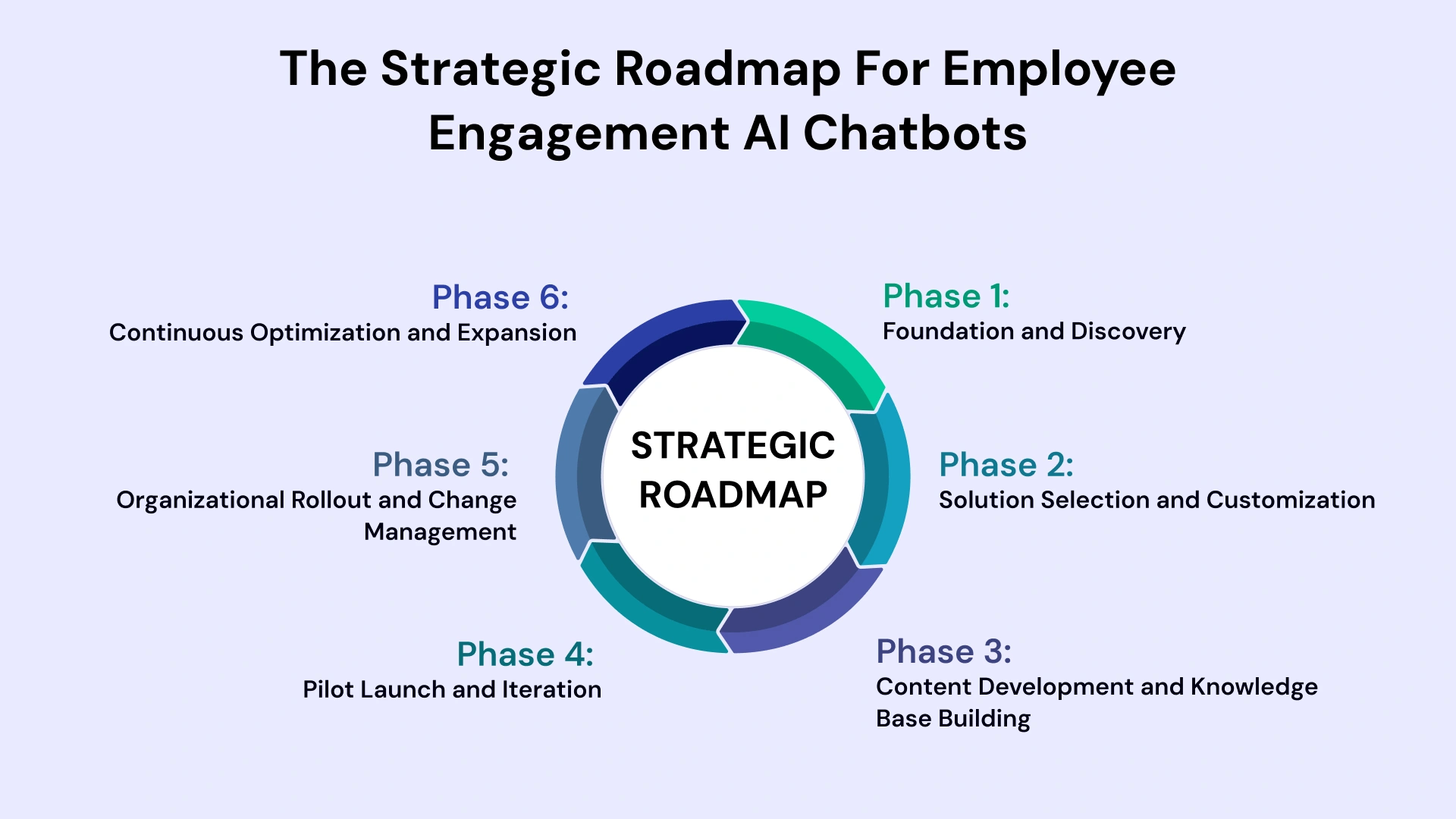
Phase 1: Foundation and Discovery
Begin by establishing clear objectives for your employee engagement technology initiative. Are you primarily focused on reducing HR service delivery costs, improving employee satisfaction scores, decreasing time-to-resolution for employee questions, increasing benefits utilization, reducing turnover in specific departments, or enabling HR teams to focus on strategic work rather than transactional queries?
Clear objectives guide solution selection and provide measurable success criteria.
Conduct a comprehensive audit of your current employee engagement landscape. Map all existing touchpoints where employees interact with HR, document common questions and pain points, identify integration requirements with current systems, assess your organization's technical infrastructure and capabilities, and evaluate employee digital literacy and technology adoption patterns.
This discovery phase also includes building your cross-functional implementation team. Successful AI chatbot deployment requires collaboration between HR leaders who understand engagement needs, IT professionals who manage integrations and security, legal and compliance teams who ensure regulatory adherence, communications specialists who drive adoption, and frontline managers who will champion the technology with their teams.
Phase 2: Solution Selection and Customization
The employee engagement chatbot market offers numerous solutions with varying capabilities, pricing models, and implementation approaches. Evaluate options based on integration capabilities with your existing technology stack, AI sophistication and natural language processing quality, multilingual support for your employee population, customization flexibility to reflect your culture and brand, vendor implementation support and ongoing partnership approach, security and compliance certifications, and total cost of ownership, including licensing, implementation, and maintenance.
Request proof-of-concept demonstrations using your actual employee questions and scenarios. This real-world testing reveals how well each solution handles your organization's specific terminology, policies, and use cases.
Once selected, invest in thorough customization that reflects your organizational voice, values, and culture. Generic corporate-speak diminishes engagement, while conversational tones that match your culture increase adoption and satisfaction. Develop your chatbot's personality, conversation flows, and responses in collaboration with employees who will use it, ensuring the experience feels authentic rather than sterile.
Phase 3: Content Development and Knowledge Base Building
The intelligence of your AI-powered HR chatbot depends on the quality and comprehensiveness of its knowledge base. Systematically catalog all employee policies, procedures, benefits information, frequently asked questions, organizational structure details, learning resources, and common workplace scenarios.
Structure this content for conversational delivery rather than simply uploading existing policy documents. Break lengthy policies into digestible segments, create multiple variations of questions for each topic, develop decision trees for complex scenarios that require clarifying questions, and incorporate examples and scenarios that illustrate abstract policies.
This content development phase also includes defining escalation triggers—the situations where the chatbot should involve human HR professionals—and creating templates for these handoffs that preserve conversation context.
Phase 4: Pilot Launch and Iteration
Rather than an organization-wide deployment, launch your employee engagement AI solution with a pilot group that represents diverse employee segments. This contained rollout allows you to identify issues, gather feedback, refine conversation flows, and build success stories before broader implementation.
Actively monitor pilot interactions, analyzing common questions the chatbot handles successfully, queries where it struggles or provides inaccurate information, user satisfaction ratings and feedback, completion rates for multi-step processes, and escalation frequency and reasons.
Use this data to continuously refine the chatbot during the pilot period. The most successful implementations treat the initial launch as a learning phase rather than a final product, iterating rapidly based on real employee experiences.
Phase 5: Organizational Rollout and Change Management
Scaling beyond the pilot requires comprehensive change management and communication. Employees won't naturally adopt new tools without understanding their value and receiving a proper introduction.
Develop a multi-channel launch campaign that explains what the chatbot does and why it matters, demonstrates everyday use cases relevant to different employee segments, addresses privacy and security concerns transparently, provides easy-to-access training resources, and creates buzz and excitement around the new capability.
Equip managers to champion the technology within their teams. Provide talking points, demonstration guides, and incentives for early adoption. Consider gamification elements—challenges, recognition, or small rewards—to encourage initial usage and habit formation.
Phase 6: Continuous Optimization and Expansion
Implementing AI chatbots in HR isn't a one-time project but an ongoing capability that should evolve with your organization's needs. Establish regular review cadences where you analyze chatbot performance data, gather employee feedback through surveys and focus groups, identify new use cases and capabilities to add, and update content to reflect policy changes and new programs.
As employees become comfortable with basic chatbot capabilities, progressively introduce more advanced features. This phased feature rollout prevents overwhelming users while continuously demonstrating increasing value, sustaining long-term engagement with the tool.
Measuring Success: KPIs for Employee Engagement AI Chatbots
Demonstrating ROI from AI employee engagement initiatives requires tracking both operational efficiency metrics and strategic engagement outcomes.
Operational Efficiency Metrics
These quantitative measures demonstrate the chatbot's impact on HR service delivery and employee productivity. Track the volume of queries handled autonomously without human escalation, average response time compared to previous support channels, HR team time saved through automation, cost per employee interaction compared to traditional support methods, and chatbot accuracy rates and resolution effectiveness.
For example, organizations typically see 60-80% of routine HR queries handled entirely by the chatbot, reducing average response time from hours or days to seconds, and freeing hundreds of HR hours monthly that can be redirected to strategic initiatives.
Employee Experience Metrics
These indicators reveal whether the chatbot is actually improving employees' experience of workplace support. Monitor employee satisfaction scores with chatbot interactions, adoption rates across employee segments, repeat usage patterns indicating sustained value, employee effort scores measuring how easy it is to get support, and net promoter scores asking whether employees would recommend the chatbot to colleagues.
Leading implementations achieve 85%+ employee satisfaction with chatbot interactions and see adoption rates exceeding 70% of the employee population within six months of launch.
Engagement Outcome Metrics
Ultimately, employee engagement AI chatbots should demonstrably improve overall workplace engagement. Connect chatbot implementation to improvements in overall engagement survey scores, reductions in voluntary turnover rates, increases in employee participation in development programs, higher benefits utilization reflecting better understanding, improved onboarding satisfaction and time-to-productivity, and positive shifts in sentiment analysis from employee communications.
While attributing engagement improvements solely to the chatbot requires careful analysis, organizations that implement comprehensive AI-driven engagement solutions typically see measurable improvements across these indicators within 12-18 months of deployment.
Business Impact Metrics
Connect engagement improvements to business outcomes that resonate with executive stakeholders. This includes productivity improvements as engaged employees accomplish more, customer satisfaction gains driven by more engaged customer-facing teams, innovation metrics showing increased idea submissions and implementation, quality improvements reflecting greater attention and care, and talent acquisition advantages as the employer brand strengthens.
These business-level metrics demonstrate that investing in AI for employee engagement delivers returns far beyond HR efficiency, impacting fundamental organizational performance.
Overcoming Common Implementation Challenges
Even well-planned employee engagement chatbot implementations encounter obstacles. Anticipating these challenges and developing mitigation strategies increases the likelihood of success.
Employee Skepticism and Resistance
Some employees resist chatbot adoption due to concerns about impersonal automation, privacy and data usage, job security if AI replaces human HR roles, or past negative experiences with clunky workplace technology.
Address these concerns through transparent communication about how employee data is used and protected, emphasis on the chatbot augmenting rather than replacing human HR professionals, demonstrations showing how the chatbot actually makes work easier, and quick wins that prove value to skeptical employees early in the rollout.
Consider featuring testimonials from pilot participants who were initially skeptical but became advocates, as peer voices often convince more effectively than corporate messaging.
Integration Complexity
Connecting your AI chatbot for employee engagement with existing systems can present technical challenges, especially in organizations with legacy HR technology or multiple disconnected platforms.
Mitigate integration risks by prioritizing connections based on employee value and usage frequency, starting with foundational integrations (e.g., an HRIS for basic employee data) before adding more sophisticated connections, working with vendors that have pre-built integrations with your specific systems, and allocating adequate time and resources for integration testing and troubleshooting.
Some organizations implement the chatbot with limited initial integrations, demonstrating value through enhanced information access before tackling more complex transactional integrations.
Content Maintenance and Accuracy
As policies change, benefits evolve, and programs launch, your chatbot's knowledge base needs continuous updates to remain accurate. Stale or incorrect information quickly erodes trust and adoption.
Establish transparent content governance processes that identify content owners across different knowledge domains, create workflows that trigger chatbot updates when policies change, implement regular content audits to identify outdated information, and monitor accuracy through testing and employee feedback.
Some organizations assign HR business partners or subject matter experts specific responsibility for maintaining chatbot content within their domains, ensuring expertise behind updates.
Balancing Automation with Human Touch
While employee engagement automation increases efficiency, over-automation can leave employees feeling undervalued or frustrated when they need human empathy and judgment.
Design escalation protocols that err on the side of human connection for ambiguous situations, empower the chatbot to recognize emotional distress and route appropriately, and maintain clear pathways for employees to request human assistance at any point. The goal is augmentation, not replacement of human HR relationships.
The Future of Employee Engagement AI: Emerging Trends and Capabilities
The AI chatbot technology landscape evolves rapidly, with emerging capabilities that will further transform employee engagement approaches.
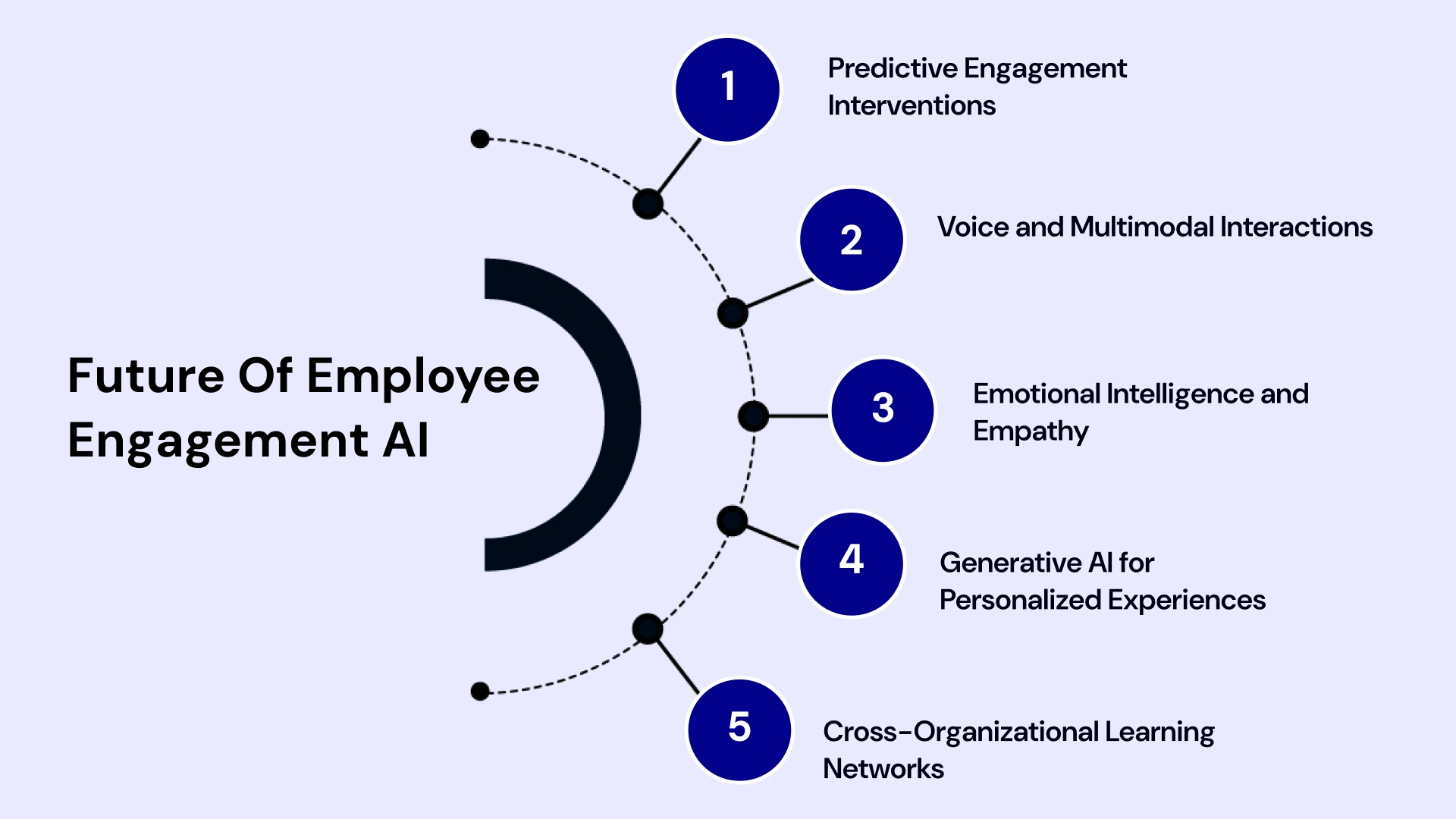
Predictive Engagement Interventions
Future AI employee engagement platforms will move beyond reactive support to predictive engagement management. By analyzing patterns in chatbot interactions, communication frequency, system usage, and external signals, AI will identify employees at risk of disengagement or turnover before traditional indicators appear, enabling proactive interventions that prevent problems rather than responding to crises.
These predictive capabilities will allow HR teams to focus their limited attention on employees who need it most, personalized to each individual's situation and preferences.
Voice and Multimodal Interactions
While text-based chatbots dominate current implementations, voice interfaces and multimodal experiences combining text, voice, video, and visual elements will create even more natural engagement experiences. Employees will interact with conversational AI the same way they use virtual assistants, through natural speech in their language of choice.
This evolution particularly benefits frontline workers without constant computer access, deskless employees who work in manufacturing, retail, healthcare, or field services, and situations where hands-free interaction improves safety and efficiency.
Emotional Intelligence and Empathy
Advanced sentiment analysis and emotional AI capabilities will enable chatbots to detect subtle emotional cues and respond with appropriate empathy. When an employee expresses frustration, confusion, or distress, the AI will recognize these emotions and adjust its tone, escalate to human support, or provide additional reassurance and clarity.
This emotional intelligence transforms chatbots from transactional tools into genuine engagement partners that employees feel understand and support them.
Generative AI for Personalized Experiences
Large language models and Gen AI enable chatbots to create truly personalized content rather than selecting from predetermined responses. This includes drafting customized development plans based on career conversations, generating personalized policy summaries highlighting aspects most relevant to each employee's situation, creating customized learning content addressing specific knowledge gaps, and composing thoughtful responses to nuanced employee questions that don't fit standard scripts.
This generative capability makes interactions feel genuinely conversational rather than scripted, significantly enhancing the employee experience.
Cross-Organizational Learning Networks
As more organizations implement AI employee engagement solutions, vendor platforms will continuously leverage anonymized aggregate data to improve chatbot intelligence across their client base. Insights from thousands of employee interactions will refine natural language understanding, identify emerging employee concerns and trends, and share best practices across organizations.
This network effect means chatbot intelligence compounds over time, with each deployment benefiting from learnings across the entire ecosystem.
Next-Gen Employee Engagement AI Chatbot Solutions by VLink
At VLink, we understand that transforming employee engagement requires more than just implementing technology—it demands a strategic partner who combines deep HR expertise with cutting-edge AI capabilities. Our employee engagement AI chatbot solutions are purpose-built for modern organizations that refuse to compromise between scalability and personalization.
We don't simply deploy off-the-shelf chatbots; we architect custom solutions that reflect your unique culture, integrate seamlessly with your existing technology ecosystem, and evolve continuously to meet your organization's changing needs. Our implementation methodology draws on successful deployments across Fortune 500 companies and fast-growing mid-market organizations, applying proven frameworks while tailoring them to your specific context.
Our AI chatbot development encompasses the entire journey from strategy through deployment and ongoing optimization. We begin with discovery sessions that map your current engagement landscape, identify priority use cases, and define measurable success criteria aligned with your business objectives. Our design team then crafts conversational experiences that feel authentically aligned with your employer brand, while our AI engineers build robust technical foundations that ensure security, scalability, and reliability.
VLink's employee engagement chatbot platform leverages the latest advances in natural language processing, machine learning, and generative AI, while maintaining the flexibility to integrate with your HR technology stack—whether you're using Workday, SAP SuccessFactors, Oracle HCM, BambooHR, or custom systems. Our solutions support omnichannel deployment across Slack, Microsoft Teams, mobile apps, and web portals, so your employees can be reached wherever they work.
Beyond implementation, VLink provides ongoing partnership through our managed services offering. We continuously monitor chatbot performance, optimize conversation flows based on interaction data, update content to reflect policy changes, and introduce new capabilities as your needs evolve. Our dedicated success team acts as an extension of your HR organization, ensuring your AI employee engagement initiative delivers sustained value year after year.
Whether you're exploring AI for employee engagement for the first time or looking to enhance an existing implementation, VLink brings the expertise, technology, and partnership approach that transforms employee experience at scale.
Conclusion
The transformation of employee engagement through AI chatbots goes far beyond a technological upgrade—it's a fundamental reimagining of how organizations connect with, support, and empower their people at scale.
As workforces become increasingly distributed, diverse, and digitally native, the limitations of traditional engagement approaches become ever more apparent. The organizations that thrive in this new landscape will be those that embrace AI-powered employee engagement not as a replacement for human connection, but as an enabler of deeper, more personalized relationships with every team member.
The evidence is compelling: companies that strategically implement employee engagement AI chatbots see measurable improvements in employee satisfaction, reductions in voluntary turnover, increased HR efficiency, and ultimately, better business outcomes driven by more engaged workforces. The technology has matured beyond early experimental phases to become a proven catalyst for engagement transformation across industries and organization sizes.
Yet technology alone doesn't create engagement—thoughtful implementation does. Success requires clear strategic objectives, comprehensive change management, continuous optimization informed by employee feedback, integration with broader talent management strategies, and an unwavering focus on employee experience rather than just operational efficiency.
As you consider your organization's engagement strategy, the question isn't whether AI chatbots will play a role, but how quickly you can leverage them to create a competitive advantage. Early adopters are already reaping the benefits of more responsive, personalized, and scalable engagement approaches. The gap between organizations that embrace these capabilities and those that cling to outdated methods will only widen.
The future of work is conversational, intelligent, and deeply personalized—and it's already here. Employee engagement AI chatbots represent your opportunity to lead this transformation, creating workplace experiences that don't just meet but exceed employee expectations, driving lasting loyalty, performance, and organizational success.
Ready to transform your employee engagement strategy with AI-powered solutions? VLink team is here to help you navigate every step of your journey—from initial assessment through deployment and beyond. Get in touch with our employee engagement AI specialists now.

Vice President, Strategy – VLink Inc.
Sambhavi Gopalakrishnan is the Vice President of Strategy at VLink Inc., bringing over a decade of experience in IT leadership, project implementation, and strategic growth. She possesses a strong foundation in technical project management and pre-sales, driving innovation and business transformation at VLink.

 Shivisha Patel