


In the hyperconnected digital economy, financial services firms face a paradoxical challenge: despite unprecedented volumes of data flowing through their systems, critical business intelligence remains locked away, isolated, and inaccessible. This phenomenon—known as data silos—has become the silent operational crisis undermining competitiveness, regulatory compliance, and customer experience across the financial services sector.
For Chief Technology Officers and C-suite executives navigating today's regulatory complexity and competitive pressure, the imperative is clear: eliminate data silos in financial services operations or risk falling behind more agile, data-driven competitors. The challenge extends beyond mere technical integration—it encompasses organizational culture, legacy system modernization, and strategic alignment across enterprise data architecture.
Microsoft Cloud emerges as a transformative solution for this challenge, offering financial institutions a comprehensive ecosystem that unifies disparate data sources, enables intelligent analytics, and supports regulatory compliance requirements. By leveraging cloud managed services and purpose-built financial services solutions, institutions can break down information barriers and unlock the strategic value hidden within their data landscape.
This comprehensive guide examines how financial services firms can systematically dismantle data silos using Microsoft Cloud technologies, exploring proven strategies, implementation frameworks, and real-world success metrics that demonstrate measurable ROI. Whether you're grappling with legacy system modernization, evaluating cloud migration consulting services, or seeking to optimize your existing cloud infrastructure, this analysis provides the strategic roadmap you need to transform fragmented data into unified, actionable intelligence.
Understanding Data Silos: The Core Challenge in Financial Services
Data silos represent isolated repositories of information that remain disconnected from other systems within an organization. In financial services, these silos typically emerge from departmental boundaries, disparate technology platforms, mergers and acquisitions, or legacy systems that were never designed for interoperability.
The persistence of data silos stems from several interconnected factors. Historical technology decisions created incompatible systems across trading desks, retail banking operations, wealth management divisions, and insurance underwriting departments. Each business unit developed specialized applications optimized for specific workflows, resulting in fragmented data landscapes where customer information, transaction records, risk assessments, and compliance documentation exist in isolation.
Organizational structures reinforce these technical barriers. When departments operate as autonomous units with separate budgets, priorities, and technology roadmaps, information sharing becomes incidental rather than intentional. The absence of enterprise-wide data governance frameworks allows silos to proliferate unchecked, with each team maintaining its own definitions, formats, and storage protocols.
The Quantifiable Impact on Financial Institutions
The consequences of data silos extend far beyond operational inconvenience. Financial services firms experience measurable impacts across multiple dimensions of business performance.
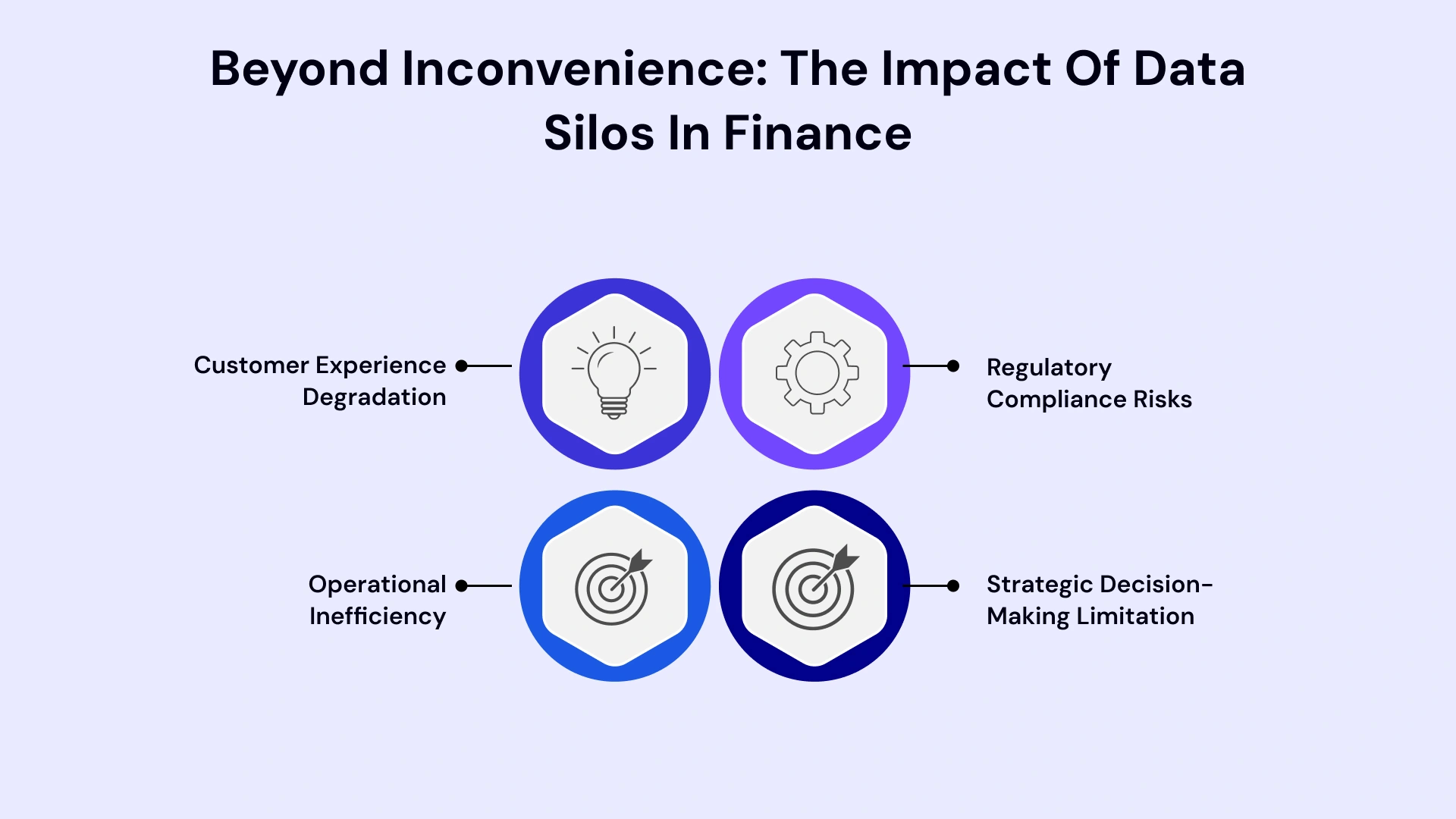
- Customer Experience Degradation: When customer data exists across disconnected systems, relationship managers cannot access comprehensive views of client interactions, account holdings, or service history. McKinsey research indicates that financial institutions with unified customer data platforms achieve 23% higher customer satisfaction scores and 19% improvement in customer retention rates compared to firms with siloed information.
- Regulatory Compliance Risks: Financial regulators demand comprehensive, timely reporting across all business activities. Data silos create compliance vulnerabilities by making it difficult to aggregate information for regulatory submissions, identify suspicious patterns for anti-money laundering requirements, or respond to audit inquiries. A 2023 Deloitte survey found that 67% of compliance officers cited data fragmentation as their primary obstacle to meeting regulatory deadlines.
- Operational Inefficiency: Teams waste valuable time searching for information, reconciling inconsistent data, or recreating analyses that already exist elsewhere in the organization. The cumulative productivity loss represents approximately 21 hours per knowledge worker per week, according to IDG research—time that could be redirected toward strategic initiatives and value-added activities.
- Strategic Decision-Making Limitations: Executives making critical business decisions require comprehensive, accurate data spanning all operational domains. Data silos prevent holistic analysis, forcing leaders to base strategic choices on incomplete information or intuition rather than evidence-based insights.
Industry-Specific Manifestations
Data silos manifest differently across financial services segments, each presenting unique challenges:
- Banking Institutions: Retail banking, commercial lending, wealth management, and investment banking divisions often operate on separate core systems, preventing comprehensive customer relationship management and cross-selling opportunities.
- Insurance Companies: Underwriting systems, claims management platforms, policy administration tools, and customer service applications rarely communicate effectively, hampering risk assessment accuracy and customer service responsiveness.
- Investment Firms: Trading platforms, portfolio management systems, client relationship tools, and regulatory reporting applications exist as disconnected islands, limiting real-time risk visibility and investment performance analysis.
- Fintech Organizations: Despite their digital-native positioning, fintech firms frequently accumulate data silos as they scale rapidly, integrate acquired companies, or adopt best-of-breed point solutions without comprehensive integration strategies.
Microsoft Cloud: A Unified Platform for Financial Data Integration
Microsoft has architected a comprehensive cloud ecosystem specifically designed to address the unique requirements of financial institutions. This platform extends beyond generic cloud infrastructure to deliver purpose-built capabilities for regulatory compliance, data security, and financial services workflows.
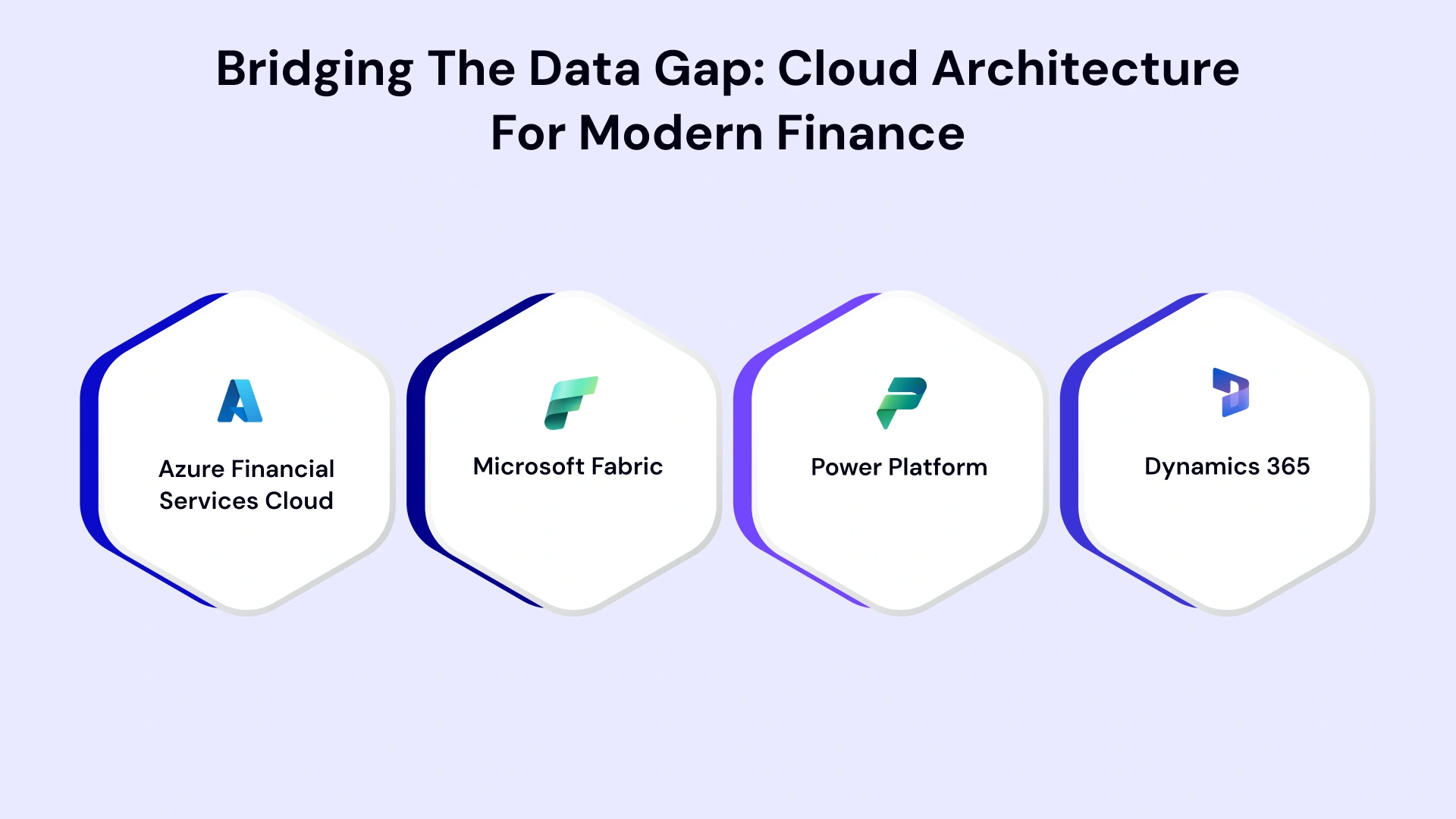
- Azure Financial Services Cloud provides industry-specific building blocks that accelerate digital transformation while maintaining rigorous security and compliance standards. These components include pre-configured solutions for customer engagement, risk management, regulatory reporting, and operational analytics—all designed with native integration capabilities that prevent new silos from forming.
- Microsoft Fabric represents a paradigm shift in enterprise data architecture, offering a unified analytics platform that consolidates data engineering, data science, real-time analytics, and business intelligence into a single, cohesive environment. For financial services firms, Fabric eliminates the traditional boundaries between operational data stores, analytical databases, and reporting systems.
- Power Platform democratizes data access and application development, enabling business users to create custom solutions without extensive coding expertise. This capability is particularly valuable for financial institutions where domain experts possess deep business knowledge but limited technical programming skills.
- Dynamics 365 delivers integrated customer relationship management and enterprise resource planning capabilities that unify customer data, financial operations, and business processes within a single system of record.
Key Integration Capabilities
Microsoft Cloud provides several foundational capabilities that directly address data silo challenges:
- Universal Data Connectivity: Azure Data Factory and Azure Logic Apps enable connections to virtually any data source—whether on-premises legacy systems, cloud-based SaaS applications, partner systems, or external market data feeds. This comprehensive connectivity ensures no data source remains isolated.
- Real-Time Data Synchronization: Change Data Capture (CDC) technologies and event-driven architectures ensure data flows continuously across systems, eliminating the lag time that creates inconsistencies and decision-making delays.
- Unified Data Governance: Microsoft Purview establishes enterprise-wide data cataloging, classification, lineage tracking, and access management. This centralized governance framework ensures consistent data definitions, quality standards, and security policies across all systems.
- AI-Powered Data Integration: Cognitive Services and Azure AI capabilities automate data mapping, transformation, and quality validation tasks that traditionally required extensive manual effort, accelerating integration timelines while improving accuracy.
Security and Compliance Foundations
Financial services firms operate under stringent regulatory oversight and face sophisticated cybersecurity threats. Microsoft Cloud addresses these concerns through comprehensive security and compliance capabilities:
- Industry-Specific Compliance Certifications: Microsoft maintains certifications for ISO 27001, SOC 2, PCI DSS, and financial services-specific regulations including FINRA, SEC, FCA, and MiFID II requirements across multiple jurisdictions.
- Data Residency and Sovereignty: Azure's global datacenter infrastructure enables financial institutions to maintain data within specific geographic boundaries required by local regulations, while still benefiting from unified data access.
- Advanced Threat Protection: Microsoft Defender for Cloud provides continuous security monitoring, threat detection, and automated response capabilities specifically tuned for financial services threat patterns.
- Zero Trust Architecture: Identity and access management capabilities ensure granular control over who can access specific data elements, with continuous verification and least-privilege access principles embedded throughout the platform.
Strategic Framework: Eliminating Data Silos with Microsoft Cloud
Eliminating data silos is not merely a technical migration; it is a fundamental shift in how financial institutions capitalize on their most valuable asset: information. To transition from fragmented data to a unified intelligence engine, firms must leverage a framework built on four strategic pillars.
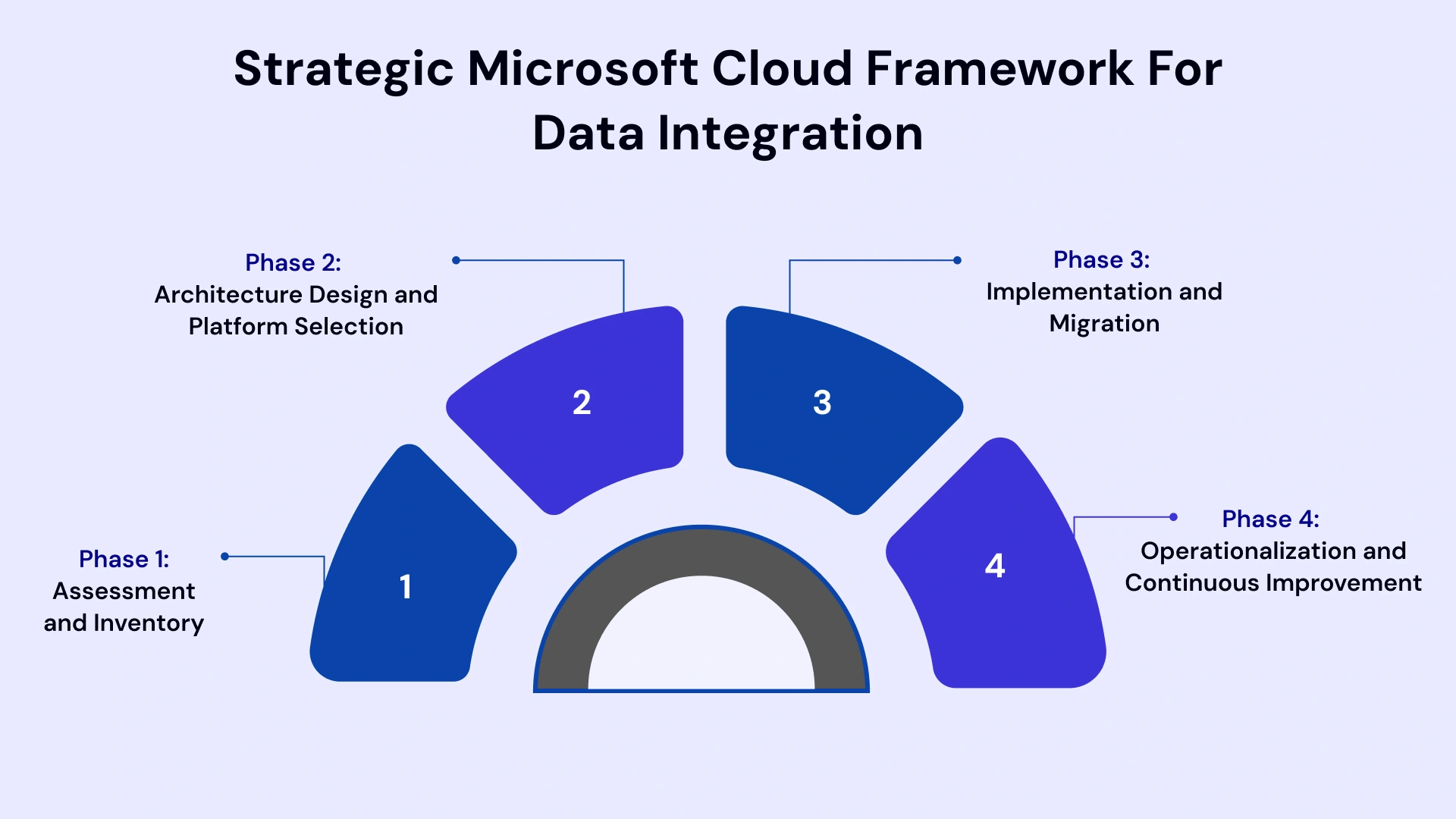
Phase 1: Assessment and Inventory
The journey toward eliminating data silos begins with comprehensive visibility into your existing data landscape. Financial institutions must conduct thorough assessments that identify all data repositories, document integration points, map data flows, and prioritize integration opportunities based on business value and technical complexity.
- Data Discovery and Cataloging: Microsoft Purview automates discovery, scanning on-premises and cloud environments to create a comprehensive inventory of data assets. This automated cataloging identifies previously unknown data sources, documents metadata, and establishes the foundation for unified governance.
- Business Impact Analysis: Not all data silos have the same business impact. Prioritization frameworks should evaluate each silo based on factors including regulatory risk exposure, customer experience implications, operational efficiency opportunities, and strategic decision-making requirements. This analysis ensures integration efforts focus on the highest-value opportunities first.
- Technical Complexity Assessment: Understanding the technical characteristics of existing systems—including technology platforms, data formats, update frequencies, and integration capabilities—informs realistic project planning and resource allocation.
- Stakeholder Alignment: Successful data integration requires organizational consensus across business units, technology teams, compliance functions, and executive leadership. Early stakeholder engagement establishes shared objectives, secures necessary resources, and builds the cross-functional collaboration essential for breaking down organizational silos alongside technical ones.
Phase 2: Architecture Design and Platform Selection
With a comprehensive assessment complete, financial institutions can design target architectures that leverage Microsoft Cloud capabilities optimally for their specific requirements.
- Modern Data Architecture Patterns: Microsoft recommends adopting lakehouse architectures that combine the flexibility of data lakes with the structure and performance of data warehouses. Microsoft Fabric implements this pattern natively, enabling financial institutions to consolidate structured transaction data, unstructured documents, and semi-structured event streams within a unified storage system while supporting diverse analytical workloads.
- Integration Architecture Selection: Financial services firms typically implement hub-and-spoke integration patterns, with Azure Data Factory serving as the central integration hub, connecting all source systems and target applications. This centralized approach provides visibility, governance, and reusability that point-to-point integrations cannot deliver.
- Real-Time vs. Batch Processing: Different data integration scenarios require different processing models. Customer interactions and fraud detection require real-time streaming integration with Azure Event Hubs and Stream Analytics, while regulatory reporting and financial consolidation can operate effectively with nightly batch processes.
- Hybrid Cloud Considerations: Many financial institutions maintain on-premises infrastructure for specific workloads due to regulatory requirements, performance considerations, or investment protection. Azure Arc extends cloud management capabilities to on-premises environments, enabling consistent data governance and integration patterns across hybrid deployments.
Phase 3: Implementation and Migration
Implementation represents the most resource-intensive phase, requiring careful planning, phased execution, and continuous validation to ensure business continuity throughout the transition.
- Pilot Project Selection: Successful implementations typically begin with pilot projects that demonstrate value quickly while building team capabilities and organizational confidence. Ideal pilots address significant business pain points, involve manageable technical complexity, and include stakeholders who can become champions for broader adoption.
- Legacy System Modernization: It represents both a challenge and an opportunity to eliminate data silos. Rather than attempting "big bang" replacements, progressive modernization strategies incrementally migrate functionality to modern platforms while establishing integration patterns that unify legacy and modern systems during transition periods. Cloud migration consulting services provide expertise in navigating these complex transitions, ensuring minimal disruption to ongoing operations.
- Data Quality and Transformation: Integration exposes data quality issues previously hidden within silos. Microsoft Purview Data Quality provides automated profiling, validation, and cleansing capabilities that ensure only accurate, complete data flows across integrated systems. Establishing master data management practices creates a single source of truth for critical entities such as customers, products, and organizational hierarchies.
- Testing and Validation: Comprehensive testing protocols verify data accuracy, integration performance, security controls, and business process functionality before production deployment. Automated testing frameworks accelerate validation cycles and provide confidence in system reliability.
Phase 4: Operationalization and Continuous Improvement
Successful data integration extends beyond initial implementation to establish ongoing operational practices that maintain system health, adapt to changing requirements, and continuously optimize performance.
- Data Governance Operating Model: Sustained integration success requires dedicated data governance teams with clear accountability for data quality, metadata management, access controls, and integration standards. Microsoft Purview provides the tooling foundation, but organizational processes and accountabilities ensure governance practices become embedded in daily operations.
- Performance Monitoring: Azure Monitor and Application Insights provide comprehensive visibility into integration performance, enabling proactive identification of bottlenecks, capacity constraints, or degradations before they cause business impact. Automated alerting ensures rapid response to any integration failures.
- Change Management Process: As business requirements evolve, new data sources emerge, and regulatory demands shift, structured change management processes ensure integration architecture adapts systematically rather than accumulating new silos through ad hoc point solutions.
- Continuous Optimization: Regular reviews of integration patterns, data flows, and usage metrics identify optimization opportunities that improve performance, reduce costs, and enhance business value delivery.

Leveraging Specialized Services for Maximum Impact
A unified cloud environment is only the starting point. To gain a true competitive edge, financial services firms must deploy specialized services that translate raw data into actionable intelligence. By moving beyond general cloud storage and into purpose-built financial services, organizations can solve specific bottlenecks in risk, compliance, and customer experience.
Cloud Managed Services: Expert Management of Complex Environments
Cloud managed services provide financial institutions with expert oversight and optimization of their Microsoft Cloud environments, ensuring maximum uptime, security, and performance without requiring extensive internal cloud expertise.
Managed service providers deliver 24/7 monitoring, proactive issue resolution, capacity planning, security patch management, and cost optimization across Azure infrastructure. For financial services firms focused on core business activities rather than infrastructure management, these services enable access to enterprise-grade cloud capabilities without the overhead of building specialized cloud operations teams.
When evaluating managed service providers, financial institutions should prioritize partners with specific financial services experience, demonstrated expertise in Microsoft Cloud technologies, and compliance capabilities aligned with regulatory requirements. The right managed services partner becomes an extension of your technology team, providing strategic guidance alongside operational excellence.
Cloud Infrastructure Services: Building Secure, Scalable Foundations
Cloud infrastructure services establish the foundational architecture upon which integrated data platforms operate. These services encompass network design, security architecture, identity management, disaster recovery, and performance optimization—all critical for financial services environments where security, compliance, and availability are non-negotiable.
Microsoft's infrastructure services include dedicated resources for financial services firms requiring specialized configurations. Azure Dedicated Host provides physical server isolation for workloads with strict regulatory requirements. Azure ExpressRoute establishes private connectivity between on-premises datacenters and Azure, bypassing the public internet for enhanced security and performance.
Infrastructure-as-code practices, implemented through Azure Resource Manager templates or Terraform configurations, ensure consistent, repeatable deployments that reduce configuration errors and accelerate environment provisioning.
Financial Software Development Services: Custom Solutions for Unique Requirements
While Microsoft Cloud provides comprehensive platform capabilities, financial software development services deliver custom applications and integrations addressing unique business requirements that off-the-shelf solutions cannot accommodate.
Custom development becomes particularly valuable when building customer-facing applications that differentiate competitive positioning, implementing proprietary risk models requiring specialized calculation engines, or creating workflow automation that encodes unique business processes.
Development teams with financial services expertise understand regulatory constraints, security requirements, and business domain complexities that generic software developers may overlook. This specialized knowledge accelerates development timelines, reduces compliance risk, and ensures solutions align with industry best practices.
Insurance Software Development Services: Addressing Industry-Specific Needs
Insurance software development services address the unique requirements of carriers, brokers, and insurance-focused financial services firms. These specialized services understand the intricacies of policy administration, claims processing, actuarial modeling, and underwriting workflows that differ substantially from banking or investment management operations.
Custom insurance applications built on Microsoft business solutions can integrate legacy policy administration systems with modern digital channels, creating unified customer experiences despite underlying system complexity. Real-time rating engines, automated claims processing, and AI-powered fraud detection represent areas where custom development delivers a significant competitive advantage.
Legacy Application Modernization: Bridging Past and Future
Legacy application modernization represents a critical enabler of data integration, as many data silos exist precisely because legacy systems lack modern integration capabilities. Microsoft provides multiple modernization pathways depending on application characteristics and business requirements.
Rehosting moves applications to cloud infrastructure with minimal changes—a quick path to cloud benefits while deferring more extensive modernization. Refactoring updates application code to leverage cloud-native capabilities, improving scalability and integration while preserving core business logic. Rebuilding recreates applications using modern architectures and technologies, delivering maximum long-term benefit at the highest initial investment.
Azure Migrate provides assessment tools that evaluate modernization options, estimate costs, and identify potential challenges before committing to specific approaches. Many financial institutions adopt progressive modernization strategies that phase application updates over multi-year roadmaps, balancing business continuity with transformation objectives.
Industry Use Cases: Real-World Data Silo Elimination
The theoretical benefits of a unified cloud are vast, but the true value is revealed in the day-to-day operations of financial institutions. Below are three high-impact scenarios where Microsoft Cloud transforms fragmented data into a competitive advantage.
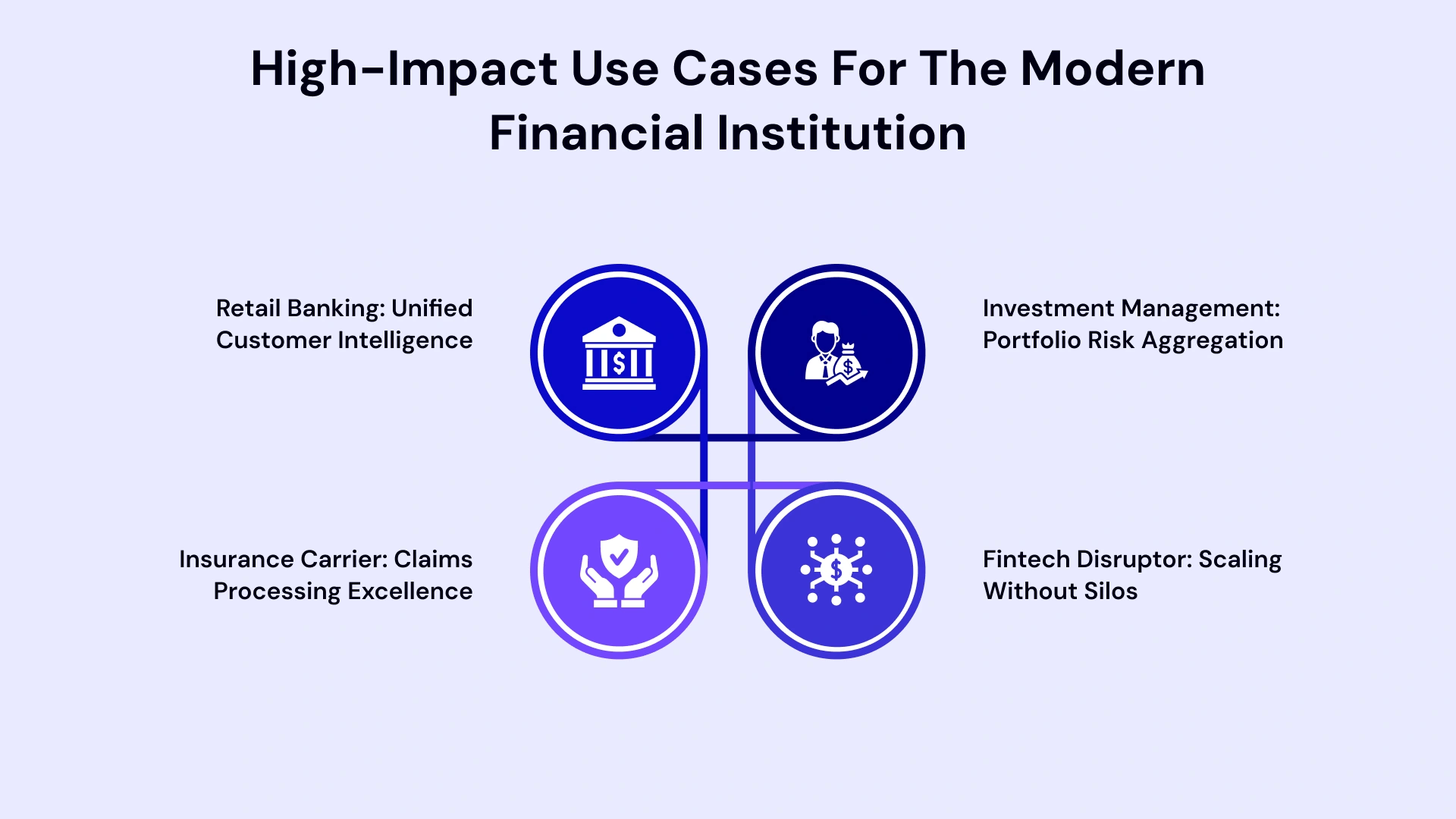
Retail Banking: Unified Customer Intelligence
A regional bank operating across multiple states struggled with fragmented customer data spanning retail banking, mortgage lending, small business banking, and wealth management divisions. Each product line maintained separate systems with inconsistent customer identifiers, preventing relationship managers from understanding the full customer relationship.
By implementing Azure Data Lake as a unified customer data repository, integrating all source systems via Azure Data Factory, and establishing master data management practices with Microsoft Purview, the institution created a single, golden customer record accessible across all channels and business lines.
Results included a 34% improvement in cross-sell conversion rates as relationship managers gained visibility into customer needs and holdings, a 28% reduction in customer service handling time through comprehensive access to customer history, and 42% faster regulatory reporting cycles through consolidated data availability.
Investment Management: Portfolio Risk Aggregation
An investment management firm managing $45 billion across multiple strategies operated separate portfolio management systems for equities, fixed income, alternatives, and multi-asset portfolios. This fragmentation prevented enterprise-wide risk aggregation, limiting the firm's ability to identify concentration risks or respond rapidly to market volatility.
Microsoft Fabric enabled real-time integration of position data, market prices, and risk factors across all portfolio systems into a unified analytics environment. Power BI dashboards provided executives and risk managers with consolidated exposure views, stress testing capabilities, and scenario analysis across the entire firm.
The integrated platform reduced overnight risk calculation times from 8 hours to 45 minutes, enabling intraday risk management previously impossible with siloed systems. The firm identified and unwound $127 million in unintended concentration exposures that fragmented systems had obscured.
Insurance Carrier: Claims Processing Excellence
A property and casualty insurer operated separate systems for policy administration, claims management, fraud detection, and customer service. Adjusters spent 30% of their time gathering information from disconnected systems rather than evaluating claims, while fraud detection relied on day-old data, allowing suspicious claims to progress through processing.
Azure Logic Apps orchestrated real-time data flows across all systems, ensuring adjusters had access to comprehensive information through unified interfaces. Azure Cognitive Services analyzed claim documentation, photos, and historical patterns to flag potential fraud immediately upon submission.
Claims processing cycle time decreased by 41%, customer satisfaction scores improved by 23 points, and fraud detection accuracy increased by 67% through real-time analytics operating on integrated data.
Fintech Disruptor: Scaling Without Silos
A rapidly growing digital banking fintech acquired three smaller companies over 18 months, inheriting disparate technology platforms, along with valuable customer bases and product capabilities. Without integration, the company risked creating permanent silos as each acquisition continued operating independently.
The company established Microsoft Cloud as its integration foundation before acquisitions closed, developing standardized integration patterns and data models that could rapidly incorporate new systems. Azure API Management provided abstraction layers that isolated integration logic from source systems, enabling parallel integration workstreams.
Within six months of each acquisition, the fintech achieved full customer data integration, unified product offerings across combined customer bases, and consolidated operational reporting. This rapid integration capability became a competitive advantage, enabling growth through acquisition while maintaining operational efficiency.
Overcoming Common Implementation Challenges
Here is how a financial services firm can navigate and overcome the most common obstacles to success.
Organizational Resistance and Change Management
Technical capabilities alone cannot eliminate data silos when organizational dynamics resist change. Successful implementations require structured change management that addresses stakeholder concerns, builds cross-functional collaboration, and demonstrates tangible value early and often.
Executive sponsorship provides essential air cover for integration initiatives, authorizing necessary resources and empowering project teams to overcome departmental resistance. Clear communication about integration objectives, benefits, and timelines builds understanding and reduces uncertainty. Early wins that demonstrate measurable business value create momentum and enthusiasm that overcome skepticism.
Training programs ensure teams possess the skills necessary to leverage integrated data effectively. Simply providing access to unified data platforms delivers limited value if business users lack the analytics capabilities to derive insights from integrated information.
Data Quality and Consistency Issues
Integration surfaces data quality problems previously hidden within silos. Customer names spelled differently across systems, inconsistent product codes, conflicting account balances, and missing information represent common challenges that must be resolved for integration to deliver reliable business value.
Microsoft Purview Data Quality provides automated profiling that identifies inconsistencies, missing values, and format violations across integrated datasets. Rule-based validation and machine learning-powered anomaly detection ensure only high-quality data flows across integrated systems.
Master data management establishes authoritative sources for critical entities, implementing standardized identifiers and reference data that eliminate inconsistencies. While initially time-consuming, MDM investments pay long-term dividends through sustained data quality and reduced reconciliation efforts.
Security and Compliance Concerns
Financial institutions rightfully prioritize security and regulatory compliance when integrating sensitive data across systems. Integration projects must address access controls, data privacy, audit trails, and regulatory reporting without compromising integration benefits.
Zero Trust security models, implemented through Azure Active Directory and Microsoft Entra, ensure granular access controls that enforce least-privilege principles. Data classification and labeling, automated through Microsoft Purview, identify sensitive information and implement appropriate protection measures regardless of where data moves within integrated environments.
Comprehensive audit logging tracks all data access and modifications, providing the documentation regulators require for compliance verification. Encryption in transit and at rest protects sensitive information throughout its lifecycle across integrated systems.
Performance and Scalability Requirements
Financial services firms process enormous data volumes with strict performance requirements for customer-facing applications, trading systems, and regulatory reporting. Integration architectures must deliver necessary performance while scaling to accommodate growth.
Azure's global infrastructure provides virtually unlimited scale for data storage and processing workloads. Distributed architectures using Azure Cosmos DB deliver single-digit millisecond latencies for global applications—Azure Synapse Analytics processes petabyte-scale datasets for analytical workloads requiring complex queries across integrated data.
Careful architecture design, including appropriate data partitioning, indexing strategies, and caching implementations, ensures integration doesn't create new performance bottlenecks. Performance testing under realistic load conditions validates architecture decisions before production deployment.
Measuring Success: KPIs and ROI Metrics
The transition to a unified Microsoft Cloud environment should be treated as a value-driver, not a cost center. To measure the impact effectively, firms should categorize their success metrics into three core areas.
1. Operational Efficiency Metrics
Data integration delivers measurable operational improvements across multiple dimensions:
- Time Savings: Quantify the hours previously spent searching for information, reconciling inconsistent data, or recreating analyses that already existed elsewhere. Post-integration time studies demonstrate productivity improvements directly attributable to unified data access.
- Process Cycle Times: Measure the end-to-end duration of key business processes such as loan origination, claims processing, or customer onboarding. Integration typically reduces cycle times by eliminating handoffs, redundant data entry, and system-to-system delays.
- Error Rates: Track the frequency of data entry errors, reconciliation discrepancies, or processing failures caused by data inconsistencies. Integration reduces error rates through single-source data entry and automated validation.
2. Business Impact Metrics
Beyond operational efficiency, data integration drives measurable business results:
- Revenue Growth: Improved cross-sell conversion rates, faster product launches, and enhanced customer experiences directly translate into revenue increases. Attribution modeling connects integration investments to revenue outcomes.
- Customer Satisfaction: Unified customer data enables consistent, personalized experiences across all touchpoints. NPS scores, CSAT ratings, and customer retention rates demonstrate improvements in experience resulting from integration.
- Risk Reduction: Consolidated risk visibility, improved compliance capabilities, and enhanced fraud detection reduce financial losses and regulatory fines. Measuring avoided losses demonstrates integration value.
- Strategic Agility: The ability to respond rapidly to competitive threats, regulatory changes, or market opportunities represents strategic value that is difficult to quantify but critical to long-term competitiveness. Time-to-market metrics for new products or capabilities demonstrate improved agility.
3. Financial ROI Calculations
Comprehensive ROI analysis accounts for both costs and benefits across multi-year time horizons:
- Cost Components: Integration project costs include software licensing, infrastructure resources, implementation services, internal labor, training, and ongoing operational expenses. Accurate cost accounting ensures realistic ROI projections.
- Benefit Components: Quantifiable benefits include cost savings from operational efficiency, risk reduction, and infrastructure consolidation, as well as revenue increases from improved business capabilities. Conservative benefit estimates improve the credibility of ROI calculations.
- Payback Periods: Most financial services integration projects achieve positive ROI within 18-24 months when accounting for both hard cost savings and revenue growth. Complex enterprise-wide transformations may extend payback periods to 36 months while delivering greater long-term value.
Future-Proofing Your Data Integration Strategy
Microsoft continues investing heavily in capabilities that extend integration value and address emerging requirements:
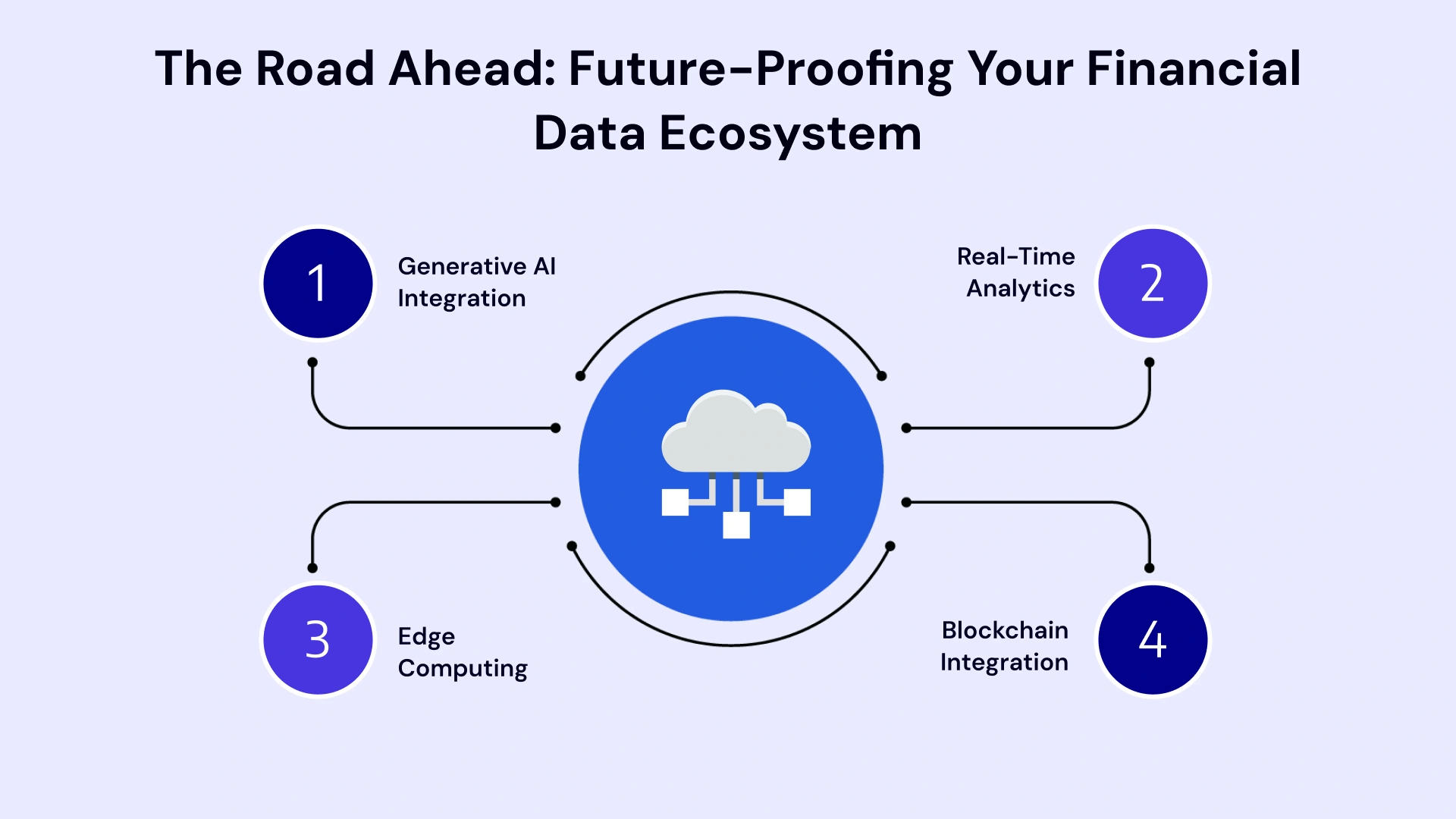
- Generative AI Integration: Azure OpenAI Service enables financial institutions to embed large language models within integrated data environments, powering conversational analytics, automated document processing, and the generation of intelligent insights that leverage unified data assets.
- Real-Time Analytics: Microsoft Fabric's Real-Time Intelligence capabilities enable streaming analytics on live data flows, supporting use cases such as fraud detection, algorithmic trading, and customer engagement that require sub-second response times.
- Edge Computing: Azure Stack and Azure IoT Edge extend cloud capabilities to branch locations, mobile devices, and operational technology environments, enabling integrated analytics across distributed environments while respecting data residency requirements.
- Blockchain Integration: Azure Blockchain Service supports distributed ledger applications that require tamper-proof audit trails, multi-party transaction settlement, or digital asset custody, all integrated with enterprise data platforms.
Adaptive Architecture Principles
Future-proof integration architectures embrace principles that accommodate changing requirements without requiring complete rebuilds:
- API-First Design: Exposing data and functionality through well-designed APIs enables flexible consumption across current and future applications without tight coupling to specific implementation details.
- Microservices Patterns: Decomposing monolithic integrations into focused microservices improves maintainability, enables independent scaling, and facilitates incremental updates without impacting entire systems.
- Event-Driven Architecture: Publish-subscribe patterns decouple data producers from consumers, enabling new integration scenarios without modifying existing systems and supporting real-time data flows as requirements evolve.
- Platform Thinking: Rather than building point solutions, platform approaches create reusable capabilities that accelerate future integration projects while maintaining consistency and governance.
Continuous Learning and Optimization
Successful integration isn't a one-time project but an ongoing capability that continuously adapts to changing business needs:
- Regular Architecture Reviews: Quarterly reviews assess integration performance, identify optimization opportunities, and ensure architecture remains aligned with evolving business requirements and technological capabilities.
- Emerging Use Case Identification: Proactive dialogue with business stakeholders identifies new integration opportunities that leverage existing capabilities to create incremental value.
- Technology Capability Assessment: Monitoring Microsoft's roadmap and emerging capabilities ensures financial institutions can adopt new features that enhance integration value or reduce operational overhead.
- Skill Development: Ongoing training ensures teams maintain current expertise in Microsoft Cloud technologies, integration patterns, and financial services best practices.
VLink: Seamless Financial Data Integration via Microsoft Cloud
At VLink, we specialize in helping financial services firms eliminate data silos through comprehensive Microsoft Cloud integration solutions. Our dedicated team combines deep Microsoft technology expertise with extensive financial services industry knowledge, enabling us to deliver transformative integration outcomes that drive measurable business results.
Our cloud migration consulting services guide financial institutions through every phase of their integration journey—from initial assessment and strategy development through implementation, optimization, and ongoing support. We understand that successful integration extends beyond technology to encompass organizational change, regulatory compliance, and business process transformation.
Whether you're undertaking legacy system modernization, implementing cloud managed services, establishing robust cloud infrastructure services, or developing custom financial software development services and insurance software development services, VLink provides the expertise and resources necessary for success.
Our proven methodology has helped dozens of financial institutions achieve:
- 40-60% reduction in data integration complexity and maintenance costs
- 30-50% improvement in operational efficiency through unified data access
- 25-45% faster time-to-market for new products and capabilities
- 50-70% reduction in regulatory reporting cycle times
- 35-55% improvement in customer satisfaction scores
We don't just implement technology—we partner with your organization to ensure integration delivers sustainable business value aligned with your strategic objectives. Our client success teams provide ongoing support, optimization, and advisory services that ensure your integration capabilities continue delivering value long after initial implementation.

Conclusion
Data silos are a significant but solvable hurdle for financial institutions. By leveraging Microsoft Cloud technologies, organizations can transform fragmented data into a unified, intelligent asset that drives competitive advantage, operational efficiency, and regulatory compliance.
Success requires more than just technology; it demands strategic alignment, executive sponsorship, and a commitment to change management. As market competition and regulatory pressures intensify, the ability to integrate data quickly and effectively is no longer optional—it is a strategic imperative. Financial institutions that act now to eliminate silos will move beyond technical limitations, turning their data into a powerful engine for growth and long-term differentiation.
Ready to break down your data silos and accelerate your digital transformation? Connect with our team of financial services experts and Microsoft Cloud specialists who are here to help you design and execute a tailored integration strategy.

Vice President, Strategy – VLink Inc.
Sambhavi Gopalakrishnan is the Vice President of Strategy at VLink Inc., bringing over a decade of experience in IT leadership, project implementation, and strategic growth. She possesses a strong foundation in technical project management and pre-sales, driving innovation and business transformation at VLink.

 Shivisha Patel