


This guide breaks down the specific DevOps security best practices that banks, fintechs, insurers, and payment processors in Dubai and the wider UAE need to implement right now. We cover everything from CI/CD pipeline security and infrastructure as code hardening to Kubernetes security best practices and UAE-specific compliance mapping for NESA, CBUAE, and PDPL. Whether you are a CTO at a DIFC-regulated firm or a startup founder scaling through ADGM’s sandbox, this is your practical roadmap to building secure, compliant, and fast-moving software delivery pipelines.
If your organization is exploring how to strengthen its DevOps services posture, this guide will show you exactly where to start — and what to prioritize.

Why UAE Financial Services Need a Security-First DevOps Strategy
Financial institutions in Dubai operate inside one of the most digitally ambitious economies on the planet. Smart Dubai, the Digital Dirham initiative, the Central Bank’s Financial Infrastructure Transformation programme — all of these push banks and fintechs to ship faster, go cloud-native, and open their APIs to third parties. But speed without security is a liability, not a competitive advantage.
The gap between deployment velocity and security maturity is where breaches happen. And in UAE financial services, that gap is widening under the pressure of three converging forces: a hardening regulatory environment, a skyrocketing cost of failure, and a rapidly expanding digital attack surface. Understanding DevOps in financial services starts with confronting this reality.
The Regulatory Pressure Cooker — NESA, CBUAE, and PDPL
The UAE’s cybersecurity regulatory landscape has shifted from advisory to mandatory in the space of 18 months. Here are the frameworks every financial service DevOps team must account for:
NESA Information Assurance Standards: The National Electronic Security Authority (now part of the Signals Intelligence Agency) mandates 188 security controls across management and technical domains for all government entities and critical infrastructure — which explicitly includes financial services. These controls span access management, cryptography, incident response, network security, and supply chain risk. For banks and insurers regulated by the CBUAE, NESA compliance is not optional.
CBUAE Federal Decree-Law No. 6 of 2025: Effective September 2025, this consolidated overhaul expanded the Central Bank’s supervisory perimeter to cover fintech platforms, payment gateways, and technology enablers facilitating licensed financial activities. Maximum administrative fines now reach AED 1 billion. Article 149 mandates robust fraud prevention mechanisms and prompt breach reporting. Organizations have until September 2026 to regularize compliance.

CBUAE Notice 2025/3057: Issued specifically to card issuers and digital banking providers, this notice prohibits weak authentication methods such as SMS OTP, email OTP, and static passwords. Financial institutions must comply by March 2026 — a directive that directly impacts how authentication is coded, tested, and deployed within CI/CD pipelines.
UAE PDPL (Federal Decree-Law No. 45 of 2021): The Personal Data Protection Law governs how customer data is collected, processed, and stored. For financial institutions handling millions of transaction records, PDPL compliance must be baked into the development lifecycle, not bolted on during audit prep.
UAE National Cyber Security Strategy 2025–2031: Structured around five pillars, this strategy signals a shift from capacity building to active defence. Financial institutions are expected to move beyond checkbox compliance and embed security into governance, operations, and culture.
The Cost of Getting Security Wrong in Financial Services
The numbers paint a stark picture. According to IBM’s Cost of a Data Breach Report, the average financial services data breach costs over USD 6 million globally — 22% higher than the cross-industry average. In the UAE specifically, cyberattacks on critical infrastructure cost the economy an estimated AED 5.9 billion annually in direct and indirect losses.
Beyond direct remediation costs, there are regulatory penalties (now up to AED 1 billion under the new CBUAE law), customer trust erosion, and the operational paralysis that follows a major incident. For a Dubai-based bank or fintech competing in a market where 60% of consumers already use at least one digital banking app, a security failure does not just cost money — it costs market share.
The argument for DevOps security best practices in UAE financial services is not theoretical. It is financial, regulatory, and existential.
Core DevOps Security Best Practices for UAE Financial Institutions
Securing a financial services DevOps pipeline requires more than installing a scanner and calling it done. It demands a layered, defence-in-depth approach that addresses vulnerabilities at every stage — from the first line of code to production runtime. Here are the five foundational practices every UAE financial institution should implement.
Shift-Left Security — Embedding Testing From Day One
Shift-left security means catching vulnerabilities when they are cheapest and easiest to fix — during development, not after deployment. For financial institutions running daily or weekly release cycles, this is non-negotiable.

The practical implementation looks like this:
Static Application Security Testing (SAST): Integrate tools like SonarQube, Checkmarx, or Snyk directly into developer IDEs and pull request workflows. Every code commit triggers an automated scan that flags insecure patterns, hardcoded credentials, and injection vulnerabilities before they enter the main branch.
Software Composition Analysis (SCA): Financial applications rely heavily on open-source libraries. SCA tools scan dependencies for known vulnerabilities (CVEs) and license compliance risks. Given that supply chain poisoning is one of the top CI/CD threat vectors in 2025, this is critical for any banking application.
Pre-commit hooks and code review gates: Enforce mandatory security checks before code can be merged. This includes secret detection scans (using tools like GitGuardian or TruffleHog) to prevent API keys, database credentials, or encryption keys from being committed to repositories.
A major study of 405 organizations found that while 68% have adopted DevSecOps practices, only 12% conduct security scans on every commit. That gap represents a significant window of exposure — particularly dangerous for financial applications processing sensitive transaction data.
CI/CD Pipeline Security for Banking Applications
Your CI/CD pipeline is not just a development tool — it is critical security infrastructure. A compromised pipeline can inject malicious code into every application it touches, affecting thousands of downstream users. The SolarWinds and Codecov breaches demonstrated exactly how devastating this can be.
For UAE banks and fintechs, CI/CD pipeline security requires:
Pipeline access control: Implement role-based access control (RBAC) with multi-factor authentication for all pipeline interactions. No single developer should have unrestricted access to production deployment triggers. Enforce the principle of least privilege across Jenkins, GitLab CI/CD, GitHub Actions, or Azure DevOps environments.
Signed and verified artifacts: Every build artifact should be cryptographically signed. Before deployment, verify the signature to ensure no tampering occurred between build and release. This creates an auditable chain of custody — critical for regulatory compliance.
Immutable build environments: Use ephemeral, containerized build agents that are destroyed after each run. This prevents persistent threats from compromising the build infrastructure itself.
Automated compliance gates: Insert policy-as-code checks directly into the pipeline. If a build fails a NESA-aligned security control or a CBUAE authentication requirement, it should be blocked automatically — not flagged for manual review three weeks later.
Infrastructure as Code Security and Policy Enforcement
Infrastructure as Code (IaC) tools like Terraform, Ansible, and AWS CloudFormation bring consistency and speed to cloud provisioning. But they also introduce a new attack surface: misconfigured infrastructure templates that get deployed at scale.
For financial institutions in the UAE, where data residency and encryption standards are regulatory requirements, IaC security is foundational:
Scan IaC templates before deployment: Tools like Checkov, tfsec, and Bridgecrew scan Terraform and CloudFormation files for misconfigurations — open S3 buckets, unencrypted databases, overly permissive security groups — before they are ever provisioned.
Enforce data residency policies: For UAE-regulated financial data, IaC templates should hard-code region constraints ensuring workloads deploy only to UAE-region data centres (e.g., AWS me-south-1, Azure UAE North). This is a PDPL and NESA requirement that cannot be left to manual verification.
Version control all infrastructure: Treat infrastructure changes with the same rigour as application code — peer-reviewed pull requests, automated tests, and full audit trails. This satisfies NESA’s governance controls and provides evidence for CBUAE compliance assessments.
Kubernetes Security Best Practices for Financial Workloads
As more UAE banks migrate to containerized architectures, Kubernetes cluster security becomes a frontline concern. A Cloud Security Alliance study found that 60% of organizations experienced at least one container security incident in the past year.
Key practices for financial Kubernetes deployments:
Network policies: Segment your cluster network to isolate payment processing pods from non-sensitive workloads. Define explicit ingress and egress rules for every namespace. In a banking context, this prevents a compromised analytics service from laterally moving into the core transaction engine.
Image scanning and admission control: Scan all container images for vulnerabilities before they are admitted to the cluster. Use admission controllers (like OPA Gatekeeper or Kyverno) to enforce policies — no images with critical CVEs, no containers running as root, no unsigned images.
Runtime protection: Deploy runtime security tools (Aqua Security, Falco, or Sysdig) to detect anomalous behaviour inside running containers — unexpected process execution, file system changes, or network connections that deviate from baseline patterns.
Secrets encryption: Enable Kubernetes Secrets encryption at rest and integrate with external key management services (AWS KMS, Azure Key Vault, or HashiCorp Vault). Never store plaintext credentials in ConfigMaps or environment variables.
Secrets Management and Identity Access Controls
In financial services, a leaked database credential or API key can have immediate, material consequences. Secrets management is not a nice-to-have — it is a compliance and operational necessity.
Centralized secrets management: Use dedicated vaults (HashiCorp Vault, AWS Secrets Manager, Azure Key Vault) to store and rotate all credentials. Applications request secrets at runtime via authenticated API calls, not from environment variables or config files baked into container images.
Automated rotation: Configure automatic credential rotation on defined schedules. This aligns with NESA’s access management controls and reduces the blast radius if a secret is exposed.
Zero-trust identity: Implement service mesh authentication (using mutual TLS via Istio or Linkerd) so that every service-to-service communication within your cluster is authenticated and encrypted. This is especially critical for CBUAE Notice 2025/3057 compliance, which mandates the elimination of weak authentication across digital banking channels.
Building a DevSecOps Implementation Framework for UAE Compliance
Knowing the best practices is one thing. Mapping them to UAE’s specific regulatory requirements is where most financial institutions struggle. Here is a practical framework for aligning your DevSecOps implementation with the compliance landscape.
Mapping DevOps Controls to NESA’s 188-Control Framework
NESA’s Information Assurance Standards are organized into management controls (60) and technical controls (128), prioritized across four levels based on their effectiveness against the 24 most common threat types. The good news: many DevSecOps practices map directly to NESA controls.
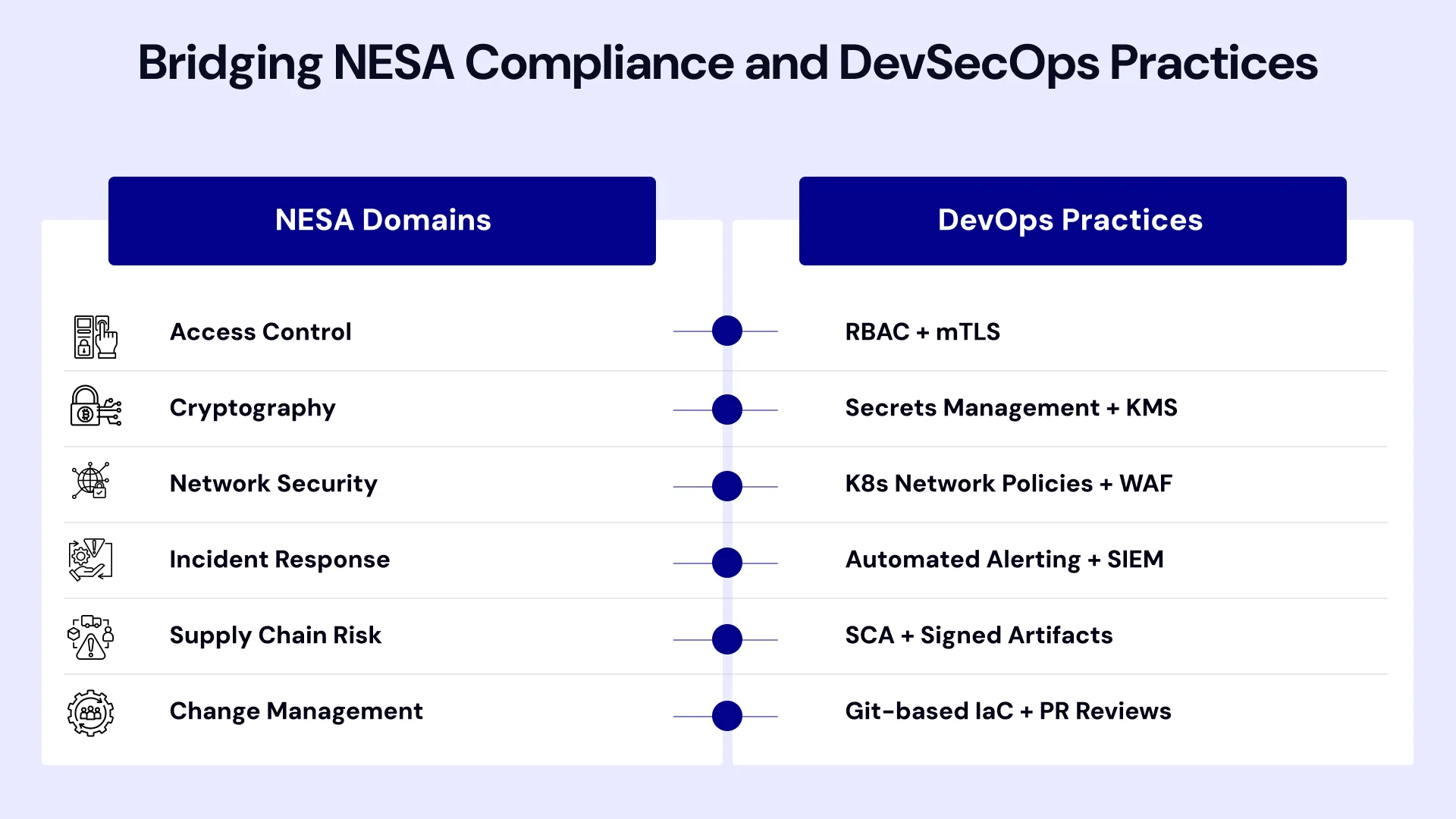
Here is how core DevOps security practices align with NESA’s key domains:
| NESA Domain | Key Controls | DevOps Security Practice |
| Access Control | Least privilege, MFA, role segregation | RBAC on CI/CD, service mesh mTLS, centralized IAM |
| Cryptography | Encryption at rest and in transit | Secrets management, TLS termination, KMS integration |
| Network Security | Segmentation, monitoring, intrusion detection | Kubernetes network policies, WAF, runtime monitoring |
| Incident Response | Detection, escalation, reporting to aeCERT | Automated alerting, SIEM integration, runbook automation |
| Supply Chain Risk | Third-party assessment, dependency management | SCA scanning, signed artifacts, dependency firewalls |
| Change Management | Controlled changes, audit trails | Git-based IaC, PR reviews, immutable build pipelines |
The critical takeaway: NESA compliance is not a separate workstream from DevSecOps — it is the same work, documented differently. Organizations that treat compliance as a byproduct of good security engineering, rather than a parallel bureaucratic exercise, move faster and spend less.
CBUAE Federal Decree-Law No. 6 of 2025 — What It Means for Your Pipeline
The new CBUAE law is the most significant regulatory development for UAE financial software development services in a decade. Here is what DevOps teams need to know:
Expanded scope: Article 62 brings technology platforms, APIs, and decentralized applications that facilitate financial activities under CBUAE supervision. If your fintech builds payment APIs or lending platforms, your development pipeline is now within regulatory scope — even if you are not a bank.
Mandatory fraud reporting (Article 149): Your pipeline must generate auditable evidence of security controls. Automated compliance reports, build-time vulnerability assessments, and deployment audit trails become legal necessities, not just engineering best practices.
AED 1 billion maximum fines: The enforcement teeth are real. This changes the ROI calculation for security tooling investments. The cost of implementing comprehensive DevSecOps is a fraction of the potential penalty for a compliance failure.
Automating Compliance as Code
The most effective way to maintain continuous compliance across NESA, CBUAE, and PDPL is to codify your compliance requirements and enforce them automatically within the pipeline.
Policy-as-code engines: Use Open Policy Agent (OPA), HashiCorp Sentinel, or AWS Config Rules to define compliance policies as code. These policies run automatically during builds and deployments, blocking non-compliant changes before they reach production.
Automated audit trail generation: Configure your CI/CD platform to generate immutable logs of every build, test, scan, approval, and deployment. Store these in tamper-proof audit storage. When the CBUAE or a NESA assessor requests evidence, you produce it in minutes, not weeks.
Continuous compliance dashboards: Integrate GRC (Governance, Risk, and Compliance) platforms with your DevOps toolchain. Real-time dashboards showing control status, open vulnerabilities, and compliance posture give CISOs and CROs the visibility they need without disrupting engineering workflows.
DevOps Risk Management - From Pipeline to Production
Security does not end at deployment. Financial applications in production face a continuous barrage of threats — and your DevOps risk management practices must cover the full operational lifecycle.
Continuous Monitoring and Threat Detection
Production monitoring for financial applications requires more than uptime checks. It demands real-time visibility into security events across infrastructure, application, and data layers.
SIEM integration: Aggregate logs from CI/CD platforms, cloud infrastructure, application runtimes, and network devices into a centralised Security Information and Event Management system. Correlate events to detect multi-stage attack patterns that individual tools would miss.
Anomaly detection: Deploy ML-driven monitoring tools that establish behavioural baselines for your applications and flag deviations — unusual API call patterns, unexpected data exfiltration volumes, or abnormal authentication attempts.
Cloud-native monitoring: Use Prometheus, Grafana, and cloud-provider tools (Azure Monitor, AWS CloudWatch) for granular visibility into container performance, resource consumption, and security events across your Kubernetes clusters.
Incident Response Aligned With UAE Reporting Requirements
Most organizations have incident response plans. Few have plans aligned with UAE-specific reporting timelines and escalation paths. This is the most common compliance gap financial institutions encounter during NESA assessments.
aeCERT reporting: The UAE’s Computer Emergency Response Team requires mandatory incident notification for critical infrastructure operators. Your IR plan must include specific escalation procedures, timeline commitments, and communication templates for aeCERT reporting — not just internal stakeholder notification.
CBUAE breach notification: Under the new law, material data breaches must be reported to the Central Bank promptly. DevOps teams must ensure that security monitoring generates the forensic evidence needed for these reports — timestamps, affected systems, data scope, and remediation actions.
Automated runbooks: Codify incident response procedures as automated runbooks within your DevOps platform. When a critical vulnerability is detected, the runbook triggers containment actions (isolating affected pods, revoking compromised credentials, scaling down exposed services) without waiting for human intervention.
Cloud Security DevOps — Multi-Cloud Considerations for Dubai
Many Dubai financial institutions operate across AWS, Azure, and Google Cloud — often using different providers for different workloads. Multi-cloud strategies offer resilience but multiply the security surface. Effective cloud infrastructure services must account for consistent security policy enforcement across environments.
Unified security policy layer: Implement a cloud-agnostic security platform that applies consistent policies (encryption standards, access controls, network segmentation rules) regardless of whether a workload runs on AWS me-south-1 or Azure UAE North.
Cross-cloud visibility: Use Cloud Security Posture Management (CSPM) tools to continuously scan all cloud environments for misconfigurations, compliance drift, and unauthorized changes.
Data residency enforcement: Automate guardrails that prevent regulated financial data from being provisioned outside UAE-approved regions. This is a hard compliance requirement under both NESA and PDPL.
DevOps Security Tools and Technology Stack for Financial Services
Choosing the right tools is critical, but what matters more is how they integrate into a cohesive, automated security pipeline. Here is a breakdown of tool categories, recommended options, and their relevance to UAE financial services compliance:
| Category | Recommended Tools | Use Case | UAE Compliance Relevance |
| SAST (Static Analysis) | SonarQube, Checkmarx, Snyk Code | Scan source code for vulnerabilities during development | NESA technical controls, CBUAE secure coding mandate |
| SCA (Composition Analysis) | Snyk, OWASP Dependency-Check, JFrog Xray | Detect vulnerabilities in open-source dependencies | Supply chain risk (NESA), artifact integrity |
| DAST (Dynamic Testing) | OWASP ZAP, Invicti, Burp Suite | Test running applications for runtime vulnerabilities | NESA application security, CBUAE fraud prevention |
| IaC Scanning | Checkov, tfsec, Bridgecrew | Audit infrastructure templates for misconfigurations | Data residency (PDPL), encryption (NESA) |
| Container Security | Aqua Security, Trivy, Falco | Scan images, enforce policies, detect runtime threats | Kubernetes security, NESA network controls |
| Secrets Management | HashiCorp Vault, AWS Secrets Manager | Store, rotate, and control access to credentials | NESA access control, CBUAE authentication rules |
| Policy as Code | OPA, Sentinel, AWS Config Rules | Automate compliance checks in pipelines | Cross-framework compliance automation |
| SIEM/Monitoring | Splunk, ELK, Prometheus + Grafana | Centralise logs, detect threats, generate audit reports | NESA incident response, CBUAE reporting |


Real-World Impact - How DevSecOps Transforms Financial Operations
The shift to DevSecOps is not theoretical — major financial institutions globally have demonstrated measurable outcomes. ING, one of the largest banking groups in Europe, adopted DevOps to accelerate its digital transformation and reported significant improvements in software delivery speed and quality. Capital One embedded security automation into its CI/CD workflows, reducing time to market and increasing deployment frequency while maintaining strict compliance. Understanding DevOps in fintech applications helps contextualize these results for UAE institutions.
In the UAE context, the opportunity is amplified. With Dubai hosting 59.68% of the country’s fintech market share and over 1,000 fintech firms operating within the DIFC alone, the competitive advantage of faster, more secure releases is immediate and material.
Consider the economics: a Canadian bank that automated 70% of its testing pipeline reduced manual QA costs by 35% while simultaneously improving security coverage. For UAE banks operating under NESA’s 188-control framework, this kind of automation does not just save money — it reduces the operational burden of ongoing DevOps cost reduction in financial services while generating the compliance evidence regulators expect.
The pattern is consistent: organizations that integrate security into their DevOps pipelines early spend less on remediation, deploy faster, achieve compliance more efficiently, and suffer fewer production incidents. In a regulatory environment as demanding as the UAE’s, this combination is not a luxury — it is a survival requirement.

Conclusion
The UAE’s financial services sector is at an inflection point. On one side: a booming digital economy, a USD 52 billion fintech market, and government-led mandates to go faster and more digital. On the other: NESA’s 188 mandatory controls, the most consequential CBUAE regulatory overhaul in a decade, and a threat landscape that hits critical infrastructure with 200,000 attacks every single day.
For CXOs in Dubai, Abu Dhabi, and across the UAE, the path forward is clear. DevOps security best practices are not a technical checkbox — they are the operational foundation that lets your institution innovate at speed without compromising on the compliance, security, and trust your customers and regulators demand.
Start with the fundamentals: shift security left, harden your CI/CD pipelines, codify your compliance requirements, and invest in continuous monitoring that covers pipeline to production. Then layer in UAE-specific controls for NESA, CBUAE, and PDPL that turn regulatory compliance from a quarterly scramble into a continuous, automated process.
VLink’s DevOps services team brings deep experience in building secure, compliant pipelines for financial institutions across the UAE. Whether you need a full DevSecOps implementation, NESA compliance mapping, or CI/CD pipeline security hardening, we are ready to help you move faster without leaving security behind. Get in touch with our financial services DevOps experts today.

Vice President, Strategy – VLink Inc.
Sambhavi Gopalakrishnan is the Vice President of Strategy at VLink Inc., bringing over a decade of experience in IT leadership, project implementation, and strategic growth. She possesses a strong foundation in technical project management and pre-sales, driving innovation and business transformation at VLink.

 Shivisha Patel