


The telecommunications industry stands at pivotal crossroads where customer expectations and technological capabilities are converging like never before. In an era where consumers demand instant gratification and seamless experiences across every touchpoint, telecom providers are turning to artificial intelligence to revolutionize their customer support infrastructure.
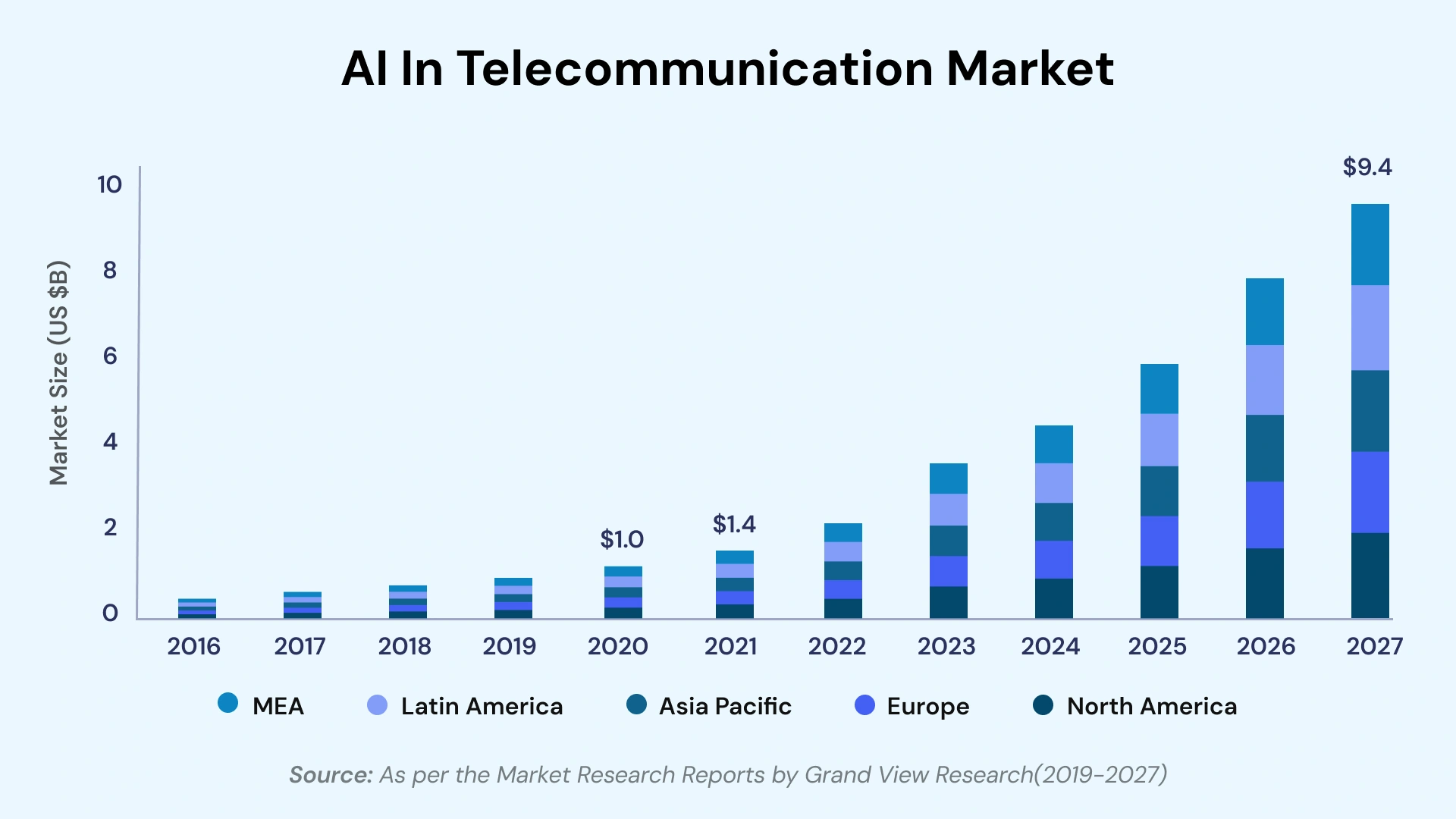
Customer support AI chatbot telecom solutions have emerged as the cornerstone of this transformation, evolving from simple scripted responders to sophisticated conversational AI platforms capable of understanding context, resolving complex queries, and delivering personalized experiences at scale. Telcom need digital transformation—AI chatbot use cases in telecom customer support reduce call volume.
For telecom leaders seeking to build comprehensive AI chatbot solutions for telecom customer support, these intelligent assistants represent not just a customer service tool but a strategic competitive advantage that can drive revenue growth, reduce operational costs, and enhance customer lifetime value.
The modern telecom customer journey is increasingly digital-first, with users expecting immediate assistance for everything from plan upgrades and billing inquiries to technical troubleshooting and device support. Traditional call centers, while still essential, cannot scale efficiently to meet the 24/7 demands of millions of connected customers.
This is where AI-powered customer support chatbot solutions for enterprises step in, bridging the gap between customer expectations and operational reality while simultaneously opening new revenue pathways through intelligent cross-selling, upselling, and personalized product recommendations.
This comprehensive guide explores how telecom customer support AI chatbot solutions are reshaping the industry landscape, examining their capabilities, implementation strategies, ROI considerations, and the future trajectory of conversational AI in telecommunications.
Whether you're a CX leader, technology executive, or business strategist looking to hire AI chatbot developers for telecom or explore AI chatbot consulting services for telecom, understanding the potential of chatbot technology is essential for staying competitive in today's hyper-connected marketplace.

Understanding Customer Support Chatbots in Telecommunications
Customer support AI chatbot implementations in telecom face unique challenges that set them apart from chatbots in other industries. Telecom customers often contact support during moments of frustration—network outages, billing disputes, or service interruptions—requiring chatbots to navigate emotionally charged interactions with empathy and efficiency.
Unlike e-commerce chatbots that primarily handle transactional queries, intelligent AI development services for telecom support must possess deep technical knowledge spanning network diagnostics, plan configurations, device compatibility, account management, and regulatory compliance. They need to access multiple backend systems simultaneously, pulling data from billing platforms, network management systems, CRM databases, and inventory management tools to provide comprehensive, contextually relevant responses.
The complexity of telecom products and services demands enterprise AI chatbot solutions for telecom capable of understanding nuanced customer intent. A query about "slow internet" could stem from dozens of root causes—equipment issues, network congestion, plan limitations, or external factors—requiring sophisticated diagnostic capabilities and decision-tree logic to guide customers through systematic troubleshooting.
Core Capabilities of Modern Telecom Chatbots
Today's advanced AI chatbot platform for telecom customer support solutions leverages natural language processing (NLP), machine learning, and integration capabilities, enabling it to serve as a comprehensive customer service platform rather than a simple FAQ responder.
- Omnichannel Integration enables end-to-end AI chatbot solutions for telecoms to maintain conversation continuity across web portals, mobile applications, social media platforms, and messaging apps such as WhatsApp and Facebook Messenger. Customers can start a conversation on one channel and seamlessly continue it on another without repeating information or losing context.
- Intelligent Routing and Escalation ensures that when scalable AI chatbot solutions for telecom operations encounter queries beyond their capability, they smoothly transfer conversations to human agents with complete context transfer. The best systems use predictive analytics to identify conversations likely to require human intervention and proactively route them appropriately, reducing customer frustration and improving first-contact resolution rates.
- Personalization Engines within customer AI chatbot development for telecom analyze customer data—usage patterns, billing history, previous interactions, device information—to deliver tailored responses and proactive recommendations. A customer nearing their data limit might receive preemptive upgrade suggestions, while someone experiencing recurring network issues could be offered targeted technical support.
- Self-Service Automation through customer support AI chatbot development telecom solutions empowers customers to complete transactions independently, from paying bills and upgrading plans to troubleshooting connectivity issues and activating new services. This reduces operational costs while giving customers the instant gratification they demand.
- Multilingual Support breaks down language barriers in diverse markets, enabling AI chatbot development services to serve global customer bases without proportionally scaling their multilingual agent workforce.
The Technology Stack Behind Telecom Chatbots
Effective telecom software development relies on a sophisticated technology foundation that combines several AI disciplines and integration layers.
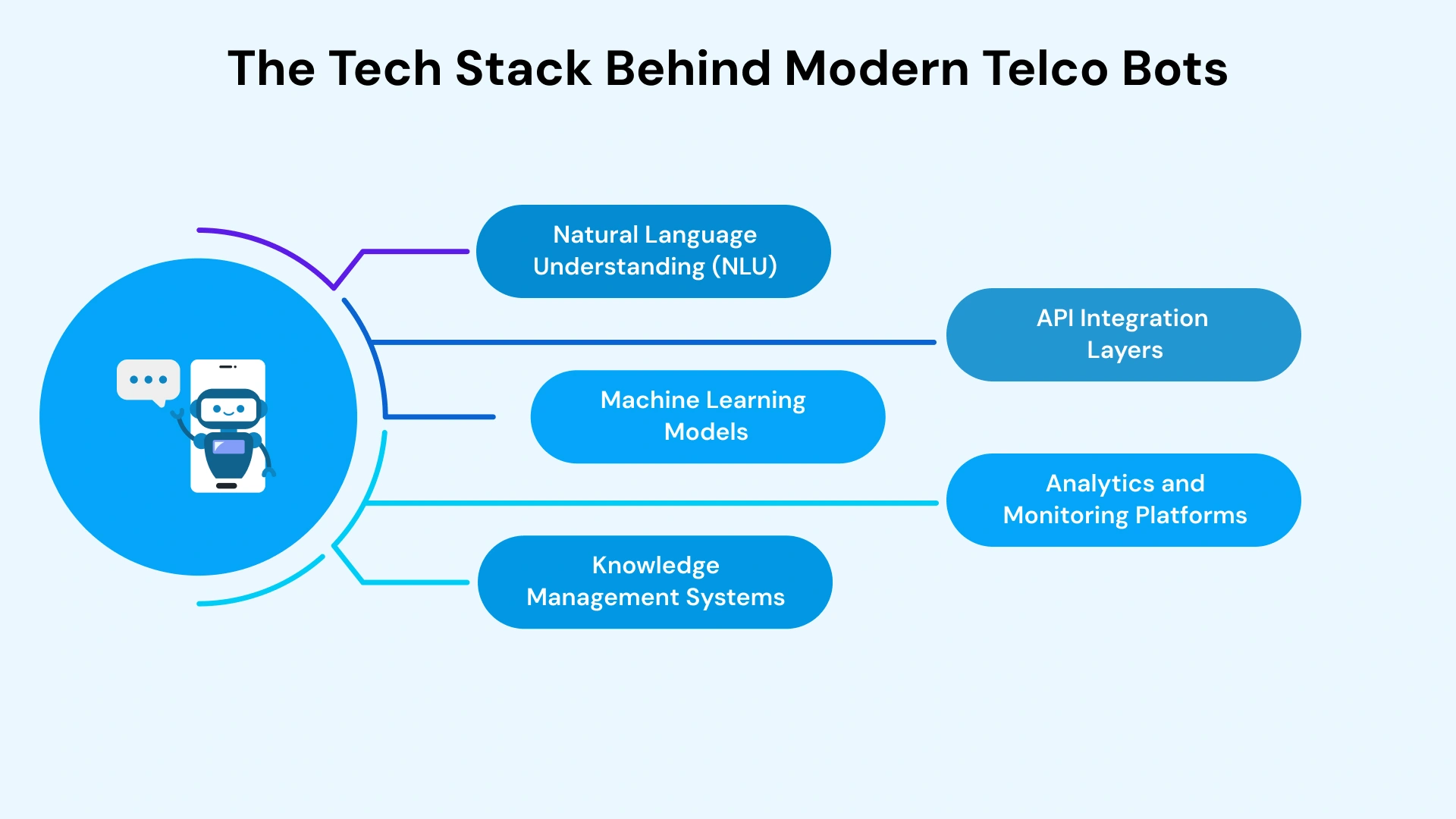
- Natural Language Understanding (NLU) forms the core of AI chatbot integration services for telecom, enabling chatbots to interpret customer intent from conversational language rather than requiring rigid command structures. Advanced NLU systems understand context, handle ambiguity, recognize entities like account numbers or device models, and maintain conversational flow across multiple exchanges.
- Machine Learning Models within custom AI chatbot development for telecom continuously improve chatbot performance by learning from interaction patterns, successful resolution pathways, and customer feedback. Over time, these systems become increasingly accurate at understanding queries, predicting customer needs, and recommending optimal solutions.
- Knowledge Management Systems serve as the chatbot's information repository, organizing technical documentation, troubleshooting procedures, product information, and policy guidelines in machine-readable formats. The quality and organization of this knowledge base directly impact the AI chatbot for customer support project.
- API Integration Layers connect the AI chatbot solution for telecom support automation to critical backend systems, enabling real-time data retrieval and transaction execution. Secure, well-documented APIs are essential for chatbots to check account balances, modify service plans, initiate service requests, and perform other operational tasks.
- Analytics and Monitoring Platforms track performance metrics, conversation flows, resolution rates, customer satisfaction scores, and escalation patterns for an AI chatbot to replace call center support in telecom, providing insights that drive continuous optimization.
Business Impact: Why Telecom Leaders Are Investing in Chatbot Technology
Telecom leaders are no longer viewing chatbots as just "FAQ robots." In 2025, the shift toward Generative AI and Agentic AI has turned these tools into strategic assets that drive significant bottom-line growth.
Here is why telecom leaders are aggressively investing in chatbot technology.
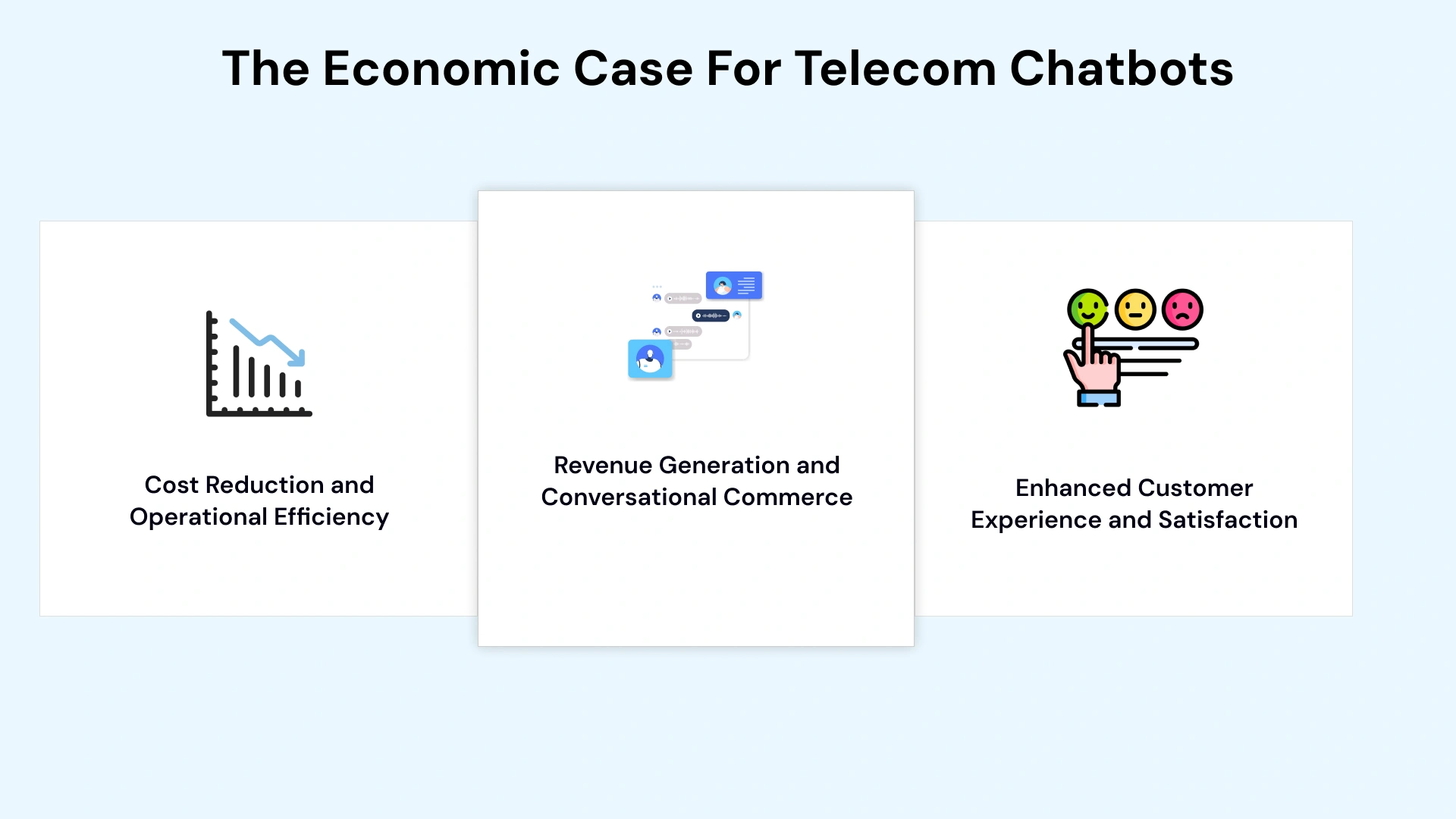
Cost Reduction and Operational Efficiency
The financial case for customer support AI chatbot telecom cost optimization is compelling. Traditional call centers operate with high fixed costs—agent salaries, training programs, facility expenses, and management overhead—that scale linearly with customer volume. AI chatbot solutions for telecom, by contrast, offer near-unlimited scalability with minimal marginal cost increases.
Leading telecom providers report cost-per-interaction reductions of 60-80% for queries handled by telecom AI chatbot development company solutions versus human agents. When a chatbot successfully resolves a billing question, password reset, or plan inquiry, it delivers the same outcome as a human agent at a fraction of the cost. For high-volume, routine inquiries that constitute 40-60% of total support contacts, this represents substantial savings.
Beyond direct cost reduction, a scalable AI chatbot solution for telecom operations improves operational efficiency by handling multiple conversations simultaneously, eliminating wait times, and operating 24/7 without breaks, holidays, or shift changes. This constant availability is particularly valuable for telecom providers serving global markets across multiple time zones.
AI-powered customer support chatbot solution for enterprise implementations also reduces agent burnout by handling repetitive, low-complexity queries, allowing human agents to focus on complex problem-solving, relationship building, and high-value customer interactions that require empathy, creativity, and strategic thinking. This improves job satisfaction, reduces turnover, and enhances the overall quality of human-delivered support.
Revenue Generation and Conversational Commerce
Forward-thinking telecom leaders recognize that AI solutions for telecom customer support aren't just cost-reduction tools but powerful revenue engines capable of driving conversational commerce initiatives.
Intelligent Upselling and Cross-Selling occur when an intelligent AI chatbot solution for telecom support systems analyzes customer profiles, usage patterns, and conversation context to identify relevant upgrade opportunities. A customer inquiring about international calling might receive personalized recommendations for global roaming plans. Someone who frequently exceeds data limits could be offered an unlimited data package with a clear value proposition tailored to their usage behavior.
Proactive Engagement enables AI agent-based customer support and AI chatbot telecom pricing models to initiate conversations based on trigger events—contract expiration approaching, new device launch relevant to customer preferences, and promotional offers aligned with customer segments. This transforms chatbots from reactive support tools into proactive sales assistants.
A generative AI chatbot solution for telecom streamlines purchase journeys, reducing friction in the buying process. Customers can explore plans, compare options, ask clarifying questions, and complete purchases entirely within the chat interface without navigating complex web forms or waiting for sales calls.
Retention and Churn Prevention become more effective when an LLM-based customer support chatbot for telecom solutions identifies at-risk customers through behavioral signals and engagement patterns, triggering retention protocols that might include personalized offers, service credits, or expedited issue resolution.
Telecom providers implementing sophisticated conversational AI for telecom customer support platforms report significant improvements in conversion rates, average transaction values, and customer lifetime value, demonstrating that well-designed chatbots deliver measurable business outcomes beyond operational efficiency.
Enhanced Customer Experience and Satisfaction
In an industry notorious for customer service challenges, AI chatbot implementations for customer support projects offer telecom providers an opportunity to differentiate through superior customer experience.
Instant Gratification through end-to-end AI chatbot solution for telecom addresses the primary customer pain point in traditional support channels: wait times. Chatbots respond immediately, eliminating hold queues and the frustration of waiting for an agent during peak hours or for after-hours inquiries.
Consistency and Accuracy improve when an enterprise AI chatbot solution for telecom systems accesses centralized knowledge bases rather than relying on individual agent expertise, which varies based on experience, training, and memory. Every customer receives accurate, policy-compliant information regardless of when or how they contact support.
Personalized Interactions through customer AI chatbot development for telecom create experiences where customers feel recognized and valued. Chatbots that remember previous conversations, acknowledge account history, and tailor recommendations based on individual preferences deliver the personalized touch customers increasingly expect from modern service providers.
Effortless Problem Resolution occurs when an AI chatbot solution for telecom support automation guides customers through intuitive self-service workflows, resolving issues in fewer steps and with less cognitive effort than traditional support channels.
Customer satisfaction metrics consistently show that when telecom customer support AI chatbot solution implementations successfully resolve inquiries without escalation, satisfaction scores rival or exceed those of human-agent interactions, particularly for straightforward transactional queries where speed and accuracy matter most.
Implementation Strategies: Building Your Telecom Chatbot Ecosystem
Building a chatbot ecosystem in telecom is no longer about deploying a single script; it’s about creating an intelligent orchestration layer that sits between your complex back-end systems (BSS/OSS) and your customers.
To move from a basic "FAQ bot" to a high-impact "Agentic AI" ecosystem, consider these core implementation strategies.
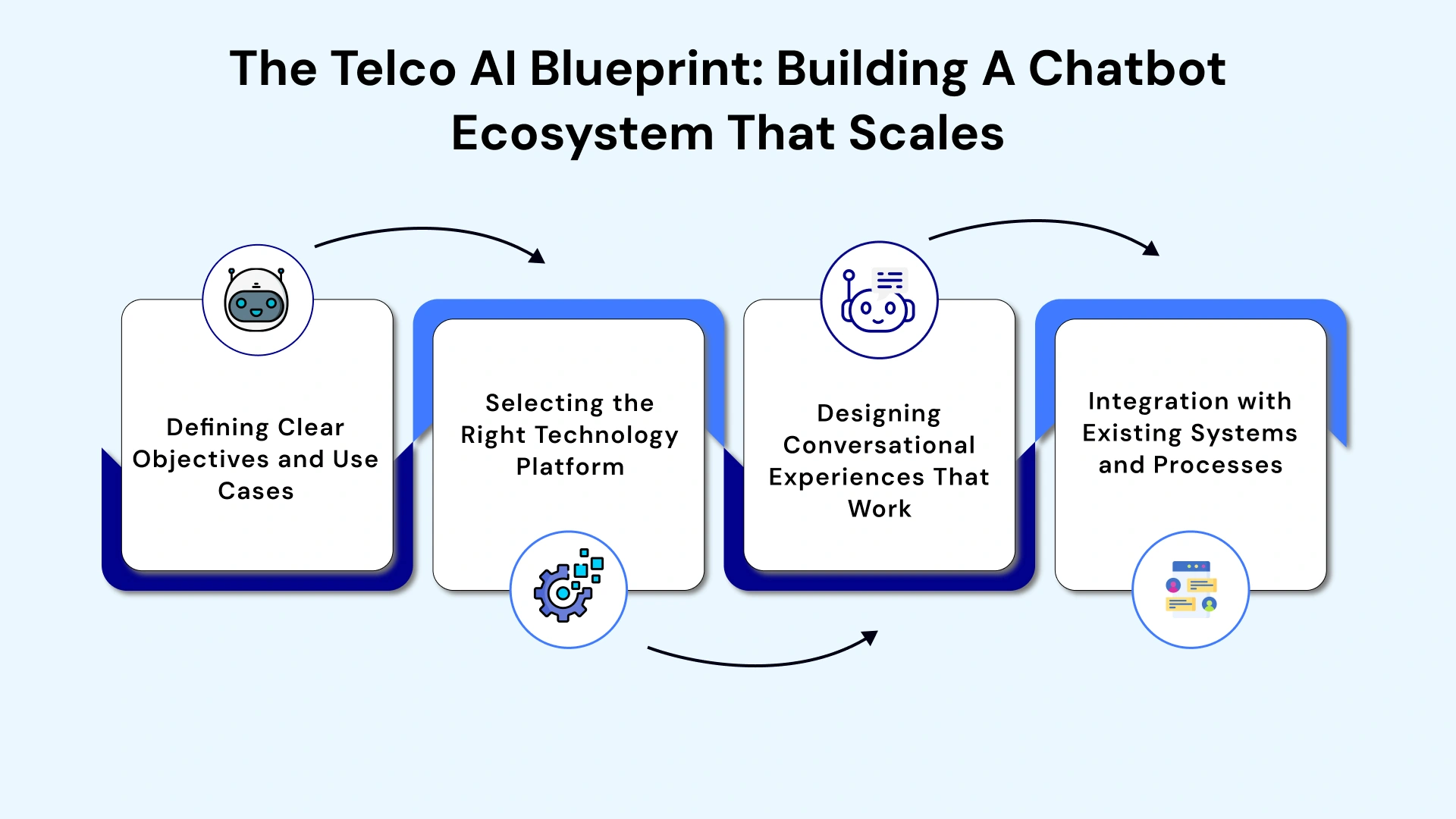
Defining Clear Objectives and Use Cases
Successful customer support AI chatbot development telecom implementations begin with clearly defined business objectives and prioritized use cases aligned with customer needs and operational goals.
- Start with High-Volume, Low-Complexity Queries that offer quick wins and measurable impact. Common starting points for AI chatbot software development for telecom include balance inquiries, payment processing, plan information, password resets, and basic troubleshooting. These queries are repetitive, rules-based, and relatively straightforward, making them ideal for initial chatbot deployment.
- Identify Pain Points in the Customer Journey where friction creates abandonment, escalations, or dissatisfaction. Map the end-to-end customer experience, identifying moments where AI chatbot integration services for telecom intervention could smooth the path or provide timely assistance.
- Establish Success Metrics before deployment to define how you'll measure chatbot effectiveness. Key performance indicators for AI chatbot development services include resolution rate, customer satisfaction scores, average handling time, escalation rate, containment rate, commerce interaction conversion rate, and cost per interaction.
- Phase Your Deployment rather than attempting to build comprehensive capabilities immediately. A phased approach to custom AI chatbot development for telecom enables learning, iteration, and gradual increases in complexity as the chatbot proves its value and the organization builds confidence in the technology.
Selecting the Right Technology Platform
The AI chatbot platform for telecom customer support you choose fundamentally shapes the capabilities, integrations, scalability, and total cost of ownership.
- Build vs. Buy Considerations represent the first significant decision. Custom-built AI chatbot software development for telecom offers maximum flexibility and control but requires considerable development resources, ongoing maintenance, and specialized AI expertise. Pre-built platforms and frameworks accelerate deployment and provide tested functionality, but may require compromise on customization and unique feature requirements.
- Integration Capabilities should be a primary selection criterion for AI chatbot integration services for telecom. Evaluate how easily platforms connect with your existing technology stack—CRM systems, billing platforms, network management tools, authentication systems, and data warehouses. Robust API support, pre-built connectors, and flexible integration architectures reduce implementation complexity and time-to-value.
- NLP and AI Sophistication vary significantly across AI chatbot development service platforms. Some offer basic keyword matching and decision trees, while others provide advanced machine learning models, contextual understanding, sentiment analysis, and intent recognition. The platform's AI capabilities directly impact how naturally customers can interact with the chatbot and how effectively it understands complex queries.
- Scalability and Performance ensure the scalable AI chatbot solution for telecom operations can handle your current volume while growing with your business. Consider peak load handling, geographic distribution capabilities, response time guarantees, and uptime commitments.
- Vendor Support and Ecosystem matter for long-term success when you hire AI chatbot developers for telecom. Evaluate the vendor's roadmap, commitment to innovation, customer support quality, training resources, and community ecosystem that can provide best practices and troubleshooting assistance.
Designing Conversational Experiences That Work
The quality of conversational design determines whether customers embrace or reject your telecom solution for customer support AI chatbot development. Poor conversation flows create frustration and erode trust, while well-crafted interactions feel natural and effective.
- Establish a Clear Personality and Tone that aligns with your brand identity while remaining professional and helpful. The chatbot's voice should reflect your company's values and resonate with your target audience, whether that's friendly and casual or formal and technical.
- Design for Quick Wins by ensuring common queries receive fast, accurate responses through an AI chatbot to replace call center support in telecom. Customers form opinions about chatbot usefulness within the first few interactions—if initial experiences are positive, they'll return for future needs.
- Provide Clear Navigation and Fallback Options so customers never feel trapped. Always offer pathways to human agents, options to rephrase queries, and suggestions for alternative approaches when the end-to-end AI chatbot solution for telecom doesn't understand or can't complete a requested task.
- Use Progressive Disclosure to gather information efficiently without overwhelming customers. Rather than requesting all details upfront, ask follow-up questions based on context to create a more natural conversational flow.
- Test with Real Users throughout the design process. Prototype conversations, conduct usability testing, and iterate based on feedback before full deployment of your customer AI chatbot development for telecom. Fundamental user interactions often reveal assumptions and edge cases not apparent during internal design sessions.
Integration with Existing Systems and Processes
AI chatbot integration services for telecom cannot function in isolation—they must integrate seamlessly with your broader technology ecosystem and operational processes.
- Authentication and Security must be robust for an AI chatbot solution for telecom support automation, ensuring chatbots can verify customer identity before accessing sensitive account information or authorizing transactions. Implement multi-factor authentication, secure token management, and compliance with data protection regulations.
- Real-Time Data Synchronization between the chatbot and backend systems ensures customers receive current information about accounts, services, and transactions. Stale data creates confusion and erodes trust in an intelligent AI chatbot solution for telecom support.
- Handoff Protocols to Human Agents should transfer the complete conversation context, eliminating the need for customers to repeat information. Implement screen pops that display chatbot conversation history, identify customer issues, and any actions already taken.
- Feedback Loops and Continuous Learning mechanisms capture conversation data, customer feedback, and resolution outcomes, feeding this information back into training processes that improve telecom AI chatbot development company performance over time.
- Compliance and Governance frameworks ensure that an AI-powered customer support chatbot solution for enterprise interactions adheres to regulatory requirements, industry standards, and internal policies. Implement audit trails, consent management, and oversight processes that maintain accountability.

Advanced Capabilities: The Next Generation of Telecom Chatbots
Here are the advanced capabilities defining the next frontier of telecom AI:
Predictive Analytics and Proactive Support
The evolution from reactive to proactive customer support represents a paradigm shift in how AI solutions for telecom customer support engage customers. Advanced chatbots leverage predictive analytics to anticipate issues before customers experience them and initiate support interactions proactively.
- Network Quality Monitoring combined with customer location data enables an LLM-based customer support chatbot for telecom to notify affected users about service disruptions before they contact support, setting expectations and reducing support volume. Proactive notifications include estimated restoration times, alternative connectivity options, or service credits to acknowledge the inconvenience.
- Usage Pattern Analysis through a generative AI chatbot solution for telecom identifies customers likely to exceed plan limits, experience bill shock, or require service adjustments. Chatbots can proactively offer personalized recommendations before problems arise, demonstrating attentiveness and providing opportunities for upselling in context.
- Churn Prediction Models flag at-risk customers based on behavioral signals—such as reduced usage, increased support contacts, negative sentiment in interactions, or approaching contract renewal dates. AI agent-based customer support, AI chatbot telecom pricing strategies can trigger retention campaigns or escalate to specialized retention teams with comprehensive customer context.
- Equipment Health Monitoring for modems, routers, and customer premises equipment enables predictive maintenance, where conversational AI for telecom customer support contacts customers about potential device issues before complete failures occur, scheduling technician visits or device replacements proactively.
Voice-Enabled and Multimodal Interactions
The future of customer support AI chatbot telecom transcends text-based chat, incorporating voice assistants, visual AI, and multimodal experiences that combine multiple interaction paradigms.
- Voice Chatbots integrate with phone systems, voice assistants, and smart speakers, enabling customers to interact naturally using speech rather than typing. Advanced voice AI understands accents, dialects, and conversational nuances, providing experiences comparable to those of human agents.
- Visual Problem-Solving allows customers to share photos or videos of equipment, error messages, or installation challenges. Computer vision AI within an enterprise AI chatbot solution for telecom analyzes these images, identifies issues, and provides guided troubleshooting instructions with annotated visuals showing exactly where to check connections, reset devices, or verify configurations.
- Augmented Reality Support takes visual assistance further by overlaying troubleshooting instructions on live camera feeds, guiding customers through complex setup procedures or repairs with step-by-step AR guidance that highlights exactly which cables to connect, which buttons to press, and which settings to adjust.
- Multimodal Conversations seamlessly combine text, voice, and visual elements in a single interaction, allowing customers to choose the most convenient input method at each step. At the same time, the chatbot maintains context across modalities.
Integration with Emerging Technologies
Forward-thinking telecom providers exploring AI chatbot consulting services for telecom are investigating how chatbots integrate with broader technology trends reshaping the industry.
- 5G and Edge Computing enable a more responsive, intelligent, scalable AI chatbot solution for telecom operations with reduced latency and enhanced processing capabilities at the network edge. Complex AI models can execute closer to users, improving performance while reducing bandwidth requirements.
- IoT Device Management is becoming more sophisticated, with an AI chatbot solution for telecom support automation serving as a control interface for connected home devices, managing smart home ecosystems, troubleshooting IoT connectivity issues, and optimizing device configurations through conversational interfaces.
- Blockchain for Identity and Transactions may enhance security and transparency in chatbot-mediated transactions, creating immutable audit trails and decentralized identity verification that reduces fraud while respecting customer privacy.
- Extended Reality (XR) Integration positions the telecom customer support AI chatbot solution as a companion within virtual and mixed reality environments, providing support and guidance for telecom services accessed through immersive platforms.
Overcoming Implementation Challenges
Implementing a chatbot ecosystem in the telecom sector is fraught with high-stakes obstacles, ranging from rigid legacy infrastructure to the "hallucination" risks of Generative AI. As of late 2025, telecom leaders are shifting from "launch and leave" tactics to a governance-first implementation approach.
Here are the primary challenges and the strategies to overcome them.
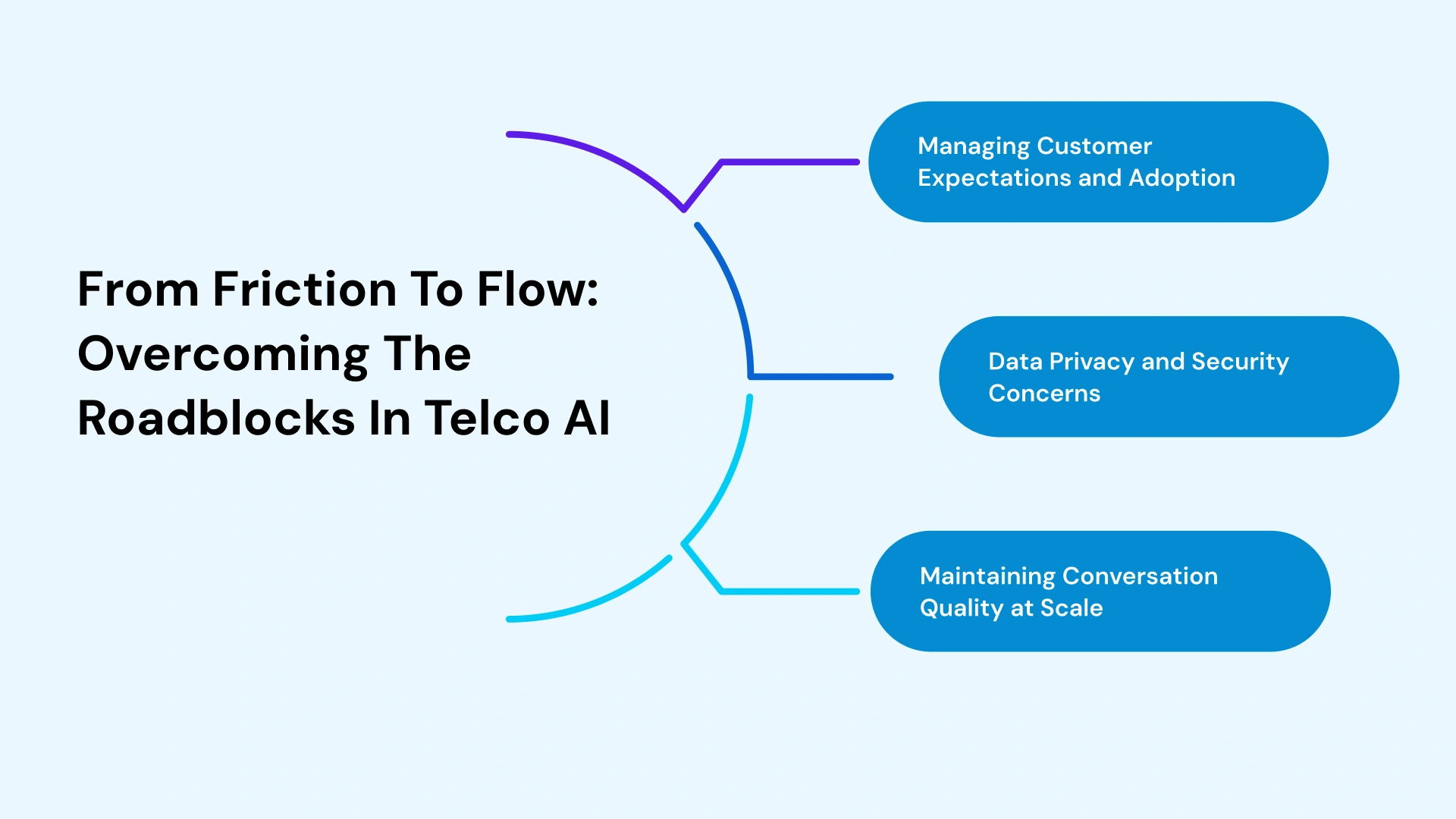
Managing Customer Expectations and Adoption
Even well-designed customer support AI chatbot development telecom solutions face adoption challenges when customers harbor skepticism or prefer traditional support channels.
- Transparent Positioning sets appropriate expectations by clearly indicating when customers are interacting with AI versus human agents. Deceptive practices that mask automation erode trust and damage brand reputation.
- Gradual Introduction eases customers into AI chatbot interactions for a customer support project by offering them as optional alternatives rather than forcing exclusive use. Allow customers to choose their preferred channel while gently encouraging chatbot trial through incentives or highlighted benefits.
- Continuous Improvement Visibility demonstrates responsiveness to feedback by regularly communicating chatbot enhancements, new capabilities, and improvements based on customer input. This builds confidence that issues are being addressed and that the experience will continue to improve.
- Human Escalation Ease reassures customers that human assistance remains accessible when needed. Remove barriers to agent escalation rather than creating friction that traps frustrated customers in chatbot loops.
Data Privacy and Security Concerns
Customer support AI chatbot telecom implementations access highly sensitive customer data—personal information, account details, usage patterns, payment information—creating significant privacy and security responsibilities.
- Privacy-by-Design Principles should guide AI chatbot software development for telecom, minimizing data collection to what's necessary, implementing strong encryption, and providing transparency about how customer data is used and protected.
- Regulatory Compliance across jurisdictions requires careful attention to evolving data protection laws such as GDPR and CCPA, as well as sector-specific telecommunications regulations. Implement robust consent management, data retention policies, and processes for fulfilling customer rights.
- Security Hardening protects the AI chatbot platform for telecom customer support infrastructure from attacks through regular security audits, penetration testing, vulnerability management, and adherence to industry security frameworks.
- Transparency and Control give customers visibility into what data chatbots access and control over permissions, data sharing, and conversation history retention.
Maintaining Conversation Quality at Scale
As end-to-end AI chatbot solutions for telecom deployments grow, maintaining consistent, high-quality interactions becomes increasingly challenging.
- Knowledge Base Governance ensures information remains current, accurate, and comprehensive through systematic review processes, subject-matter expert oversight, and version control that tracks changes and their impacts in an intelligent AI chatbot solution for telecom support.
- Conversation Monitoring and Quality Assurance samples chatbot interactions regularly to evaluate conversation quality, resolution effectiveness, and adherence to brand standards. Use both automated metrics and human review to catch issues before they spread across your enterprise AI-powered customer support chatbot solution.
- Feedback Mechanisms capture customer satisfaction after each interaction, identifying problem areas and successful patterns. Analyze negative feedback systematically to understand root causes and prioritize improvements for custom AI chatbot development for telecom.
- A/B Testing and Experimentation enable data-driven optimization by testing variations in conversation flows, response phrasings, and interaction patterns to identify what works best for different customer segments and use cases.
Measuring Success: KPIs and ROI for Telecom Chatbots
In 2025, telecom leaders have moved beyond vanity metrics like "number of chats." Success is now measured through a sophisticated blend of financial impact, operational efficiency, and customer sentiment.
To demonstrate the value of your chatbot ecosystem, focus on these measurement pillars.
Essential Performance Metrics
Effective telecom AI chatbot development company management requires tracking metrics that provide comprehensive visibility into performance, customer satisfaction, and business impact.
- Containment Rate measures the percentage of conversations that an AI chatbot successfully resolves, replacing call center support in telecom without human escalation. High containment rates indicate that chatbots are handling their intended use cases effectively while also reducing human-agent workload.
- First Contact Resolution (FCR) tracks whether customer issues are resolved during the initial chatbot interaction or require follow-up. Higher FCR correlates with customer satisfaction and operational efficiency for a generative AI chatbot solution for telecom.
- Customer Satisfaction Score (CSAT) gathered through post-interaction surveys provides direct feedback on customer perception of chatbot interactions—segment CSAT by interaction type, customer segment, and outcome to identify strengths and weaknesses.
- Average Handling Time (AHT) indicates how quickly the LLM-based customer support chatbot for telecom resolves inquiries. While speed matters, balance this against resolution quality—rushed interactions that fail to solve problems create repeat contacts.
- Escalation Rate shows the percentage of conversational AI for telecom customer support conversations that are transferred to human agents. Monitor which query types escalate most frequently to identify training gaps or areas requiring enhanced capabilities.
- Conversion Rate for commerce-related interactions measures how effectively AI agent-based customer support AI chatbot telecom pricing strategies drive revenue through upselling, cross-selling, and direct purchases.
Calculating Return on Investment
Building a comprehensive business case for customer support AI chatbot telecom cost investment requires quantifying both costs and benefits across multiple dimensions.
- Direct Cost Savings come from reduced call center volume, lower agent requirements, and decreased training expenses. Calculate cost-per-interaction for an AI chatbot solution for telecom support automation versus human channels, multiplied by interaction volume, to determine gross savings.
- Revenue Impact includes incremental sales from chatbot-driven conversions, reduced churn from improved support experiences, and increased customer lifetime value from enhanced engagement and satisfaction through AI solutions for telecom customer support.
- Productivity Gains occur when human agents handle fewer routine queries and focus on complex, high-value interactions. Measure this through improved agent utilization rates, reduced turnover, and enhanced customer satisfaction with human-delivered support.
- Customer Experience Value is harder to quantify but manifests in improved retention rates, positive word of mouth, and brand preference that drive customer acquisition and reduce marketing costs.
- Implementation and Ongoing Costs for AI chatbot development services include platform licensing, development and customization, integration work, training data preparation, ongoing maintenance, and continuous improvement efforts.
A realistic ROI timeline for telecom customer support AI chatbot development spans 12-24 months for initial payback, with ongoing returns accruing as chatbot capabilities expand and deployment scales.
Future Trends: What's Next for Telecom Chatbots
As we move into 2026, the telecom chatbot is no longer just a "support interface"—it is becoming the primary operating system for the customer relationship. The industry is shifting from reactive chat bubbles to a world of autonomous, multimodal, and network-aware agents.
Here are the key trends defining the next generation of telecom AI.
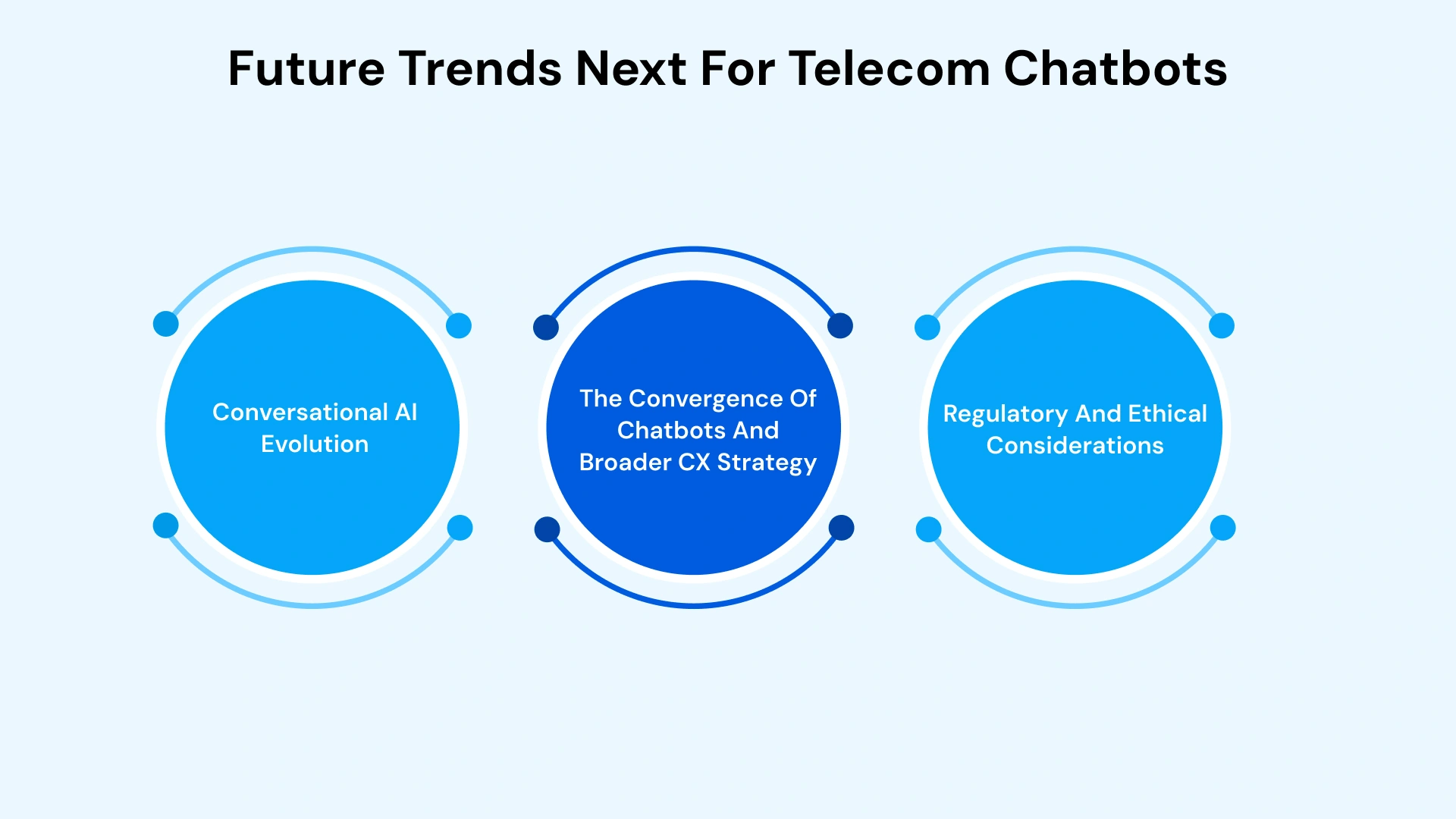
1. Conversational AI Evolution
The next generation of customer support AI chatbots in telecom will leverage breakthrough advances in Large Language Models (LLMs) and Generative AI to provide a more "human" experience.
- More Natural Conversations: Gone are the days of rigid, "if/then" logic. LLM-based systems excel at understanding context and maintaining coherent, multi-turn dialogues. They can parse complex sentences like, "I moved last week, and while my phone works, my home internet is spotty, and I haven't received my first bill yet," and address all three points in a single, fluid response.
- Emotional Intelligence & Empathy Modeling: Sophisticated sentiment analysis enables bots to detect real-time frustration, urgency, or satisfaction. A frustrated customer reporting a service outage will receive a concise, apologetic, and solution-oriented tone, while a satisfied customer inquiring about new features might experience a more enthusiastic, conversational interaction.
- Domain Expertise Depth: Specialized training on telco-specific data (network engineering, device manuals, and infrastructure maps) creates bots with expert-level technical knowledge. They can guide users through complex 5G router configurations or explain the nuances of "Network Slicing" for business clients.
- Autonomous Problem-Solving: Generative AI is moving toward "reasoning." Instead of following a script, the bot can develop a unique solution strategy—such as cross-referencing a user's billing history with a known regional cell tower maintenance log—to independently resolve a "unique" problem.
2. The Convergence of Chatbots and Broader CX Strategy
Leading providers are no longer treating bots as standalone silos; they are the "connective tissue" of a comprehensive Customer Experience (CX) ecosystem.
- Unified Customer Intelligence: By combining chatbot data with web behavior, app usage, and network performance, telcos create a "360-degree view." If a bot knows your 5G signal has been weak at home for three days, it doesn't wait for you to ask—it greets you with a diagnostic report.
- Orchestrated Journeys: The bot acts as a primary conductor. It might start a conversation on WhatsApp, send a follow-up summary via email, and, if the issue persists, schedule a human technician visit that is pushed as a notification to the mobile app—all in one cohesive, intentional flow.
- Continuous Engagement: The relationship becomes persistent. The AI becomes a "lifecycle assistant" that provides ongoing value, such as account-optimization suggestions (e.g., "You're paying for 50GB but only using 10GB; want to switch to a cheaper plan?") rather than just popping up when something breaks.
- Ecosystem Integration: AI integration services now extend to third-party partners. Your telecom bot might coordinate with your smart home hub manufacturer or a streaming service partner (such as Netflix or Disney+) to troubleshoot login issues across platforms.
3. Regulatory and Ethical Considerations
As AI capabilities expand, so does the scrutiny from global regulators (like the EU AI Act and new state laws in the US).
- AI Transparency & Disclosure: By 2026, many jurisdictions (including California and the EU) will mandate that bots clearly identify themselves as AI at the start of an interaction. Providers must also be able to "explain" how an AI arrived at a specific decision, such as a credit score check for a new line of credit.
- Algorithmic Fairness: There is a rigorous push to audit training data for bias. Telecoms must ensure their AI doesn't offer better deals or faster support based on zip codes or demographic markers that could lead to discriminatory treatment.
- Digital Accessibility: Next-gen bots are being designed for "Equitable Access." This includes multimodal interfaces for people with visual or hearing impairments and real-time translation for non-native speakers, ensuring no customer is left behind.
- Environmental Considerations: The massive computing power required for LLMs has a significant carbon footprint. Forward-thinking telcos are investing in "Frugal AI"—smaller, more energy-efficient models (such as SLMs or quantized models) that deliver the same accuracy with 90% less energy consumption.

Scale Your Connectivity: Harnessing VLink Expertise for Telecom AI Chatbots Development
As the telecommunications industry races toward AI-driven customer engagement, selecting the right telecom AI chatbot development company partner becomes critical for success. VLink stands at the forefront of AI chatbot development services, delivering comprehensive solutions that transform customer support from a cost center to a revenue engine.
Our expertise in customer support AI chatbot development for telecom spans the entire implementation lifecycle—from strategic consulting and use-case prioritization to development, integration, deployment, and continuous optimization.
Our dedicated team has extensive experience with a scalable AI chatbot solution for telecom operations that handles millions of concurrent conversations, maintains sub-second response times, and operates with carrier-grade reliability.
We've successfully deployed an end-to-end AI chatbot solution for telecom implementations that deliver:
- 60-80% reduction in cost-per-interaction versus traditional support channels
- 40-50% improvement in first contact resolution rates
- 25-35% increase in customer satisfaction scores
- 15-25% revenue lift from intelligent upselling and cross-selling
Our ideal solutions leverage state-of-the-art natural language processing, machine learning models trained on telecommunications-specific datasets, and sophisticated dialogue management systems that handle complex, multi-turn conversations with contextual understanding and empathy.
Transforming your telecom customer support with AI solutions begins with a conversation. VLink's approach starts with understanding your specific challenges, customer pain points, competitive positioning, and business objectives. Our proven methodology for an AI chatbot to replace call center support in telecom ensures smooth deployment, stakeholder alignment, and measurable business impact from day one.
Conclusion: Embracing the Chatbot-Powered Future of Telecom
The telecommunications industry is at a transformative moment in which customer expectations, technological capabilities, and business imperatives converge around intelligent automation. Customer support AI chatbot telecom solutions have evolved from experimental novelties to strategic necessities, fundamentally reshaping how providers engage customers, deliver support, and drive commercial outcomes.
The compelling economics—dramatic cost reductions, revenue generation through AI solutions for telecom customer support, and operational efficiency gains—provide clear financial justification. But beyond numbers, these technologies enable fundamentally better customer experiences characterized by instant availability, personalized interactions, and frictionless problem resolution.
For telecom leaders building conversational commerce platforms, success requires strategic vision for how an enterprise AI chatbot solution for telecom fits within broader customer experience strategies, thoughtful design that prioritizes user needs, and operational commitment to continuous improvement based on data and feedback.
The future of telecom customer support is conversational, intelligent, and always available. Companies that master the AI chatbot platform for telecom customer support technology today are building the customer engagement platforms that will define industry leadership tomorrow. The transformation has begun—the question is whether you'll lead it or follow others who do.
Ready to revolutionize your telecom customer support with AI? Partner with VLink for conversational AI for telecom customer support that delivers exceptional customer experiences while driving operational efficiency and revenue growth. Contact our team today to schedule your strategic consultation and discover how our telecom AI chatbot development company's expertise can accelerate your digital transformation journey.

Vice President, Strategy – VLink Inc.
Sambhavi Gopalakrishnan is the Vice President of Strategy at VLink Inc., bringing over a decade of experience in IT leadership, project implementation, and strategic growth. She possesses a strong foundation in technical project management and pre-sales, driving innovation and business transformation at VLink.

 Shivisha Patel