

Custom software vs off-the-shelf is the build-or-buy decision every Gulf enterprise eventually faces. Custom software is built specifically around one company's processes. Off-the-shelf software, whether SAP, Salesforce, or a vertical SaaS product, is built to serve many companies at once. The tradeoff is not simply speed against flexibility. For Gulf enterprises, it is a cost-and-compliance calculation with real numbers on both sides.
This guide runs those numbers. It compares five-year total cost of ownership for custom development against off-the-shelf licensing. It maps the specific UAE and Saudi compliance requirements that off-the-shelf software structurally cannot satisfy. It gives CFOs and CIOs a scoring framework for the decision. That framework breaks down by industry. The answer becomes a calculation specific to a company's own portfolio, not a generic opinion.

Why Do Gulf Enterprises Face This Decision Differently?
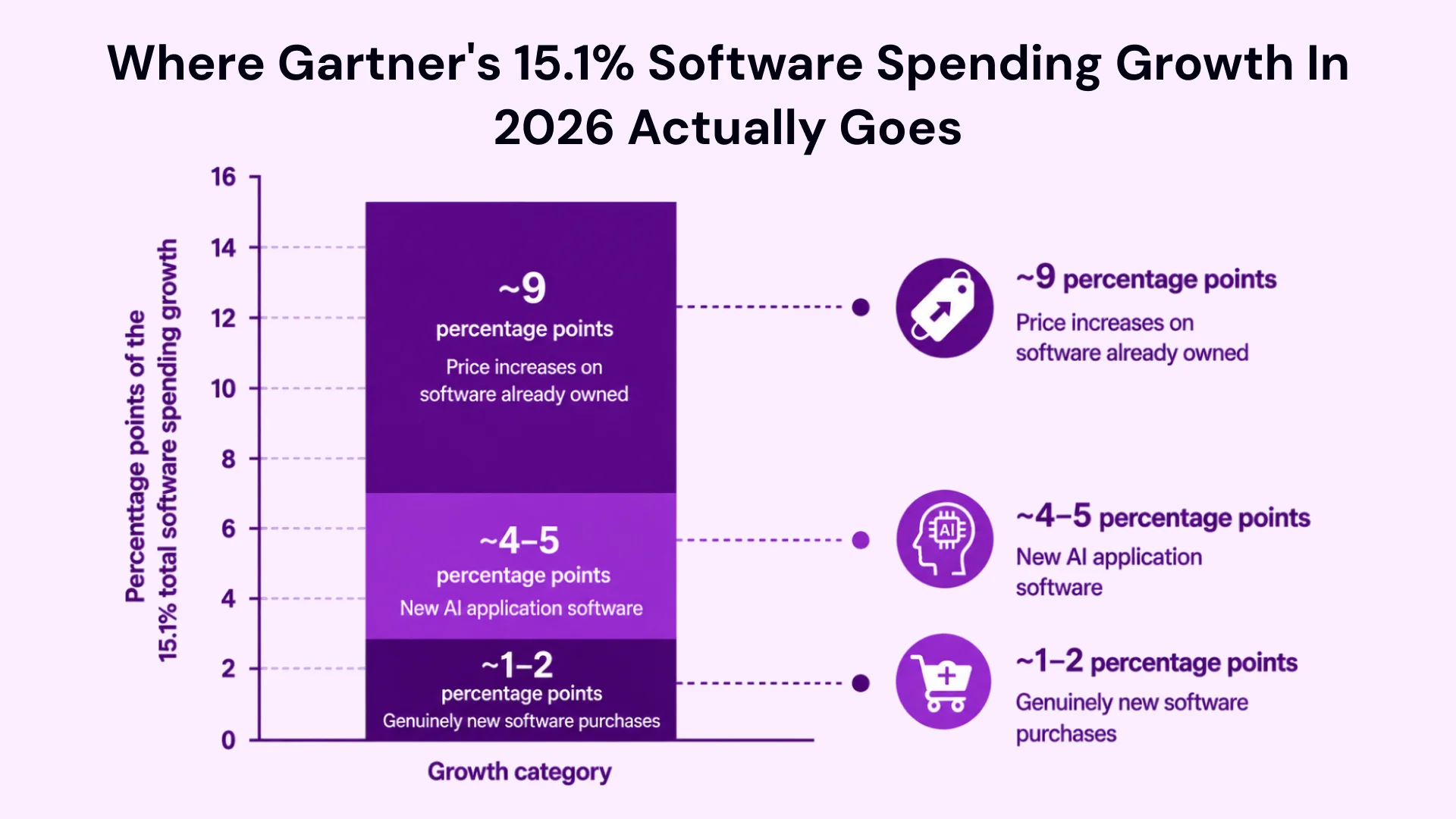
Global software spending is on an unusual trajectory. Gartner forecasts worldwide IT spending will exceed $6 trillion for the first time in 2026, up 9.8% from 2025. Software is the fastest-growing category inside that number, projected to reach $1.43 trillion, a 15.1% increase. Roughly 9% of that growth is not new capability. It is CIOs budgeting for price increases on software they already own. Zylo's 2026 SaaS Management Index found something specific. 79% of IT leaders hit a price increase at renewal in the past 12 months. Gartner-tracked data shows subscription costs from several large vendors rose 10% to 20% in 2025 alone. 2026 renewals now carry a separate AI feature pricing line too. That line adds 20% to 37% on top of the base increase.
This changes the build-versus-buy math everywhere. It changes it more in the Gulf, for a second reason. A Forrester analyst covering this market has argued that traditional build-vs-buy thinking is out of date. Pure buy rarely covers a real enterprise, and pure build is often impractical. In the UAE and Saudi Arabia, a third factor compounds the first two. Certain compliance requirements, tied to data residency and sector regulation, cannot be satisfied by a standard multinational SaaS contract. That holds true no matter the budget. It turns a cost question into a cost-and-compliance question, which most global build-vs-buy guidance never addresses.
What Does Custom Software Actually Cost vs. Off-the-Shelf Over 5 Years?
The honest answer depends heavily on scale and complexity. The shape of the curve is consistent regardless. Off-the-shelf software starts cheaper and gets more expensive every year. Custom software starts more expensive and gets cheaper on a per-year basis, once the initial build is paid off. Take a mid-sized Gulf enterprise, roughly 300 to 500 users, running a core system like CRM or ERP. The crossover point typically falls between year three and year five.
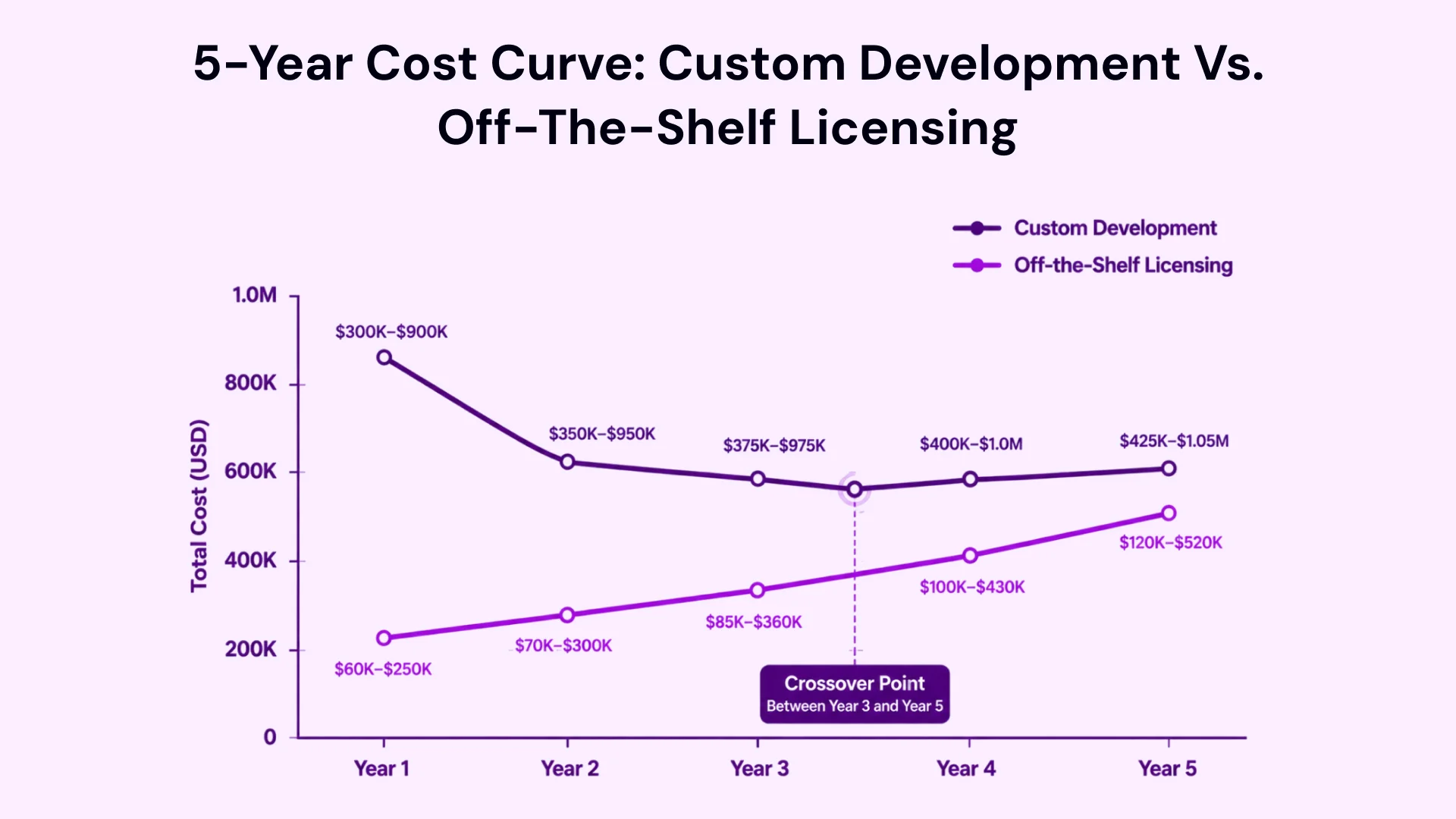
Estimated 5-Year TCO: Custom Development vs. Off-the-Shelf Licensing (300-500 User Enterprise)
| Cost Category | Custom Development | Off-the-Shelf (SaaS License) |
| Year 1 (build/implementation) | $300,000 - $900,000 | $60,000 - $250,000 (implementation + Year 1 license) |
| Years 2-5 (annual run cost) | $45,000 - $135,000/year (15-22% of build cost) | $70,000 - $300,000/year, plus 10-20% renewal increases |
| 5-Year Total (typical range) | $480,000 - $1,440,000 | $540,000 - $1,650,000+, before compliance add-ons |
| Cost Trajectory | Front-loaded, flattens after Year 1 | Compounds annually via renewal increases and per-seat growth |
| Ownership at Year 5 | Full source code and data ownership | License only; no ownership, vendor can discontinue or re-price |
These ranges assume a mid-complexity system. They exclude compliance-specific costs, which Section 3 covers separately. Those costs apply asymmetrically between the two paths. The off-the-shelf total also assumes renewal increases stay within the 10% to 20% range Gartner tracked in 2025. Enterprises adding AI-enabled modules should budget for the additional 20% to 37% uplift now appearing on many 2026 renewals.
A Concrete Example: CRM Licensing vs. a Custom Build
A 400-user Salesforce Enterprise deployment in the Gulf typically runs $180 to $250 per user per year, including standard customization. That is roughly $85,000 to $110,000 annually before renewal increases. Over five years, with realistic 10-15% renewal growth, that reaches $500,000 to $700,000. This is before any UAE- or Saudi-specific customization. Picture a comparable custom CRM, built to the same 400-user scale with the workflows the business actually uses. It tells a different story. It typically costs $250,000 to $450,000 to build, plus $40,000 to $70,000 a year to maintain. That lands the five-year total closer to $410,000 to $730,000, with full data ownership included at no extra cost.
The pattern holds at ERP scale too, though the numbers grow. An SAP S/4HANA license for a 400-user Gulf enterprise typically runs $200,000 to $400,000 a year. That figure includes implementation and support. Over five years it reaches $1 million to $2 million or more, before renewal increases. A custom ERP core tells a different story. It is scoped only to the modules the business actually needs, rather than a full packaged suite. That version commonly runs $600,000 to $1.5 million to build, plus 15-20% annually to maintain. The gap narrows considerably once compliance customization gets added to the SAP side, which Section 3 covers next. For an ERP-specific version of this decision, the guide to ERP software in the UAE weighs modernize, replace, and rebuild against the same criteria.
What Can't Off-the-Shelf Software Do for Gulf Compliance?
Some Gulf compliance requirements are not a pricing problem. They are a structural one. A standard multinational SaaS contract, built around a single global data architecture, often cannot satisfy them regardless of budget.
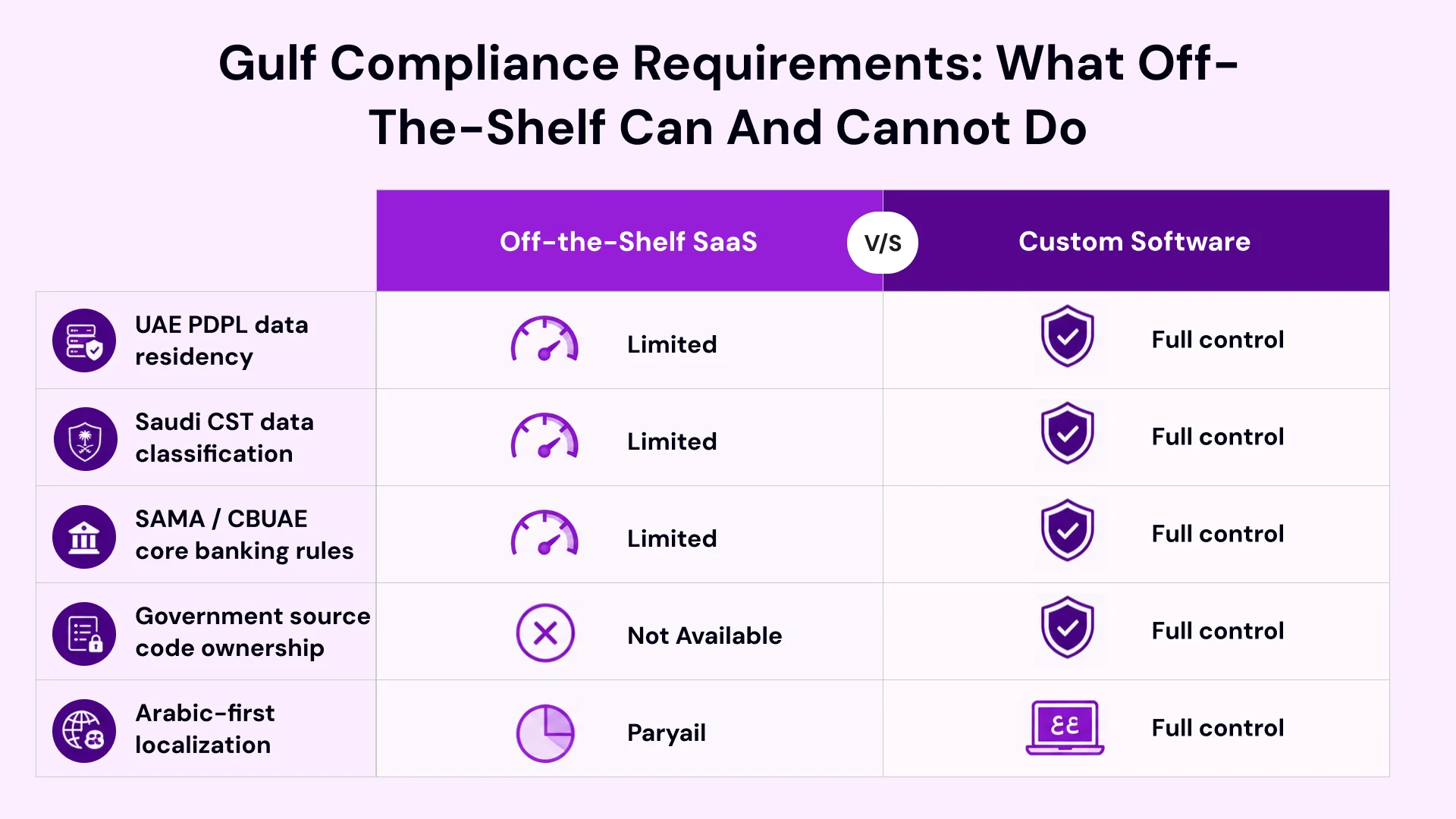
The UAE's Federal Decree-Law No. 45 of 2021, amended by Law No. 1 of 2025, requires a documented adequacy assessment before personal data crosses UAE borders. Most global SaaS vendors host data in regions the vendor chooses, not the customer. Many do not offer a UAE-specific hosting commitment at all. Saudi Arabia's data classification framework, set by the Communications, Space and Technology Commission, sorts data into four tiers. The two most sensitive tiers, Secret and Top Secret, cannot leave the Kingdom under any circumstances. A SaaS product without a Saudi-hosted deployment option is structurally disqualified for that data. This holds no matter how well it fits every other requirement.

Financial services face an additional layer. SAMA in Saudi Arabia and the Central Bank of the UAE both restrict certain data. Core banking data must sit on approved in-country infrastructure. Government procurement in both countries increasingly requires source code escrow or full ownership. Most SaaS licensing models do not offer that under any contract terms. Arabic-first localization is often a secondary market for global SaaS vendors. This covers right-to-left interfaces, Hijri calendar support, and Arabic-language regulatory reporting. It gets addressed with partial features rather than native design.
Gulf Compliance Requirements: Off-the-Shelf vs. Custom Capability
| Requirement | Typical Off-the-Shelf SaaS | Custom Software |
| UAE PDPL data residency (Federal Decree-Law No. 45/2021, amended 2025) | Vendor-chosen hosting; documented adequacy assessment often unclear | Hosting location and data flows fully controlled by design |
| Saudi CST data classification (Secret/Top Secret tiers) | Rarely offers in-Kingdom-only hosting | Can be built to keep specific data entirely within Saudi borders |
| SAMA / CBUAE core banking data rules | Limited or no in-country infrastructure guarantee | Can be deployed on approved in-country infrastructure |
| Government source code / IP ownership requirements | Not available under standard licensing | Full source code ownership by default |
| Arabic-first localization (RTL, Hijri calendar, Arabic reporting) | Often a secondary, partially supported market | Can be designed Arabic-first from the start |
When Does Custom Win, and When Does Off-the-Shelf Win?
Neither path wins by default. The right call depends on how a specific workload scores across five dimensions.
Decision Matrix: Custom vs. Off-the-Shelf Scoring
| Dimension | Off-the-Shelf Signal | Custom Signal |
| Process uniqueness | Workflow matches how most companies in the industry operate | Workflow is specific to this company, no packaged product fits |
| Compliance exposure | Data is low-sensitivity, no residency or source-code requirement | Data is regulated, subject to UAE/Saudi residency or ownership rules |
| Speed to value | Need to be live in weeks, not months | Can absorb 4-9 months build for long-term fit |
| Scale trajectory | User count is stable or shrinking | User count is growing fast enough that per-seat costs compound quickly |
| Integration depth | Standalone tool, minimal integration needs | Deep integration with legacy systems, middleware, or multiple platforms |
A workload scoring mostly in the first column is a strong off-the-shelf candidate. A workload scoring mostly in the second column is different. Particularly on compliance exposure, it becomes a strong custom candidate. That holds regardless of what the first four dimensions suggest. Compliance exposure functions as a veto in Gulf enterprise decisions. A system can score as an off-the-shelf fit on every other dimension and still be disqualified. That happens if it cannot satisfy a hard residency or ownership requirement.
What Are the Hidden Costs of Off-the-Shelf Software?
The sticker price on a SaaS contract rarely reflects what an enterprise pays over five years. Four categories consistently get underestimated during procurement.
Hidden Costs of Off-the-Shelf Software
| Cost Category | What Drives It | Typical Impact |
| Customization fees | Vendor professional services to adapt standard workflows | 10-30% of the initial license cost, often billed annually for changes |
| Per-seat scaling | License cost grows linearly, or worse, with headcount | Can double total license cost as the company grows from 200 to 500 users |
| Integration middleware | Connecting SaaS to legacy systems the vendor does not natively support | $30,000 - $150,000 per major integration point |
| Exit and migration costs | Data extraction, vendor lock-in penalties, and re-implementation elsewhere | Often 20-40% of one year's license cost if switching vendors |
Vendor lock-in is the least visible cost of the four. It is often the most expensive one too. Picture a company that has built five years of custom workflows on top of a SaaS platform's proprietary data model. That company faces a hard choice at renewal time. It can accept the price increase, or absorb a costly, disruptive migration. Custom software does not eliminate this risk entirely. It does keep the exit cost inside the company's own control. That is because the company owns the code and the data model from day one.
Is Low-Code a Middle Path Between the Two?
Forrester's research on this exact question is worth noting. Its analysts found that low-code development has been shifting enterprise preference for years now. It moves preference away from off-the-shelf applications and toward custom development. The reasoning centers on lower cost, lower risk, and shorter lead time compared to fully custom code. It also comes with easier integration and a larger available developer pool.
For Gulf enterprises, low-code is not a universal answer to the compliance problem this guide covers. A low-code platform still runs on infrastructure the platform vendor controls. It can still face the same UAE PDPL or Saudi CST residency questions a SaaS product faces. What low-code changes is the economics of the custom side of the comparison. Workflows that once needed a nine-month custom build can sometimes ship in weeks on a low-code platform. That narrows the cost gap in Table 1. It does not solve the compliance gap in Table 2 on its own.
Does Sovereign Cloud Infrastructure Change the Math?
Gulf infrastructure has changed since most global build-vs-buy guidance was written. AWS operates a full region in Dammam, Saudi Arabia. Microsoft Azure runs regions in both the UAE and Saudi Arabia. STC Cloud and G42 Cloud offer fully domestic, sovereign alternatives in Saudi Arabia and the UAE respectively. This matters for both paths in this guide, not just custom. A growing number of global SaaS vendors now offer a Gulf-region hosting option through one of these providers. That closes part of the compliance gap in Table 2 without a custom build.
The gap does not close completely. A SaaS vendor offering Gulf-region hosting still controls the contract terms, the data model, and the exit costs. It does not automatically satisfy a government source code requirement or a SAMA in-country infrastructure rule on its own. Sovereign cloud availability narrows the compliance argument for custom software. It does not eliminate it, particularly for the source code ownership and deep localization requirements Table 2 covers.
How Does the Answer Change by Industry?
BFSI institutions in the Gulf increasingly build custom fraud detection and core transaction engines. Off-the-shelf fraud tools rarely satisfy SAMA and CBUAE's specific reporting formats. Making them fit requires heavy, expensive customization that erodes the cost advantage entirely. Healthcare providers face a similar pattern with electronic medical records. Commercial EMR platforms cover general clinical workflows well. They struggle with UAE and Saudi-specific patient data residency rules. That pushes many hospital groups toward a custom or heavily modified deployment. Government entities lean toward custom-built citizen portals over packaged content management systems. The main reason is procurement rules that increasingly require full source code ownership, something commercial CMS licensing does not offer. Retail and manufacturing sit at the other end of the spectrum. Their workflows are closer to industry standard. Off-the-shelf ERP and POS platforms usually fit well. Data sensitivity is low enough that residency rules rarely force a custom build.

Industry Lean: Custom vs. Off-the-Shelf
| Industry | Typical System in Question | Typical Lean | Primary Driver |
| BFSI | Fraud detection, core transaction engines | Custom | SAMA/CBUAE reporting formats rarely fit packaged tools |
| Healthcare | Electronic medical records | Custom or heavily modified | UAE/Saudi patient data residency requirements |
| Government | Citizen portals, case management | Custom | Source code ownership requirements in procurement rules |
| Retail & Manufacturing | ERP, POS, inventory | Off-the-shelf | Workflows close to industry standard; lower data sensitivity |
How Should Gulf CFOs and CIOs Evaluate This Decision?
A Saudi banking client once approached VLink assuming their off-the-shelf core banking platform simply needed a configuration change. The goal was to meet a new SAMA reporting requirement. The platform vendor's own team had already said this was not possible within the standard product. The actual fix required a custom middleware layer, built on WebSphere MQ and IIB. It sat between the core banking system and the regulator's reporting portal. From there, it translated and validated data the packaged system could not format correctly on its own. The client had budgeted for a small configuration project. What they needed was a scoped custom integration, roughly 12 weeks of work. The off-the-shelf platform alone could never have delivered it. That middleware-first diagnosis is the same one set out in the guide to legacy system modernization for Gulf enterprises.
That pattern repeats often enough to be a rule, not an exception. Before signing an off-the-shelf contract or scoping a custom build, a Gulf CFO or CIO should confirm four things. First, run the 5-year TCO comparison from Section 2 against the actual user count and growth trajectory. The current headcount alone is not enough. Second, map every data type the system will touch against UAE PDPL and Saudi CST classification. Add any sector-specific rule from SAMA, CBUAE, or a relevant government authority. Third, score the workload against the five dimensions in Section 4's decision matrix. Treat a compliance veto as final, regardless of the other scores. Fourth, get a written commitment from any SaaS vendor. That commitment should cover hosting location, source code escrow terms, and exit costs, secured before signing. These terms are negotiable pre-contract and nearly impossible to negotiate after.
Run the Numbers Before You Sign Anything
Most build-vs-buy content treats this as a philosophical question. For Gulf enterprises, it is an arithmetic one, with a compliance veto layered on top. VLink's custom development team runs the same TCO and compliance analysis used in this guide. It gets applied against a client's actual systems and actual regulatory exposure, before any build or licensing decision gets made.
Get Your Free Build vs Buy Analysis, scored against your own cost and compliance profile. Or talk to VLink's custom development team about a system you are currently evaluating. Download the Custom vs Off-the-Shelf Decision Calculator to run your own 5-year TCO comparison before you scope any project.

In Summary
Custom software and off-the-shelf software are not competing on flexibility alone, and they are not competing on price alone either. They are competing on a five-year cost curve. Off-the-shelf starts winning that curve, and custom eventually wins it. The crossover typically falls between year three and year five for a mid-sized Gulf enterprise. Layered on top of that curve is a compliance question global build-vs-buy guidance rarely addresses. UAE PDPL, Saudi CST data classification, and SAMA or CBUAE rules can disqualify an off-the-shelf product outright. That holds regardless of price or fit on every other dimension. The right decision comes from running both calculations together. Compare the 5-year TCO and the compliance capability check for the specific workload in question. Neither should be replaced with a blanket policy applied across the whole software portfolio.

Global Delivery Manager, VLink Inc.
Shivisha Patel serves as the Global Delivery Manager at VLink Inc., bringing a wealth of experience in program delivery and management, particularly in the insurance and banking sectors. She has a robust technical background with deep expertise in WebSphere MQ, WTX, IIB, middleware, and enterprise system integration.

 Shivisha Patel