



Statista reports that conversational commerce has emerged as a critical channel for retailers, with 67% of consumers worldwide having used chatbots for customer support in the past year. More impressively, businesses that implement conversational commerce solutions see an average increase of 30-40% in conversion rates compared to traditional e-commerce channels.
But what exactly is driving this transformation?
The answer lies in changing consumer expectations. Today's shoppers demand instant responses, personalized recommendations, and seamless experiences across multiple touchpoints. Traditional e-commerce platforms, with their static product pages and one-way communication, simply can't keep pace with these evolving demands.
A conversational commerce platform bridges this gap by enabling real-time, two-way dialogues between brands and customers through messaging apps, chatbots, voice assistants, and live chat interfaces. These platforms don't just facilitate transactions—they create meaningful connections that drive customer loyalty, increase average order values, and ultimately scale revenue in ways previously unimaginable.
For retail leaders looking to stay competitive in an increasingly digital marketplace, understanding and implementing conversational AI development services isn't just an option—it's a strategic imperative. This comprehensive guide will walk you through everything you need to know about conversational commerce platforms, from foundational concepts to implementation strategies that deliver measurable ROI. Scale conversations enterprise-wide—enterprise conversational AI solutions for commerce and support.

What is a Conversational Commerce Platform?
A conversational commerce platform is an integrated technology solution that enables businesses to engage customers in natural, human-like conversations across various digital channels to facilitate discovery, customer service, and transactions. Unlike traditional e-commerce systems that rely on browsing and searching, conversational commerce creates interactive shopping experiences through dialogue-driven interfaces.
These platforms leverage artificial intelligence, natural language processing (NLP), and machine learning to understand customer intent, provide personalized recommendations, answer questions in real-time, and guide users through the entire purchase journey—from product discovery to post-sale support.
Core Components of Conversational Commerce Platforms
Conversational Commerce represents the convergence of messaging and monetization. To move beyond simple "chat" and deliver a high-converting "chat-to-checkout" journey, a platform must synchronize several complex technical and operational layers.
The foundational architecture of a robust C-Commerce ecosystem is comprised of the following core components:
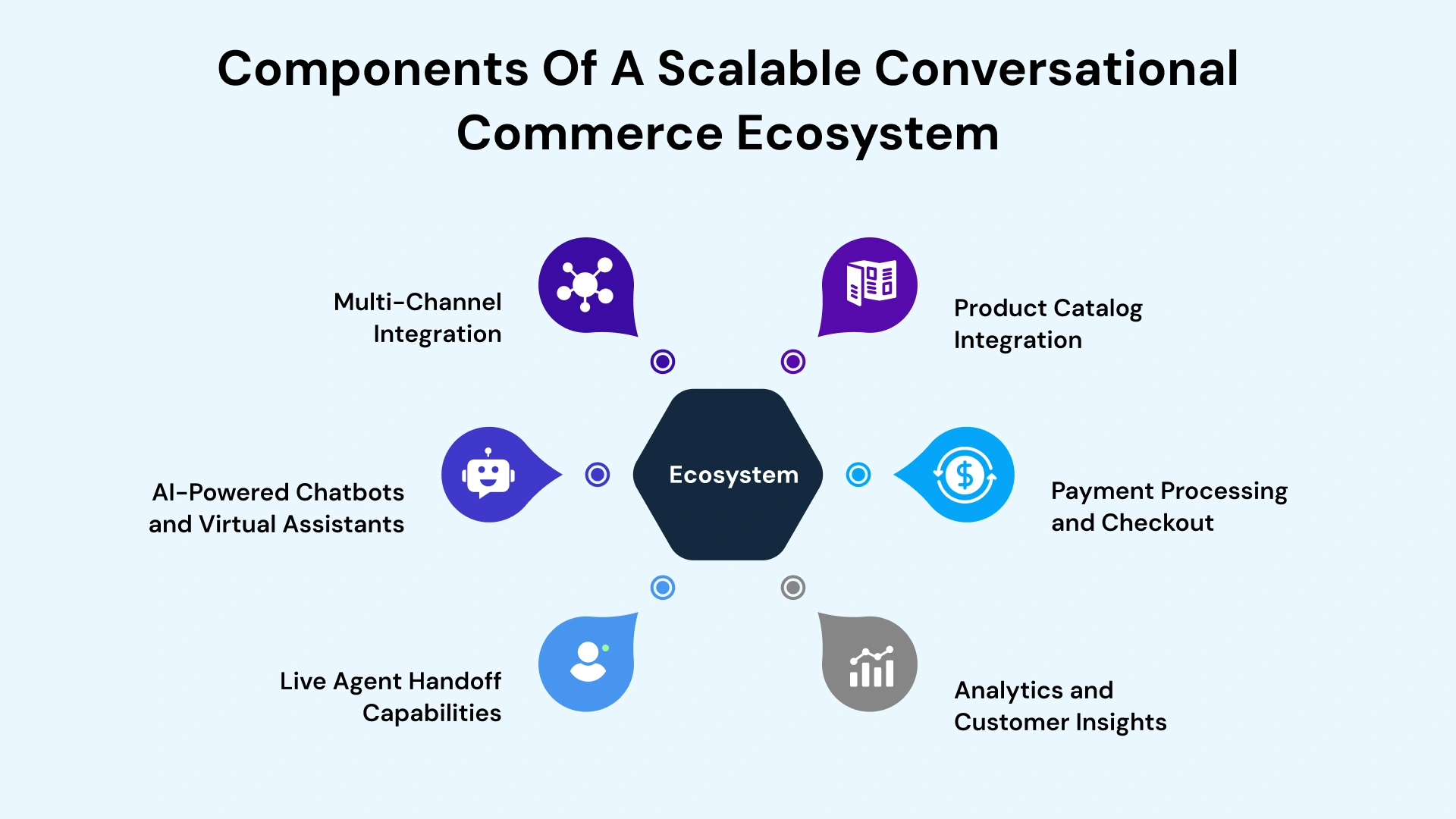
- Multi-Channel Integration: The best conversational commerce platforms operate seamlessly across WhatsApp Business, Facebook Messenger, Instagram Direct, SMS, website chat commerce, mobile apps, and voice assistants like Alexa and Google Assistant. This omnichannel approach ensures customers can engage on their preferred platforms without losing conversation context.
- AI-Powered Chatbots and Virtual Assistants: Advanced chatbots for order tracking, chatbots and live chat integration, and virtual store assistants powered by generative AI and NLP can handle thousands of simultaneous conversations, understanding nuanced queries, product specifications, and even emotional context. These bots learn from each interaction, continuously improving their ability to serve customers effectively.
- Live Agent Handoff Capabilities: While automation handles routine inquiries through AI chatbot development services for retail, complex questions or sensitive issues require human intervention. Sophisticated platforms enable smooth transitions from bot to human agent, passing along full conversation history to ensure continuity.
- Product Catalog Integration: Direct connection to inventory management systems allows conversational interfaces to provide real-time product availability, specifications, pricing, and personalized product recommendations based on customer preferences and browsing history.
- Payment Processing and Checkout: Chat-based checkout capabilities and in-chat payments eliminate the need to redirect customers to external pages, reducing friction and cart abandonment. Secure payment gateways integrated directly into messaging platforms create seamless transactional experiences.
- Analytics and Customer Insights: Comprehensive dashboards track conversation metrics, customer sentiment analysis, conversion rates, and revenue attribution, providing actionable insights to optimize both automated and human-led interactions.
How Conversational Commerce Differs from Traditional E-Commerce
Traditional e-commerce follows a linear, self-service model in which customers navigate categories, search for products, read descriptions, and complete purchases independently. This approach works well for customers who know exactly what they want but creates friction for those seeking guidance, recommendations, or quick answers.
Conversational commerce inverts this paradigm by making the shopping experience interactive and advisory. Instead of customers searching for products, the platform proactively engages them, asks qualifying questions, understands their needs, and guides them to the right solutions. This consultative approach mirrors in-store experiences where knowledgeable sales associates help customers find exactly what they need.
The result is higher engagement, increased customer satisfaction, reduced return rates, and significantly improved conversion metrics—particularly for complex products requiring education or customization.
Why Retail Leaders Are Prioritizing Conversational Commerce Platforms
Retail leaders are shifting away from static, click-based e-commerce toward Conversational Commerce (C-Commerce) because it addresses the industry’s most persistent pain points: rising acquisition costs, cart abandonment, and the "choice paralysis" of modern shoppers.
By 2025, global spending on conversational channels is projected to reach $290 billion, signaling that this is no longer a niche experiment but a strategic imperative. Here is why leadership teams are prioritizing these platforms:
Meeting Evolving Customer Expectations
Today's consumers have been conditioned by experiences with companies like Amazon, Netflix, and Spotify to expect instant, personalized interactions. According to recent research, 82% of consumers expect immediate responses to sales or marketing questions, and 90% rate an "immediate" response as important or very important when they have a customer service question.
Conversational commerce platforms deliver on these expectations by providing 24/7 customer support, instant responses, and personalized customer engagement at scale. This always-on accessibility is particularly valuable for global retailers serving customers across multiple time zones.
Driving Measurable Revenue Growth
The business case for conversational commerce is compelling. Retailers implementing these platforms typically see conversion rates improve by 25-40% compared to traditional web experiences. Average order values often increase by 10-20% due to naturally emerging personalized upselling and cross-selling opportunities during conversations.
Furthermore, conversational commerce reduces customer acquisition costs by improving engagement rates on paid social media campaigns. When ads direct users to Messenger commerce platforms or WhatsApp conversational commerce rather than traditional landing pages, engagement rates can increase by 3-5 times, dramatically improving return on ad spend.
Reducing Operational Costs
One of the most significant advantages of conversational commerce platforms is their ability to automate routine customer service interactions without sacrificing quality. AI-powered chatbots for retail can handle 60-80% of common customer inquiries—such as order tracking, product information, return policies, and store hours—freeing human agents to focus on complex issues that truly require empathy and problem-solving skills.
This automation doesn't just reduce labor costs; it actually improves customer satisfaction by providing instant answers to simple questions through real-time customer engagement. Customers appreciate getting immediate responses for straightforward inquiries rather than waiting in a queue to speak with a human agent about basic information.
Capturing Rich Customer Data and Insights
Every conversation generates valuable data about customer preferences, pain points, common questions, and purchase triggers. Advanced conversational commerce platforms analyze these interactions through deep customer insights and customer journey automation to identify trends, optimize product offerings, improve messaging, and personalize future engagements.
This conversational data is often richer and more actionable than traditional analytics because it reveals the "why" behind customer behaviors, not just the "what." Understanding why customers abandon carts, what concerns prevent purchases, or which product features matter most enables retailers to make more informed strategic decisions.
Creating Competitive Differentiation
As conversational commerce adoption accelerates, early movers gain significant competitive advantages. Brands that excel at conversational engagement build stronger customer relationships, improve lifetime value, and create barriers to entry that make it difficult for competitors to win customers away.
In commoditized product categories where price competition erodes margins, conversational commerce provides an opportunity to compete on experience rather than price alone. A superior conversational shopping experience becomes a defensible moat that protects market position.
Key Features of High-Performing Conversational Commerce Platforms
Here are the essential features of Conversational Commerce Platforms:
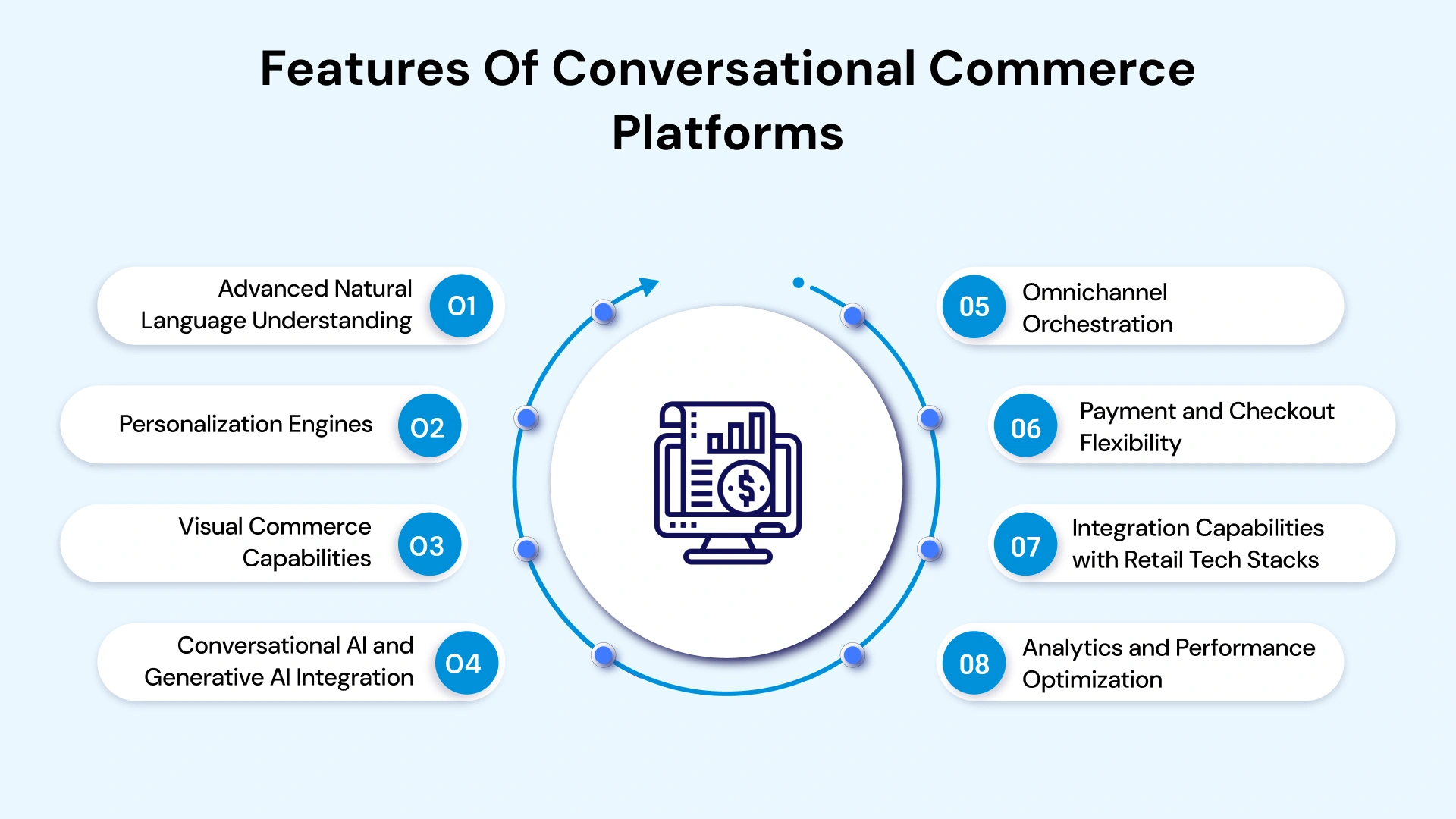
Advanced Natural Language Understanding
The foundation of effective conversational commerce is the ability to accurately interpret customer intent regardless of how questions are phrased. Top-tier platforms employ sophisticated NLP models that understand context, handle misspellings, recognize synonyms, and even interpret emoji and colloquial language.
These systems go beyond simple keyword matching to grasp the nuanced meaning behind customer queries. For example, understanding that "Do you have this in blue?" and "What colors does this come in?" both relate to product availability requires contextual awareness that separates excellent platforms from mediocre ones.
Personalization Engines
Generic, one-size-fits-all conversations don't drive results. Leading conversational commerce platforms leverage customer data—such as purchase history, browsing behavior, demographic information, and past conversation context—to deliver hyper-personalized customer experiences.
This personalization extends beyond simply addressing customers by name. Advanced platforms recommend products based on individual preferences, adjust conversation tone to match customer communication styles, and remember previous interactions to create continuity across sessions.
Visual Commerce Capabilities
While conversational interfaces excel at dialogue, visual elements remain crucial for retail experiences. Modern platforms seamlessly integrate rich media—product images, carousels, videos, GIFs, and interactive elements—directly within conversation flows.
These visual components allow customers to browse products, compare options, and visualize purchases without leaving the messaging interface. The combination of conversational guidance and visual browsing creates an optimal shopping experience that leverages the strengths of both modalities.
Conversational AI and Generative AI Integration
The latest generation of conversational commerce platforms incorporates generative AI, such as GPT-4 and Claude, to enable more natural, flexible conversations that adapt to complex customer needs. These AI conversational commerce platforms can generate product descriptions, compose personalized recommendations, answer nuanced questions, and even handle objections in remarkably human-like ways.
Generative AI also enables dynamic content creation at scale, allowing platforms to automatically generate product comparison charts, styling suggestions, gift recommendations, and other value-added content tailored to individual conversations.
Omnichannel Orchestration
Customers don't think in channels—they expect consistent experiences regardless of where they engage. High-performing conversational commerce platforms maintain conversation continuity as customers move between channels, whether starting on Instagram, continuing on the website, and completing purchases via WhatsApp.
This omnichannel customer engagement requires sophisticated identity resolution to recognize customers across touchpoints and centralized conversation management to maintain context throughout the journey.
Payment and Checkout Flexibility
Friction during checkout is the leading cause of cart abandonment. Advanced conversational commerce platforms minimize this friction by offering multiple payment options directly within messaging interfaces via chat-based checkout—credit cards, digital wallets, buy now, pay later services, and even cash on delivery, where it's preferred.
These platforms also enable saved payment methods, one-click reordering, and subscription management, making repeat purchases effortless and increasing customer lifetime value.
Integration Capabilities with Retail Tech Stacks
Conversational commerce platforms don't operate in isolation—they must integrate seamlessly with existing retail infrastructure, including e-commerce conversational commerce solutions (Shopify, Magento, WooCommerce), CRM systems (Salesforce, HubSpot), inventory management solutions, order management systems, and marketing automation tools.
Robust API frameworks and pre-built connectors enable these integrations without extensive custom development, accelerating time-to-value and ensuring conversational experiences reflect real-time business data.
Analytics and Performance Optimization
Effective measurement is essential for continuous improvement. Leading platforms provide comprehensive analytics covering conversation metrics, customer satisfaction scores, channel conversion rates, revenue attribution, common drop-off points, and agent performance.
Advanced platforms also offer A/B testing capabilities to optimize conversation flows, AI-powered recommendations to improve bot responses, and predictive analytics to identify at-risk customers or high-value opportunities.

Top Conversational Commerce Platform Solutions for Retail
Enterprise-Grade Platforms
- Salesforce Service Cloud with Einstein Bots: Salesforce offers robust conversational commerce capabilities integrated with its CRM ecosystem. Einstein AI powers intelligent routing, predictive recommendations, and automated responses while maintaining full visibility into customer journeys across all touchpoints. Best suited for large enterprises with complex customer service operations.
- Zendesk Conversational Commerce: Zendesk combines its renowned customer service platform with conversational AI to create seamless shopping experiences. Strong ticketing integration ensures no customer inquiry falls through the cracks, while their Answer Bot handles routine questions effectively. Ideal for retailers prioritizing customer support excellence.
- IBM Watson Assistant: IBM's enterprise AI platform provides sophisticated NLP capabilities and can handle complex, multi-turn conversations across voice and text channels. Deep customization options and industry-specific models make it suitable for retailers with unique requirements or highly regulated industries.
Mid-Market and Growth-Stage Solutions
- Kore.ai: This platform excels at building sophisticated conversational AI experiences with visual flow designers and extensive channel integrations. Their retail-specific templates accelerate deployment while allowing significant customization—a strong choice for growing retailers that need enterprise features without the complexity.
- Gupshup: Particularly strong in WhatsApp Business API integration, Gupshup enables conversational commerce across 30+ messaging channels. Their bot builder requires minimal technical expertise, and pre-built retail templates cover common use cases. Excellent for retailers focusing on messaging app commerce, especially in international markets.
- ManyChat and MobileMonkey: These platforms specialize in social media messaging, particularly Facebook Messenger and Instagram. User-friendly visual builders allow marketers to create conversation flows without coding. Best suited for SMBs and DTC brands leveraging social commerce.
Specialized and Emerging Platforms
- Zoko: Built specifically for WhatsApp conversational commerce, Zoko integrates with Shopify to enable product catalogs, order management, and payments within WhatsApp conversations. Particularly popular with retailers in India and Southeast Asia, where WhatsApp dominates customer communication.
- Heyday.ai (by Hootsuite): Focuses on social commerce across Instagram, Facebook, and web chat. Strong product tagging and catalog integration make it easy to turn social conversations into sales. Ideal for retailers with a strong social media presence looking to monetize followers.
- Ada: This platform emphasizes automated resolution without requiring extensive training data. Their machine learning approach learns from existing help center content and customer interactions, enabling it to become effective quickly—a good choice for retailers needing fast deployment with minimal initial setup.
Considerations for Platform Selection
Choosing the right conversational commerce platform requires evaluating several factors: compatibility with the existing technology stack, primary customer communication channels, team technical capabilities, budget constraints, scalability requirements, and specific use cases (customer service, sales, marketing, or all three).
Most successful implementations start with a focused use case—such as chatbots for order tracking or personalized product recommendations—and expand capabilities over time as teams build expertise and demonstrate ROI.
Implementing Conversational Commerce: A Strategic Framework
To move from a basic chatbot to a fully integrated Conversational Commerce strategy, organizations need a structured approach. This framework ensures that the technology aligns with business goals while maintaining a human-centric customer experience.
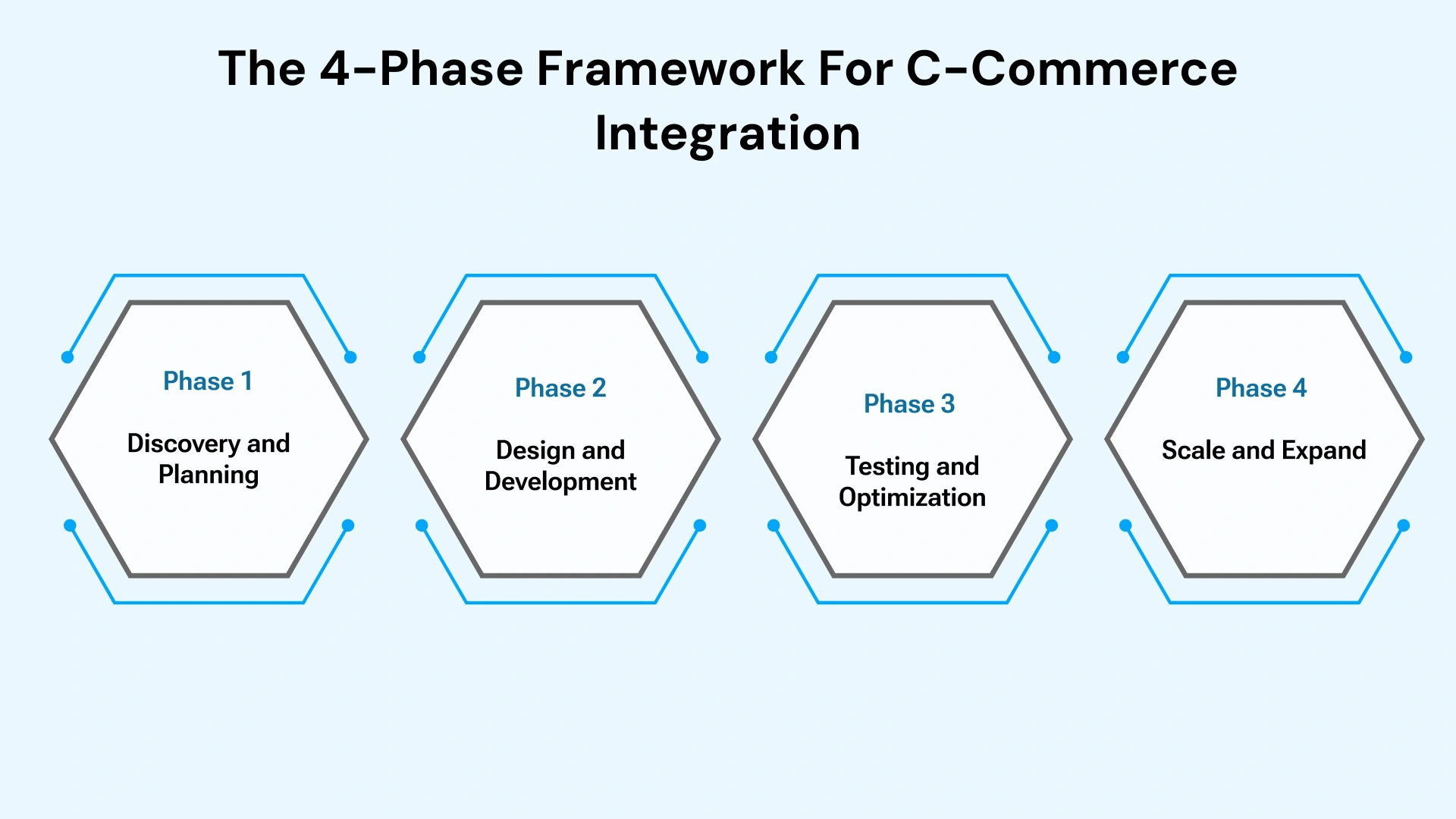
Phase 1: Discovery and Planning
- Audit Current Customer Journey: Begin by mapping existing customer touchpoints, identifying pain points, analyzing customer service inquiry patterns, and understanding where conversations currently happen (phone, email, social media). This audit reveals opportunities where conversational commerce creates the most value.
- Define Clear Objectives and KPIs: Establish specific, measurable goals such as reducing customer service costs by 30%, increasing conversion rates by 25%, improving customer satisfaction scores, or generating specific revenue through conversational channels. Clear objectives guide platform selection and conversation design.
- Identify Priority Use Cases: Rather than attempting to implement conversational commerce everywhere simultaneously, prioritize high-impact use cases such as personalized product recommendations, chatbots for order tracking, customer service automation, abandoned cart recovery, or post-purchase engagement.
- Select the Right Platform: Based on objectives, use cases, existing technology infrastructure, and team capabilities, evaluate platforms using proof-of-concept testing. Many conversational commerce platforms offer free trials, enabling hands-on evaluation before commitment.
Phase 2: Design and Development
- Create Conversation Flow Blueprints: Map detailed conversation flows for each use case, including greeting sequences, qualification questions, product recommendation logic, objection handling, in-chat payment processes, and escalation paths. Visual flow diagrams help teams align on desired experiences.
- Develop Brand Voice and Personality: Define how your conversational AI should communicate—formal or casual, enthusiastic or understated, humorous or straightforward. Consistent voice strengthens brand identity across conversational touchpoints. Create response libraries and style guides to maintain consistency.
- Build and Train AI Models: Configure natural language understanding for your product catalog, train intent recognition models, create entity extraction rules for product attributes and customer information, and develop response variations to avoid robotic repetition. Initial training requires significant effort but dramatically improves conversation quality.
- Integrate Backend Systems: Connect conversational commerce platforms to product catalogs, inventory management, order management, payment gateways, CRM systems, and customer service platforms. These integrations enable real-time access to information and the completion of transactions within conversations.
- Design Handoff Protocols: Establish clear rules for when conversations escalate from bots to human agents through chatbots and live chat integration, how context transfers between systems, agent training on conversational commerce tools, and quality assurance processes to maintain service standards.
Phase 3: Testing and Optimization
- Conduct Comprehensive Testing: Before launch, test conversation flows exhaustively across different customer scenarios, edge cases, channel variations, device types, and payment methods. Involve diverse team members to identify issues developers might miss.
- Pilot with Limited Audience: Launch conversational commerce to a small customer segment initially, gathering feedback, monitoring performance metrics closely, and iterating based on real-world usage. Controlled pilots minimize risk while providing valuable learning.
- Gather Customer Feedback: Implement post-conversation surveys, analyze customer sentiment in conversation transcripts, conduct customer interviews, and monitor social media mentions. Direct customer input reveals experience gaps that quantitative metrics miss.
- Iterate Based on Data: Review analytics regularly to identify common drop-off points, frequently misunderstood intents, popular conversation paths, and revenue-generating patterns. Use these insights to refine conversation flows, expand bot capabilities, and improve personalization.
Phase 4: Scale and Expand
- Gradual Rollout: After successful pilot validation, expand conversational commerce to broader customer segments, additional communication channels, new use cases, and international markets. Staged rollout allows teams to manage complexity and maintain quality.
- Continuous Training and Improvement: Conversational AI requires ongoing refinement. Regularly review misunderstood queries, add new intents and entities, update product information, refresh conversation flows based on customer feedback, and incorporate new platform capabilities.
- Expand Team Capabilities: As conversational commerce scales, invest in training team members on platform features, conversation design principles, AI optimization techniques, and data analysis. Cross-functional collaboration between marketing, customer service, product, and technology teams drives the best results.
- Measure and Communicate ROI: Regularly report on key metrics—cost savings from automation, revenue generated through conversational channels, customer satisfaction improvements, and efficiency gains. Demonstrating clear ROI secures continued investment and organizational support.

Best Practices for Conversational Commerce Success
To transition from a functional chat tool to a high-performing sales channel, retail leaders must follow a set of strategic best practices. Success in Conversational Commerce (C-Commerce) is measured not just by response speed, but by the ability to build trust and reduce friction in the buying journey.
Prioritize Customer Value Over Automation
The goal of conversational commerce isn't to replace humans with bots—it's to create better customer experiences. Design conversations that genuinely help customers accomplish goals faster and more enjoyably than alternatives. When automation creates friction rather than reducing it, default to human assistance through chatbots and live chat integration.
Maintain Transparency About AI
Customers appreciate knowing when they're interacting with AI-powered chatbots versus human agents. Clear disclosure builds trust and sets appropriate expectations. Simple statements like "I'm an AI assistant here to help you" at the start of a conversation prevent disappointment when bots can't handle complex requests.
Design for Mobile-First Experiences
Most conversational commerce happens on mobile devices. Optimize conversation flows for small screens, minimize typing by using buttons and quick replies, ensure images load quickly on cellular connections, and test extensively across various devices and operating systems.
Implement Progressive Disclosure
Avoid overwhelming customers with information or options. Present choices gradually based on customer responses, reveal product details progressively as interest deepens, and save complex configuration for later in conversations after initial engagement succeeds.
Create Smooth Handoff Experiences
When escalating from bot to human agent, transfer the entire conversation history, clearly summarize customer needs, minimize wait times through intelligent routing, and ensure agents have the authority to resolve issues without further transfers. Seamless handoffs feel like natural conversation continuation rather than frustrating restarts.
Personalize Without Being Creepy
Use customer data to improve experiences through hyper-personalization, but avoid demonstrating overly detailed knowledge that feels invasive. Reference recent purchases when relevant, but don't recite complete order history. Balance personalization with privacy respect.
Optimize for Voice of Customer
Pay attention to how customers naturally describe products and problems. Incorporate common phrasing and terminology into bot training rather than forcing customers to adopt company jargon. Effective conversational AI speaks the customer's language, not the business's internal terminology.
Test Across Demographics
Conversational preferences vary by age, culture, geography, and personal communication style. Ensure your platform serves diverse customer segments effectively through inclusive testing and flexible conversation designs that adapt to individual preferences.
Integrate Conversational Commerce with Broader Marketing
Don't treat conversational channels as isolated from other marketing efforts. Coordinate messaging across email, social media, advertising, and conversational touchpoints. Use conversations to gather zero-party data that enhances other marketing activities and creates unified customer experiences.
Establish Governance and Quality Standards
Create clear guidelines for conversation design, brand voice, customer data usage, privacy compliance, and quality assurance. Regular audits ensure conversations maintain standards as teams scale and new use cases launch.
Measuring ROI: Key Metrics for Conversational Commerce
Conversation Metrics
- Conversation Completion Rate: Percentage of conversations where customers achieve their intended goal, whether purchasing, getting questions answered, or resolving issues. Low completion rates indicate friction in conversation flows or insufficient bot capabilities.
- Average Conversation Duration: Time from conversation start to resolution. Track trends to determine whether efficiency improves as AI learns and whether certain conversation paths lead to unnecessary delays.
- Bot Containment Rate: Percentage of conversations handled entirely by AI-powered chatbots without human escalation. Higher containment reduces support costs while maintaining customer satisfaction through instant resolution.
- Customer Satisfaction Score (CSAT): Post-conversation ratings indicate whether customers found the interaction helpful. Compare CSAT scores between bot-only and human-assisted conversations to validate the automation's quality.
Business Impact Metrics
- Conversion Rate: Percentage of conversations resulting in purchases. Track overall conversion and segment by channel, product category, customer segment, and conversion type to identify optimization opportunities.
- Average Order Value: Compare AOVs between conversational commerce and traditional e-commerce channels. Practical, personalized product recommendations and upselling through conversation should measurably increase AOV.
- Revenue Attribution: Total revenue generated through conversational channels, broken down by channel (WhatsApp conversational commerce, Messenger commerce platforms, website chat commerce), use case (product discovery, cart recovery, customer service), and customer segment.
- Cost Per Conversation: Calculate total program costs (platform fees, development, operations) divided by conversation volume. Track trends as automation improves efficiency and volume scales.
- Customer Acquisition Cost (CAC): For conversations initiated through paid advertising, measure the cost to acquire customers through conversational channels versus traditional landing pages. Effective conversational commerce typically reduces CAC significantly.
Operational Efficiency Metrics
- Support Ticket Deflection: Number and percentage of customer service inquiries resolved through conversational AI rather than traditional support tickets. Multiply deflected tickets by the average handling cost to calculate savings.
- Agent Productivity: For conversations requiring human assistance, measure average conversations per agent per hour, average handle time, and first-contact resolution rates. Conversational commerce tools should improve agent efficiency through better context and suggested responses.
- Return and Refund Rates: Effective personalized product recommendations and education during conversational shopping should reduce returns by ensuring customers purchase appropriate products. Track return rates for conversational commerce purchases versus traditional e-commerce.
Customer Experience Metrics
- Net Promoter Score (NPS): Measure the likelihood of customers recommending your brand after conversational commerce experiences. NPS provides insight into the long-term impact on loyalty beyond individual transaction satisfaction.
- Customer Lifetime Value (CLV): Segment customers by engagement channel to determine whether conversational commerce customers exhibit higher CLV due to stronger relationships and better experiences.
- Repeat Purchase Rate: Track whether customers who purchase through conversational channels return more frequently than those using traditional e-commerce paths. Higher repeat rates indicate successful relationship building.
- Response Time: Measure average time to first response for both automated and human-assisted conversations. Faster response times through real-time customer engagement correlate strongly with customer satisfaction and conversion.
Future Trends in Conversational Commerce
The next frontier of conversational commerce is moving beyond simple "chatbots" toward Agentic Commerce—where autonomous AI agents manage the entire shopping lifecycle from discovery to negotiation.
As we look toward 2026, the focus is shifting from "solving for a single pain point" to a full-scale redesign of the retail experience.
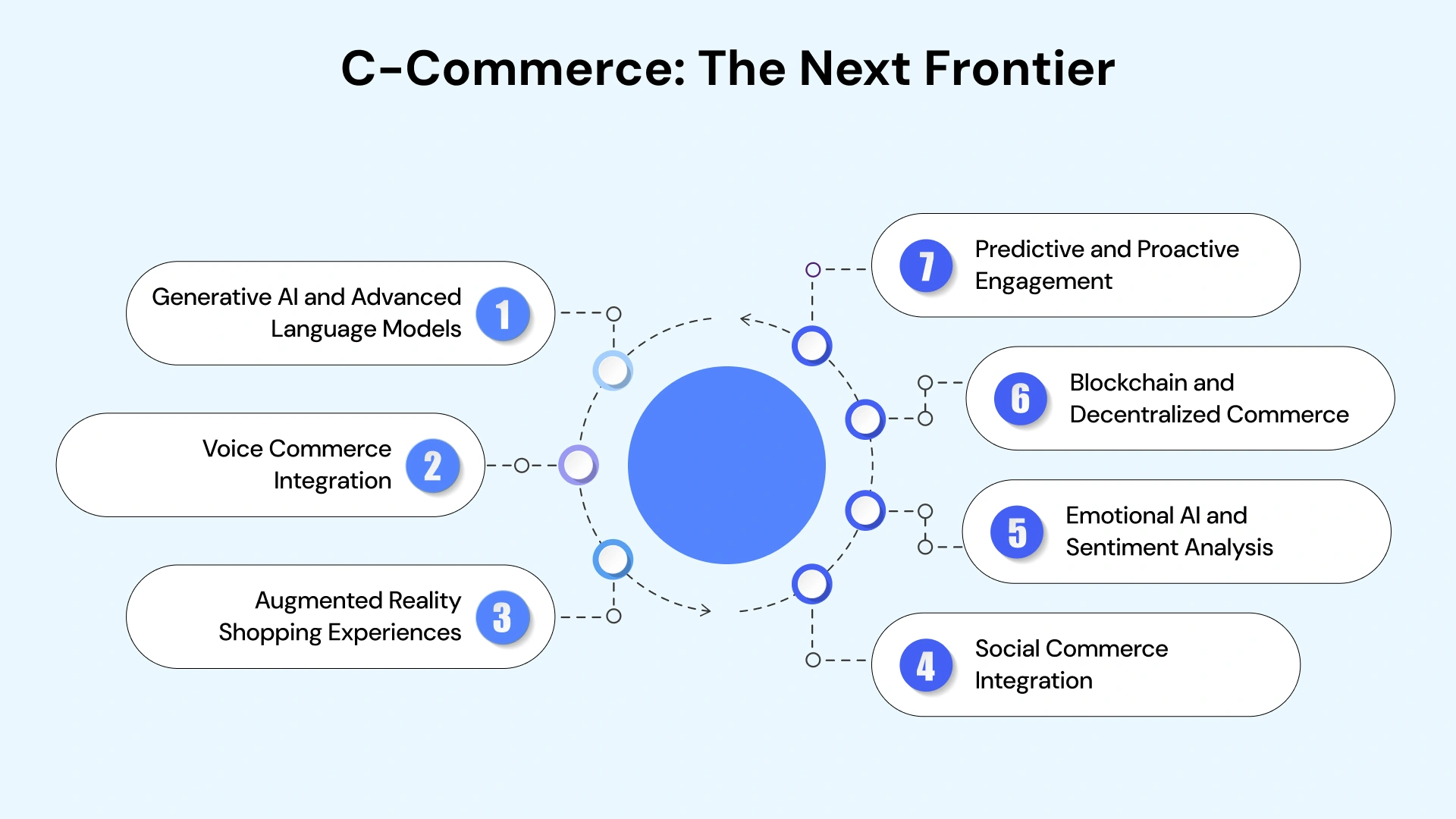
Generative AI and Advanced Language Models
The integration of the best large language models, such as GPT-5 and Claude, is transforming conversational commerce from scripted interactions to truly dynamic conversations. These AI conversational commerce platforms enable platforms to understand complex, nuanced requests, generate creative product recommendations, compose personalized product descriptions, and handle unexpected questions without explicit programming.
Future conversational commerce platforms will feel less like talking to programmed chatbots and more like consulting with knowledgeable virtual store assistants who understand context, preferences, and subtle communication cues.
Voice Commerce Integration
While text-based conversations dominate today, voice interfaces are gaining prominence through smart speakers, voice assistants, and phone-based commerce. Future conversational commerce platforms will seamlessly span text and voice, allowing customers to start conversations on smart speakers, continue them on messaging apps, and complete purchases on mobile devices—all while maintaining context.
Voice commerce presents unique opportunities for hands-free shopping during activities like cooking, driving, or exercising, expanding commerce into new contexts and occasions.
Augmented Reality Shopping Experiences
Forward-thinking conversational commerce platforms are integrating AR capabilities that allow customers to visualize products in their spaces through conversational interfaces. Imagine chatting with a furniture retailer's bot, receiving recommendations, and instantly seeing how a recommended sofa looks in your living room through your phone camera—all in a single conversation.
This convergence of conversational AI and AR creates immersive shopping experiences that dramatically reduce purchase uncertainty and return rates.
Predictive and Proactive Engagement
Rather than waiting for customers to initiate conversations, advanced platforms are becoming predictive and proactive. By analyzing browsing behavior, purchase history, and contextual signals, these systems identify optimal moments to engage customers with relevant offers, personalized recommendations, or helpful information.
Proactive engagement transforms conversational commerce from reactive customer service into strategic relationship management that drives loyalty and lifetime value.
Blockchain and Decentralized Commerce
Emerging blockchain technologies enable secure, decentralized conversational commerce, where customers control their data and transactions occur directly between parties, without intermediaries. While still nascent, decentralized conversational commerce could reshape the dynamics of relationships between brands and customers.
Cryptocurrency payment integration within conversational interfaces is also expanding, particularly for international transactions where traditional payment methods face friction.
Emotional AI and Sentiment Analysis
Next-generation conversational commerce platforms incorporate emotional intelligence, detecting customer sentiment, frustration, excitement, or confusion in real-time through linguistic analysis and voice tone recognition. These systems adapt conversation style, escalate to human agents when detecting distress, or amplify upselling when detecting enthusiasm.
Emotional AI enables more empathetic, human-like interactions that strengthen customer relationships beyond transactional exchanges.
Social Commerce Integration
As social media platforms evolve into shopping destinations, conversational commerce is becoming deeply embedded in social experiences. Future implementations will enable seamless transitions from influencer content to conversational shopping, group purchasing conversations, and social shopping experiences where friends collaborate on purchases through shared chats.
The lines between social networking, content consumption, and commerce will continue blurring, with conversational interfaces serving as the connective tissue across experiences.
Overcoming Common Implementation Challenges
Here is a breakdown of the most common implementation challenges and the strategic solutions to overcome them.
Insufficient Training Data
Many retailers lack the conversation data needed to train effective AI models initially.
Solution: Start with rule-based conversation flows while collecting real conversation data; leverage transfer learning from pre-trained models; use data augmentation techniques to expand training datasets; and consider platforms with pre-built retail models that require less customization.
Integration Complexity
Connecting conversational commerce platforms to existing retail systems often proves more difficult than anticipated.
Solution: Prioritize platforms with pre-built connectors for your specific e-commerce platform and CRM; invest in proper API documentation and developer resources; start with minimal viable integrations and expand gradually; and consider middleware platforms that simplify multi-system integration.
Maintaining Conversation Quality at Scale
As conversation volume grows, maintaining consistent quality and brand voice becomes challenging.
Solution: Implement robust quality assurance processes, regularly review conversation samples across channels and use cases, create comprehensive conversation libraries and response templates, establish clear escalation triggers and agent training, and use AI-powered conversation analytics to identify quality issues automatically.
Managing Customer Expectations
Customers sometimes expect more from conversational AI than current technology can deliver.
Solution: Set clear expectations upfront about bot capabilities, provide easy paths to human assistance through chatbots and live chat integration when needed, continuously expand bot capabilities based on common requests, and gather customer feedback to prioritize the enhancement roadmap.
Privacy and Data Security Concerns
Conversational commerce involves collecting and processing sensitive customer information.
Solution: Implement robust data encryption for conversations and payment information, comply with regulations like GDPR, CCPA, and PCI-DSS, provide transparent privacy policies and data usage disclosures, offer customers control over their conversational data, and regularly audit security practices and vendor compliance.
Organizational Alignment
Successful conversational commerce requires coordination across traditionally siloed teams.
Solution: Establish cross-functional governance structures, create shared metrics and incentives across teams, invest in change management and training, celebrate early wins to build organizational momentum, and secure executive advocacy to drive adoption.
Measuring True ROI
Attributing revenue and impact to conversational commerce can be complex when customers use multiple channels.
Solution: Implement comprehensive conversation analytics platforms, use multi-touch attribution models that credit all customer touchpoints, establish baseline metrics before implementation for comparison, track both direct conversions and influenced journeys, and focus on leading indicators like engagement and satisfaction alongside revenue metrics.
Leverage VLink Expertise for Conversational Commerce Platform Development
Implementing a conversational commerce platform that delivers measurable business results requires strategic planning, technical expertise, and a deep understanding of retail customer experiences.
VLink brings specialized AI development services expertise to help retail brands design, implement, and optimize conversational experiences that drive revenue growth.
Our Conversational Commerce Services
- Custom Platform Development: We build tailored conversational commerce solutions integrating with your existing technology stack—Shopify, Magento, Salesforce, or custom platforms. Our solutions leverage cutting-edge AI technologies, including GPT-4, Claude, and proprietary NLP models.
- AI Model Training: Our dedicated team trains custom language models on your product catalogs, brand voice, and customer communication patterns, ensuring your conversational AI understands industry-specific terminology and maintains a consistent brand personality.
- Omnichannel Integration: We connect conversational experiences across WhatsApp conversational commerce, Facebook Messenger, Instagram, SMS, website chat commerce, and mobile apps, ensuring seamless omnichannel customer engagement.
- Performance Optimization: Beyond implementation, we provide ongoing optimization using advanced analytics to improve AI accuracy, enhance personalization, and maximize conversion rates for measurable ROI.
Why Choose VLink
With proven retail expertise across fashion, electronics, and specialty retail sectors, we understand vertical-specific challenges. Our accelerator frameworks enable rapid deployment within 8-12 weeks, while flexible engagement models suit your specific needs and budget.
Ready to turn every interaction into a transaction? Partner with VLink to architect a high-performance conversational commerce strategy that scales your revenue and deepens customer loyalty.
Conclusion: Embracing the Conversational Commerce Imperative
The retail industry stands at an inflection point where consumer expectations have permanently shifted toward instant, personalized, conversational experiences. Brands that implement sophisticated conversational commerce platforms position themselves for sustained competitive advantage by achieving higher conversion rates, increased customer lifetime value, and reduced operational costs.
With the global AI in retail market projected to reach USD 40.74 billion by 2030 and conversational commerce adoption accelerating across all retail segments, the question isn't whether to implement these platforms—it's how quickly you can do so effectively. Success requires strategic vision, customer-centric design, and continuous optimization.
Start with clear objectives and focused use cases, such as chatbots for order tracking or personalized product recommendations. Invest in conversation design and AI training that reflects your brand personality. Measure rigorously, iterate continuously, and scale based on demonstrated results. Your customers are ready to engage in conversation, the technology has matured, and the business case has been proven.
The time to act is now—turn every customer conversation into an opportunity for connection, loyalty, and revenue growth.

Vice President, Strategy – VLink Inc.
Sambhavi Gopalakrishnan is the Vice President of Strategy at VLink Inc., bringing over a decade of experience in IT leadership, project implementation, and strategic growth. She possesses a strong foundation in technical project management and pre-sales, driving innovation and business transformation at VLink.

 Shivisha Patel