


For financial services and banking leaders, the Azure vs AWS decision is no longer a pure “IT choice”—it’s a board‑level conversation about risk, growth, and time‑to‑market. In 2026, cloud is the operating backbone for digital banking, instant payments, AI‑driven risk models, and always‑on customer experiences.
AWS still leads the global cloud market with roughly 31–32% share, while Microsoft Azure holds a strong second position at about 21–25%, but is growing faster and now powers over 95% of Fortune 500 enterprises. For a bank, insurer, or capital‑markets firm, the real question is: which platform will give you compliant innovation at scale—with predictable TCO and as little migration friction as possible?
This guide breaks down the top 10 comparison areas that concern CXOs and CTOs most, mapping Azure and AWS strengths specifically for financial services and banking workloads. You’ll also see where a hybrid or multi‑cloud approach makes sense, and how partners like VLink can de‑risk your migration and modernization programs.

Azure vs AWS for Financial Services – Quick Executive Snapshot
While both providers offer ironclad security and global reach, the decision for financial leaders typically comes down to a trade-off between seamless ecosystem integration and unrivaled service depth.
Market Position and Ecosystem Fit
What this means for banks and insurers:
- If your organization is already heavily invested in Microsoft 365, Windows Server, SQL Server, and Active Directory, Azure is often the path-of-least-resistance for cloud adoption. Its enterprise sales, licensing, and governance model aligns naturally with regulated, hybrid environments.
- If you prioritize maximum service breadth, community support, and fine‑grained engineering control, AWS often edges ahead—especially for greenfield digital‑only banks or high‑frequency trading platforms that want to squeeze every microsecond of performance.
Azure vs AWS Comparison Areas for Financial Services
Below are the ten dimensions that matter most when comparing Azure vs AWS for financial services and Azure vs AWS for banking workloads.
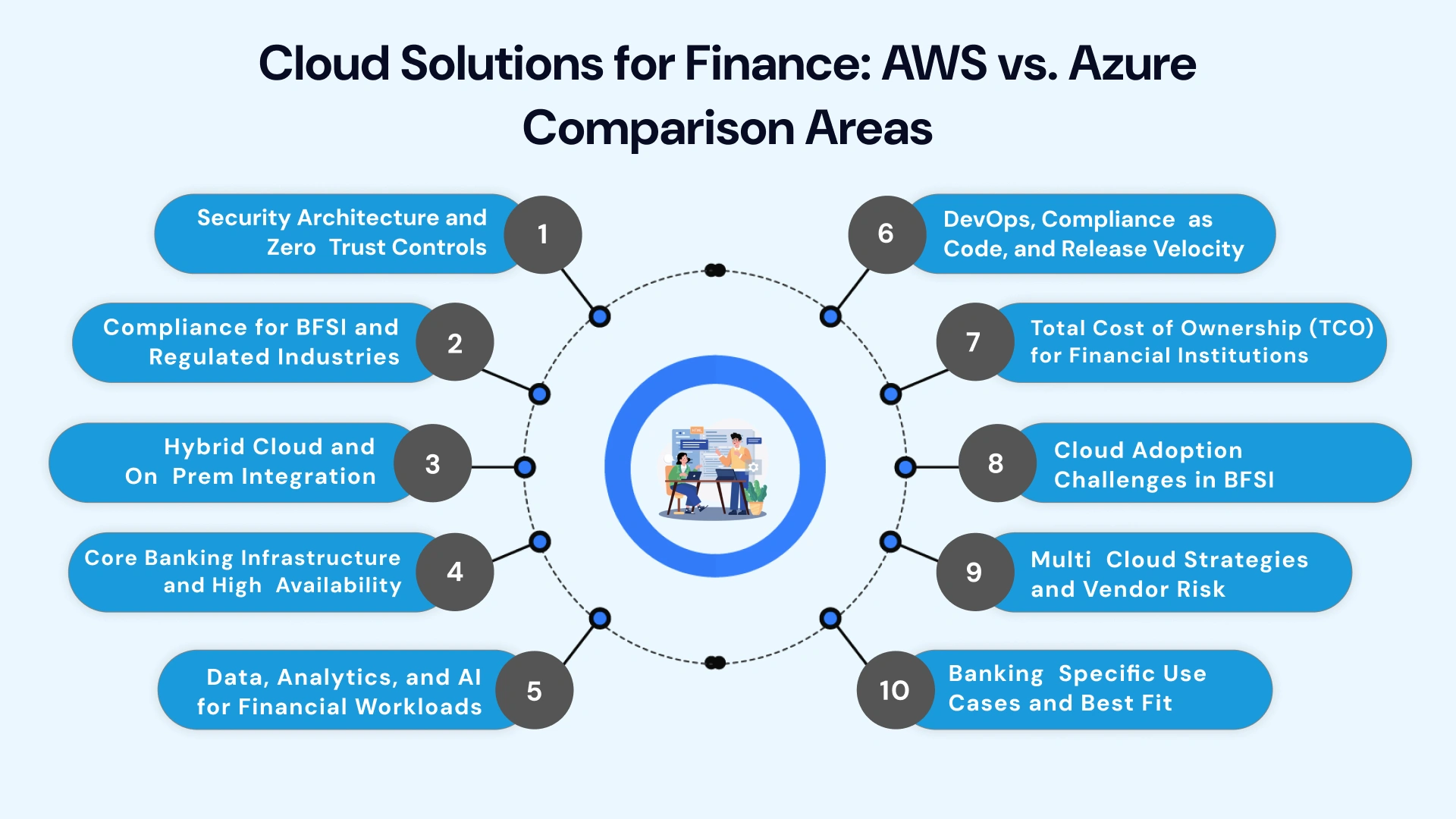
1. Security Architecture and Zero‑Trust Controls
In cloud migration, both clouds deliver strong baseline security, but their philosophies differ in ways that matter for regulated industries:
- AWS security centers on highly granular Identity and Access Management (IAM), GuardDuty for anomaly detection, AWS Shield for DDoS, and services like Security Hub and Control Tower for centralized governance. This model is ideal if you want ultimate flexibility and are comfortable engineering your own guardrails.
- Azure security relies on Microsoft Defender for Cloud for unified posture management, integrated threat protection across on-premises and multiple clouds, and tight integration with Azure Policy and Azure Monitor for continuous compliance.
For banks, Azure’s single security pane, backed by Entra ID, often simplifies audits and enables consistent zero‑trust policies across branches, call centers, and cloud workloads. AWS gives you more knobs and switches but expects stronger in‑house DevSecOps maturity.
2. Compliance for BFSI and Regulated Industries
- Both AWS and Azure support major financial and privacy frameworks, including ISO 27001, PCI DSS, SOC 1/2/3, GDPR, and HIPAA (for relevant workloads).
- Azure is frequently preferred by government and highly regulated sectors due to its emphasis on hybrid cloud, regional data residency options, and extensive compliance tooling (e.g., built‑in assessments and compliance scorecards).
If your priority is Azure vs AWS compliance for BFSI, Azure often has the edge thanks to more prescriptive templates, automated assessments, and alignment with regulators’ expectations around identity‑centric controls and audit trails.
3. Hybrid Cloud and On‑Prem Integration
For most banks, a “lift‑everything” public‑cloud move isn’t realistic. You need a hybrid model that spans data centers, branch infrastructure, and cloud regions.
- Azure hybrid strengths: Services like Azure Arc, Azure Stack HCI, and strong support for VPN/ExpressRoute make it easy to project Azure management, policy, and security into on‑prem and even other clouds. The Azure Hybrid Benefit also allows the reuse of existing Windows and SQL Server licenses, improving cost efficiency for core banking and risk systems.
- AWS hybrid strengths: AWS Outposts, Local Zones, and Direct Connect provide powerful options for latency‑sensitive or data‑residency‑constrained workloads, but they are typically more cloud‑native in design and require you to adopt AWS constructs upfront.
For hybrid cloud for banks, Azure usually provides a more familiar extension of your current network and identity model; AWS is better if you want a uniform cloud‑first footprint even inside your own data centers.
4. Core Banking Infrastructure and High‑Availability
When comparing Azure vs AWS for banking core systems—payment gateways, loan origination, treasury platforms—the key questions are resiliency, latency, and operations:
- AWS excels with mature building blocks like EC2 (with 400+ instance types), S3 for ultra‑durable storage, and a global footprint engineered for high‑availability and multi‑region architecture. This suits performance‑intensive trading, fraud detection, and customer‑facing APIs that must stay online during extreme market volatility.
- Azure’s competitive advantage lies in integrated monitoring, policy, and recovery tools. When paired with AKS, Service Bus, SQL Database, and Cosmos DB, Azure enables highly available financial microservices with tight SLAs and automated failover policies that align with regulatory requirements for RTO/RPO.
For banks that need deterministic failover and straightforward DR governance, Azure’s guided patterns can reduce engineering and audit complexity. AWS still leads when you need raw customization and edge‑tuned architectures.
5. Data, Analytics, and AI for Financial Workloads
Modern financial services strategies hinge on data—risk models, customer 360, fraud analytics, ESG reporting, and GenAI‑driven productivity.
- Azure for financial analytics: Azure Databricks, Synapse, Power BI, and Microsoft Fabric form a tightly integrated data platform; benchmarks show Azure Databricks can run up to about 21% faster on some query streams than its AWS counterpart, which is meaningful for data‑heavy risk and pricing workloads. Azure AI (formerly Azure Machine Learning), Azure AI Foundry, and Copilot Studio provide enterprise‑grade ML and generative AI, all governed under the same identity and compliance umbrella.
- AWS for financial analytics: Amazon SageMaker, Redshift, Athena, and EMR remain a powerful toolkit for quants and data engineers who value flexibility and are comfortable assembling best‑of‑breed components. AWS also offers specialized silicon (Trainium, Inferentia) to optimize training and inference at scale.
If your goal is a cloud strategy for financial institutions that democratizes AI across business and risk teams while keeping governance simple, Azure often aligns better. For niche, high‑performance quantitative research where teams want full control over toolchains, AWS remains compelling.
6. DevOps, Compliance‑as‑Code, and Release Velocity
Regulated financial firms must balance fast change with rigorous controls—change windows, segregation of duties, and traceable approvals.
- Azure DevOps offers a cohesive platform (Boards, Repos, Pipelines, Test Plans, Artifacts) deeply integrated with Entra ID and Azure Policy. This makes it easier to standardize SDLC controls, embed approval gates, and link releases directly to audit evidence.
- AWS DevOps is more modular: CodeCommit, CodeBuild, CodeDeploy, and CodePipeline combine with CloudFormation, CDK, and third‑party tools to form very flexible pipelines. This flexibility is powerful, but you’re on the hook to stitch together approvals, segregation, and reporting in a way that satisfies auditors.
For Azure vs AWS security and compliance challenges in BFSI, Azure’s “guided path” to DevSecOps often reduces long‑term governance overhead. AWS rewards teams that treat DevOps as a first‑class engineering discipline with strong platform engineering capabilities.
7. Total Cost of Ownership (TCO) for Financial Institutions
Surface‑level list price comparisons rarely tell the whole story. You need to factor in licensing, tooling, staffing, and compliance overhead.
- Recent TCO analyses for financial services highlight that Azure “shifts cost left” by bundling more security, governance, and compliance tools, such as Microsoft Defender for Cloud, Purview for data governance, and Azure Policy. This can reduce dependence on third‑party tools and audit prep time.
- Azure Hybrid Benefit plus Reserved Instances and Savings capabilities can yield TCO savings of up to 40% or more for Microsoft‑heavy workloads compared with running them on other clouds, especially when reusing Windows and SQL licenses.
- AWS offers powerful cost‑optimization levers (Savings Plans, RIs, Spot Instances), but you often need stronger FinOps and engineering practices to maintain efficiency and avoid sprawling.
For Azure vs AWS cost optimization for BFSI, Azure typically wins when you factor in license reuse, embedded controls, and reduced vendor complexity; AWS is attractive if you already operate with mature multi‑account FinOps and automation.
8. Cloud Adoption Challenges in BFSI
Common cloud adoption challenges in BFSI include legacy mainframe integration, data residency, skills gaps, and regulatory scrutiny of third‑party risk.
- On Azure, banks often leverage hybrid reference architectures, Azure Migrate, and landing zones that encode security and compliance standards from day one, reducing rework and audit surprises.
- On AWS, landing zone accelerators and Control Tower provide strong foundations, but the broader service surface means that architecture principles and guardrails must be clearly defined to avoid fragmented patterns.
Both clouds require a robust cloud operating model, but Azure’s enterprise orientation and hybrid focus typically map more naturally to incumbent banks’ starting points.
9. Multi‑Cloud Strategies and Vendor Risk
Many global financial institutions are now adopting multi‑cloud strategies to mitigate concentration risk and maintain negotiating leverage.
- Industry data shows a growing share of Azure customers (over a third) also using AWS, GCP, or Oracle Cloud in multi‑cloud setups.
- Azure’s Defender for Cloud and Purview extend governance and security signals to AWS and other environments, enabling unified policy and visibility. AWS similarly supports multi‑cloud monitoring through partner tools and open telemetry, but Azure’s security tooling often includes built-in, first‑class multi‑cloud awareness.
If your board expects a formal vendor-diversification strategy, Azure can serve as a strong primary or secondary platform, especially if your existing ecosystem is already Microsoft‑centric.
10. Banking‑Specific Use Cases and Best Fit
Below is a concise mapping of Azure vs AWS for financial services workloads:
Banking / FS use case | Azure best‑fit scenarios | AWS best‑fit scenarios |
Microsoft‑based cores, heavy SQL Server, tight AD integration, strong need for hybrid and branch connectivity. | Cloud‑native or microservices‑based cores optimized for EC2, Lambda, and container services. | |
Digital banking & mobile apps | Desire to integrate with Microsoft stack, unified CI/CD and identity, Power Platform for rapid front‑ends. | High‑growth digital banks favoring global reach, microservices depth, and extensive third‑party integrations. |
Risk and regulatory reporting | Heavy use of Power BI, Excel, and Microsoft‑centric analytics; need for governed data meshes and lineage. | Custom analytics stacks using Redshift, EMR, and open‑source tooling with bespoke pipelines. |
Real‑time fraud detection | Need for multi‑region data consistency and built‑in compliance guardrails via Cosmos DB and AKS. | Ultra‑low‑latency streaming pipelines on Kinesis, Fargate, and custom ML on SageMaker with specialized hardware. |
Wealth & asset management portals | Integration with Microsoft 365 collaboration, Teams, and internal advisory tools. | Complex multi‑tenant SaaS for advisors across geographies needing flexible tenancy patterns. |
After reviewing these ten areas, a pattern emerges: AWS generally leads where raw performance, service breadth, and customization matter most, while Azure dominates where hybrid cloud, governance, and Microsoft‑centric ecosystems are non‑negotiable.
For most financial institutions, the winning strategy is not about declaring a single “winner,” but about aligning each critical workload—core banking, risk, payments, analytics—with the cloud that best fits its security, compliance, and TCO profile over a three‑ to five‑year horizon.
Note: Businesses evaluating Cloud Adoption Challenges in BFSI should also consider BFSI cloud adoption strategy to improve execution quality, scalability, and long-term operational resilience.
Azure vs AWS Cloud Benefits for Financial Institutions
For financial institutions in 2026, the choice between Azure and AWS is rarely about which cloud is "better" in a vacuum, but rather which ecosystem aligns with your existing technical debt, regulatory strategy, and internal expertise.
Both providers have achieved "super-major" status, offering high-grade security and compliance. However, their value propositions differ significantly for the finance sector.
Key Benefits of Microsoft Azure Cloud Platform
When you evaluate the benefits of the MS Azure cloud platform for financial services:
- Enterprise and compliance alignment: Azure’s identity‑first model, hybrid tooling, and broad compliance certifications make it well‑suited to banks, insurers, and capital‑markets firms under tight regulatory scrutiny.
- Cost and licensing advantages: Azure Hybrid Benefit and Reserved Instances can significantly reduce infrastructure and licensing TCO, which matters when you’re modernizing dozens of core and peripheral systems.
- Integrated analytics and productivity: Tight integration with Power BI, Fabric, and Microsoft 365 enables front‑office, risk, and finance teams to access the same governed data sources.
Key Benefits of AWS for Financial Services
When considering AWS cloud migration advantages for the banking industry and financial institutions:
- Breadth and maturity of services: AWS offers the largest collection of cloud services, targeting almost every niche—from high‑frequency trading analytics to digital banking chatbots.
- Performance engineering: AWS often leads in scenarios where raw performance, low latency, and deep customization matter, especially in FinTech DevOps.
- Ecosystem depth: A massive community, partner network, and talent pool reduce the risk of skills shortages and accelerate the hiring of AWS‑experienced engineers.
Azure vs AWS Cost, Pricing, and Cloud Migration Strategy
Navigating the financial landscape of the cloud is no longer just about comparing hourly rates; it’s about choosing a migration path that aligns your existing software investments with your long-term operational budget. Let’s explore the details.
Evaluating Azure vs AWS Pricing for Financial Services
Both providers offer pay‑as‑you‑go models, Reserved Instances, and discount programs, but the levers differ:
- AWS Savings Plans and Reserved Instances deliver substantial discounts (often up to around 72–75%) if you commit to consistent usage over one to three years.
- Azure Reservations extend beyond VMs to services like SQL Database and Cosmos DB, and Azure Hybrid Benefit can reduce infrastructure costs by up to 40% compared with repurchasing licenses elsewhere.
- Azure’s built‑in cost-optimization (Advisor, Cost Management) and governance tooling can reduce the need for third‑party FinOps platforms, especially in Microsoft‑centric estates.
Cloud Migration Services: Azure vs AWS
For cloud migration services in financial services:
- Azure offers Azure Migrate, Database Migration Service, and prescriptive landing‑zone blueprints tailored to hybrid Microsoft environments. These accelerate migration of Windows, SQL, and .NET‑based banking systems.
- AWS provides the Application Migration Service, Database Migration Service, and various accelerators, but Microsoft‑heavy shops may require additional planning for identity, group policy, and licensing transformations.
In practice, many BFSI firms adopt a staged cloud adoption approach: migrate Microsoft‑centric, compliance‑sensitive workloads to Azure first, then use AWS selectively for performance‑intensive or innovation sandboxes. This blended model supports both risk reduction and innovation.
How to Decide: Azure vs AWS Cloud Comparison Framework
When conducting an Azure vs AWS cloud comparison for your bank or financial institution in 2026, focus on these strategic questions:
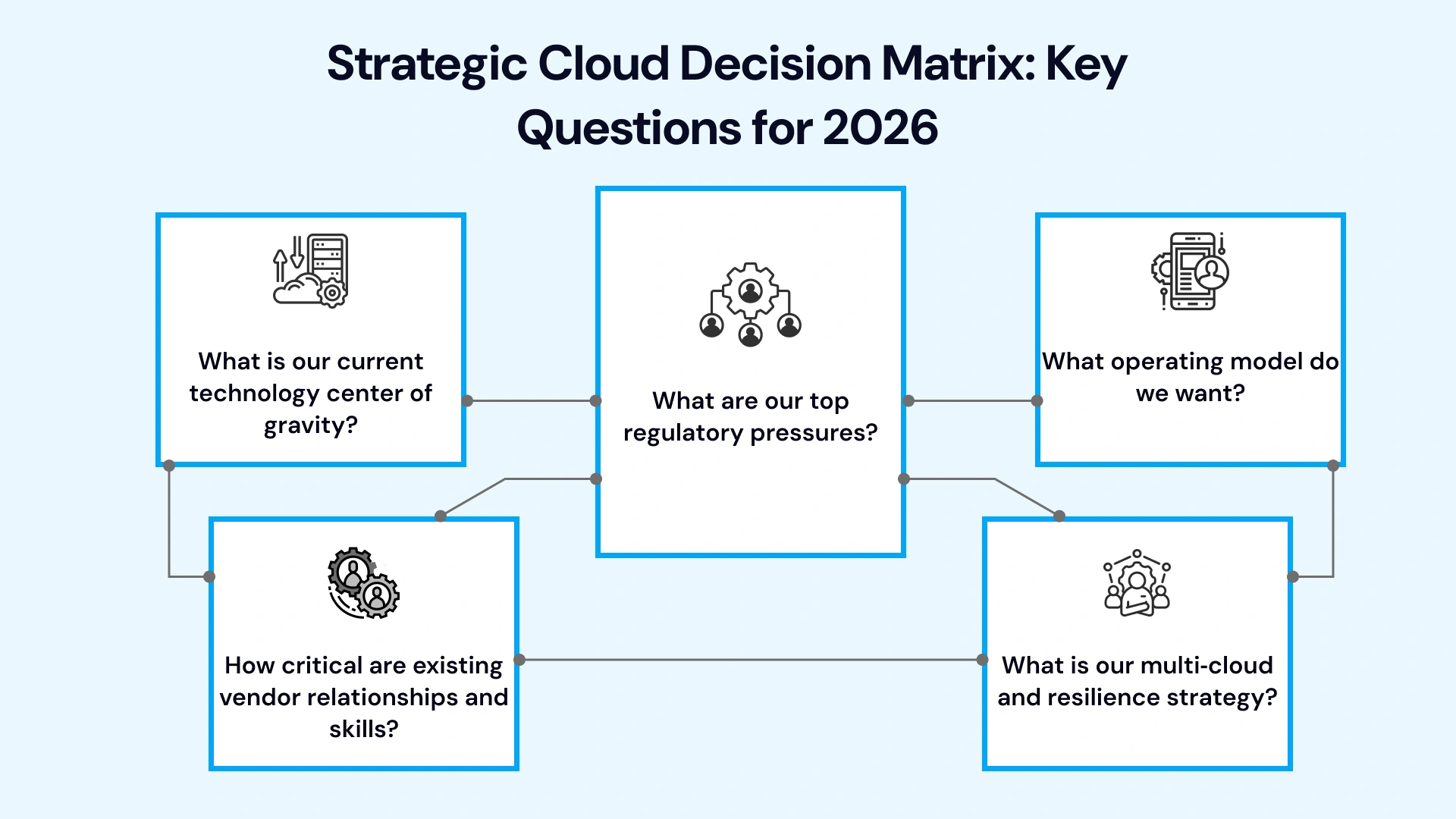
1. What is our current technology center of gravity?
- If your environment is Microsoft‑heavy—Windows Server, SQL Server, .NET, and Active Directory at the core—Azure usually offers the most direct path, with smoother alignment for identity, management, and licensing.
- If your stack is heterogeneous, heavily open‑source, or already optimized around containers and cloud‑native patterns, AWS’s breadth and flexibility often provide more architectural options.
2. What are our top regulatory pressures?
- When regulators emphasize identity‑driven controls, data lineage, and hybrid oversight of on‑prem and cloud workloads, Azure’s integrated compliance tooling and hybrid services can simplify audits and reporting.
- If you operate across many jurisdictions with strict data‑sovereignty rules and latency‑sensitive trading or payment workloads, AWS’s global reach, region coverage, and performance‑tuning capabilities can be a major advantage.
3. What operating model do we want?
- A centralized, governance‑first cloud operating model—driven by a Cloud Center of Excellence and standardized landing zones—tends to map better to Azure’s opinionated patterns for identity, security, and policy.
- A platform‑engineering‑first model, where product teams are empowered to compose services and take more responsibility for guardrails, aligns more naturally with AWS’s modular, highly configurable ecosystem.
4. How critical are existing vendor relationships and skills?
- If your workforce is already deeply experienced with Microsoft 365, Dynamics, Power Platform, and .NET, Azure lets you reuse that skill base and existing support relationships, accelerating adoption and reducing training effort.
- If you have strong internal AWS experience or rely heavily on partners and ISVs that primarily build on AWS, staying with or moving to AWS can reduce delivery risk and shorten time‑to‑value for new initiatives.
5. What is our multi‑cloud and resilience strategy for the next 3–5 years?
- Institutions pursuing a deliberate multi‑cloud posture—using one provider for regulated cores and another for innovation or specialized workloads—should evaluate how easily each platform can participate in consistent security, monitoring, and data‑governance models.
- If your board or regulators are concerned about concentration risk, decide upfront which cloud will be “primary,” which will be “secondary,” and how you’ll avoid duplicating tooling and skills across both platforms while still meeting resilience targets.

Optimize Your Cloud Migration with VLink Expertise
Choosing between Azure and AWS is only the first decision—the real challenge is executing a secure, low‑risk migration that delivers measurable business value. This is where VLink’s Microsoft Business Solutions and ideal cloud migration services for financial services make the difference.
VLink’s cloud architects and domain experts help CXOs and CTOs:
- Build a cloud adoption roadmap tailored to banking and financial‑services regulations, mapping which workloads should go to Azure, AWS, or remain hybrid in the short term.
- Design and implement a secure landing zone on Azure, AWS, or multi‑cloud, embedding identity, network, and compliance controls so every new workload is compliant by default.
- Modernize core banking, risk, and analytics platforms using the benefits of MS Azure cloud platform and AWS’s advanced services, including data lakes, AI/ML, and event‑driven architectures.
- Establish continuous FinOps and governance practices that keep TCO under control while supporting innovation and rapid iteration.
Whether you’re launching a new digital bank, consolidating regional data centers, or modernizing your risk engines, VLink’s dedicated team accelerates outcomes while reducing technical and regulatory risk, freeing your internal teams to focus on innovation and customer value.
Conclusion
For financial services organizations in 2026, the Azure vs AWS decision is less about which cloud is “better” and more about which platform aligns with your identity, compliance, and innovation strategy. AWS remains the market‑share leader, with unparalleled service breadth and performance‑engineering options that are ideal for cloud‑native fintechs and latency‑sensitive workloads.
Azure, meanwhile, has become the de facto choice for Microsoft‑centric banks and insurers that need hybrid cloud, tightly integrated identity and security, and a governed path to AI and analytics at scale. Many institutions will ultimately adopt a multi‑cloud posture—leading with Azure for regulated cores and exploiting AWS for specific innovation and performance needs.
If you’re ready to design a future‑proof cloud strategy, modernize your banking infrastructure, or accelerate AI‑driven initiatives, VLink can help you evaluate Azure vs AWS for financial services, architect the right mix, and execute with confidence.
Contact us today to schedule a discovery workshop with our cloud and financial‑services specialists, and unlock a secure, compliant, and scalable cloud foundation for your roadmap.

Vice President, Strategy – VLink Inc.
Sambhavi Gopalakrishnan is the Vice President of Strategy at VLink Inc., bringing over a decade of experience in IT leadership, project implementation, and strategic growth. She possesses a strong foundation in technical project management and pre-sales, driving innovation and business transformation at VLink.

 Shivisha Patel