


Azure cloud cost optimization is a top priority for IT and finance leaders managing modern infrastructure and for good reason. Unmanaged Azure environments routinely leak double-digit percentages to avoidable waste.
However, treating "30% savings" as a blanket promise rather than the cumulative result of targeted technical actions makes it impossible to distinguish between a Managed Services Provider (MSP) offering real execution and one simply repeating an industry-average marketing slogan.
This blog breaks down that headline figure into its actual operational components:
- Part of a Bigger Ecosystem: Cost optimization does not exist in a vacuum. As a core pillar of comprehensive Azure Cloud Management Services, it works in tandem with continuous monitoring, governance, and security to keep environments scalable and healthy.
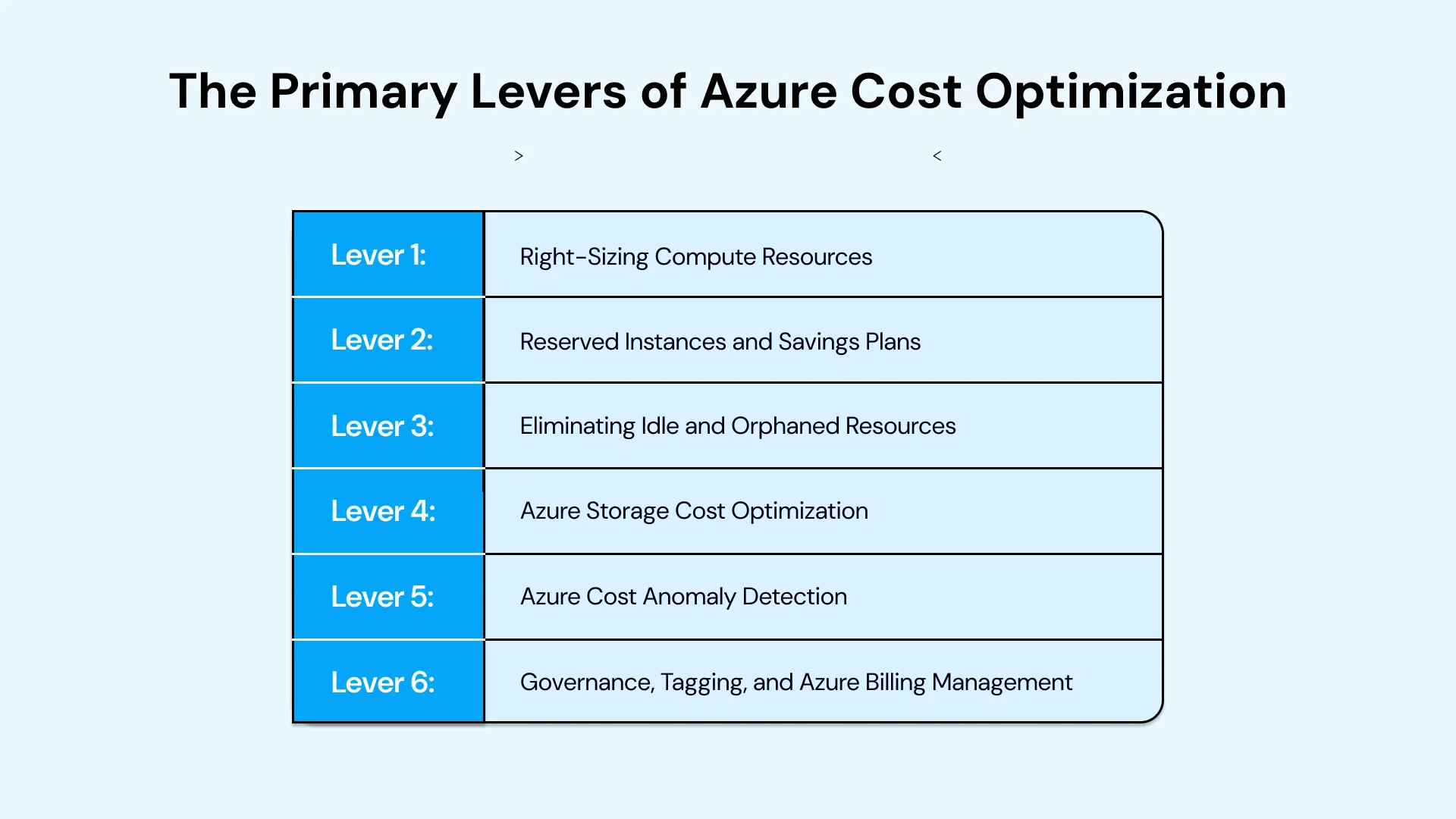
- Driven by Granular Levers: Broad savings claims are built on individual operational adjustments, from right-sizing compute and leveraging reserved instances to eliminating orphaned assets and automating shutdowns.
- Continuous, Not One-Time: Azure environments continuously evolve. Realizing and sustaining savings requires proactive, ongoing management rather than a single point-in-time cleanup.
- A Framework for Evaluation: Understanding what each lever targets, its typical impact, and its maintenance requirements empowers you to vet any Azure MSP proposal against real-world mechanics rather than sales fluff.
Below, we dissect each contributing lever step-by-step so you can measure, validate, and maximize your cloud ROI. Let’s explore in detail.

The Mechanics of Cloud ROI: Strategic Levers That Drive 30% Savings
A headline savings target is only as reliable as the individual levers used to achieve it. Below, we break down the primary engineering and architecture strategies that drive real cost reduction across Azure workloads. Evaluating these mechanisms individually allows you to identify immediate quick wins, establish long-term governance, and ensure your cloud spend directly aligns with actual performance demands.
Lever 1: Right-Sizing Compute Resources
Right-sizing is usually the single largest contributor to Azure cost optimization savings, often accounting for a meaningful share of the total 30% figure on its own. Virtual machines and databases provisioned based on peak-load assumptions, or simply copied from on-premises sizing, routinely run 30-50% larger than actual usage requires.
Why this requires ongoing management, not a one-time review: Usage patterns shift constantly as applications evolve, traffic grows, and features launch. A right-sizing pass done once at migration goes stale within months. Azure managed services providers run this analysis continuously using Azure Advisor recommendations combined with historical utilization data, adjusting instance sizes as patterns change rather than locking in a snapshot from day one.
Lever 2: Reserved Instances and Savings Plans
Committing to Azure Reservations or Azure Savings Plans for compute in exchange for discounted rates- commonly 20-40% off pay-as-you-go pricing- is one of the most reliable ways to reduce Azure costs for stable, predictable workloads.
Where the complexity lives: Committing too early, before usage patterns stabilize, or too broadly, across workloads that may shrink or move, can lock in wasted spend just as easily as it can save money. This is a genuine Azure reserved instances vs savings plan decision that depends on workload flexibility; reservations offer deeper discounts for fixed, unchanging capacity, while savings plans offer more flexibility across instance families and regions at a slightly lower discount.
Getting this balance right, and rebalancing commitments as the environment evolves, is a core part of ongoing Azure managed services cost optimization rather than a decision made once and forgotten.
Lever 3: Eliminating Idle and Orphaned Resources
Unattached storage volumes, forgotten test environments, idle load balancers, and unused public IP addresses accumulate quietly in almost every Azure environment. Individually small, collectively these orphaned resources are a consistent, measurable drag on the monthly bill.
Why continuous scanning matters: Idle resources reappear constantly: a new test environment spun up for a sprint, a load balancer left behind after a migration, a snapshot nobody remembers taking. A one-time cleanup addresses the backlog that exists today; ongoing scanning is what prevents that backlog from rebuilding within a few months, which is exactly why this lever contributes more cumulative savings under continuous managed services than under a periodic internal review.
Lever 4: Azure Storage Cost Optimization
Azure resource optimization extends well beyond compute. Storage is one of the most commonly overlooked cost categories. Azure storage cost optimization involves moving infrequently accessed data to cooler storage tiers (cool or archive rather than hot), cleaning up redundant snapshots and backups beyond retention requirements, and right-sizing managed disk performance tiers to match actual I/O needs rather than defaulting to premium storage everywhere.
The savings compound over time: Because storage volumes only grow, a disciplined, recurring storage review captures increasingly larger savings each cycle compared to a single tiering exercise performed once at the start of an engagement.
Lever 5: Azure Cost Anomaly Detection
Even a perfectly optimized environment can quietly drift: a misconfigured auto-scaling rule, a runaway query, an accidental resource left running in a non-production subscription. Azure cost anomaly detection uses Azure Cost Management's built-in anomaly alerts, tuned and monitored actively, to catch these spikes within days instead of discovering them at the end of a billing cycle.
Why this is where managed services earn their keep: Anomaly detection tools exist natively in Azure, but someone has to actually watch the alerts, investigate them, and act quickly. This is the clearest example of why Azure managed services cost optimization outperforms a one-time audit; anomalies happen continuously, and catching them requires continuous attention, not a quarterly review.
Lever 6: Governance, Tagging, and Azure Billing Management
Cost optimization without governance erodes over time. Consistent resource tagging by team, project, or cost center enables accurate Azure billing management and accountability; without it, nobody owns the responsibility to act when costs rise, and cloud cost governance breaks down into ad hoc, reactive spending decisions instead of a managed discipline. Cloud cost governance also includes budget alerts, spending policies enforced through Azure Policy, and regular showback or chargeback reporting that connects spend to the business units generating it.
Why this lever protects all the others: Technical optimization (right-sizing, reservations, storage tiering) delivers savings once; governance is what prevents those savings from being undone by unmanaged growth in the months that follow. This is frequently the most underinvested lever, precisely because it's process discipline rather than a one-time technical fix.
Putting the Levers Together: Where the 30% Actually Comes From
When Azure managed services providers cite a 30% Azure cost optimization figure, it typically reflects a combination like this across a representative enterprise environment:
- Right-sizing compute: roughly 8-12% of total savings
- Reserved instances and savings plans: roughly 6-10%
- Idle and orphaned resource elimination: roughly 3-6%
- Azure storage cost optimization: roughly 2-5%
- Anomaly detection and drift prevention: roughly 2-4%
- Governance-driven avoidance of future waste: compounding, ongoing benefit beyond the initial figure
These ranges vary meaningfully by environment maturity; an environment that has never been optimized will see the higher end of these ranges initially, while a well-governed environment will see smaller, more incremental gains from each subsequent review cycle. This is precisely why Azure resource optimization should be evaluated as an ongoing program with a trajectory, not a single number promised at the start of a contract.

Why Managed Services Capture More Savings Than a One-Time Internal Effort
The mechanics above explain the "what." The "why managed services" question comes down to operating model.
- Continuous versus periodic attention. An internal dedicated team doing a quarterly cost review will catch a fraction of what continuous, daily monitoring catches, simply because drift happens faster than quarterly cycles can respond to.
- Specialized tooling and pattern recognition. Azure cloud managed service providers see cost patterns across many environments, which is a core reason enterprises hire Azure cloud managed service providers instead of relying solely on internal reviews, sharpening their ability to spot waste that looks "normal" to a team that's only ever seen their own environment.
- Dedicated ownership. Azure managed services pricing models typically build cost optimization into the core scope of the engagement, which means someone is explicitly accountable for it; a structural advantage over internal teams where cost governance is often nobody's full-time responsibility.
- Combined technical and financial expertise. Effective Azure cloud cost optimization requires both engineering skill (to right-size safely without breaking performance) and financial discipline (to model reservation commitments correctly); a combination that's expensive to build and retain internally at the depth a specialized provider can offer.
A common misconception is that aggressive cost-cutting undermines resilience. In practice, well-executed Azure cost optimization and strong disaster recovery and business continuity planning reinforce each other. Eliminating idle resources and right-sizing compute doesn't mean cutting redundancy; it means ensuring the redundancy you pay for (multi-region failover, tested backups, geo-replicated storage) is deliberate and monitored, not accidental sprawl left over from years of unmanaged growth.
A mature Azure managed services engagement treats disaster recovery and business continuity as a protected category, optimized for efficiency but never cut purely to hit a savings target.
How to Evaluate a Provider's Azure Cost Optimization Claims
Before committing to a provider based on a headline savings percentage, use this checklist to validate their methodology, pricing incentives, and execution capability:
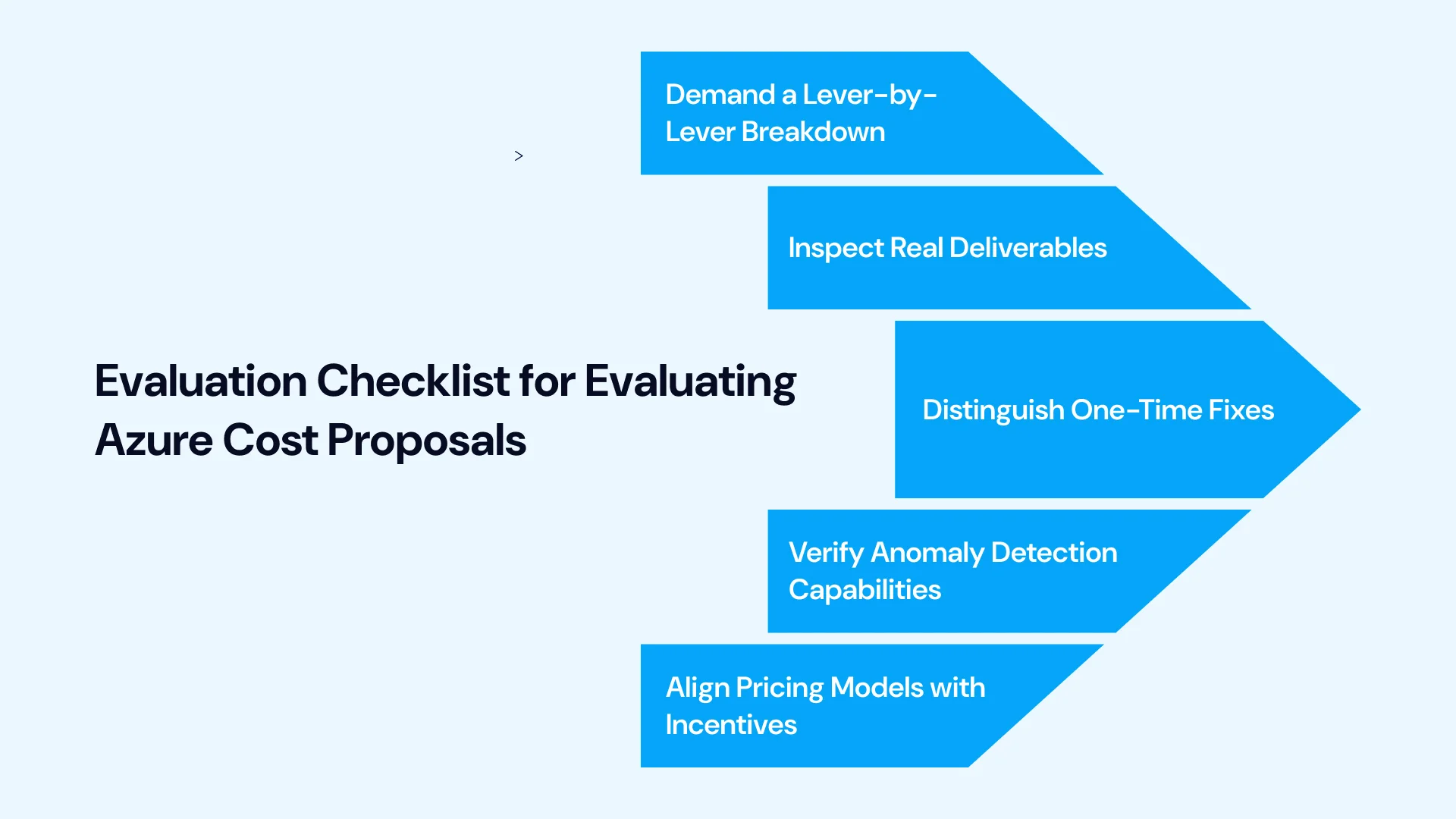
- Demand a Lever-by-Lever Breakdown: Ask for a detailed, itemized plan showing exactly where savings will originate, rather than accepting a single blanket figure.
- Inspect Real Deliverables: Request an anonymized, monthly optimization report from a current client to verify the actual depth and clarity of their reporting.
- Distinguish One-Time Fixes from Sustained ROI: Clarify whether quoted projections reflect a single, point-in-time cleanup or an ongoing, long-term reduction in run-rate spend.
- Verify Anomaly Detection Capabilities: Inquire about their process for catching unexpected cost spikes; specifically, who monitors alerts and what their mean time to resolution (MTTR) is.
- Align Pricing Models with Incentives: Scrutinize how Azure managed service fees are structured. Compare flat retainers, percentage-of-savings, and percentage-of-cloud-spend models to ensure the provider is financially incentivized to aggressively reduce your bill rather than just maintain it.
Unlock Measurable Azure Savings with VLink Experts
Our team delivers ongoing Azure managed services cost optimization for mid-market and enterprise organizations across the US, Canada, and India, built around the same levers outlined in this blog- right-sizing, reservation and savings plan management, idle resource elimination, storage tiering, and continuous anomaly monitoring- backed by transparent, itemized monthly reporting rather than a single headline percentage.
Our broader cloud managed services capability, alongside our dedicated Azure cloud management services, extends this same discipline across platforms, and our Azure Migration Services build cost governance in from day one for organizations still planning their move. If licensing is part of your cost picture, our Microsoft licensing partner services can identify additional savings through Azure Hybrid Benefit and enterprise agreement optimization.
For a transparent look at what this kind of engagement costs, see our breakdown of Azure consulting services pricing, and for a real example of results at scale. Organizations running workloads across multiple platforms can also explore our broader Cloud Migration Services.

Conclusion
Achieving a 30% reduction in Azure spend isn't magic; it's disciplined cloud engineering. From right-sizing compute to continuous anomaly detection, real savings come from the compounded effect of sustained, proactive management.
Before committing to an MSP, look beyond the headline promise and demand transparency into the actual mechanics. The providers who can show you exactly where every dollar of savings comes from are the ones who will deliver lasting value.
Take control of your Azure cloud budget. Get in touch with our team to discuss your environment, evaluate your potential cost savings, and build a transparent optimization roadmap.

Vice President, Strategy – VLink Inc.
Sambhavi Gopalakrishnan is the Vice President of Strategy at VLink Inc., bringing over a decade of experience in IT leadership, project implementation, and strategic growth. She possesses a strong foundation in technical project management and pre-sales, driving innovation and business transformation at VLink.

 Shivisha Patel