


Azure consulting is often used as a catch-all term for everything from a quick cost-optimization audit to a multi-year managed services contract. This broad scope makes it difficult to evaluate quotes, understand what you are paying for, and ensure the proposed engagement matches your actual needs.
While specialized Azure consultants typically charge anywhere from $125 to $250+ per hour (or $10,000 to $100,000+ for fixed-scope projects), the true value isn't measured in hourly rates—it's measured in eliminating that 32% waste and securing your infrastructure long-term. Some businesses hire a consultant expecting a migration and get a cost audit. Others expect ongoing support and end up with a one-time project that leaves them unsupported six months later.
This guide breaks down exactly what Microsoft Azure consulting services typically includes, the different engagement models available, and the real factors that drive cost, so you can evaluate a quote (or a consulting company) with actual context instead of guessing. Whether you're exploring Azure cloud consulting for the first time or trying to understand why one proposal costs significantly more than another, this is meant to answer the practical questions that generic service pages usually skip.

What Does Microsoft Azure Consulting Actually Include?
Microsoft Azure consulting spans several distinct service areas, and most engagements combine two or three of them rather than covering everything at once. The core categories include:
- Assessment and strategy. Before any technical work happens, Azure consultants typically evaluate current infrastructure, workloads, and business goals to determine what Azure services fit, what a migration or modernization roadmap should look like, and what it will realistically cost.
- Migration services. For businesses moving from on-premises infrastructure or another cloud provider, Azure workload migration services cover discovery, assessment, and the actual move of servers, applications, and databases into Azure.
- Cost optimization. Azure cloud cost consulting focuses specifically on right-sizing resources, identifying unused or underutilized services, and restructuring pricing tiers to reduce ongoing spend without sacrificing performance.
- Security and infrastructure consulting. Azure infrastructure consulting covers identity management, network architecture, and security configuration; work that's often bundled into migration projects but can also be a standalone engagement for businesses already running on Azure.
- Managed services. Rather than a fixed-scope project, Azure managed services provide ongoing monitoring, optimization, and support, typically billed monthly rather than as a one-time engagement.
What Does an Azure Consultant Actually Do Day to Day?
It helps to look past the service categories and understand what Microsoft Azure experts are actually doing during a typical engagement.
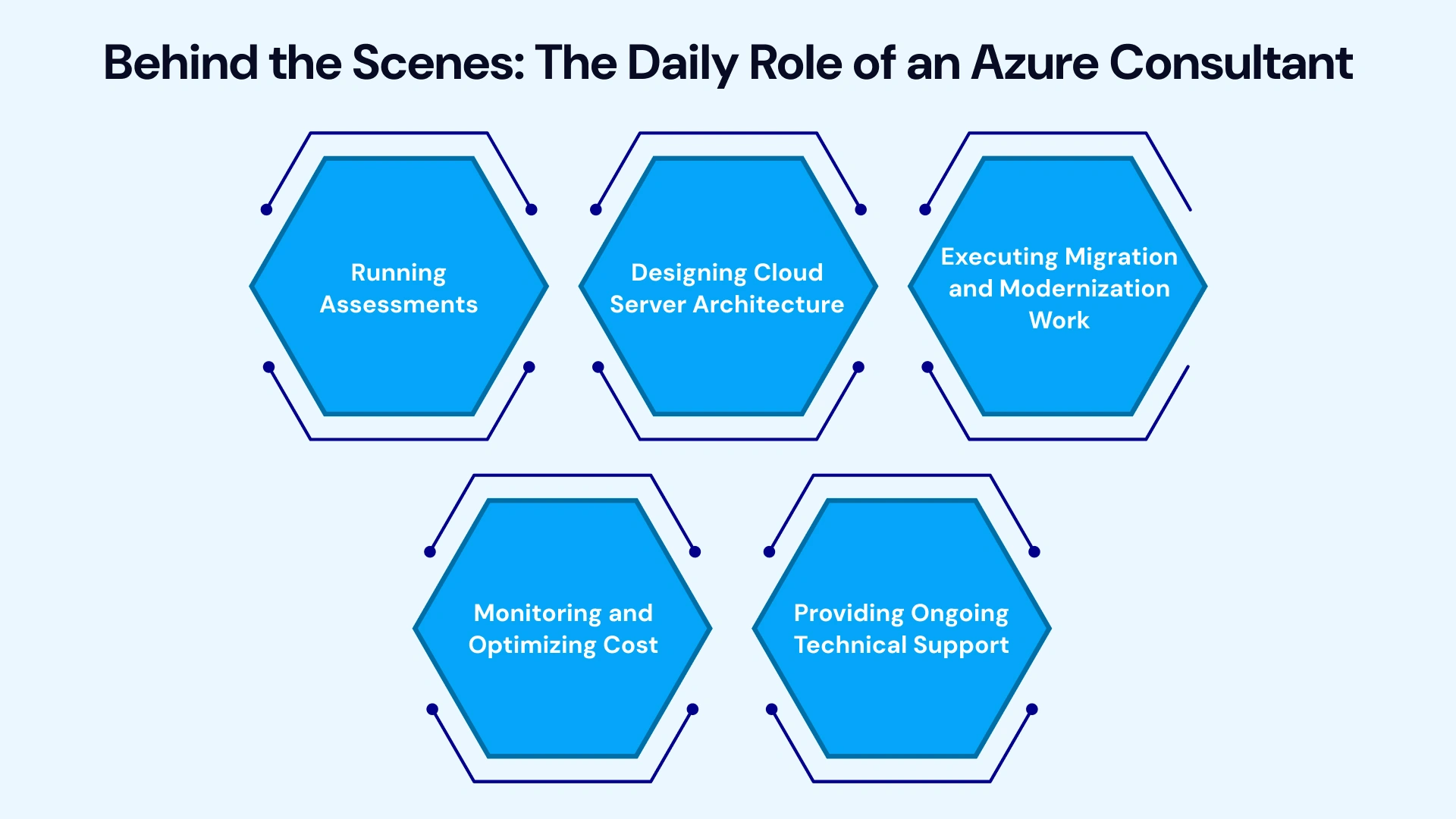
Running Assessments
A significant portion of early-stage consulting work involves an Azure Cloud Assessment; reviewing current infrastructure, usage patterns, and business requirements to build recommendations grounded in real data rather than assumptions.
Designing Cloud Server Architecture
Consultants design how workloads will be structured in Azure; which services to use, how networking and security should be configured, and how the environment will scale as the business grows.
Executing Migration and Modernization Work
For engagements involving cloud migration and modernization, consultants handle the hands-on technical work of moving workloads and, where relevant, restructuring applications to take better advantage of Azure's cloud-native capabilities.
Monitoring and Optimizing Cost
Ongoing engagements often involve regular review of Azure billing and usage data, flagging opportunities to reduce spend through right-sizing, reserved pricing, or eliminating unused resources.
Providing Ongoing Technical Support
For managed services clients specifically, consultants handle day-to-day monitoring, troubleshooting, and incremental improvements rather than a single defined project scope.
Azure Consulting Engagement Models
Understanding how Azure consulting is typically packaged helps explain why costs vary so widely between providers and proposals.
Project-Based Engagements
Project-based work has a defined scope and end date; a migration, a security audit, or an architecture redesign, for example. Pricing is usually quoted as a fixed project cost or estimated hours, based on the complexity revealed during an initial assessment.
Best for: Businesses with a specific, time-bound need, like moving off an aging on-premises environment or completing a one-time cost optimization review.
Managed Services
Azure managed services are ongoing engagements, typically billed monthly, covering continuous monitoring, optimization, and support rather than a fixed deliverable.
Best for: Businesses that want continuous oversight of their Azure environment without maintaining that expertise fully in-house, especially as usage and complexity grow over time.
Hourly or Retainer-Based Consulting
Some engagements are billed hourly or through a retainer, useful for businesses that need flexible, as-needed access to Azure expertise without committing to a large project or full managed services contract.
Best for: Smaller businesses or specific, narrow needs; like periodic architecture reviews, that don't justify a full project engagement.
What Should Microsoft Azure Consulting Cost?
This is usually the question that matters most, and the honest answer is that it depends heavily on scope, engagement model, and workload complexity. That said, a few consistent cost drivers apply across most engagements:
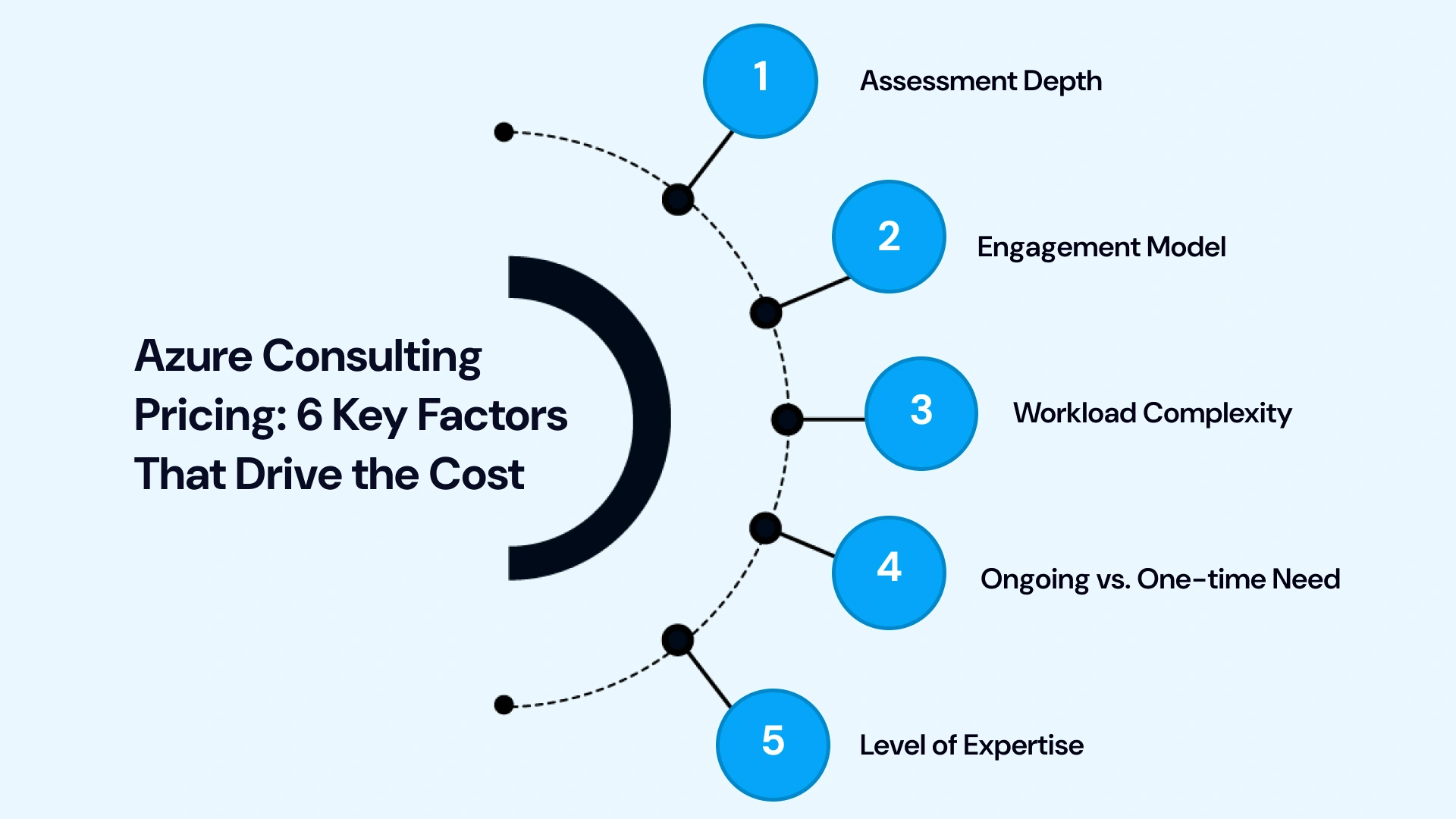
- Assessment Depth: A lightweight cost review costs significantly less than a full infrastructure assessment covering security, architecture, and migration readiness across an entire environment.
- Engagement Model: Project-based work is typically priced around defined deliverables, while managed services are billed as an ongoing monthly cost that scales with environment size and complexity.
- Workload Complexity: Migrating or optimizing a handful of straightforward applications costs far less than doing the same work across a large, interconnected enterprise environment with legacy dependencies.
- Ongoing vs. One-time Need: Microsoft Azure Consulting cost for a single project is structured very differently than Azure cloud services cost for continuous managed support, and comparing the two directly rarely gives an accurate picture.
- Level of Expertise: Specialized work, deep security architecture, complex database migration, large-scale cost optimization; commands higher rates than more general implementation support.
Because of this variability, the most reliable way to get an accurate cost estimate is through an initial Azure Cloud Assessment specific to your environment, rather than relying on generic published rate cards, which rarely reflect the actual complexity of a specific business's infrastructure.
Azure Cloud Cost Consulting: Reducing What You're Already Spending
Separate from migration or new implementation work, Azure cloud cost consulting focuses specifically on reducing what businesses already spend on Azure. This typically involves:
- Reviewing actual usage data against provisioned resources to identify oversized or underutilized services.
- Recommending pricing tier adjustments, such as reserved instances for predictable workloads instead of pay-as-you-go pricing.
- Identifying unused or forgotten resources that continue generating cost without providing active value.
- Setting up ongoing cost monitoring so future spend increases are caught early rather than discovered months later on a bill.
For many businesses already running on Azure, a focused cost consulting engagement delivers faster, more measurable ROI than a broader project, since the savings are often visible within the first billing cycle after optimization.
Azure Migration Strategy: When Consulting Includes a Move
For businesses still running on-premises infrastructure or another cloud provider, Azure cloud migration services strategy is often the starting point for a broader consulting engagement. This work typically follows a structured path:
- Assessment: Cataloging current workloads, dependencies, and readiness for Azure.
- Strategy: Determining the right migration approach for each workload, from simple rehosting to deeper application modernization.
- Execution: Migrating servers, applications, and databases using Azure-native tooling.
- Optimization: Right-sizing resources and refining architecture after workloads are live in Azure.
Because migration and ongoing consulting are closely related, many Azure consulting companies structure their engagements to transition naturally from a migration project into managed services once the move is complete, rather than treating them as entirely separate relationships.
Azure Modernization and Migration Services
Beyond a straightforward move to Azure, Azure modernization and migration services often include restructuring applications to take better advantage of cloud-native capabilities, such as containerization, managed databases, or serverless computing, depending on the workload. This work goes beyond a simple lift-and-shift and typically requires deeper application-level expertise than infrastructure migration alone.
Businesses considering modernization alongside migration should expect a more involved assessment phase, since determining which applications genuinely benefit from modernization versus which are fine with a simpler move requires evaluating both technical architecture and business value application by application.
How to Choose an Azure Consulting Company
With engagement models and pricing varying this widely, choosing the right Azure consulting company comes down to a few consistent evaluation points:
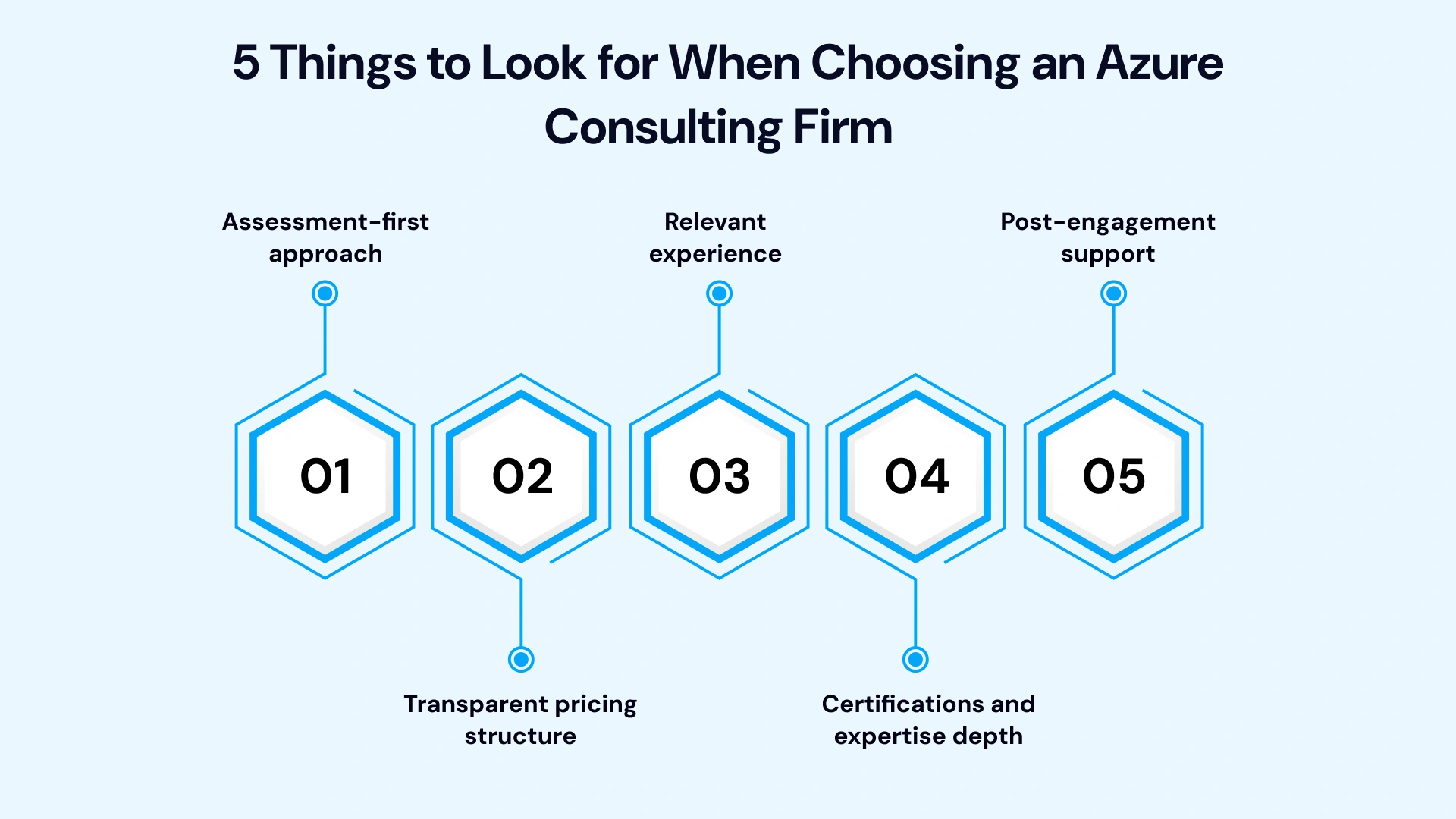
- Assessment-first approach:- A reliable Azure consulting company starts with genuine assessment work, not a generic proposal built before understanding your specific environment.
- Transparent pricing structure:- Ask directly whether pricing is project-based, retainer, or managed services, and confirm what's included versus billed separately; vague pricing structures are a common source of unexpected costs later.
- Relevant experience:- Look for examples of work similar in scope to your need, whether that's migration, cost optimization, or ongoing managed services, rather than generic Azure experience alone.
- Certifications and expertise depth:- While not the only factor, verified Microsoft Azure expertise and relevant certifications are a reasonable signal of technical credibility, especially for complex architecture or security work.
- Post-engagement support:- Confirm what happens after a project-based engagement ends; some consulting companies offer a clean handoff with documentation, while others expect you to transition into a managed services contract to maintain support.
Azure Implementation Services vs. Consulting
It's worth distinguishing Azure implementation services from broader consulting engagements, since the terms often get used interchangeably but describe slightly different work. Implementation services typically refer to the hands-on technical execution of a specific Azure deployment: setting up a new environment, configuring a specific service, or deploying an application into Azure according to a plan that's already been defined.
Consulting, by contrast, often includes the strategic layer that comes before implementation: deciding what should be deployed, how it should be architected, and why a particular approach fits the business's goals. In practice, many engagements blend: a consultant assesses and designs the approach, then the same team (or a closely coordinated one) handles implementation.
When evaluating proposals, it's worth clarifying whether a quoted price covers strategy and design work, hands-on implementation, or both, since providers structure this differently and it directly affects what you're paying for at each stage.
Common Mistakes Businesses Make with Azure Consulting
A few recurring mistakes show up across businesses evaluating or engaging Azure consulting services, and being aware of them ahead of time tends to lead to better outcomes:
- Skipping assessment to save time or money upfront. It's tempting to jump straight into implementation, especially under deadline pressure, but skipping assessment usually means decisions get made on assumptions rather than actual usage and dependency data, and those assumptions are frequently wrong in ways that cost more to fix later than the assessment would have cost to run.
- Comparing quotes without confirming they cover the same scope. Two proposals with very different price tags often aren't actually quoting the same work; one might include ongoing support, while the other covers only initial implementation. Confirming scope before comparing cost prevents choosing based on price alone.
- Treating cost optimization as a one-time fix. Azure environments change as businesses grow, and a cost optimization review done once, without follow-up monitoring, tends to lose its impact within a year as usage patterns shift and new resources get added without the same scrutiny.
- Underestimating the value of ongoing managed services. Businesses sometimes view managed services as an unnecessary added cost after a migration or implementation project, only to find that without continuous oversight, small inefficiencies and configuration drift accumulate quietly over time.
Transform Your Business with Custom Azure Solutions from VLink
Understanding what Azure consulting should cost starts with understanding what you actually need: a one-time project, ongoing managed support, or something in between. VLink's team begins every engagement with a genuine Azure Cloud Assessment, giving you a cost estimate grounded in your specific environment rather than a generic rate card, and structures pricing transparently around the scope that assessment reveals.
Whether you need Azure Migration Services for a full move to the cloud, Cloud Infrastructure Services for architecture and security work, or Azure Consulting Services for ongoing optimization and support, explore how VLink's approach applies to your environment. If you're weighing platforms before committing, our AWS vs Azure vs GCP comparison and AWS migration guide are useful starting points, and our mainframe to cloud migration guide covers migrations involving legacy core systems.
In Summary
Microsoft Azure consulting isn't one thing; it spans assessment, migration, cost optimization, security architecture, and ongoing managed services, and understanding which of these your business actually needs is the first step toward getting an accurate cost estimate instead of comparing quotes that aren't really for the same scope of work. Engagement model, workload complexity, and assessment depth all shape pricing far more than any flat industry benchmark can predict.
Whether you're exploring Azure for the first time or trying to reduce what you're already spending, the businesses that get the most value treat consulting as a relationship built on genuine assessment and transparent pricing, not a single generic proposal. Start with a real look at your environment, the right engagement model, and the right cost; it tends to become clear from there. Whichever path fits your situation, the consultants worth working with will be able to explain their reasoning at every step, not just deliver a number and move forward.
Ready to maximize the ROI on your Microsoft Azure investments while keeping costs predictable and transparent? Contact VLink's team of certified Azure consultants today. We will partner with you to conduct a detailed environment assessment, eliminate cloud spend waste, and build a tailored engagement model that aligns with your specific technical and business goals. Reach out now to schedule your initial strategy consultation.

Vice President, Strategy – VLink Inc.
Sambhavi Gopalakrishnan is the Vice President of Strategy at VLink Inc., bringing over a decade of experience in IT leadership, project implementation, and strategic growth. She possesses a strong foundation in technical project management and pre-sales, driving innovation and business transformation at VLink.

 Shivisha Patel