


Consider the Chief Digital Officer of a 2,500-employee retail and logistics group headquartered in Dubai. The group runs ERP, CRM, and warehouse management as three disconnected platforms, none of them cloud-ready. Its last modernization vendor missed two delivery dates and never explained why costs rose 40% mid-project.
The board has now asked the CDO to select a long-term technology partner, not another one-time vendor. That calls for a defensible evaluation process before any shortlist goes back to the executive committee.
VLink is a global IT services company. It helps CIOs, CTOs, and Chief Digital Officers at UAE enterprises evaluate application development partners. VLink also delivers the work itself. That includes custom application development, mobile app development, and IT staff augmentation for enterprise-scale builds and legacy modernization. Delivery hubs span the United States, India, and Indonesia. A dedicated practice supports UAE-based engagements across BFSI, healthcare, government, retail, and logistics.
What Is Driving Demand for Enterprise Application Development in the UAE?
Three independent research firms have measured the UAE software market in the past two years. All three point in the same direction. Grand View Research's UAE Mobile Application Market Outlook (2026-2033) puts the market at $2,620.3 million in 2025. It projects growth to $7,993.6 million by 2033, a 15.2% compound annual growth rate. Gaming was the largest segment in 2025, at 31.34% share; Health & Fitness is the fastest-growing category.
A separate Grand View Research outlook covers enterprise software specifically. It puts the UAE enterprise software market at $4,019.8 million in 2025. That figure is projected to reach $11,042.5 million by 2033, a 13.5% CAGR. Customer relationship management software is the largest segment, at 28.52% share. Mordor Intelligence's UAE ICT Market Report puts the broader ICT market at $57.61 billion in 2026. It grows to $94.02 billion by 2031, a 10.29% CAGR. The report names AWS, Microsoft, IBM, e&, and du as the market's major players.
Most published guides on this topic are ranked vendor lists. This one is an evaluation framework instead. It covers what to check before you sign and how UAE enterprise's structure engagement models. It also covers compliance questions and what application development costs at enterprise scale.
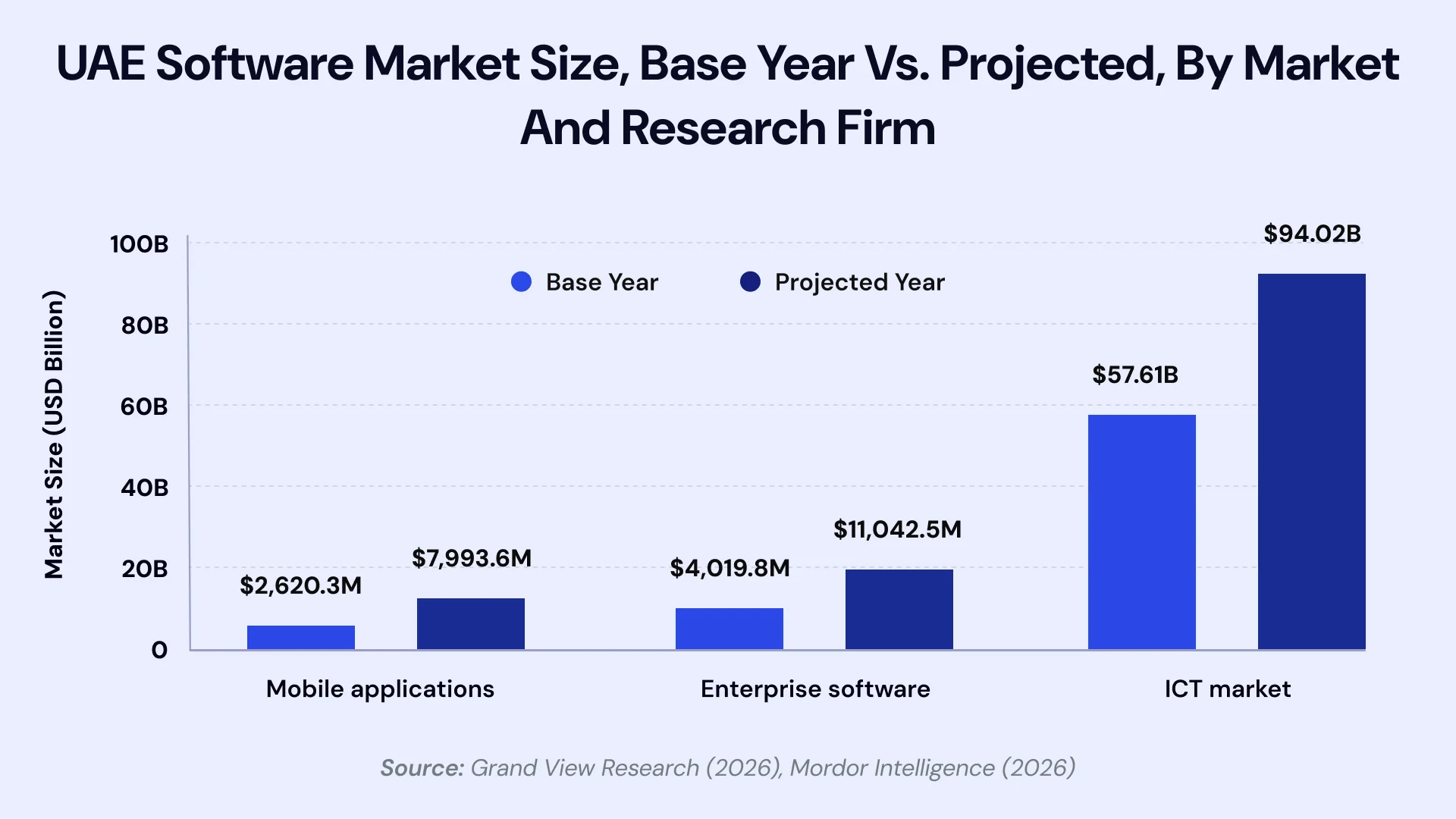
UAE Software Market Size — Three Independent Estimates
| Market | Research Firm | Base Year Size | Projected Size | CAGR |
| Mobile applications | Grand View Research | $2,620.3M (2025) | $7,993.6M (2033) | 15.2% (2026-2033) |
| Enterprise software | Grand View Research | $4,019.8M (2025) | $11,042.5M (2033) | 13.5% (2026-2033) |
| Broader ICT market | Mordor Intelligence | $57.61B (2026) | $94.02B (2031) | 10.29% (2026-2031) |
Behind the growth: enterprises are replacing fragmented, on-premises applications with cloud-ready systems. Those systems need to connect to ERP, CRM, and HRMS platforms. A UAE-based CIO and technology expert spoke with Computer Weekly in March 2026 about this exact constraint. "Digital leaders cannot choose between legacy transformation and new technologies," he said. "The task is sequencing both to create value without increasing technical debt." That sequencing problem is driving enterprises toward specialist application development partners. Generalist agencies rarely have an answer for it.
The pattern behind most modernization requests is consistent. A legacy application built for a smaller organization starts breaking under current transaction volume. A workaround gets patched in. Two years later, three more workarounds sit on top of the first one. No single engineer fully understands how the application behaves under load. Rebuilding that application is rarely a like-for-like replacement. It is a chance to remove the accumulated technical debt that CIO describes. The parts of the original system that still work can stay. Where that rebuild also means moving off on-premises infrastructure, the guide to cloud migration services in the UAE covers the residency and cost questions that follow.
What Should Enterprises Look For When Evaluating an App Development Partner?
A vendor's portfolio proves they can build an app. It does not prove they can deliver one on a fixed enterprise timeline, inside a compliance boundary. It also does not prove they can do that without breaking three other integrated systems. Enterprise evaluation needs a different scorecard than a consumer app decision.
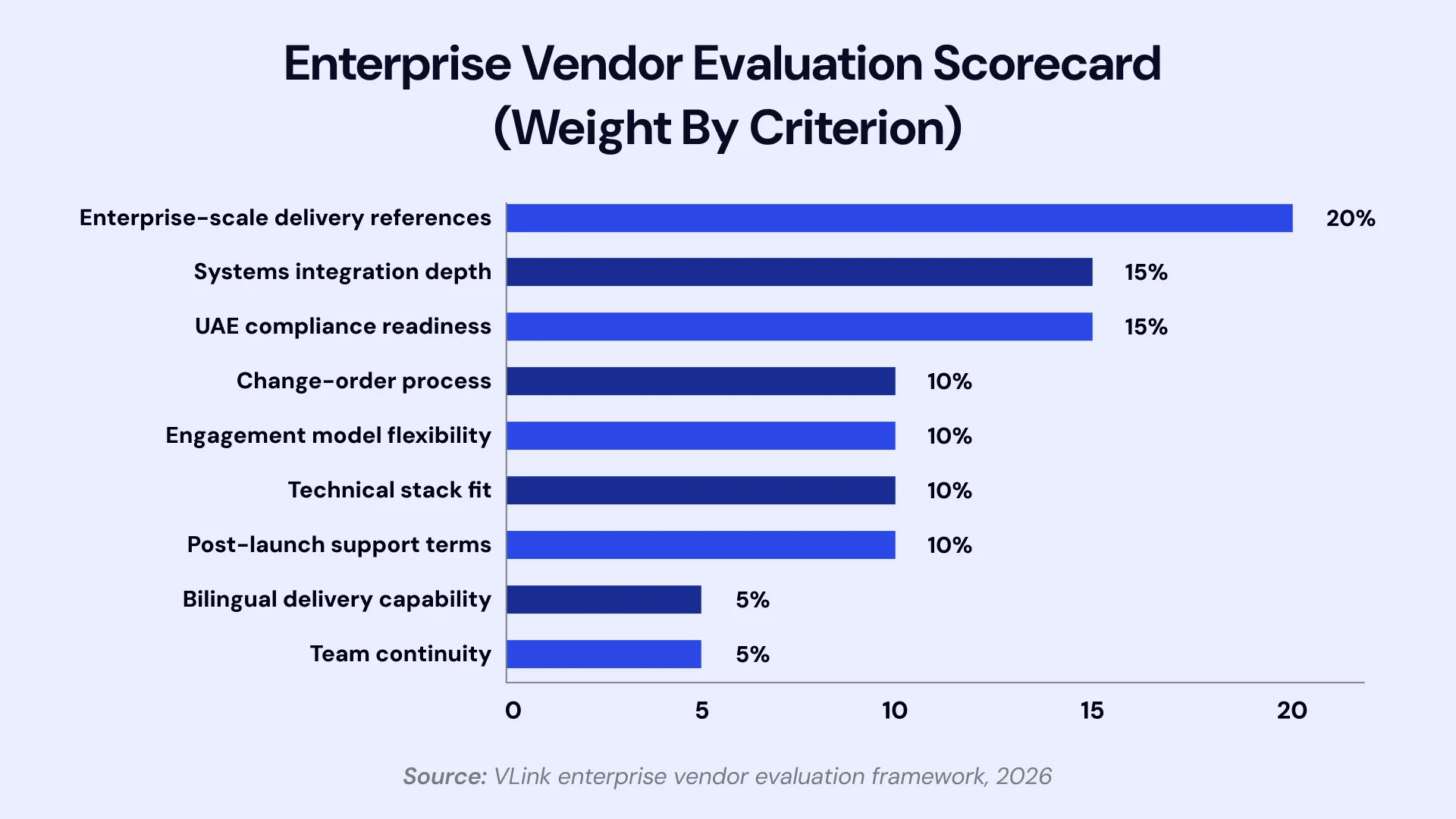
Enterprise Vendor Evaluation Scorecard
| Criterion | Weight | What to Verify |
| Enterprise-scale delivery references | 20% | Ask for a comparable project, not just a comparable industry |
| Systems integration depth | 15% | Can they connect to your existing ERP, CRM, and HRMS, not just build standalone |
| UAE compliance readiness | 15% | Direct answer on data residency, not a generic security-page link |
| Change-order process | 10% | A documented process, not a verbal promise |
| Engagement model flexibility | 10% | Can they shift from project-based to dedicated team if scope grows |
| Technical stack fit | 10% | Match to your existing stack, not their preferred stack |
| Post-launch support terms | 10% | SLA response times in writing, not "we'll be around" |
| Bilingual delivery capability | 5% | English and Arabic interface experience, not translation as an afterthought |
| Team continuity | 5% | Named delivery team, not a rotating bench |
**What this means for a CDO in that position: ** the highest-weighted criteria are not the ones most vendor pitches lead with. Systems integration depth and UAE compliance readiness carry more weight than portfolio size. Those are the two areas where generalist vendors most often underdeliver on enterprise projects.
Which Engagement Model Fits Your Project?
UAE enterprise’s structure application development engagements four ways. The choice affects cost, control, and risk more than the vendor's brand name does.
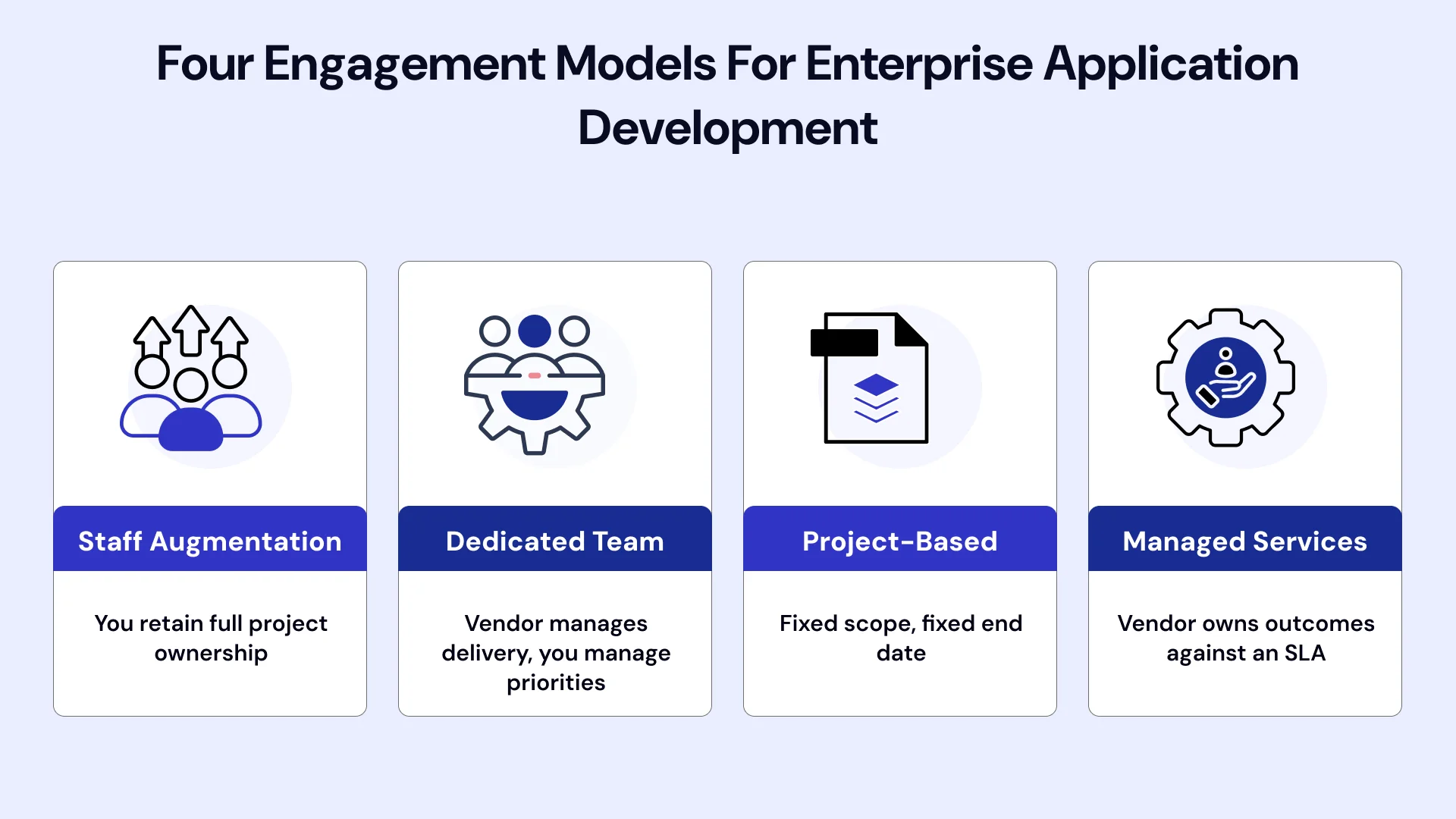
Engagement Model Comparison for Enterprise Application Development
| Model | Best For | Ownership | Flexibility |
| Staff Augmentation | Filling a specific skills gap inside your own team and process | You retain full project ownership | High — scale up or down per sprint |
| Dedicated Team | Long-running programs needing consistent, embedded capacity | Shared; vendor manages delivery, you manage priorities | Medium — team is fixed, scope can flex |
| Project-Based | A defined build with a clear scope and end date | Vendor owns delivery against a fixed spec | Low — scope changes trigger a change order |
| Managed Services | Ongoing support, maintenance, and incremental feature work post-launch | Vendor owns operational outcomes against an SLA | Medium — bound by contract terms, not sprint-by-sprint |
Enterprises modernizing a fragmented systems environment, like the retail group above, often start differently. They begin with a dedicated team for the core rebuild. They shift to managed services once the new application stabilizes. Locking into a single model for the entire programme is a common and avoidable planning mistake.
The right starting model also depends on organizational type, not just project phase. A funded startup past its Series A round typically needs project-based delivery. It also needs the option to convert to a dedicated team if the product gains traction. A large family business group with an established internal IT function usually needs something different: staff augmentation. That model adds specific skills to a process that already exists, rather than outsourcing the process itself. Neither approach is wrong. What keeps the engagement on budget is matching the model to the organization. Defaulting to whatever the vendor sells hardest does not.
What Technical Stack and Delivery Capabilities Should You Confirm Before Signing?
Enterprise application projects fail as often on stack mismatch as on scope creep. A vendor building in a stack your internal team cannot maintain creates a problem. That problem surfaces the day the project ends and handover begins.
Common Enterprise Application Technology Stacks by Layer
| Layer | Common Choices | What to Confirm |
| Mobile / Frontend | React, Angular, Flutter | Which framework matches your internal team's existing skills |
| Backend | .NET, Java, Node.js, Python | Compatibility with your current ERP, CRM, or HRMS APIs |
| Cloud Infrastructure | AWS, Azure | Which platform your organization already has governance and billing set up on |
Two capabilities matter beyond the stack itself. The first is bilingual delivery. Enterprise applications serving UAE customers or employees typically need both English and Arabic interfaces, including right-to-left layout support. That is not a translation layer added at the end. The second is API and integration tooling experience. A vendor should describe, specifically, how they connected a past application to an existing ERP or CRM. A general answer is not enough.
What Compliance and Data Residency Requirements Apply to Enterprise Apps in the UAE?
Compliance requirements for an enterprise application depend on the industry and the data it handles. They do not depend on the technology stack.
UAE Compliance Requirements by Industry for Enterprise Applications
| Industry | Regulator / Framework | Key Requirement for App Development |
| Banking & Finance | CBUAE (Central Bank of the UAE) | Customer and transaction data must stay within the UAE; new applications touching confidential data need compliance sign-off before launch |
| Healthcare | DHA / DoH, Health ICT Law (Federal Law No. 2 of 2019) | Patient health data must remain in-country; applications must support DHA-mandated record formats |
| Government & Semi-Government | TDRA / Smart Dubai (Dubai Digital Authority) | Government-facing applications must integrate with UAE PASS and meet federal digital service standards |
| Cross-sector baseline | Federal Decree Law No. 45 of 2021 (PDPL) | Governs data residency and cross-border transfer conditions for any application handling personal data |
That same Computer Weekly interview makes a related point directly relevant to app development budgets. Security and compliance built in from the start cost less than security retrofitted after launch. "If cyber security is added after launch, organisations pay twice — once in rework and again in exposure," he said. An enterprise evaluation should confirm a vendor treats compliance as a design input, not a post-launch checklist item.
Retail, logistics, manufacturing, and oil and gas enterprises face lighter regulatory requirements than BFSI or healthcare. They are not exempt from PDPL, though. A retail group handling customer loyalty data still needs to confirm where that data sits. So does an oil and gas operator running IoT-connected field applications. Both need to know who can access it. The evaluation bar is lower than in a regulated industry. It is not zero.
What Does Enterprise Application Development Cost in the UAE?
Published UAE app development pricing mostly covers consumer and small-business apps. Enterprise-scale builds are different — the kind that integrate with existing ERP, CRM, and HRMS systems. They carry a different cost profile, driven by integration complexity more than screen count.
Typical UAE Enterprise Application Development Cost by Scope
| Project Scope | Typical Cost Range (USD) | Typical Duration |
| Single enterprise module (one workflow, one integration point) | $40,000 - $120,000 | 8-16 weeks |
| Mid-size enterprise app suite (multiple modules, 2-3 integrations) | $120,000 - $400,000 | 16-32 weeks |
| Large-scale enterprise program (multi-system, compliance-bound) | $400,000 - $1,500,000+ | 8-18 months |
These ranges reflect engagement patterns reviewed across UAE enterprise application projects for this guide, not a single vendor quote. The actual number depends heavily on how many existing systems the new application needs to talk to.
A note from VLink's VP & Global Head of Digital. "I have sat through enough vendor shortlist reviews to know the lowest bid rarely wins in the end. On one enterprise evaluation, two vendors led with a rate 30% below the rest of the shortlist. Neither could describe how they would handle a mid-project scope change without a new contract negotiation. The client picked a mid-priced vendor with a documented change-order process instead, and the project finished on the original timeline."
What this means for a finance or procurement leader: ask every vendor for a cost breakdown by integration point. Do not accept a breakdown by screen or feature alone. Integration work, not UI design, is where enterprise app budgets most often go over.
What Red Flags Signal a Vendor Isn't Enterprise-Ready?
Panorama Consulting Group's 2026 ERP Report is a global, industry-wide study, not UAE-specific. It was found that vendor selection errors account for 19% of enterprise software implementation failures. The same report found an industry-wide implementation failure rate of 68%, with average budget overruns of 189%. A non-specialist vendor does not just fail on its own. It amplifies every other risk in the project.
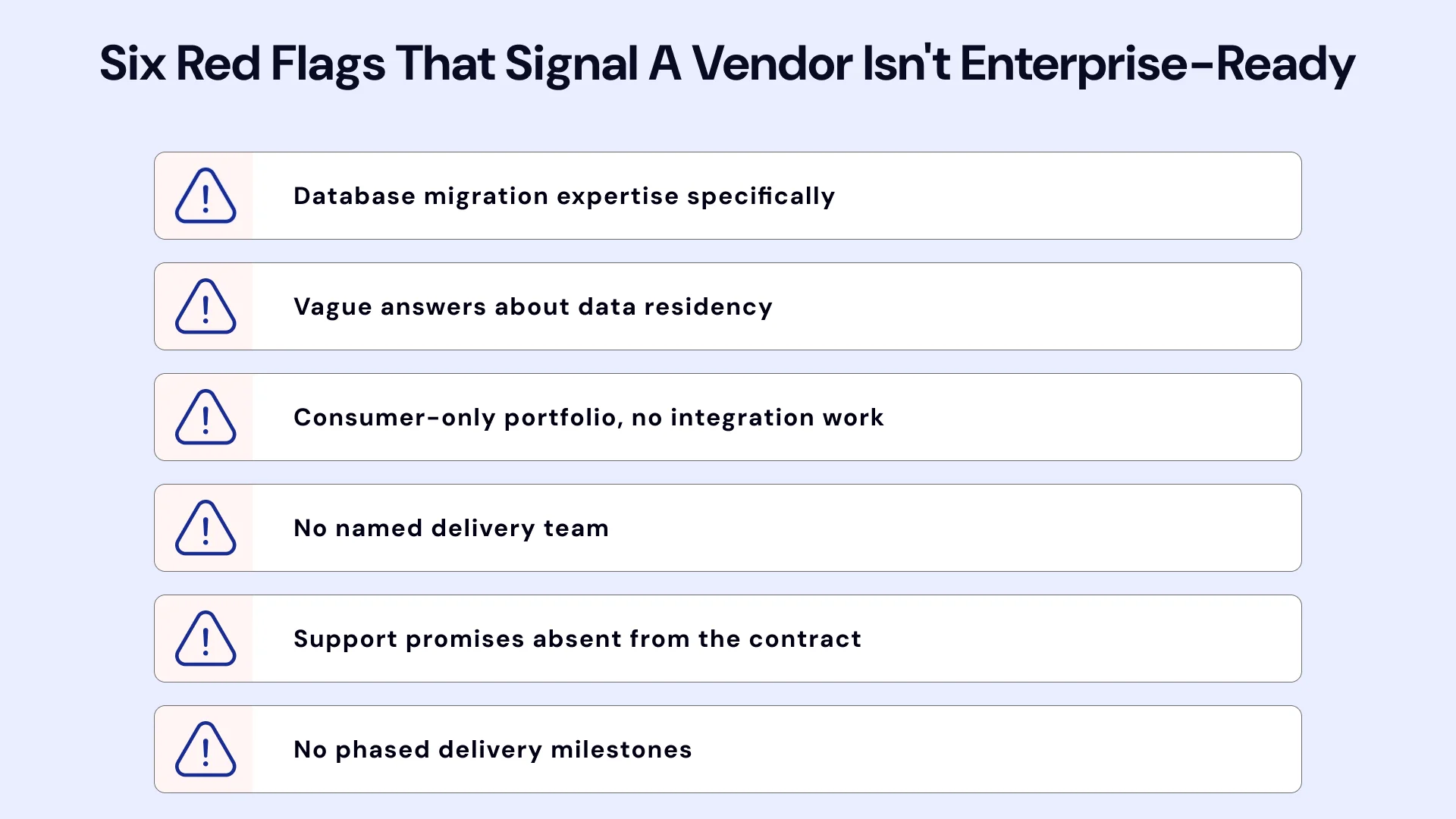
Six red flags surface repeatedly during UAE enterprise vendor evaluations.
- No documented change-order process — everything is negotiated verbally, project by project.
- Vague answers about data residency — a generic security-page link instead of a direct answer about where your data will sit.
- A portfolio of consumer apps with no enterprise integration work — building a standalone app is a different skill from connecting one to your ERP.
- No named delivery team — a rotating bench means you retrain a new team mid-project.
- Post-launch support described only in the sales pitch, never written into the contract with response-time SLAs.
- No phased delivery milestones — a single go-live date with nothing to review in between hides schedule slippage until it is too late to fix cheaply.
Which UAE Application Development Companies Should Enterprises Evaluate?
The list below is not a ranking. It reflects companies with a verifiable UAE presence and enterprise-relevant delivery work, listed alphabetically. Score each one against the evaluation framework in this guide before adding it to a shortlist. A name appearing here is a starting point for due diligence, not an endorsement. If the build centers on AI features, the market map of AI companies in Dubai and the UAE covers that vendor set separately.
UAE Application Development Companies for Enterprise Evaluation (Alphabetical)
| Company | UAE Presence | Focus Area |
| Apptunix | Dubai (.ae domain) | Mobile app development, digital transformation consulting |
| Devicebee | Dubai | Mobile and web application development |
| Esferasoft Solutions | Dubai World Trade Centre | AI-powered mobile app development; healthcare, e-commerce, media clients |
| VLink | UAE-focused delivery; global HQ Connecticut, USA | Enterprise custom application development, mobile app development, IT staff augmentation |
| Zazz | Dubai | Mobile app development for startups and enterprises |
Directories such as Clutch and GoodFirms list additional UAE app development vendors with client-submitted reviews. Treat directory ratings as one input among several. A high rating tells you clients were satisfied enough to leave a review. It does not tell you whether the vendor has integrated with an ERP as complex as yours. It also will not tell you if their team has changed since that review was written. Use directory ratings to build a longlist. Use the scorecard in Table 2 and a direct reference call to cut that longlist down to a real shortlist. For a cross-checked starting longlist, see the ranked guide to the top custom software development companies in the UAE.
How Does VLink Support Enterprise Application Development in the UAE?
VLink has delivered custom application development and modernization work for mid-market and enterprise clients since 2006. The company has grown to more than 500 employees serving 200-plus clients across 10-plus countries. VLink's UAE-focused practice covers enterprise-scale builds. A new application often has to integrate into an existing ERP, CRM, or HRMS environment. That is a different job from launching a standalone product.
VLink's mobile app development services cover native iOS and Android builds and cross-platform delivery. They also cover the systems integration work most consumer-focused agencies do not staff for. Clients referenced in VLink's delivery history include Checkwriters, Arambh, and the State of Connecticut. VLink has been recognized on the Inc 5000 list, and as a Great Place to Work certified employer.
VLink's custom software development practice handles the ERP, CRM, and HRMS integration work most enterprise application projects depend on. UAE teams often need certified engineers embedded into an internal team. VLink's IT staff augmentation services fill that gap without a full-time hiring cycle. For clients building AI-enabled features, VLink's AI development services cover model integration and data pipeline work alongside the core build.
To score your current vendor shortlist against VLink's enterprise evaluation framework, engage VLink's advisory team for an independent review.
In Summary
Enterprise application development in the UAE is growing fast. But most published guidance is service pages and generic ranked lists, not evaluation frameworks. Enterprises that score vendors against integration depth, compliance readiness, and change-order process avoid the failure patterns documented across the industry. Portfolio size and rate alone will not tell you that.
- UAE mobile application and enterprise software markets are both growing at 13-15% CAGR through 2033, per Grand View Research.
- Vendor selection errors drive 19% of enterprise software implementation failures industry-wide, per Panorama Consulting Group.
- Engagement model choice (Staff Augmentation, Dedicated Team, Project-Based, Managed Services) affects cost and risk as much as vendor selection.
- Compliance requirements differ by industry — BFSI, healthcare, and government each have distinct data residency rules.
- Enterprise app costs range from $40,000 for a single module to $1.5 million or more for a multi-system program.

Global Delivery Manager, VLink Inc.
Shivisha Patel serves as the Global Delivery Manager at VLink Inc., bringing a wealth of experience in program delivery and management, particularly in the insurance and banking sectors. She has a robust technical background with deep expertise in WebSphere MQ, WTX, IIB, middleware, and enterprise system integration.

 Shivisha Patel