AI in healthcare across the Gulf means very different things depending on who answers. A hospital CIO might mean the appointment-booking chatbot on the patient portal. A CMIO might mean the AI reading a chest X-ray before a radiologist opens the file. Both are correct. Both sit on the same maturity curve, just at opposite ends of it.
This guide maps that curve directly. It defines four stages, from basic chatbots to full clinical integration. It places real AI in healthcare examples from UAE and Saudi hospitals at each stage, not hypothetical use cases. It covers what DHA, DOH, MOHAP, and Saudi regulators actually require. It closes with the vendor evaluation criteria that separate a working deployment from a pilot that never scales.
What Is the State of AI in Healthcare Across the Gulf Today?
Saudi Arabia holds the largest share of that market, at 27.12% in 2024. Vision 2030's healthcare cluster is the primary driver, prioritizing digitization and AI integration across public and private providers. The UAE is growing faster than any other Gulf country though. Artificial intelligence in UAE healthcare has a dedicated policy anchor: the National Strategy for Artificial Intelligence 2031 names healthcare a priority sector, backed by dedicated AI infrastructure and research funding.
Software dominates spend, holding 58.31% of the regional market in 2024. That share reflects how many AI healthcare solutions ship as software rather than hardware. Among AI applications in healthcare, robot-assisted surgery leads at 13.50% share. UAE and Saudi hospitals are investing heavily in surgical robotics as part of their modernization plans. Fraud detection is the fastest-growing application segment. Insurers and payers are pushing hard to reduce claims leakage across the region's expanding private healthcare sector.
Middle East AI Healthcare Market Snapshot, 2024-2025
| Segment | 2024/2025 Figure | What It Means |
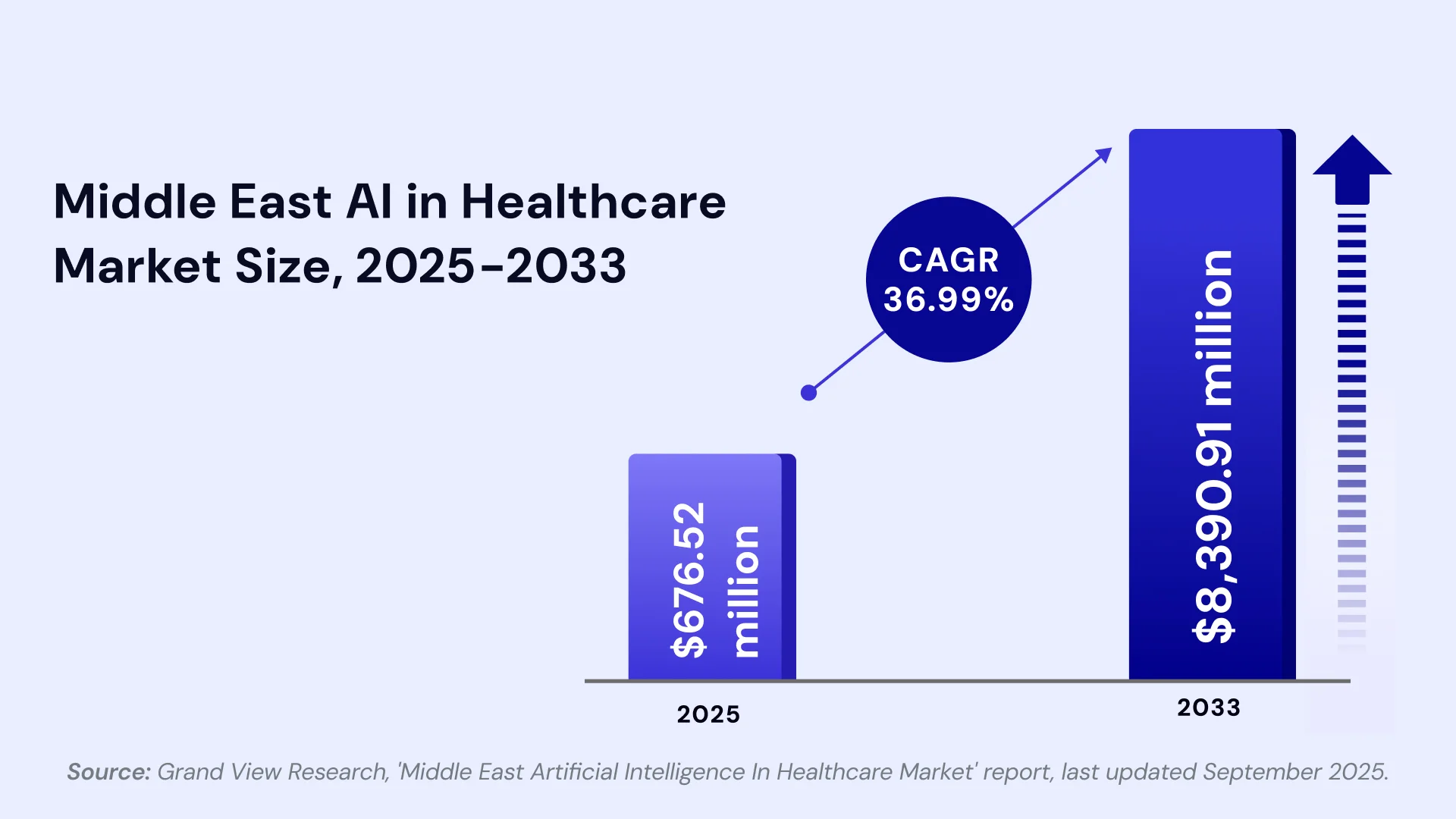
| Overall market size | $676.52 million in 2025, projected $8.39 billion by 2033 | 36.99% CAGR, among the fastest healthcare-tech segments globally |
| Saudi Arabia country share | 27.12% of regional market, 2024 | Largest single-country share, driven by Vision 2030 healthcare cluster |
| UAE growth rate | Fastest CAGR of any Gulf country | National AI Strategy 2031 names healthcare a priority sector |
| Software category | 58.31% of component spend, 2024 | Dominant spend category; services segment growing fastest 2025-2033 |
| Robot-assisted surgery | 13.50% share, largest application, 2024 | UAE and Saudi Arabia lead regional robotic surgery investment |
What Government Initiatives Are Driving Artificial Intelligence in UAE and Saudi Healthcare?
Government strategy, not hospital-level demand alone, explains why Gulf healthcare AI is growing faster than most global markets.
Saudi Arabia's approach centers on Vision 2030's healthcare cluster. Healthcare investments announced at the Global Health Exhibition 2025 exceeded 133 billion Saudi riyals. Of that total, 31 billion riyals targets healthcare infrastructure projects. More than 12 billion riyals targets venture capital and strategic investment funds. Separately, Saudi Arabia launched HUMAIN in May 2025, a government-owned AI company under the Public Investment Fund. HUMAIN's mandate spans several strategic sectors, with healthcare named specifically. That funding sits inside the wider story of AI & Generative AI in the Middle East, which reaches well beyond healthcare alone.
Cross-border expansion is following the funding too. In February 2025, Aster DM Healthcare launched myAster in Saudi Arabia at the LEAP 2025 technology conference. myAster is the company's flagship digital health platform. The launch expanded on its earlier success in the UAE. The AI-powered app bundles telemedicine, online pharmacy access, appointment management, and chronic disease monitoring into one platform. That single-app model shows where government strategy is pushing hospital groups next. Consolidated digital health platforms are replacing standalone point tools.
What Is the Four-Stage Progression From an AI Healthcare Chatbot to Clinical Integration?
Most conversations about AI use cases in healthcare across the Gulf jump straight to diagnostics. Real deployments rarely start there. A four-stage progression describes where most Gulf hospitals actually sit, and where they are headed next.
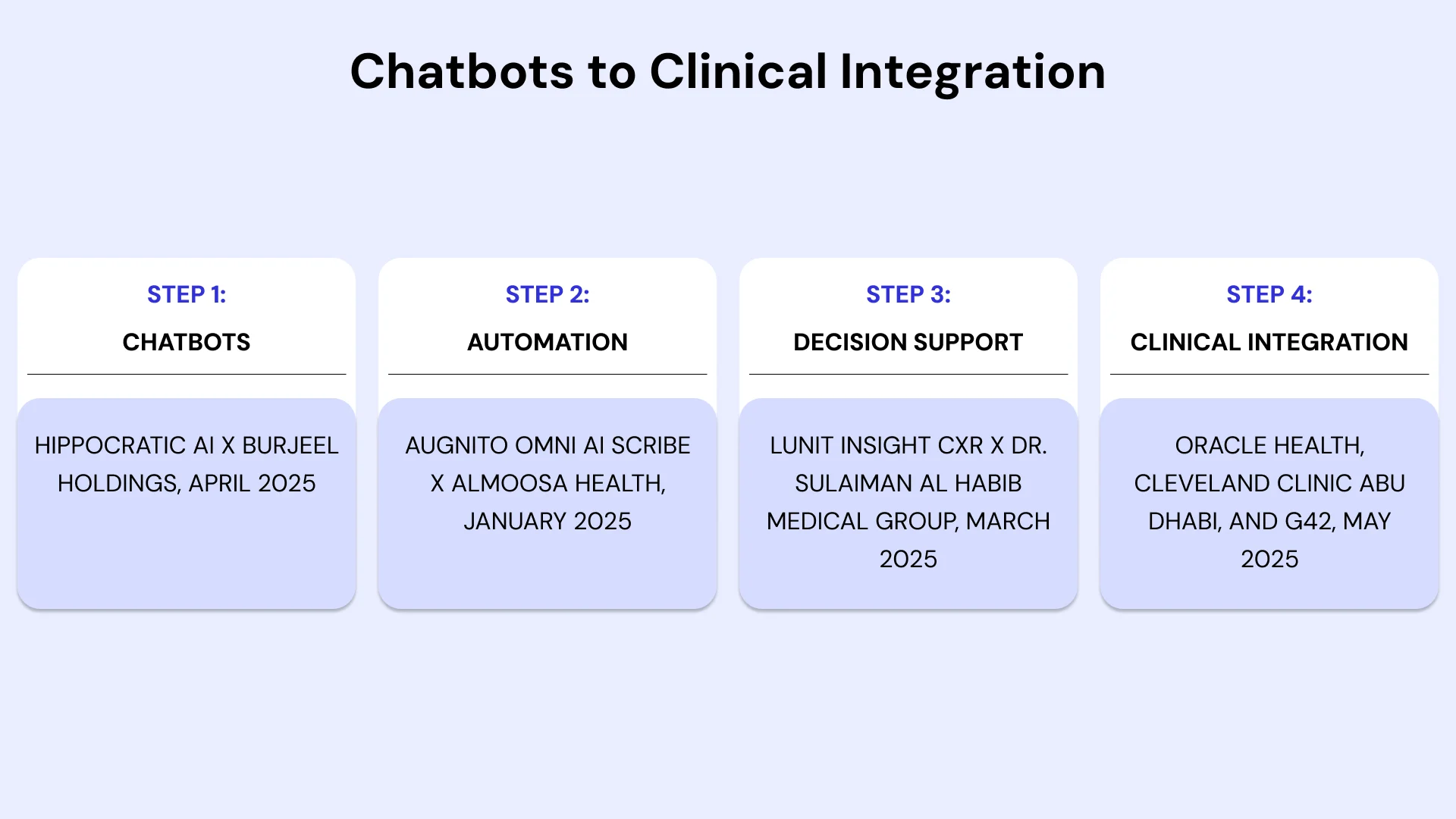
- Stage 1, Chatbots: An AI healthcare chatbot handles scheduling, FAQs, and reminders. This is where most Gulf hospitals are today.
- Stage 2, Automation: AI takes over claims processing, billing, and administrative workflows behind the scenes.
- Stage 3, Decision Support: AI surfaces clinical alerts, flags drug interactions, and suggests diagnostic pathways for a clinician to review.
- Stage 4, Clinical Integration: AI directly assists diagnosis and treatment planning, in radiology, pathology, and predictive patient risk scoring.
Real AI in healthcare examples already exist at every stage, which is unusual for a technology this new. That spread matters for buyers benchmarking their own hospital's progress against the AI healthcare solutions already in production.
What Is the Role of AI in Healthcare at Each Stage?
The role of AI in healthcare changes as a hospital moves up the curve. At Stage 1 and Stage 2 it is an efficiency tool, absorbing scheduling, documentation, and claims work that clinicians never wanted. At Stage 3 and Stage 4 the role of AI in healthcare shifts to clinical augmentation, surfacing findings a tired reader might miss on a night shift. The benefits of AI in healthcare follow that same order: administrative savings first, clinical quality gains later. AI driven healthcare programmes that skip the first two stages usually stall on data quality, not on model accuracy.
Real AI in Healthcare Examples Across the Gulf by Maturity Stage
| Stage | Real Deployment | Detail |
| Chatbots | Hippocratic AI x Burjeel Holdings | Generative AI agents handle scheduling, education, and follow-ups across UAE and Oman facilities, announced April 2025 |
| Automation | Augnito Omni AI Scribe x Almoosa Health | Arabic-capable AI scribe integrates directly with EMR and Hospital Information System at Almoosa Specialist Hospital, Saudi Arabia, January 2025 |
| Decision Support | Lunit INSIGHT CXR x Dr. Sulaiman Al Habib Medical Group | AI-powered chest X-ray analysis under an expanded second contract with Saudi Arabia's largest medical group, March 2025 |
| Clinical Integration | Oracle Health, Cleveland Clinic Abu Dhabi, and G42 | Strategic partnership building an AI-based healthcare delivery platform on sovereign AI infrastructure, announced May 2025 |
How AI Is Used in Healthcare to Automate Administrative Work in the Gulf
How AI is used in healthcare day to day usually starts here. Administrative automation delivers the fastest return of any AI investment across the Gulf. It also carries the lowest clinical risk. A billing error is recoverable. A missed diagnosis is not.
Claims processing is the clearest example. Fraud detection is the fastest-growing application segment in the regional market, according to Grand View Research. Insurers and payers face real financial pressure. Fraudulent claims, billing errors, and benefit misuse erode margins across the region's expanding private insurance sector. AI healthcare solutions built on pattern recognition catch anomalies a manual review would miss.
Which AI Applications in Healthcare Are Already Making Clinical Decisions?
Clinical decision support and full clinical integration remain the smallest category of AI applications in healthcare deployed across the Gulf. They are not rare anymore though.
"We are proud to further strengthen our collaboration with Dr. Sulaiman Al Habib Medical Group. This second contract underscores the value of our AI solutions and reflects our shared commitment to advancing healthcare through innovation," said Lunit's CEO.
Robot-assisted surgery represents the deepest clinical integration in the region today. It is also the largest application segment by revenue. In June 2025, Yas Clinic in Abu Dhabi launched an AI-powered robotic spine surgery program. AI-driven navigation runs directly inside the surgical workflow. That level of integration was rare in the Gulf even two years earlier.
Diagnostics beyond imaging are advancing too. In May 2025, Synyi AI launched what it called the world's first AI-powered doctor clinic. The clinic sits in Saudi Arabia's Al-Ahsa region. The AI system diagnoses respiratory disease and proposes treatment plans. A human doctor reviews and approves every case. It is a clear illustration of Stage 4 integration, still built around human oversight.
Two further 2025 launches show how quickly this stage is broadening beyond imaging and surgery. In April 2025, Unilabs Middle East introduced the region's first AI-powered digital cytology technology in the UAE. The system combines deep learning with volumetric imaging to detect pre-cancerous and cancerous cervical cells. In May 2025, X-Technology, one of the UAE’s AI healthcare startups, launched an AI-powered virtual reality platform targeting patients with cancer, Alzheimer's, and chronic stress. Both examples confirm that Stage 4 clinical integration in the Gulf now spans far more than radiology alone. Buyers mapping the wider vendor field can start from the market map of AI companies in Dubai.
Where Does AI in Mental Healthcare Fit on This Curve?
AI in mental healthcare is the newest Gulf category and sits awkwardly across the four stages. Screening and triage chatbots behave like Stage 1 tools, while therapy-support and stress-management platforms behave like Stage 3 decision support. X-Technology's virtual reality platform for cancer, Alzheimer's, and chronic stress patients is the clearest regional example so far. Two cautions apply. AI in mental healthcare carries a higher duty of care than administrative AI, and Gulf regulators treat mental health records as sensitive data under the same rules covered later in this guide. Most AI healthcare startups entering this space underestimate that second point.
How Does AI Actually Connect to a Hospital's EMR and HIS?
Integration architecture determines whether a healthcare AI project succeeds or stalls. Most failed pilots in the Gulf fail here, not on model accuracy.
Most Gulf hospitals still run on Epic or Cerner as their core EMR platform. Johns Hopkins Aramco Healthcare became the first hospital in Saudi Arabia to go live on Epic. Mubadala Healthcare's Healthpoint facility in Abu Dhabi was among the first Middle East hospitals with an integrated Cerner record system. Healthcare AI companies entering the Gulf need proven integration experience with one or both platforms, and many AI companies in Dubai now list Epic and Cerner work explicitly. A vendor without it will spend months on integration work a buyer assumed was already solved.
Interoperability gaps remain the most common reason AI pilots never reach production. Patient data scattered across EMR, HIS, and PACS systems blocks AI tools from seeing the full clinical picture. A radiology tool that cannot pull prior imaging automatically loses much of its value. So does an alert system that cannot see medication history from another department. The same integration-first lesson plays out in regulated finance, covered in the guide to application modernization for UAE banks and insurers.
What Do DHA, DOH, MOHAP, and Saudi Regulators Require?
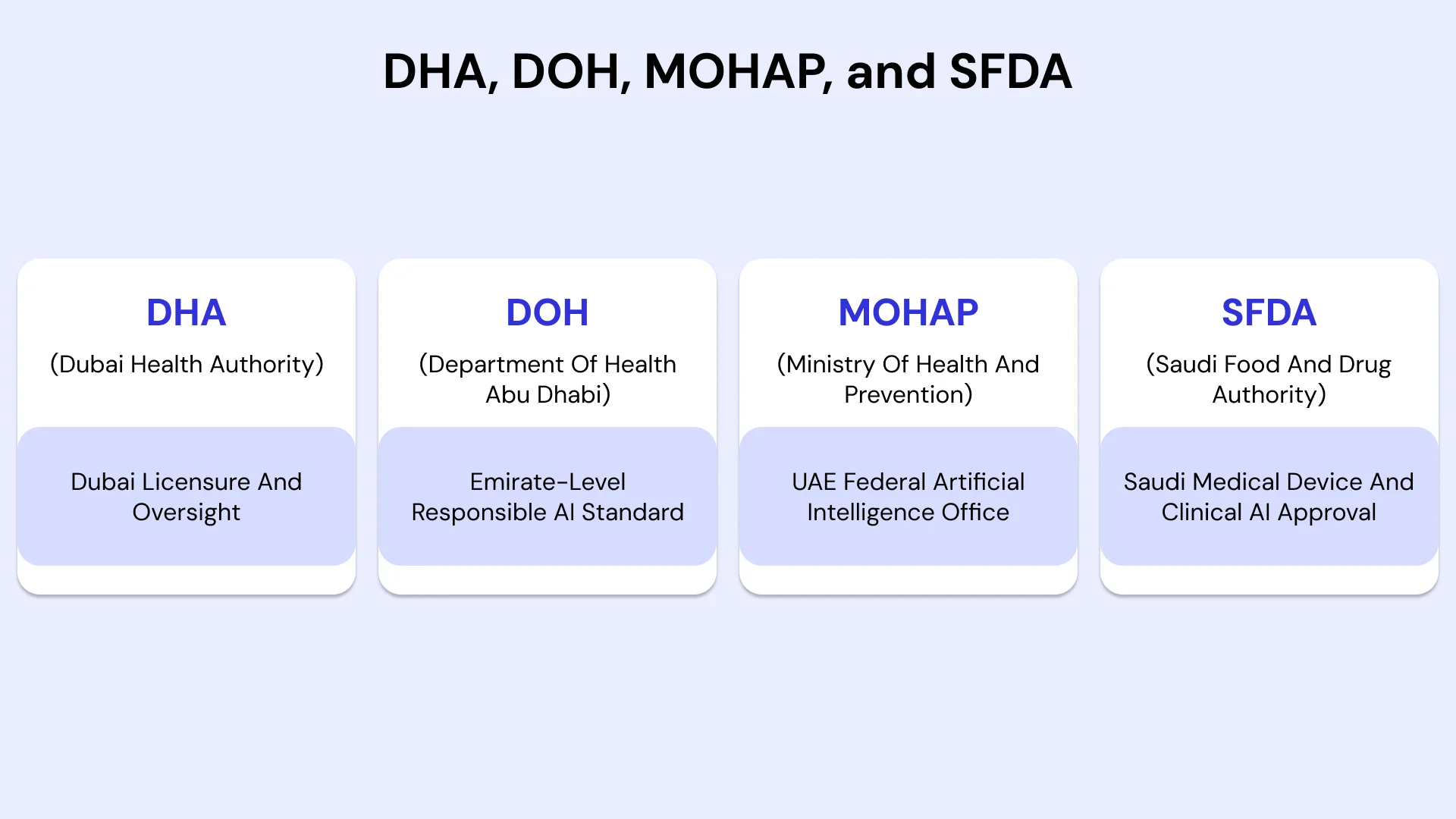
Gulf Healthcare AI Regulators at a Glance
| Regulator | Jurisdiction | What It Covers |
| DHA (Dubai Health Authority) | Dubai | Licensing and oversight for Dubai-based healthcare providers; expanded exam weighting now covers telemedicine and digital ethics |
| DoH (Department of Health Abu Dhabi) | Abu Dhabi | First emirate-level AI governance framework in the region; introduced a Responsible AI Standard in 2025 |
| MOHAP (Ministry of Health and Prevention) | UAE federal | National oversight and approvals; operates a dedicated Artificial Intelligence Office |
| SFDA (Saudi Food and Drug Authority) | Saudi Arabia | Regulates AI-based medical devices and clinical AI tools nationally |
Abu Dhabi's DoH policy stands out regionally. It was the first emirate-level AI governance framework of its kind. It sets explicit technical, data-privacy, transparency, and explainability requirements for healthcare AI. A vendor's platform needs to satisfy explainability requirements, not just accuracy benchmarks, to pass DoH review. The wider policy picture, including the new Federal Authority for AI and Data, is covered in the guide to AI in the UAE.
Is Patient Data Safe With Cloud AI Under the UAE Data Protection Law?
Data residency is not optional in Gulf healthcare AI. It is often the deciding factor in vendor selection, ahead of accuracy or cost.
Both the UAE data protection law and Saudi PDPL treat health information as sensitive data specifically, not general personal data. That classification raises the bar on consent, safeguards, and accountability well above what a standard patient-portal login would require. It also creates real friction for AI training itself. Machine learning models typically need large-scale secondary data use. Consent-based data protection models were not built with that use case in mind. Regulators in both countries are still working through that unresolved tension.
This is why sovereign and on-premise AI infrastructure has become a genuine differentiator, not a marketing term. The Oracle Health, Cleveland Clinic Abu Dhabi, and G42 partnership explicitly combines Oracle Cloud Infrastructure with G42's sovereign AI infrastructure. That combination lets patient data stay within UAE borders while still running on modern cloud-native AI tooling.
Buyers evaluating a cloud AI vendor should ask exactly where inference happens. Where data sits at rest is not the only question that matters. A model that briefly sends patient data to a US or EU endpoint can trigger the same restrictions. Storing the data abroad outright carries that same risk.
What Does Healthcare AI Cost, and What Are the Benefits of AI in Healthcare?
Cost uncertainty is one of the most common reasons Gulf hospital boards delay AI investments, and cost varies widely across AI use cases in healthcare. The impact of AI in healthcare shows up differently at each stage of the maturity curve, and so does return on investment. That is exactly why a single ROI number for healthcare AI rarely holds up.
Illustrative Cost and Return by AI Maturity Stage
| Stage | Typical Investment Range | Where the Return Shows Up |
| Chatbots | Lowest of the four stages | Reduced call-center load and faster scheduling; return visible within months |
| Automation | Moderate, tied to EMR and HIS integration depth | Lower claims denial rates and reduced documentation time; return visible within a year |
| Decision Support | Higher, requiring clinical validation and regulator review | Fewer missed findings and faster specialist throughput; return builds over one to two years |
| Clinical Integration | Highest, often requiring dedicated infrastructure | Improved diagnostic accuracy and surgical precision; return compounds over multiple years |
The benefits of AI in healthcare arrive on different timelines by stage. Chatbot and automation projects tend to pay back fastest. They touch administrative workflows directly, where savings are easy to measure. Decision support and clinical integration projects take longer to show return, but the return compounds. The impact of AI in healthcare is simply easier to measure at the administrative end first. Some AI applications in healthcare compound instead: a single imaging AI deployment, once validated, keeps delivering value across every patient scan that follows.
Change management drives more AI pilot failures than the technology itself. A pilot introduced without clinical staff input often gets quietly ignored after launch. That happens regardless of how accurate the underlying model is. Hospitals that succeed typically involve physicians and department heads in vendor selection from the start. IT and procurement teams alone rarely secure that same buy-in.
Does the Gulf Have Enough Skilled Staff to Run These Systems?
Technology adoption is outpacing workforce readiness in most Gulf healthcare systems. That gap shapes which AI projects succeed.
A growing healthcare professional shortage sits behind much of the administrative automation push described earlier in this guide. Fewer available clinicians mean each one needs to handle a larger caseload. AI-assisted documentation and triage tools exist specifically to offset that gap, not to replace clinical judgment.
Staffing the AI side carries its own challenge though. Hospitals need staff who understand both clinical workflows and the AI tools layered on top of them. Most Gulf hospitals do not have that hybrid skill set in-house yet. Vendors offering ongoing training and change-management support, not just a delivered platform, see far higher adoption among clinical staff. That support gap is common among younger AI healthcare startups.
What Does the Future of AI in Healthcare Look Like in the Gulf?
The future of AI in healthcare in the Gulf looks less like new model breakthroughs and more like consolidation. Hospitals running four separate point tools are already moving toward platforms that share one data layer, following the myAster pattern. Sovereign infrastructure is the second shift, which turns AI driven healthcare from a cloud question into an architecture question. The third shift is commercial: AI in healthcare companies that cannot show Gulf deployment references are losing deals to smaller regional specialists. For hospital leaders, the practical read on the future of AI in healthcare is simple. Buy for the stage after the one you are on, not the one you are in.
What Should Hospital Leaders Check Before Buying From Healthcare AI Companies?
AI in healthcare companies all demo well. Rate and feature comparisons matter less than a handful of criteria specific to Gulf deployments.
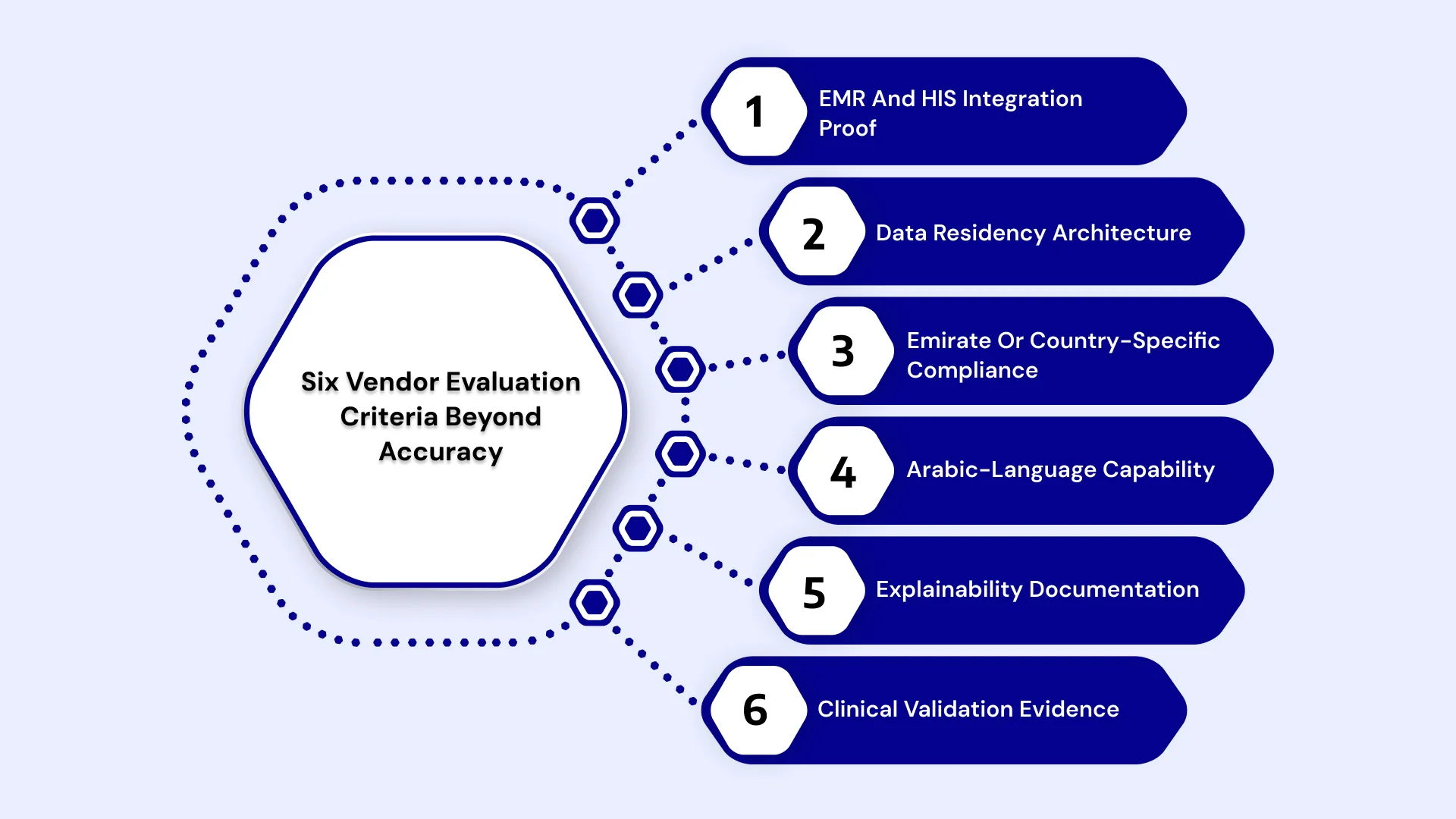
- EMR and HIS integration proof: Ask for a live reference at a Gulf hospital running the same core platform, Epic or Cerner, not a generic case study.
- Data residency architecture: Confirm exactly where data is stored and where inference runs, not just where the vendor's headquarters sits.
- Emirate or country-specific compliance: A DoH-approved platform in Abu Dhabi is not automatically approved for Dubai's DHA or Saudi Arabia's SFDA.
- Arabic-language capability: Confirm the tool works with Gulf Arabic dialects specifically, not a generic Modern Standard Arabic model trained elsewhere.
- Explainability documentation: Ask how the vendor documents AI decision logic for regulator review, especially for anything touching Stage 3 or Stage 4 use cases.
- Clinical validation evidence: Ask for peer-reviewed or regulator-reviewed accuracy data specific to the intended clinical use, not marketing benchmarks.
VLink's VP and Global Head of Digital has seen this chatbot-to-clinical gap firsthand with a Gulf hospital client. Its leadership believed their AI strategy was largely complete after an AI healthcare chatbot launch. The chatbot handled appointment bookings well. It could not flag a returning patient's documented drug allergy. That detail sat buried in a scanned referral letter from another facility. That single gap, not the chatbot itself, became the real scope of the project that followed.
Get Your Free Healthcare AI Readiness Assessment
Most Gulf hospitals do not need another chatbot. They need a clear view of where they actually sit on the maturity curve. VLink's health-tech team scores your current AI deployment against the four stages in this guide. It then maps a realistic path to the next stage. As an AI Software Development Company in Dubai, the team works to the same DHA and DoH requirements your hospital does.
The Gulf Healthcare AI Implementation Playbook comes with the assessment. It covers what most vendor pitches skip:
- A maturity assessment placing your hospital on the four-stage framework
- An EMR and HIS integration checklist specific to Epic and Cerner deployments in the Gulf
- A DHA, DOH, MOHAP, and SFDA compliance readiness check
- A data residency architecture review for cloud versus on-premises AI
- A vendor evaluation scorecard covering the six criteria in this guide
Get your free Healthcare AI Readiness Assessment. Or talk to VLink's health-tech team, whose AI development services cover every stage of this curve, about a project you are currently scoping.
As an AI Software Development Company in Saudi Arabia and the UAE, VLink has worked across every stage of this maturity curve with Gulf healthcare clients. Projects span patient-facing chatbot integrations through EMR-connected clinical decision support work. That range matters because a hospital rarely stays at one stage for long. A chatbot project that succeeds tends to generate the internal case for automation next. An automation project that proves out data quality often becomes the foundation for decision support later. Vendors who only build for one stage of that curve leave a hospital rebuilding integration work every time it advances. That is where a custom software development company with healthcare integration depth earns its place over a point-solution vendor.
In Summary
AI driven healthcare in the Gulf is advancing fast, but unevenly. Cost concerns and workforce gaps shape which stage each hospital can realistically reach next. The regional market is projected to grow from $676.52 million in 2025 to $8.39 billion by 2033. Most hospitals still operate at the chatbot or automation stage. Real AI healthcare solutions already prove every stage of the maturity curve works in the Gulf specifically. Augnito's Arabic AI scribe, Lunit's imaging AI, and the Oracle Health and G42 sovereign infrastructure partnership all prove it. Regulatory structure varies sharply by emirate and country. Data residency law makes infrastructure architecture a compliance decision, not just a technical one. Hospital leaders getting real value from AI are not chasing the newest chatbot. They are mapping their actual position on the maturity curve. Then they choose infrastructure and vendors that can carry them to the next stage without a rebuild.

Vice President, Strategy – VLink Inc.
Sambhavi Gopalakrishnan is the Vice President of Strategy at VLink Inc., bringing over a decade of experience in IT leadership, project implementation, and strategic growth. She possesses a strong foundation in technical project management and pre-sales, driving innovation and business transformation at VLink.

 Shivisha Patel