Yet despite record technology investment, most BFSI CIOs and CTOs in India are unable to answer one fundamental question with precision: what does our current IT staffing model actually cost, and what would it cost under an augmentation model?
That gap — between technology ambition and workforce cost clarity — is where failed digital transformation programmes are born. A board-approved INR 500 crore modernisation initiative can stall within two quarters when the talent model is misaligned with the delivery timeline and budget envelope.
This article is a structured cost calculator for IT staff augmentation costs in India, built specifically for the BFSI context. It covers total cost of employment (TCE) benchmarks, offshore developer cost per hour by role and seniority, ROI frameworks for technology leadership, and compliance considerations under India's revised Labour Codes.
The goal is to give CIOs, CTOs, and Digital Transformation Heads in BFSI the data they need to build a financially defensible staffing case.

Why BFSI India Faces a Structural IT Staffing Cost Problem
Consider this scenario: Rajiv Mehta is the CTO of a mid-tier private bank headquartered in Mumbai, managing a 1,200-strong workforce and a digital transformation programme that spans core banking re-platforming, regulatory reporting automation, and UPI 3.0 integration.
Following a quarterly technology review, Rajiv's board questioned why IT staffing costs had risen 18% year-on-year while delivery throughput had declined. Three system integrators were billing on a time-and-material basis. Two internal specialists had resigned within six months. The cost per delivered feature was rising — but no one had a consolidated view of what the staffing model was actually spending.
This is not an exceptional case.
The structural problem is this: BFSI enterprises are competing for a finite pool of BFSI-domain IT specialists in a regulated environment where onboarding timelines, compliance clearances, and vendor lock-in create cost multipliers that generic staffing benchmarks do not capture. The IT staff augmentation services model — when costed correctly — addresses this directly.
How to Calculate the True IT Staff Augmentation Cost in India
Most IT staffing cost discussions in BFSI stop at the vendor billing rate. That is the wrong starting point. The correct metric is Total Cost of Employment (TCE) — the fully-loaded cost of delivering one productive BFSI technology professional over 12 months.
TCE Formula for BFSI IT Staffing:
TCE = Direct Compensation + Employer Statutory Contributions + Onboarding and Clearance Costs + Productivity Ramp Time + Management Overhead + Technology Licensing + Attrition Risk Premium
For a full-time core banking specialist in Mumbai, this TCE typically runs 1.6x to 1.9x the gross salary when all components are included. For a senior cybersecurity architect with SEBI or RBI compliance domain knowledge, the TCE can exceed 2.2x gross salary due to domain scarcity, clearance timelines, and management overhead.
BFSI IT Staffing Cost Calculator: TCE vs Augmentation Rate (Annual Benchmark)
Role | Full-Time TCE (INR/year) | Augmentation Annual Cost (USD) | TCE Savings via Augmentation |
Mid-Level Core Banking Developer | ₹28–38 lakh | $26,400–$36,000 | 30–40% |
Senior API / Integration Architect | ₹55–75 lakh | $48,000–$66,000 | 25–38% |
BFSI Cybersecurity Engineer | ₹60–90 lakh | $52,800–$72,000 | 28–42% |
Data Engineer – Regulatory Reporting | ₹45–65 lakh | $38,400–$55,200 | 30–40% |
DevOps / Cloud Engineer (AWS/Azure) | ₹42–60 lakh | $35,000–$52,000 | 28–38% |
Note: Augmentation costs are based on all-inclusive vendor rates through structured IT staff augmentation partners. Full-time TCE includes PF, gratuity, ESIC, onboarding, laptop, software licenses, and management overhead. Attrition risk at 18–22% in BFSI IT roles adds 10–15% effective cost to full-time hiring in high-demand roles.
IT Staff Augmentation vs Full-Time Hiring: The Cost Case for BFSI
In IT staff Augmentation strategies for fintech, the build-vs-buy decision for technology talent is one of the most consequential financial choices a BFSI CTO makes. The conventional assumption — that full-time staff are cheaper in the long run — does not hold across all role types, project durations, or specialisation bands.
According to Deloitte research (2025), 59% of companies cite cost reduction as a primary reason for outsourcing IT specialists. In the BFSI context, the case is even stronger because of three India-specific multipliers: high voluntary attrition in specialist roles (18–22% annually in banking technology), regulatory clearance lead times of 4–12 weeks for compliance-sensitive positions, and the opex vs capex shift that makes augmented headcount more budget-predictable under RBI's technology investment disclosure norms.
IT Staff Augmentation vs Full-Time Hiring: Decision Matrix for BFSI India
Decision Factor | Full-Time Hiring | IT Staff Augmentation |
Time to Productivity | 3–6 months (onboarding + clearance) | 2–4 weeks (pre-vetted, domain-ready) |
Total Cost Certainty | Low — TCE exceeds budgeted salary by 60–120% | High — all-inclusive billing rate, no hidden employer costs |
BFSI Domain Fit | Strong if retained; weak at hire for niche roles | High if the vendor specialises in BFSI-ready talent |
Attrition Risk | 18–22% per year — disruptive to project continuity | Vendor-backed replacement — delivery continuity protected |
Regulatory Flexibility | Fixed headcount complicates RBI IT governance disclosures | Variable headcount — cleaner opex model for audit purposes |
Skill Specificity | Ideal for stable, long-term core roles | Ideal for niche, project-specific, or emerging-tech roles (AI, RegTech) |
The correct application is a blended model: retain full-time talent for permanent, governance-critical roles — CISO, Head of Architecture, Core Banking Owner. Augment for delivery-phase talent — UI/UX engineers, data engineers, DevOps specialists, RegTech developers, and QA engineers on defined programme milestones.
BFSI-Specific Role Rate Card: India Offshore Developer Cost Per Hour
The offshore developer cost per hour from India ranges from USD 18 to USD 65 per hour, depending on role, seniority, and domain specificity. For BFSI-regulated engagements — where RBI, SEBI, and IRDAI compliance knowledge is a hard requirement — expect a domain premium of 15–25% above standard IT augmentation rates.
BFSI India IT Staff Augmentation Rate Card: Offshore Developer Cost Per Hour (2025–2026)
Role / Specialisation | Junior (0–3 yrs) | Mid-Level (3–7 yrs) | Senior (7+ yrs) | Engagement Tier |
Core Banking Developer (Finacle, Temenos, FIS) | $20–25/hr | $28–38/hr | $42–55/hr | Dedicated / Long-term |
BFSI Cloud Architect (AWS, Azure) | $22–28/hr | $32–42/hr | $48–65/hr | Staff Augmentation |
RegTech / Compliance Engineer (SEBI/RBI) | $25–30/hr | $35–45/hr | $52–70/hr | Dedicated / Project |
Data Engineer – Regulatory Reporting | $20–26/hr | $30–40/hr | $44–58/hr | Staff Augmentation |
Cybersecurity Engineer (BFSI-certified) | $24–30/hr | $36–46/hr | $50–68/hr | Dedicated / Long-term |
Full Stack Developer (FinTech APIs) | $18–24/hr | $26–36/hr | $40–52/hr | Time & Material |
DevOps / SRE (Banking Infrastructure) | $22–28/hr | $30–40/hr | $44–58/hr | Staff Augmentation |
AI/ML Engineer (Fraud Detection, Credit) | $28–35/hr | $40–52/hr | $58–75/hr | Dedicated / Project |
Note:- These rates reflect all-inclusive vendor billing through structured staff augmentation partners with BFSI delivery credentials. They exclude freelancer marketplace rates, which carry significantly higher IP risk and compliance exposure for regulated entities.
IT Outsourcing Pricing Models That Work for Regulated Enterprises
Choosing the right IT outsourcing pricing model is as consequential as choosing the vendor. For BFSI enterprises operating under RBI's IT Governance Framework and SEBI's Technology Risk circulars, the pricing model also determines your audit trail, cost disclosure posture, and how easily your technology team can scale down without contractual penalties.
IT Outsourcing Pricing Models: Suitability Matrix for BFSI India
Model | Best Fit in BFSI | Cost Predictability | Regulatory Suitability | Risk Profile |
Time and Material (T&M) | Short-burst projects, system audits, regulatory sprint work | Low-Medium | Acceptable — needs clear SOW for RBI vendor disclosures | Medium |
Dedicated Team | Multi-quarter programmes: core banking re-platforming, UPI integration | High — fixed monthly billing | Strong — named resources, contractual accountability | Low |
Fixed-Price Project | Defined-scope compliance implementations (CKYC, T+0 settlement) | High | Strong — clear output definitions | Low-Medium |
Staff Augmentation Model | Flexible delivery phases — scale up for milestones, scale back post-delivery | Medium-High | Strong if vendor provides named resources and IP assignment | Low |
Managed IT Services | Long-term infrastructure, application support, and SecOps | High — SLA-based billing | Strong — aligns with RBI's outsourcing risk management norms | Low |
For most BFSI transformation programmes in India, the optimum pricing architecture is a hybrid: dedicated team rates for the core delivery squad, with T&M supplements for specialist roles in the discovery and testing phases. This delivers cost predictability for the programme core while preserving flexibility at the margins.
ROI of Staff Augmentation: A BFSI Finance Leader's Framework
The ROI of staff augmentation is not difficult to calculate — it is difficult to present in a form that satisfies a BFSI board. Finance committees in Indian banking services and insurance institutions apply strict scrutiny to technology workforce spend, particularly in the context of RBI's guidelines on IT governance and cost transparency.
The correct ROI framework has three components: Direct Cost Savings, Velocity Gain, and Risk Avoidance.

Direct Cost Savings
Compare the TCE of a full-time hire against the all-inclusive augmentation billing rate over the same period. For a senior data engineer in the regulatory reporting domain — where the full-time TCE runs INR 65–75 lakh per year — augmentation at USD 42–52 per hour (approximately INR 42–52 lakh at current rates) delivers a 25–40% direct cost saving.
Velocity Gain
A full-time specialist in a niche BFSI domain (fraud detection ML, SEBI MII compliance, ISO 20022 migration) takes 3–6 months to source, onboard, and reach full productivity. An augmented resource from a BFSI-specialist partner reaches productive output within 2–4 weeks. For a programme with a 12-month delivery window, that 10–16 week productivity gain is worth INR 12–22 lakh in delivery cost avoidance per specialist.
Risk Avoidance
Attrition in BFSI IT specialist roles runs 18–22% annually in India. When a core banking developer or RegTech architect exits mid-programme, the replacement cost (recruiter fees, ramp time, project delay penalties) typically runs 50–75% of the annual TCE. An augmentation vendor with a guaranteed replacement SLA converts this attrition risk from a programme threat into a contractual protection.
Three-Year ROI Model: Augmentation vs Full-Time Hire (Senior BFSI Specialist, Mumbai-based)
Cost Component | Full-Time Hire (3 Years) | Staff Augmentation (3 Years) | Saving |
Direct Compensation + Benefits | ₹195–225 lakh | ₹126–156 lakh | ₹60–75 lakh |
Recruitment + Onboarding | ₹8–12 lakh (per hire) | Nil (vendor-managed) | ₹8–12 lakh |
Attrition Replacement (1 exit assumed) | ₹28–40 lakh | Nil (SLA-covered) | ₹28–40 lakh |
Management Overhead (10% of TCE) | ₹20–24 lakh | Nil | ₹20–24 lakh |
Total 3-Year Cost (Estimated) | ₹251–301 lakh | ₹126–156 lakh | ₹116–145 lakh |
How India's New Labour Codes Affect Your IT Outsourcing Cost Calculation
India replaced 29 legacy labour laws with four consolidated Labour Codes effective November 2025. These Codes — covering wages, social security, workplace safety, and industrial relations — materially affect the cost structure of both direct employment and outsourced staffing arrangements.
For BFSI technology leaders building an IT outsourcing cost comparison, the key impact areas are:
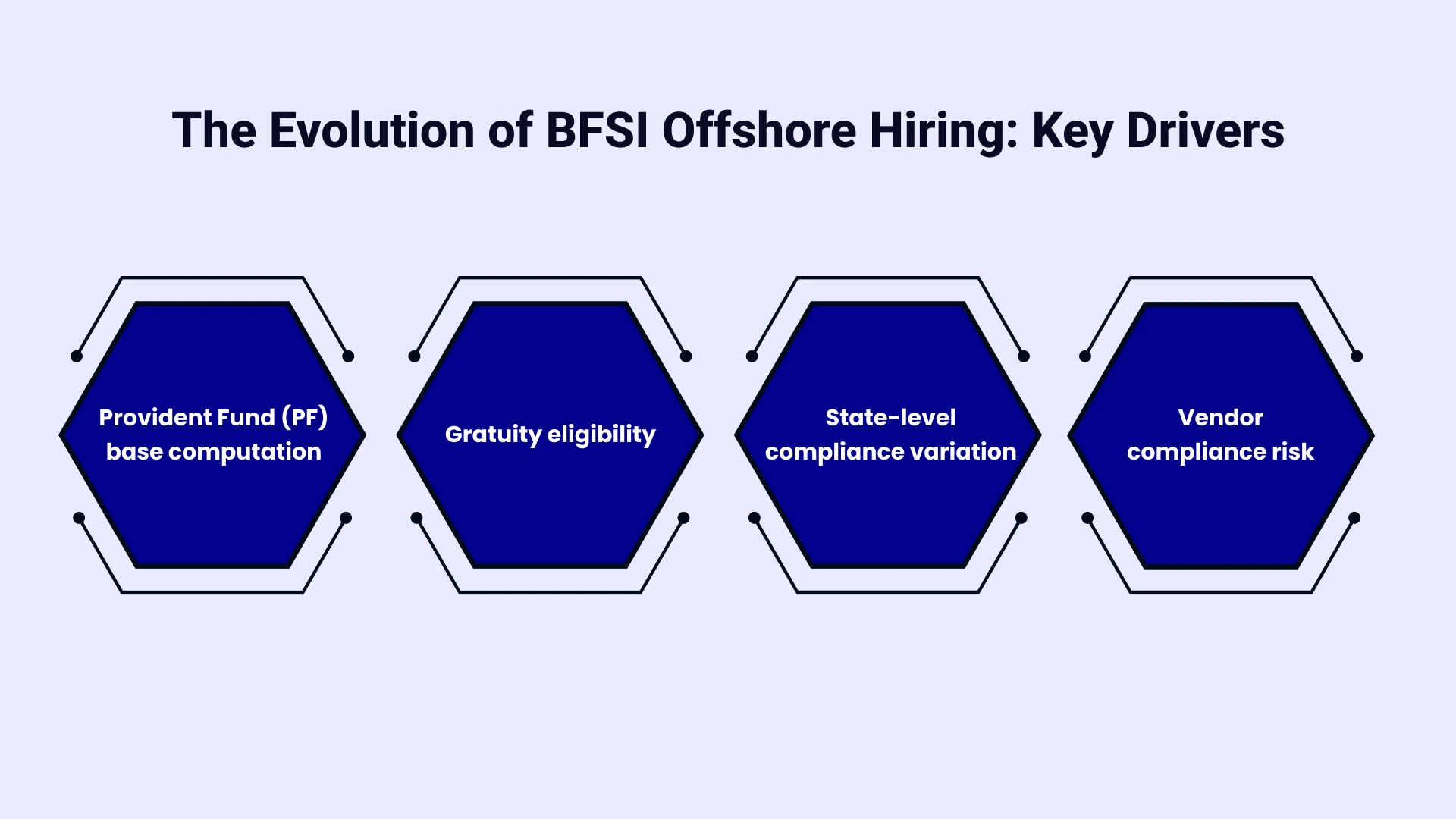
- Provident Fund (PF) base computation: Under the new Wages Code, PF contributions are now calculated on a broader wage base — removing the practice of structuring allowances to reduce PF liability. Full-time IT hires become marginally more expensive in the near term.
- Gratuity eligibility: The Social Security Code reduces the qualifying period for gratuity for fixed-term employees, which increases the effective cost of contract-to-hire models compared to pure augmentation.
- State-level compliance variation: Each state implements the Labour Codes differently. A BFSI firm with technology teams across Bengaluru, Hyderabad, and Pune faces three distinct compliance environments — a complexity that a structured Employer of Record (EOR) or augmentation partner absorbs entirely.
- Vendor compliance risk: Per RBI's outsourcing guidelines (2023 circular), BFSI entities are responsible for ensuring their IT vendors comply with applicable labour and social security laws. Using a vendor who has not updated their practices for the new Labour Codes exposes the bank to regulatory censure.
The practical implication is clear: augmentation through a compliance-current vendor with EOR capability eliminates this entire risk layer from the BFSI enterprise's balance sheet.
Building an Offshore Banking Technology Team: Cost Architecture and Governance
An offshore banking technology team is not simply a collection of developers billing at lower rates. For a BFSI enterprise, it is a governed delivery unit that must satisfy RBI's outsourcing risk framework, SEBI's Technology Risk circulars, and IRDAI's IT governance norms, depending on the institution type.
The architecture of a well-governed offshore BFSI technology team has four structural layers:
Layer | Function | Typical Roles | Monthly Cost Range (USD) |
Architecture & Governance | Technical ownership, RBI alignment, and delivery assurance | Solution Architect, Delivery Manager | $8,000–$14,000 per role |
Core Delivery | Feature development, integration, and data engineering | Senior + Mid-level Engineers | $3,500–$7,500 per role |
Quality & Compliance | Test automation, regulatory QA, VAPT support | QA Lead, Security Engineer | $3,000–$6,000 per role |
Support & Operations | Infra management, monitoring, and incident response | DevOps / SRE, L2 Support | $2,500–$5,000 per role |
For a mid-tier bank running a two-year core banking modernisation programme, a typical offshore team of eight to twelve specialists — blending dedicated and augmented resources — runs USD 35,000–60,000 per month all-inclusive. That is equivalent to two to three permanent senior hires in Mumbai on a TCE basis, but with a team that is 4x larger and governed to a contractual SLA.
The IT staffing cost benchmarks that matter most for a BFSI board presentation are not hourly rates — they are cost per delivered sprint, cost per compliance certification, and cost per system integration milestone. These metrics connect technology workforce spend to programme outcomes in the language that finance committees and regulators understand.

How VLink Delivers IT Staff Augmentation for India's BFSI Sector
VLink’s IT staff augmentation in fintech practices is built on a proven track record of driving large-scale digital transformation for the Banking, Financial Services, and Insurance (BFSI) sectors across India and North America. We provide the specialized talent necessary to navigate complex regulatory environments and modernize legacy infrastructures.
Our Core Credentials
We deliver elite technical talent for high-stakes initiatives, including:
- Core Banking Transformation: End-to-end re-platforming programs for Tier-2 and Tier-3 institutions.
- Regulatory & Compliance Automation: Streamlining reporting for capital markets and ensuring adherence to evolving mandates.
- Modernization for BIMA Sugam: API gateway architecture and modernization for insurance platforms transitioning to unified digital ecosystems.
- FinTech & NBFC Innovation: Engineering AI-powered fraud detection systems and robust lending engines for mid-market NBFCs.
Optimize Your Delivery Model
Move beyond traditional hiring hurdles. VLink provides a data-driven approach to scaling your technical workforce without compromising on quality or compliance.
Ready to evaluate your staffing efficiency? Engage VLink’s advisory team to receive a Cost Benchmarking Analysis, featuring a customized IT staff augmentation calculator tailored to your specific role mix and delivery timelines.
Conclusion
The IT staff augmentation cost calculation for India's BFSI sector is not a simple rate comparison. It is a multi-variable financial model that incorporates total cost of employment, domain specialisation premiums, regulatory compliance overhead, attrition risk, and Labour Code compliance — all within a governance framework that your RBI relationship manager and board audit committee will scrutinise.
The case for a structured augmentation model is financially clear across most BFSI role types and programme profiles. The challenge is not in the economics — it is in finding a partner with genuine BFSI domain depth, compliance with current vendor practices, and transparent billing that survives audit. That is where the selection decision actually resides.

Business Development Professional
Vineel is a seasoned sales and business development leader with extensive experience in the telecommunications and IT industries. Over the course of his career, he has worked with global teams at multinational organizations, having lived and operated in India, Canada, the Netherlands, and the United Kingdom.

 Shivisha Patel