

India has quietly become one of the world's most consequential AI talent hubs. For CTOs, VP Engineering leaders, and GM IT decision-makers evaluating where to build their next AI team, India is no longer just a cost-optimization story. It is a strategic capability play.
The numbers tell a clear picture.
But here is what most salary guides miss: salary benchmarks alone do not tell you whether you can actually hire the team you need, in the city you want, at the speed your roadmap requires.
This hiring AI/ML engineers guide goes beyond standard pay charts. It delivers a complete market-readiness view — role-by-role salary bands, city-wise availability, demand vs supply realities, AI hiring cost in India breakdown, and a practical AI team hiring strategy India framework that CTOs and engineering leaders can act on immediately.
India AI Talent Market Snapshot (2026 Outlook)
India's value for AI hiring has shifted structurally. Three forces drive this:
- Scale of talent pipeline: IITs, NITs, BITS Pilani, and hundreds of engineering colleges produce technically grounded graduates ready for AI/ML roles.
- GCC-led maturation: Global firms, including Google, Microsoft, JPMorgan, and Goldman Sachs, have established AI-focused GCC units in India, raising the overall quality bar and creating a secondary market of experienced engineers.
- GenAI boom: The 2023-2025 generative AI for business growth surge created an entirely new class of roles — LLM engineers, prompt engineers, AI safety researchers — that India's workforce is actively upskilling into.
For an IT services company for AI talent, India now offers what no other geography can match: the combination of volume, cost advantage, and growing specialization depth.
Demand vs Supply: The Real Market Reality
India has plenty of AI engineers. Finding the right ones at the right seniority, with the specific skills your product needs, is a different challenge. AI engineer demand vs supply has reached a critical imbalance at the senior and specialized layers:
Role Type | Active Talent Pool | Open Positions (Est.) | Supply Gap |
General ML Engineer | ~180,000 | ~95,000 | Manageable |
Senior AI Engineer (5+ yrs) | ~55,000 | ~70,000 | Tight |
GenAI / LLM Engineer | ~18,000 | ~45,000 | Critical |
MLOps Engineer | ~22,000 | ~38,000 | High |
AI Safety / Governance | ~3,500 | ~12,000 | Very High |
The Rise of AI Pods & GCC-led Hiring
Rather than building traditional engineering teams, forward-thinking companies are moving toward AI pods — small, cross-functional squads of 5-8 engineers combining ML, MLOps, data, and AI governance skills. GCCs pioneered this model in India, and it is now the dominant hiring architecture for enterprise AI build-outs. This context matters when you structure your hiring of AI ML engineers, guide, and plan a budget.
AI/ML Engineer Salary Benchmarks in India (Role-by-Role)
Below are the 2026 market salary ranges (CTC, annual, in INR) across experience bands. These reflect the full compensation picture — base, variable, and stock — and are benchmarked against startup, enterprise, and GCC employers.
AI Engineer Salary in India
Experience Band | Startup CTC (INR) | Enterprise CTC (INR) | GCC CTC (INR) |
Entry (0-2 yrs) | ₹7L – ₹12L | ₹10L – ₹16L | ₹14L – ₹22L |
Mid (3-5 yrs) | ₹15L – ₹28L | ₹22L – ₹38L | ₹30L – ₹50L |
Senior (6-9 yrs) | ₹32L – ₹55L | ₹45L – ₹75L | ₹60L – ₹100L |
Principal / Staff (10+ yrs) | ₹60L – ₹90L | ₹80L – ₹130L | ₹110L – ₹180L |
The AI engineer salary in India varies significantly by employer type. GCC roles carry a 30-45% premium over comparable startup positions at the mid and senior bands.
Machine Learning Engineer Salary in India
Machine learning engineer salary in India follows a similar arc with slight compression at the entry level:
Experience Band | Range (INR CTC) | Key Differentiators |
0-2 years | ₹6L – ₹14L | PyTorch, scikit-learn, basic NLP |
3-5 years | ₹16L – ₹32L | Production ML, A/B testing, cloud deployment |
6-9 years | ₹35L – ₹65L | ML platform ownership, team leadership |
10+ years | ₹70L – ₹140L | AI architecture, cross-functional ownership |
When you hire ML engineers in India, expect the widest pay variance between companies that treat ML as a support function vs companies where ML is product-critical. The latter pays 20-35% more.
GenAI & LLM Engineer Salary Premiums
GenAI engineer hiring in India commands a significant market premium. LLM engineer demand in India has surged with the rise of RAG systems, fine-tuning pipelines, and AI agent frameworks. These are the scarcest profiles in the market:
Role | Salary Range (INR CTC) | Scarcity Level | Avg. Time-to-Hire |
GenAI Engineer (Mid) | ₹28L – ₹55L | High | 60-90 days |
LLM Engineer (Senior) | ₹55L – ₹100L | Critical | 90-120 days |
Prompt Engineer (specialized) | ₹18L – ₹40L | Moderate | 45-60 days |
AI Research Engineer | ₹45L – ₹90L | Very High | 90-150 days |
Deep learning engineer salary in India sits within the AI Engineer range but commands premiums for vision, speech, or NLP specializations — typically 15-25% above general ML engineer bands.
MLOps Engineer Salary Trends
MLOps engineer hiring in India reflects growing infrastructure maturity. As companies move models from notebook to production, MLOps engineers have become mission-critical:
Band | Salary Range (INR CTC) | Key Skills Valued |
Junior MLOps | ₹8L – ₹18L | Kubeflow, MLflow, basic CI/CD |
Mid MLOps | ₹20L – ₹40L | Feature stores, model monitoring, Vertex AI / SageMaker |
Senior MLOps | ₹42L – ₹80L | Platform architecture, cost optimization, multi-cloud |
The AI startup vs big tech salary in India gap is sharpest in MLOps: startups often underpay and then struggle to retain engineers who get poached by GCCs and big tech.
City-Wise AI Talent Availability & Salary Comparison
Location strategy is one of the most underestimated decisions when you hire AI engineers in India. Here is the real picture across major hiring markets:
City | Talent Density | Avg. Senior AI Salary | Attrition Risk | GCC Presence | Hire Difficulty |
Bengaluru | Highest | ₹55L – ₹110L | High (18-22%) | Very Strong | Hard |
Hyderabad | High | ₹45L – ₹90L | Moderate (14-18%) | Strong | Moderate |
Pune | Medium-High | ₹40L – ₹80L | Moderate (13-16%) | Growing | Moderate |
Gurugram / NCR | High | ₹50L – ₹100L | High (16-20%) | Strong | Hard |
Mumbai | Medium | ₹45L – ₹85L | Moderate (15-18%) | Finance-led | Moderate |
Chennai | Medium | ₹35L – ₹70L | Lower (10-14%) | Moderate | Easier |
Tier-2 (Coimbatore, Kochi, Indore) | Lower | ₹20L – ₹50L | Low (8-12%) | Emerging | Easiest |
Now, let’s examine the diverse perspectives on city-specific AI talent.
Bengaluru — High Cost, Highest Talent Density
AI engineer availability in Bangalore is unmatched in terms of volume and seniority depth. But hiring here is expensive and competitive. Expect 18-22% annual attrition, aggressive counter-offers, and 60-90 day hiring cycles for senior profiles. If you are hiring ML engineers or LLM engineers, Bengaluru is where the pool is — but plan your AI hiring cost in India accordingly.
Hyderabad & Pune — Balanced Cost vs Quality
Both cities offer strong alternatives to Bengaluru's salary pressure. Hyderabad has a large GCC cluster and a growing GenAI talent base. Pune is particularly strong for ML engineers with product company backgrounds. These are strong choices for companies building their first India AI pod.
Gurugram & Mumbai — Enterprise/GCC Hubs
NCR (Gurugram, Noida) is strong for enterprise AI, especially in BFSI and e-commerce. Mumbai's AI scene is finance-heavy and growing. Both cities carry premium salary expectations and urban lifestyle demands — but offer access to senior leaders who prefer these metros.
Chennai & Emerging Tier-2 Cities
Chennai offers lower attrition and manageable salary bands, making it ideal for ML engineers in production-support or data engineering roles. Tier-2 cities like Coimbatore, Kochi, and Indore are increasingly viable for junior-to-mid AI engineers, especially with remote-first models and strong connectivity infrastructure.
AI Talent Availability vs Hiring Difficulty: Reality Check
The AI talent shortage in India is real — but it is not evenly distributed. AI engineer demand vs supply analysis shows clear fault lines:
The GenAI Talent Bottleneck (10:1 Gap)
For every qualified GenAI or LLM engineer, there are approximately 10 open positions in the market today. This means that when you hire AI/ML developers for generative AI roles, you are not just competing on salary — you are competing on project quality, team culture, engineering reputation, and growth visibility. Candidates at this level receive 3-5 active inbound offers at any time.
Time-to-Hire Benchmarks by Role
Role | Average Time-to-Hire | Key Bottlenecks |
Junior ML Engineer | 30-45 days | Volume filtering, basic skills gap |
Mid ML Engineer | 45-60 days | Portfolio review, offer competition |
Senior AI Engineer | 60-90 days | Role scarcity, negotiation cycles |
LLM / GenAI Engineer | 90-120 days | Extreme demand, counter-offers |
MLOps Engineer | 60-90 days | Tool-stack specificity |
AI Architect / Principal | 90-150 days | Niche supply, compensation alignment |
Attrition & Offer Drop Trends
AI engineer hiring challenges in India extend beyond sourcing. Offer drops — where candidates accept and then renege — run at 25-35% for GenAI profiles. Annual attrition for senior AI engineers in Bengaluru exceeds 20%. Planning for AI recruitment agency support or a dedicated development team model can significantly reduce these risks.
AI Hiring Cost Breakdown in India: Beyond Salary
Hiring AI talent in India in 2026 is no longer just about matching a competitive salary; it’s about accounting for a complex ecosystem of "hidden" costs. For specialized AI roles, the base salary typically represents only 60% to 70% of the Total Cost to Employer (TCE).
Here is the breakdown of the costs beyond the paycheck.
Base Salary vs Total Cost (CTC Reality)
The AI/ML engineer salary india shown in job postings is base salary. The total employer cost — the real AI hiring cost in India — is substantially higher:
Cost Component | Typical Range (% of Base Salary) | Notes |
Base Salary | 100% | Benchmark from tables above |
Variable / Bonus | 15-25% | Performance-linked, paid quarterly or annually |
PF / ESI (Employer) | 12-13% | Statutory — applies to all employees |
Group Health Insurance | 3-5% | Family floater increasingly expected |
Gratuity Provision | 4-5% | Statutory accrual after 5 years |
Stock / ESOPs | 10-30% | Critical for senior engineers; startup vs GCC varies |
Infra / Tooling per engineer | ₹3L – ₹8L/yr | Cloud, compute, licenses, collaboration tools |
Hiring Cost (Agency/RPO) | 8-12% of annual CTC | One-time; varies by channel |
- Total employer cost for a senior AI engineer drawing ₹60L
- CTC: factor ₹80L – ₹100L per year including all components.
- For LLM/GenAI engineers, add 20-30% for premium skill uplift.
Premium Skills Cost Uplift (LLM, MLOps, AI Safety)
Certain specializations command market premiums above standard AI engineer salary in India benchmarks. When you hire AI engineers with these skills, build these uplifts into your compensation model:
- LLM fine-tuning + RAG architecture: +20-35% above standard senior AI engineer CTC
- AI Safety / Red-teaming: +25-40% — extremely scarce
- MLOps at scale (10M+ model calls/day): +15-25%
- Multi-modal AI (vision + language): +15-20%
Build vs Augment: What's the Right AI Hiring Strategy?
One of the most critical AI team hiring strategy India decisions is structural: do you build an in-house team from scratch, or do you accelerate via staff augmentation or a dedicated development team model? Let’s explore in detail with below table.
Model | Best For | Time to Productivity | Cost Profile | Key Risk |
In-house Hiring | Long-term capability ownership, IP sensitivity | 6-12 months | High upfront + ongoing | Slow ramp, attrition exposure |
Staff Augmentation | Fast scaling, niche skills, project surges | 2-6 weeks | Predictable, flexible | Integration, knowledge transfer |
Dedicated Development Team | Mid-to-long term, managed AI pods | 4-8 weeks | Moderate, team-led | Vendor dependency risk |
GCC Build-out | Enterprises, 50+ engineers, multi-year horizon | 6-18 months | High investment, long ROI | Setup complexity, governance |
When to Choose Each Model
Use in-house hiring when AI is your core product differentiator and you are hiring ML engineers for proprietary model development. Use IT staff augmentation services when you need to move fast, fill a skills gap, or test a new AI use case before full commitment.
Use a dedicated development team when you want the benefits of a stable team without the overhead of full in-house hiring — this is the most popular build vs augment AI team India model for mid-size enterprises entering the AI space. Use GCC tech talent sourcing in India when you have scale ambitions, a multi-year roadmap, and the governance appetite for a full entity setup.
The India AI Pod Hiring Framework (Step-by-Step)
For most CTO and VP Engineering buyers, the fastest path to productive AI output in India is the AI Pod model. Here is a proven four-step build sequence used by enterprise and mid-market companies scaling AI through hiring ML engineers India:
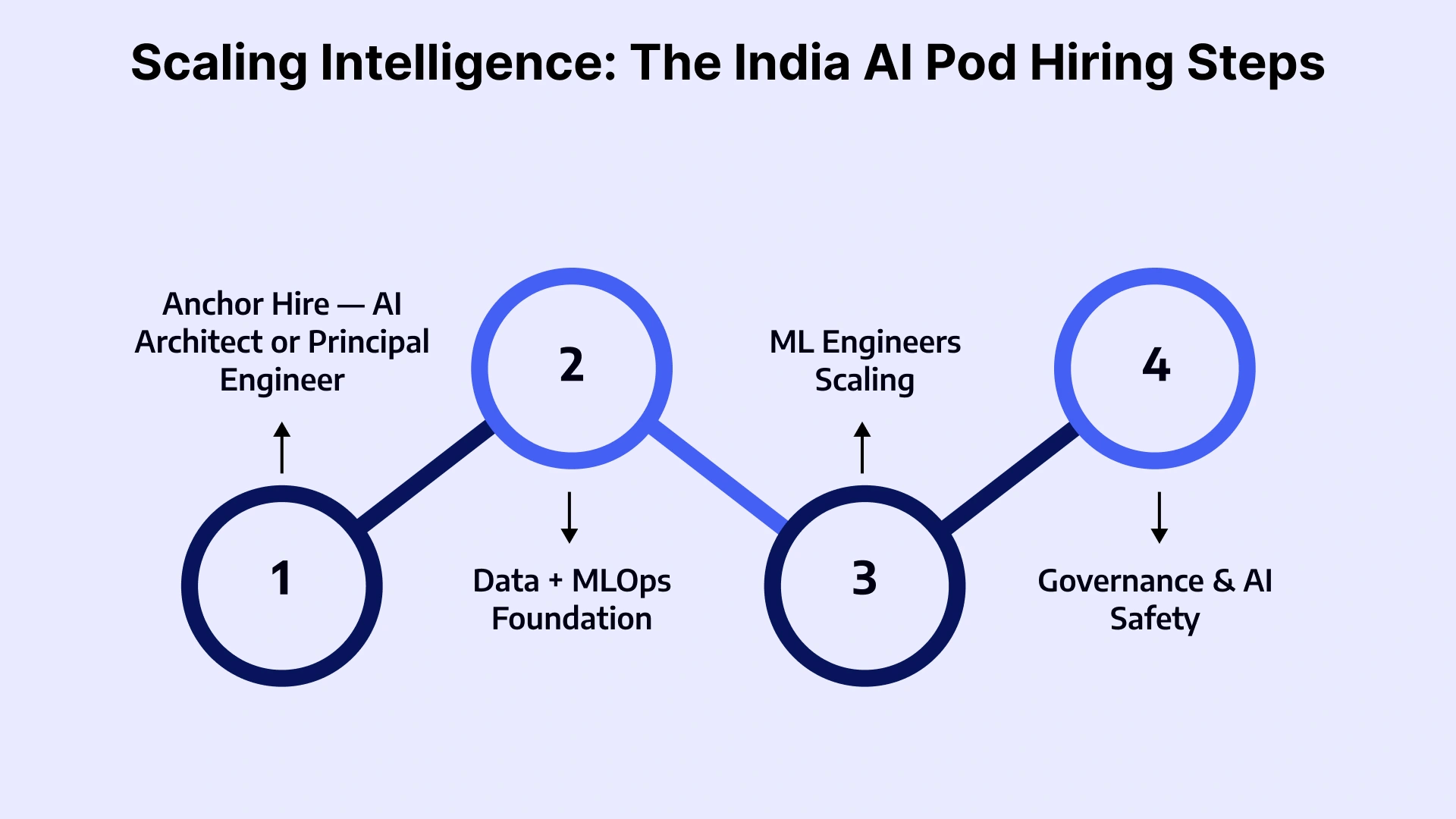
Step 1: Anchor Hire — AI Architect or Principal Engineer
This is your most critical hire. The AI Architect sets the technical foundation, selects the ML stack, and defines the data architecture. Budget ₹90L – ₹150L CTC for a genuinely experienced profile. Rushing this hire or underpaying is the single most common mistake in India AI hiring.
Step 2: Data + MLOps Foundation
Before you can run models in production, you need clean data pipelines and infrastructure. Hire 1-2 Data Engineers and 1 MLOps Engineer in parallel with or immediately after the anchor hire. This is where ML development services vendors can accelerate timelines — they bring pre-built pipeline accelerators that reduce ramp time by 40-60%.
Step 3: ML Engineers Scaling
Once infrastructure is stable, hire AI/ML developers for model development and experimentation. Hire in cohorts of 2-3, not individually, to build team learning velocity. For AI engineer remote hiring India, ensure you have async-first processes and clear documentation standards in place before this phase.
Step 4: Governance & AI Safety
As your AI systems go to production, add AI Safety / Governance profiles. This is increasingly non-negotiable for enterprises in regulated industries. These are the scarcest profiles — plan 90-120 days hiring lead time and consider AI development services partnerships that include embedded governance frameworks.
Hiring Challenges & Mitigation Strategies for CTOs
Hiring in 2026 has become a high-stakes game of "signal vs. noise." For CTOs, the challenge isn't just finding someone who can code—it’s finding leaders who can navigate a landscape dominated by AI-augmented workflows, cybersecurity threats, and a workforce that values flexibility over almost everything else.
Below are the primary hiring challenges for CTOs today and the strategic pivots required to mitigate them.
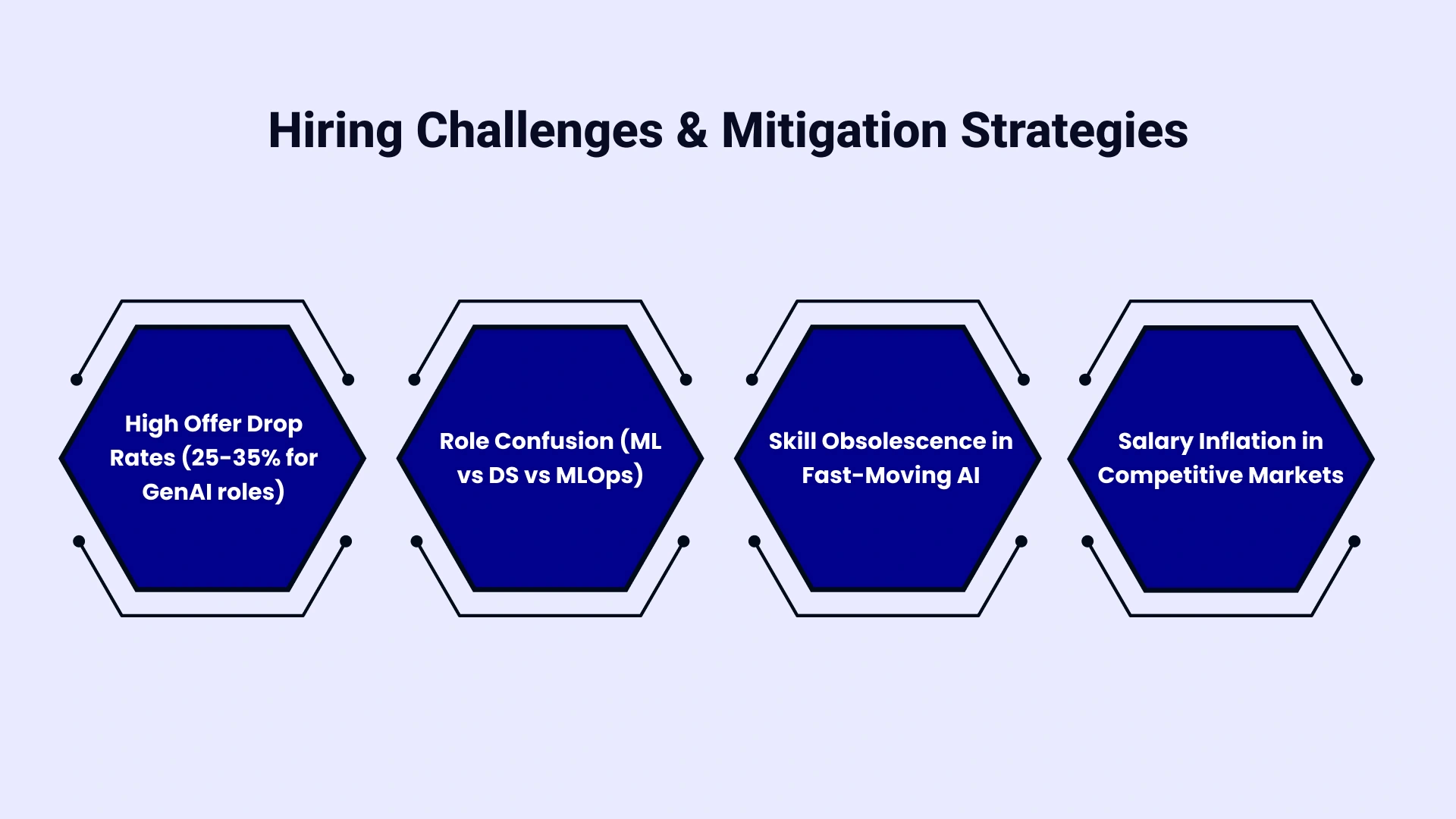
Challenge 1: High Offer Drop Rates (25-35% for GenAI roles)
Mitigation: Move faster — compress hiring cycles from 90 days to 60 days by parallelizing technical assessment and cultural evaluation. Offer joining bonuses for niche profiles. Consider AI recruitment agency support for GenAI-specific sourcing. Engage candidates with technical challenges and leadership visibility during the process.
Challenge 2: Role Confusion (ML vs DS vs MLOps)
Mitigation: Define job descriptions with extreme specificity. Conflating Data Scientist and ML Engineer roles leads to mismatched hires. Use role scorecards. When you hire best ai developer for project needs, clarity on deliverables during screening eliminates 40% of mismatches.
Challenge 3: Skill Obsolescence in Fast-Moving AI
Mitigation: Hire for learnability and structured learning culture. Engineers who mastered BERT in 2021 need to ship with GPT-4 class models today. AI talent acquisition strategy should include a '70-20-10' learning investment model: 70% on-project learning, 20% internal knowledge sharing, 10% external conferences and courses.
Challenge 4: Salary Inflation in Competitive Markets
Mitigation: Expand your geography. AI engineer availability in Bangalore is high but expensive. Hyderabad, Pune, and Chennai offer 15-25% lower salary bands with comparable quality for most roles. Hybrid models — senior leadership in Bengaluru, execution teams in Tier-2 — are increasingly common.
Real-World Case Studies: AI Hiring in India
India’s tech ecosystem has moved rapidly from "AI-curious" to "AI-first," with major players like TCS, Zomato, and Swiggy fundamentally restructuring their hiring and internal talent management pipelines.
In 2026, the focus has shifted from finding traditional coders to identifying "AI-augmented" talent and leveraging autonomous systems to manage vast workforces.
Case Study 1: Global BFSI Enterprise — AI Pod via Dedicated Team Model
A US-headquartered financial services firm needed to build a credit risk AI team in India. In-house hiring would have taken 12-18 months given BFSI's compliance-heavy hiring process. Instead, they engaged a dedicated development team partner with pre-vetted AI engineers and an embedded MLOps capability.
The result: 8-engineer AI pod operational in 14 weeks, 60% faster than projected internal timelines. Total AI hiring cost in India came in at 40% below comparable US team cost.
Case Study 2: SaaS Startup — Tier-2 AI Hiring Strategy
A Series B SaaS company needed ML engineers for recommendation engine development. They initially targeted Bengaluru — and faced 90-day hiring cycles, salary demands 30% above budget, and three offer drops.
After pivoting to a Pune + Coimbatore hybrid model, they filled the same roles in 45 days at 20% below original budget. AI engineer remote hiring India enabled asynchronous collaboration across cities without productivity loss.
Case Study 3: Hyper-Growth Logistics — Autonomous High-Volume Screening
A leading Indian food-tech unicorn needed to scale its engineering and data teams by 400+ roles in a single quarter. Traditional manual screening created a "hiring debt," where top-tier talent was lost to competitors during the 60-day lag between application and interview.
They deployed an autonomous AI recruitment layer that conducted initial technical assessments and evaluated "AI-fluency" (the candidate's ability to prompt and pair-program). The result: Time-to-offer dropped from 45 days to 9 days, with a 75% reduction in recruitment overhead.

Accelerate Innovation: Hire Top-Tier AI/ML Talent from VLink
VLink is a leading IT services company for AI talent with deep roots in India's top engineering talent markets. We help CTOs and VP Engineering leaders hire AI engineers, hire ML engineers, and build production-ready AI teams — without the 90-day wait or the offer-drop anxiety.
Our AI talent acquisition strategy spans every role in the stack: GenAI engineers, LLM specialists, MLOps engineers, AI architects, and data engineers. We operate across Bengaluru, Hyderabad, Pune, Chennai, and Tier-2 markets — giving you flexibility on cost and speed.
What we offer:
- Dedicated development team models — stable, long-term AI teams with VLink management
- IT staff augmentation services — fast plug-in of niche AI/ML skills for 3-18 month engagements
- GCC tech talent sourcing in India — end-to-end support for enterprise AI pod formation with ideal
- AI development services — from model development to production deployment
- ML development services — specialised ML pipelines, feature engineering, model optimization
- Future-Proofing your business with Industry-Specific AI Integration services
If you want to hire AI/ML developers with proven production experience — not just certified freshers — VLink has the network, the process, and the India-market depth to deliver.
Final Takeaway: India Is a Capability Play, Not Just a Cost Play
The CTO or VP of Engineering who treats India purely as a low-cost labour market will be disappointed. The one who treats it as a strategic AI capability geography — with thoughtful role selection, city strategy, compensation structuring, and the right hiring model — will build one of the most competitive AI teams in their industry.
India has the depth. The AI ML engineers' availability guide reality is that the talent exists, the specialisation is growing, and the infrastructure is mature. What separates successful AI hiring programs from failed ones is execution clarity: knowing which roles to hire where, what the real cost looks like, and whether to build vs augment.
Don't wait to transform this guide into your strategic market blueprint and VLink into your dedicated execution partner. Build your India-based AI team with absolute confidence—contact us today for a custom hiring roadmap tailored to your vision.

Vice President & Global Head of Digital, VLink Inc.
Amitabh is the Vice President and Global Head of Digital at VLink Inc., with over 20 years of leadership experience in IT strategy, digital transformation, and emerging technologies.

 Shivisha Patel