


The GCC region is no longer asking whether artificial intelligence belongs in customer service. That question was settled years ago. The new question CXOs across UAE and Saudi Arabia are grappling with is far more pressing: How do we move from chatbots that frustrate customers to generative AI solutions that actually resolve issues, reduce costs, and scale without proportional headcount increases?
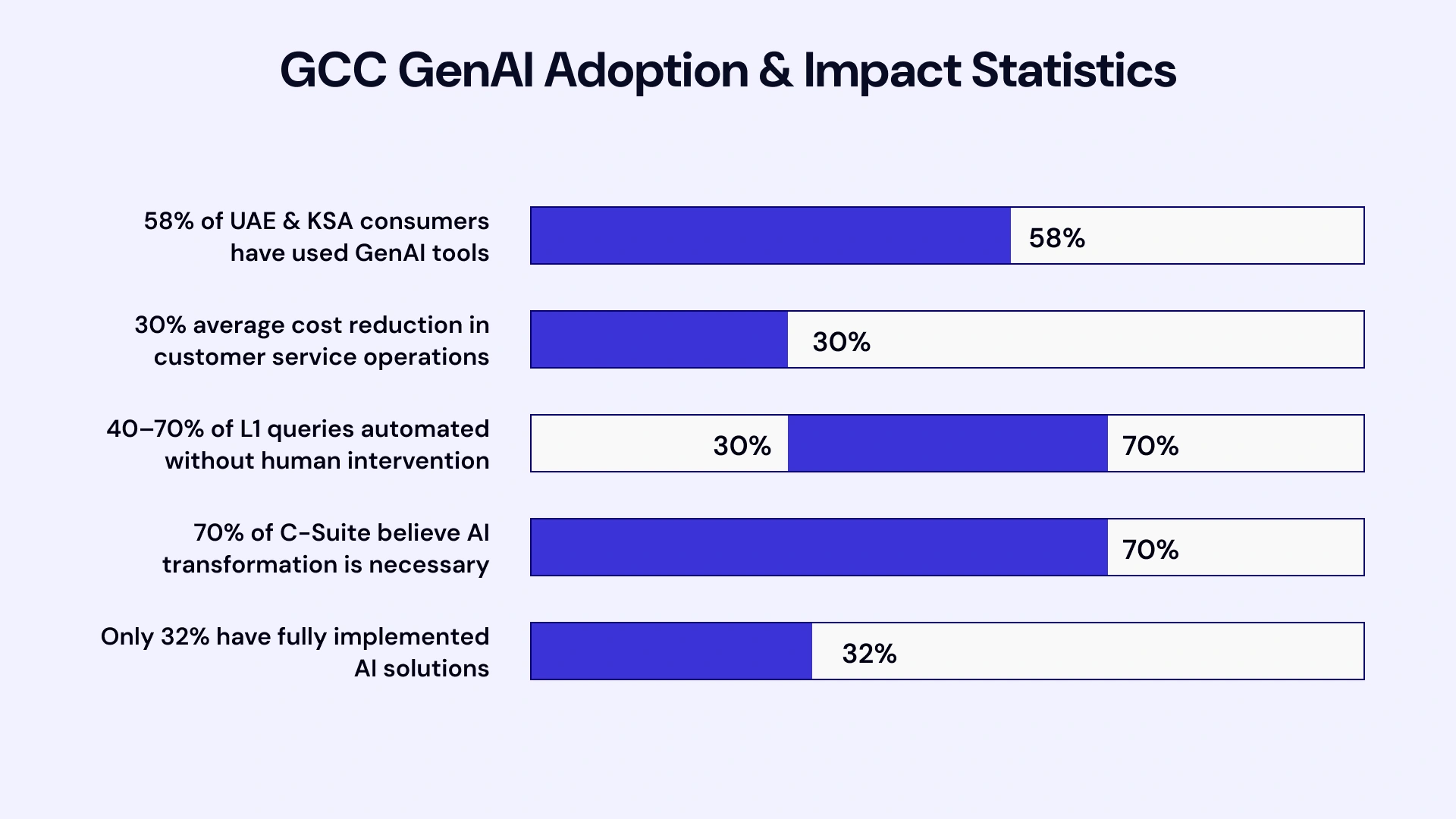
The numbers tell a compelling story. According to recent industry research, 58% of consumers in the UAE and Saudi Arabia have already used GenAI tools—significantly outpacing adoption rates in European markets. Meanwhile, companies implementing AI automation in customer service operations report an average 30% cost reduction. Yet here's the contradiction: while 70% of C-Suite executives in the region believe AI transformation is necessary, only 32% have fully implemented solutions.
This gap between intention and execution represents both a challenge and an opportunity. For enterprise retail chains managing thousands of daily customer inquiries across WhatsApp, email, and IVR systems, or telecom operators drowning in billing disputes and SIM management requests, generative AI offers a path forward that traditional chatbots never could. Organizations exploring AI development services find that the technology has matured significantly, enabling capabilities that seemed futuristic just two years ago.
This playbook examines what generative AI for customer service actually enables in the GCC context, addresses the region-specific barriers that competitors consistently overlook, and provides a practical framework for implementation that respects both regulatory requirements and commercial realities.

Why GCC Retail and Telecom Are Moving from Chatbots to Generative AI
The Shift from AI Hype to AI Execution in UAE & Saudi Arabia
The transition happening across GCC enterprises is fundamentally different from previous automation waves. This shift is defined by three converging forces: sovereign AI requirements, agentic AI capabilities, and local compliance mandates that make generic global solutions inadequate.
Consider a scenario playing out at major UAE telecom providers. What started as a simple FAQ chatbot has evolved into an autonomous billing-resolution agent capable of accessing customer accounts, identifying discrepancies, calculating adjustments, and executing refunds—all without human intervention. This represents the practical reality of agentic AI: systems that don't just answer questions but take actions within integrated enterprise systems. Organizations investing in conversational AI development are discovering that these intelligent agents can handle complex multi-step workflows that previously required human judgment.
CX Leaders' Pain Points in Retail and Telecom
The decision-makers driving this transformation—Chief Customer Officers, Heads of Contact Center Operations, VPs of Digital Transformation—share remarkably consistent challenges across both retail and telecom sectors.
High ticket volume remains the most pressing operational concern. Major retail chains process thousands of daily inquiries about order status, returns, and product availability. Telecom operators face even higher volumes centered on billing queries, SIM management, network troubleshooting, and plan modifications. Traditional approaches require proportional staffing increases, creating unsustainable cost trajectories. Industry data suggests that telecom contact centers in the GCC handle an average of 15,000-50,000 daily interactions, with billing-related queries comprising 35-40% of total volume.
SLA pressure compounds this challenge. Enterprise service level agreements demand rapid first-contact resolution, yet existing chatbot systems handle less than 20% of queries effectively. The result is escalation bottlenecks, extended wait times, and deteriorating customer satisfaction scores. For telecom providers, every percentage point improvement in first-contact resolution translates to measurable cost savings and reduced customer churn.
Multilingual support requirements add another dimension that global AI solutions consistently underserve. GCC customer bases require fluent support in Arabic—including Khaleeji dialect nuances—alongside English and often additional expatriate languages. Generic language models struggle with cultural context, leading to responses that feel tone-deaf or inadequate. The UAE's diverse population includes residents from over 200 nationalities, creating linguistic complexity that standard translation approaches cannot adequately address.
Regulatory constraints in telecom particularly create compliance overhead that manual processes struggle to maintain. From KYC requirements to data handling protocols, the regulatory environment demands systems that can enforce consistency at scale. Enterprises exploring machine learning development solutions find that AI systems can be trained to recognize and flag compliance-relevant interactions automatically.
What Generative AI Actually Enables in GCC Customer Service
Automated L1 Support for 40–70% of Queries
The most immediate impact of generative AI in customer service comes from automating frontline query resolution. Research from enterprise implementations across the region indicates that AI customer service solutions can effectively handle 40–70% of incoming queries without human intervention.
This automation extends beyond simple FAQ retrieval. Modern AI chatbots for customer support can interpret customer intent from conversational language, access relevant knowledge bases, and generate contextually appropriate responses. For a retail customer asking about return eligibility, the system can check purchase date, assess product category policies, and provide specific instructions—all within seconds. Organizations that have invested in AI chatbot development for customer management report significant improvements in response accuracy compared to rule-based systems.
The cost implications are substantial. With contact center operations representing significant overhead for both retail chains and telecom providers, automating even half of L1 queries translates directly to operational savings while simultaneously improving response times. A typical GCC telecom provider spending $15-20 million annually on contact center operations could realize $4-6 million in savings through effective L1 automation while improving average response times from minutes to seconds.
The technology enabling this automation has matured considerably. Retrieval-Augmented Generation (RAG) architectures allow AI systems to ground their responses in verified enterprise knowledge bases, dramatically reducing the hallucination problems that plagued earlier implementations. When a customer asks about a specific policy or product detail, the AI retrieves relevant documentation and generates accurate responses rather than improvising potentially incorrect information.
AI Assist for Human Agents: Summaries, Suggested Responses, Live Prompts
Generative AI transforms agent productivity even for queries requiring human handling. Implementation data from regional telecom operators demonstrates that AI-driven call summarization and topic extraction reduces pre- and post-call manual operations by 30%.
Rather than replacing agents, these human-in-the-loop AI systems augment their capabilities. During live interactions, agents receive real-time suggested responses, relevant knowledge base excerpts, and contextual prompts. After calls, automatic summarization eliminates manual note-taking while ensuring consistent documentation. This approach aligns with insights on AI-driven business intelligence, where the goal is enhancing human decision-making rather than replacing it entirely.
This approach addresses the high agent turnover challenge plaguing GCC contact centers. With AI handling routine cognitive tasks, agents can focus on complex problem-solving and relationship building—work that's more engaging and less subject to burnout. Agent satisfaction scores typically improve when repetitive tasks are automated, leading to lower attrition and reduced training costs.
The technology also enables consistent quality across agent interactions. Rather than relying on individual agent knowledge, which varies based on experience and training, AI-assisted responses draw from centralized knowledge bases. This standardization is particularly valuable for complex products like telecom bundles or financial services where incorrect information can create liability.
Multilingual and Culturally Localized CX
Effective generative AI for customer service in the GCC must navigate linguistic complexity that extends far beyond translation. Khaleeji Arabic carries cultural connotations and conversational patterns that differ substantially from Modern Standard Arabic. A system trained exclusively on MSA may technically communicate but will feel foreign to Gulf customers.
Leading implementations use Retrieval-Augmented Generation (RAG) with datasets fine-tuned on local cultural and linguistic contexts. Historical customer transcripts from UAE and Saudi operations provide the training foundation for systems that understand regional expression patterns, cultural references, and appropriate formality levels. This localization effort represents a significant differentiator for AI software development in the Dubai and GCC market.
This localization extends to understanding context-specific terminology. Telecom queries in Saudi Arabia reference different plan structures, regulatory frameworks, and service expectations than identical queries in UAE. Effective AI systems recognize and adapt to these variations. For example, a query about "data rollover" in one market might use entirely different terminology in another, and the AI must recognize these equivalents.
Code-switching—the common practice of mixing Arabic and English within single conversations—presents additional challenges. Many GCC consumers naturally blend languages based on topic and context. AI systems must handle these transitions smoothly rather than treating them as errors or failing to understand mixed-language inputs.
AI for Omnichannel Engagement
WhatsApp dominates customer communication in the GCC. With 73% of consumers in UAE and Saudi Arabia shopping via social media channels, AI for omnichannel customer engagement must prioritize conversational commerce platforms over traditional web interfaces.
Generative AI enables seamless customer journeys across WhatsApp, IVR, webchat, and mobile applications. A customer might initiate a query via WhatsApp, continue the conversation through voice when it becomes complex, and receive confirmation via the original channel—all while the AI maintains context throughout. This omnichannel continuity represents a significant advancement over traditional systems where channel-switching meant starting conversations from scratch.
The personalization potential is significant. Rather than generic responses, AI systems can reference previous interactions, purchase history, and stated preferences to deliver individualized experiences. This capability transforms customer service from cost center to relationship-building opportunity. Data analytics in retail demonstrate that personalized interactions significantly improve customer lifetime value and repeat purchase rates.
Integration with backend systems enables the AI to provide actionable information rather than generic responses. When a customer asks about order status, the AI can pull real-time tracking data, identify potential delivery issues, and proactively offer solutions—all within the same conversational interface.

Industry-Specific Use Cases: Retail vs. Telecom in GCC
Retail: Hyper-Personalization, Virtual Shopping Assistants, Returns Automation
Generative AI in UAE retail is redefining what personalized service means at scale. The concept of "segment of one" marketing—treating each customer as a unique market based on their individual preferences, purchase history, and behavioral patterns—becomes operationally feasible when AI handles the complexity.
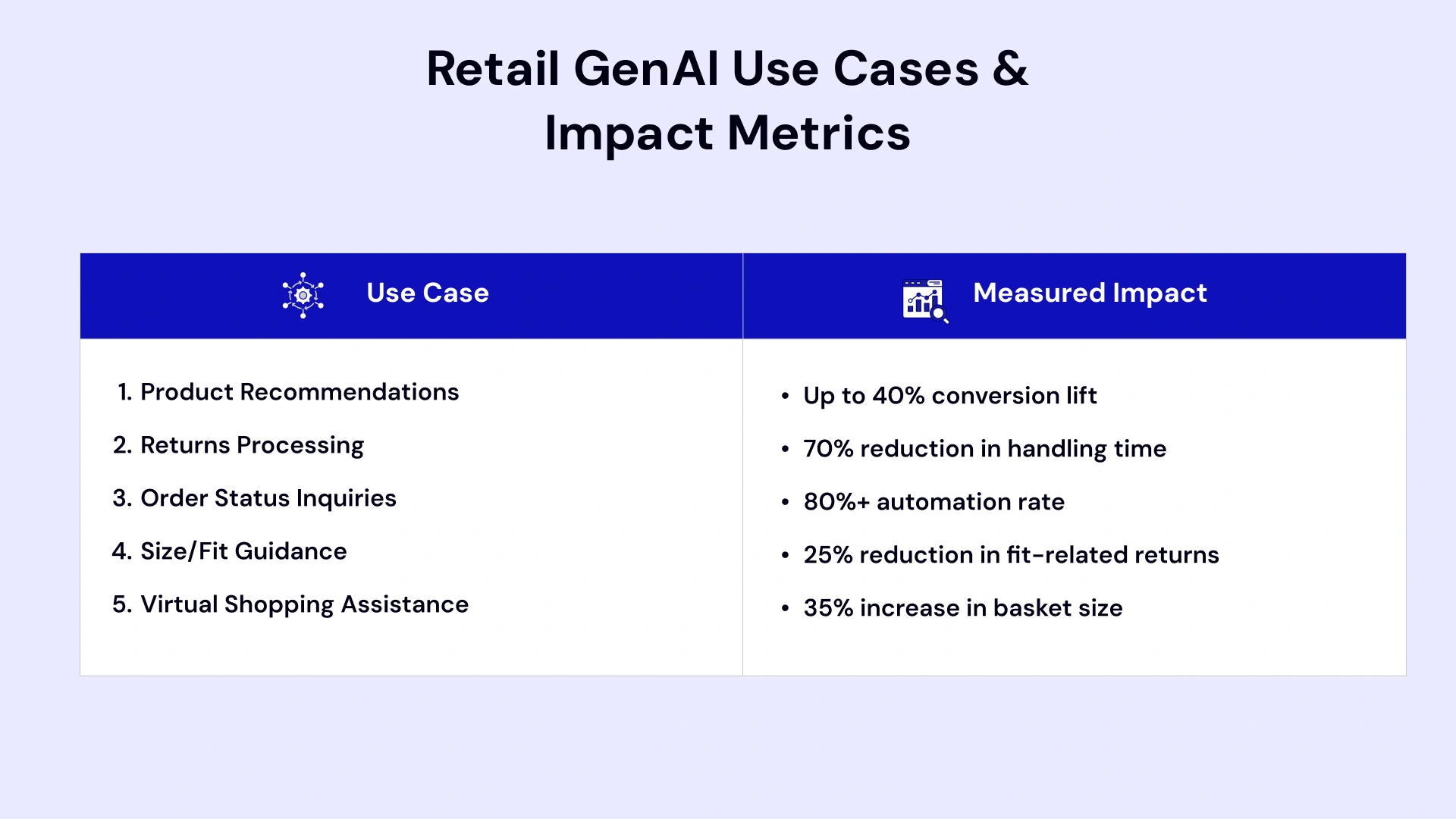
Consider a Dubai-based fashion retailer implementing AI-powered WhatsApp commerce. When a customer inquires about a specific item, the AI doesn't simply confirm availability. It references previous purchases, identifies complementary pieces, considers stated style preferences, and suggests complete outfit combinations. Early implementations of such approaches report conversion lifts of up to 40% compared to generic product recommendations. This level of personalization, previously available only through dedicated personal shoppers, now scales across entire customer bases.
Returns automation addresses another retail pain point. Rather than routing all return requests to human agents, AI systems can assess return eligibility, generate shipping labels, initiate refund processing, and update inventory—reducing handling time from minutes to seconds while maintaining policy compliance. For fashion retailers where return rates can exceed 30%, this automation delivers substantial operational savings.
Virtual shopping assistants extend this capability further. Customers can describe what they're looking for in natural language, receive curated recommendations, ask follow-up questions, and complete purchases—all within a conversational interface that feels more like interacting with a knowledgeable salesperson than a website. The AI can handle nuanced requests like "something for a beach vacation that isn't too casual for evening dinners" and provide relevant suggestions based on inventory and customer preferences.
Inventory visibility and availability checking benefit from AI integration as well. Rather than simply reporting whether an item is in stock, AI systems can check availability across multiple locations, suggest alternatives for out-of-stock items, and even predict restocking timelines based on supply chain data.
Retail GenAI Use Cases and Impact Metrics
| Use Case | Traditional Approach | GenAI Capability | Measured Impact |
| Product Recommendations | Rule-based, segment-level | Individualized, context-aware | Up to 40% conversion lift |
| Returns Processing | Manual agent handling | Automated eligibility and execution | 70% reduction in handling time |
| Order Status Inquiries | FAQ lookup or agent escalation | Real-time tracking with proactive updates | 80%+ automation rate |
| Size/Fit Guidance | Generic size charts | Personalized recommendations from purchase history | 25% reduction in fit-related returns |
| Virtual Shopping Assistance | Not available at scale | Natural language product discovery | 35% increase in basket size |
Telecom: Billing, SIM Management, Network Troubleshooting, Plan Upgrades
Generative AI in GCC telecom addresses the highest-volume query categories while integrating deeply with operational systems. The vision isn't chatbots that deflect to human agents but AI agents that perform actions within CRMs and billing platforms. Enterprises investing in telecom software development increasingly prioritize these AI integration capabilities.
Billing queries represent the largest single category for regional telecom contact centers. AI systems now analyze bill components, identify usage patterns that explain charges, compare current plans against alternatives, and—when appropriate—execute plan modifications or apply credits. What previously required agent intervention across multiple systems now happens within a single conversational interaction. For customers confused by complex bills with multiple line items, the AI can provide clear explanations and even suggest plan optimizations based on actual usage patterns.
SIM management has similarly transformed. From activation to replacement to porting, AI agents guide customers through requirements, verify identity documentation, and execute backend processes. Saudi telecom providers implementing such capabilities report significant reductions in call volume for plan-change journeys. The AI can handle the entire eSIM activation process, including identity verification, plan selection, and technical configuration, without human intervention.
Network troubleshooting showcases AI's diagnostic capabilities. Rather than walking customers through generic reset procedures, AI systems can analyze network status, identify service issues affecting specific locations, and provide targeted resolution steps. When issues require field intervention, the AI can schedule technician visits with appropriate context already documented. Integration with network operations centers allows the AI to provide real-time status updates about outages and expected resolution times.
Proactive service management represents an emerging use case. AI systems can identify customers likely to experience issues based on network data and usage patterns, initiating outreach before problems manifest as complaints. This predictive approach transforms customer service from reactive to proactive, significantly improving customer satisfaction and reducing churn.
Omnichannel Journey Automation: Voice AI Replacing IVR
The traditional IVR experience—"Press 1 for Sales, Press 2 for Support"—represents everything customers dislike about automated service. Voice bots for telecom support are fundamentally reimagining this interaction model.
Industry projections indicate that by 2026, intelligent voice agents will replace traditional IVR menus with natural, context-aware conversations. Customers state their needs in natural language, and AI systems interpret intent, ask clarifying questions when necessary, and either resolve issues directly or route to appropriate specialists with full context preserved. This evolution is detailed in research on integrating AI chatbots into website and voice interfaces.
This evolution particularly benefits complex service journeys. A customer calling to upgrade their plan while also disputing a charge and inquiring about family member additions can address all three needs in a single conversation that flows naturally rather than navigating multiple menu trees and repeating information to successive agents.
Voice AI also enables biometric authentication, eliminating the friction of PIN codes and security questions. Customers can be authenticated by their voice patterns, allowing faster access to account information and transaction authorization. This security enhancement reduces call handling time while improving the customer experience.
GCC-Specific Barriers and How to Solve Them
Localization and Data Quality Challenges
The performance gap between global AI solutions and GCC customer expectations traces largely to localization inadequacies and data quality issues. Generic large language models trained predominantly on English content struggle with Arabic linguistic nuance, while even Arabic-capable models often lack Gulf-specific cultural context.
Enterprise data challenges compound this problem. Organizations typically find customer interaction data fragmented across platforms—chat logs in one system, email in another, call transcripts rarely digitized. This fragmentation prevents the creation of unified knowledge bases essential for effective AI training. Many enterprises discover that their historical data requires significant cleaning and structuring before it can effectively train AI models.
The solution involves deliberate investment in localized RAG architectures. This means sourcing training data from actual GCC customer interactions, incorporating Khaleeji dialect patterns, and building knowledge bases that reflect regional product configurations, regulatory requirements, and cultural expectations.
Organizations exploring generative AI development services should prioritize partners with demonstrated GCC deployment experience and linguistic expertise. The technical capability to deploy a large language model matters less than the practical ability to fine-tune that model for regional effectiveness. Look for partners who can demonstrate successful Arabic dialect handling and cultural localization in previous implementations.
Data Residency and Sovereign Cloud Compliance
UAE Data Protection Law and Saudi SDAIA expectations create non-negotiable constraints around customer data handling. Personal data generally cannot leave national boundaries, and the trend toward stricter enforcement is clear.
This reality eliminates many global AI solutions from consideration. Cloud-based services processing customer data through infrastructure in Europe, North America, or Asia cannot meet compliance requirements regardless of technical capabilities.
The solution architecture involves hybrid or on-premise deployment models. Major GCC governments are investing heavily in sovereign cloud infrastructure specifically to enable AI adoption while maintaining data residency. Abu Dhabi's sovereign cloud initiatives, for instance, provide the foundation for compliant AI deployment. Organizations must evaluate whether potential AI partners can deploy within these sovereign environments or provide on-premise solutions.
Data Residency Compliance Framework
| Requirement | UAE Approach | Saudi Arabia Approach | Implementation Consideration |
| Data Storage | UAE Data Protection Law mandates local storage for sensitive data | SDAIA requires in-Kingdom processing for personal data | Sovereign cloud or on-premise deployment required |
| Cross-Border Transfer | Restricted without adequate protection measures | Requires explicit consent and safeguards | Limit AI model training to local data sources |
| Regulatory Authority | UAE Data Office oversight | SDAIA enforcement | Document compliance architecture for audits |
| Timeline Pressure | Active enforcement | Increasing enforcement focus | Prioritize compliance in vendor selection |
| Audit Requirements | Regular compliance documentation | Comprehensive data processing records | Build audit trails into AI system design |
Legacy System Integration
Major telecom operators and established retail chains operate technology ecosystems accumulated over decades. CRM platforms, billing systems, IVR infrastructure, and inventory management tools often lack modern API capabilities, creating integration barriers for AI implementation. The enterprise software development process must account for these legacy constraints.
The solution involves modular API architectures that enable AI agents to interface with legacy systems through abstraction layers. Rather than wholesale platform replacement—which carries enormous risk and cost—organizations can deploy integration middleware that translates between AI capabilities and existing system interfaces.
This approach allows AI customer service solutions to access customer records, execute transactions, and update systems even when underlying platforms predate modern integration standards. The technical investment in integration infrastructure pays dividends across multiple AI use cases rather than requiring repeated integration efforts.
Common integration patterns include API gateway deployment for legacy system access, event-driven architectures for real-time data synchronization, and wrapper services that expose legacy functionality through modern interfaces. Organizations should plan for integration complexity in their AI implementation timelines and budgets.
The 7-Step Implementation Framework for GCC Enterprises
Step-by-Step Rollout From Pilot to Scale
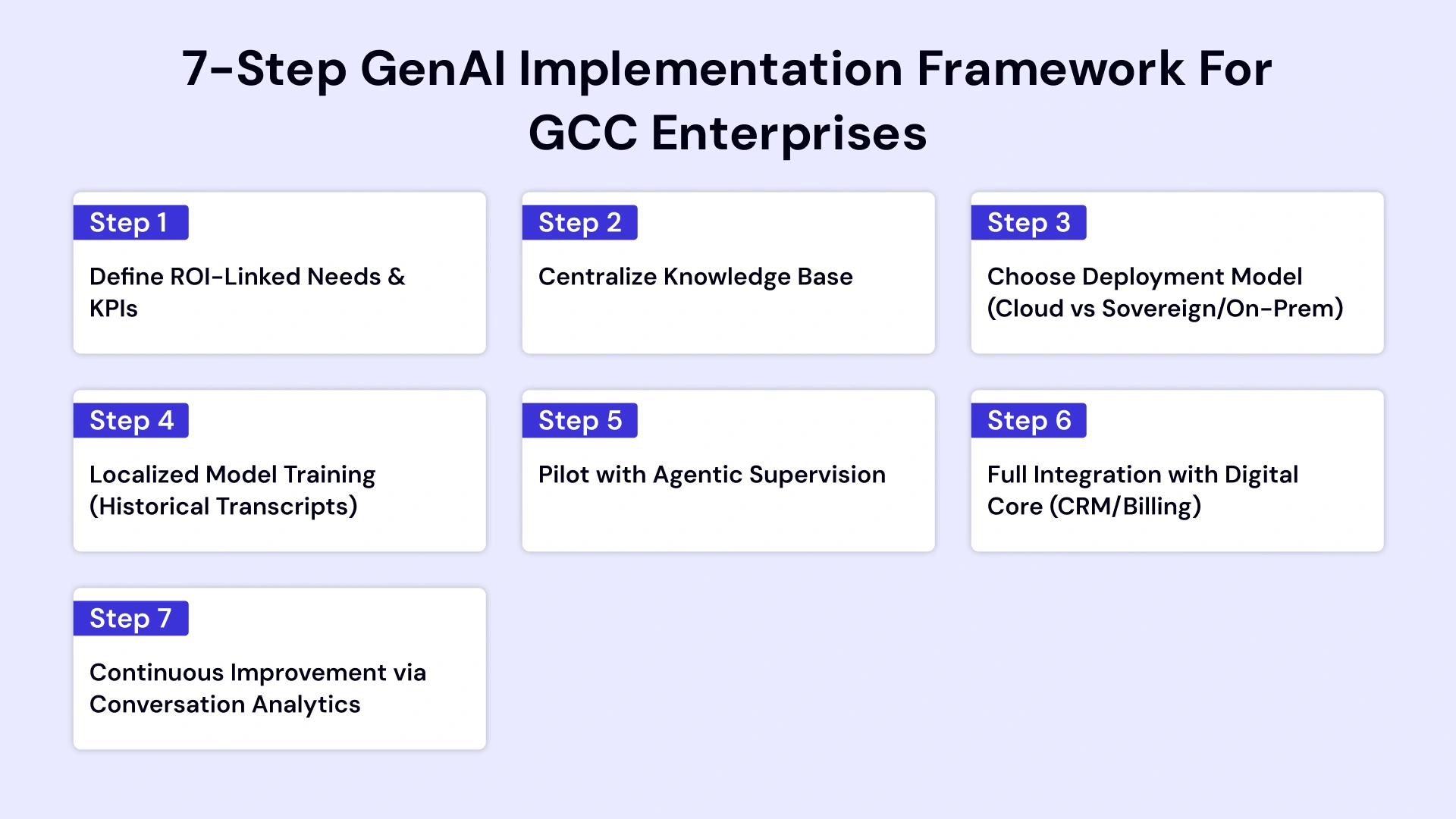
Moving from concept to production requires systematic execution. GCC enterprises successfully deploying generative AI for customer service follow a consistent seven-step framework:
Step 1: Define ROI-Linked Needs and KPIs
Begin by identifying workflows with high ticket volume and clear automation potential. For telecom, this typically means billing inquiries and plan modifications. For retail, order status and returns processing. Establish baseline metrics for cost per ticket, first-contact resolution rate, customer satisfaction scores, and agent handle time. These become the benchmarks against which AI investment is measured.
Quantify the opportunity by analyzing current contact volumes, average handling times, and cost structures. A clear financial case accelerates organizational buy-in and provides objective criteria for evaluating implementation success. Most successful implementations target specific use cases with measurable outcomes rather than attempting broad transformation immediately.
Step 2: Centralize Knowledge Base
AI systems require a unified "source of truth" to generate accurate responses. This means consolidating support documentation, FAQs, policy information, and product details into a structured knowledge repository. Without this foundation, AI systems hallucinate—generating plausible but incorrect information that damages customer trust and creates liability.
Knowledge base development often reveals inconsistencies in existing documentation. Take this opportunity to standardize terminology, clarify policies, and ensure information accuracy. The quality of your knowledge base directly determines AI response quality.
Step 3: Choose Deployment Model
Select cloud deployment for rapid pilots and lower initial investment, or sovereign/on-premise deployment for regulated data handling. The choice depends on data sensitivity, compliance requirements, and long-term operational preferences. Many organizations pilot in cloud environments before migrating to sovereign infrastructure for production.
Consider hybrid approaches where non-sensitive queries route through cloud infrastructure while regulated data remains on-premise. This architecture can provide flexibility during the transition period while maintaining compliance.
Step 4: Localized Model Training
Fine-tune AI models using actual historical customer transcripts from UAE and Saudi Arabia operations. This step transforms generic language capabilities into region-specific competence. The quality and volume of local training data directly impacts AI effectiveness—organizations with well-documented customer interaction histories have significant advantages.
Invest in data preparation before training. Clean, categorized, and annotated training data produces dramatically better results than raw transcript dumps. Consider engaging linguistic experts to ensure dialect accuracy and cultural appropriateness.
Step 5: Pilot with Agentic Supervision
Launch limited deployment where AI drafts responses for human agents to approve before sending. This "human-in-the-loop" approach builds confidence in AI capabilities while identifying edge cases and improvement opportunities. Pilot scope should be narrow enough for meaningful evaluation but broad enough to test realistic query variety.
Establish clear escalation criteria and feedback mechanisms. Agent feedback during pilot phases provides valuable training signal for model improvement. Track not just resolution rates but also the types of queries where AI struggles, informing targeted improvements.
Step 6: Full Integration with Digital Core
Connect AI systems to CRM, billing, and operational platforms to enable autonomous action. This step transforms AI from response generator to AI-driven CX transformation agent capable of executing transactions, updating records, and completing customer journeys end-to-end.
Plan integration work carefully, as this phase often requires significant technical coordination. Establish clear data flow patterns, error handling procedures, and rollback capabilities before enabling autonomous transactions.
Step 7: Continuous Improvement via Conversation Analytics
Establish feedback loops that identify new customer trends, surface knowledge gaps, and drive weekly knowledge base updates. AI effectiveness degrades when underlying information becomes stale. Conversation analytics reveal what customers are actually asking about, enabling proactive content updates and capability expansion.
Build monitoring dashboards that track key performance indicators in real-time. Set alerts for performance degradation and establish regular review cadences to evaluate AI effectiveness and identify improvement opportunities.
Decision Framework: Buy vs. Build vs. Hybrid
GCC enterprises face strategic choices about AI implementation approach. The decision depends on specific organizational factors:
Build vs. Buy vs. Hybrid Decision Matrix
| Factor | Build | Buy | Hybrid |
| Compliance Control | Full control over data handling and architecture | Dependent on vendor compliance capabilities | Customize compliance-critical components |
| Time-to-Value | 12-18+ months for production-ready systems | 3-6 months for initial deployment | 6-12 months with phased approach |
| Integration Complexity | Maximum flexibility for legacy integration | Constrained by vendor API capabilities | Selective customization where needed |
| Data Governance | Complete ownership and control | Shared responsibility with vendor | Control over sensitive elements |
| Total Cost | Higher initial investment, lower ongoing fees | Lower initial, higher ongoing licensing | Balanced investment profile |
| Internal Capability Required | Significant AI/ML engineering team | Minimal technical staff required | Moderate technical capability |
| Customization Depth | Unlimited customization potential | Limited to vendor platform capabilities | Deep customization where needed |
ROI Snapshot: What GCC Retail and Telecom Can Expect in 3-9 Months
Cost Reduction Metrics
The financial case for generative AI in customer service rests on documented outcomes from regional implementations. Enterprise adopters consistently report 30% average cost reduction in customer service operations within the first year of deployment.
These savings derive from multiple sources: reduced staffing requirements for L1 query handling, decreased average handle time for agent-assisted interactions, lower training costs as AI handles knowledge transfer, and reduced error-related rework. For organizations with contact centers handling thousands of daily interactions, even modest per-interaction savings compound to substantial annual impact.
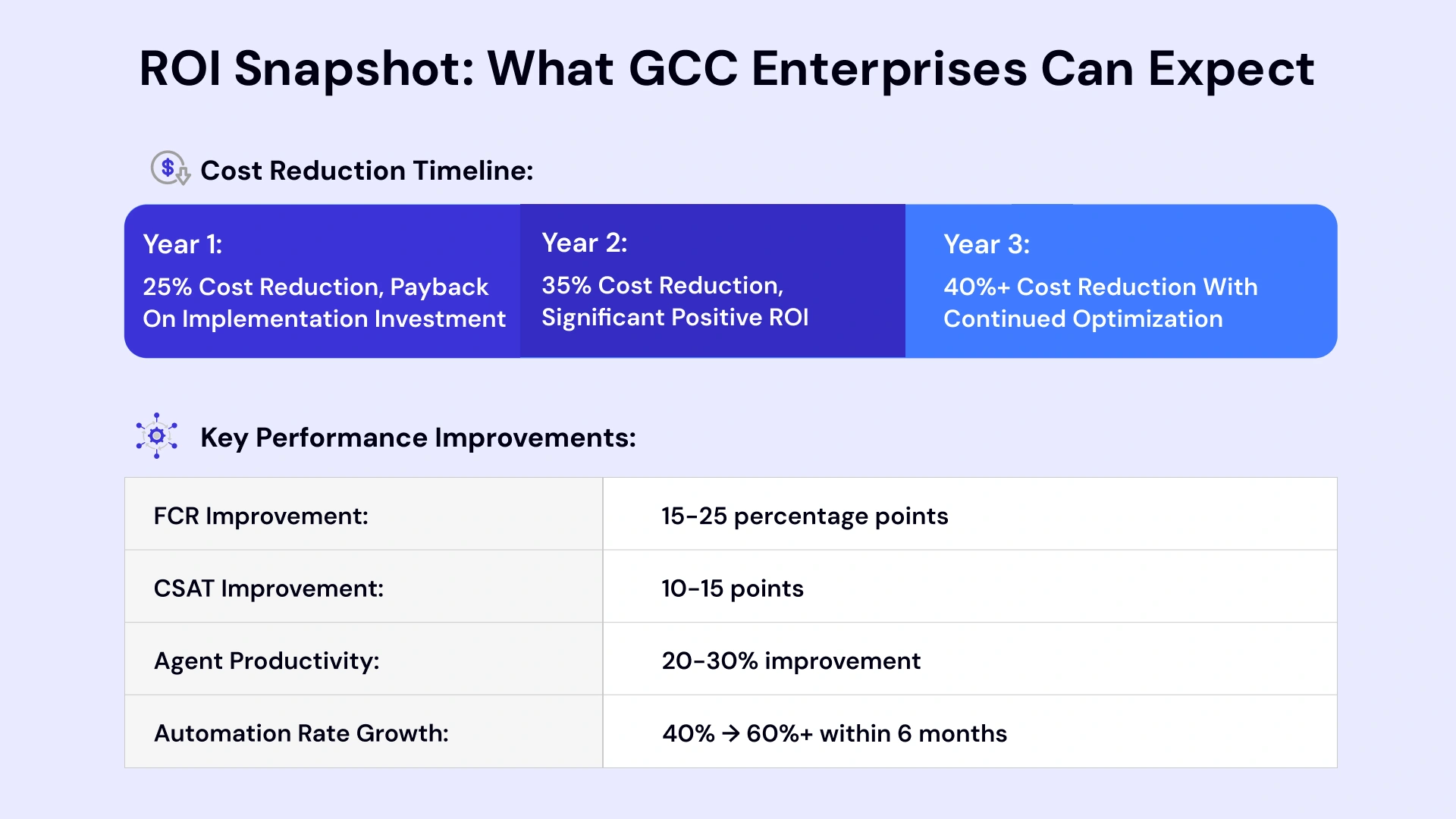
The cost reduction trajectory typically accelerates after initial deployment. Early months focus on establishing baseline automation rates, but as AI systems learn from ongoing interactions and knowledge bases mature, automation capabilities expand. Organizations commonly see automation rates increase from 40% in early deployment to 60%+ within six months.
A typical ROI model for a mid-sized GCC telecom provider might show:
- Year 1: 25% cost reduction, payback on implementation investment
- Year 2: 35% cost reduction, significant positive ROI
- Year 3: 40%+ cost reduction with continued optimization
FCR, CSAT, and Agent Productivity Gains
Beyond cost metrics, AI implementation drives improvements in the operational KPIs that CX leaders prioritize:
First-Contact Resolution rates improve when AI systems can execute complete customer journeys rather than merely providing information. A billing query resolved through automated adjustment scores as FCR; the same query answered with instructions for calling back does not. Organizations typically see FCR improvements of 15-25 percentage points for AI-handled queries.
Customer Satisfaction scores typically improve despite automation—counterintuitive for organizations expecting customers to prefer human interaction. The explanation lies in speed: customers prefer fast, accurate resolution regardless of whether a human or AI provides it. When AI delivers instant resolution for straightforward queries, satisfaction increases. CSAT improvements of 10-15 points are common for queries handled entirely by AI.
Agent productivity metrics show the augmentation benefit. With AI handling routine queries and providing real-time assistance for complex ones, agents handle more interactions at higher quality levels. The cognitive burden of routine work decreases, enabling focus on relationship-building and complex problem-solving. Organizations report 20-30% improvements in agent productivity metrics.
Hidden Costs and How to Avoid Them
Realistic ROI projections must account for implementation costs that competitors often minimize in initial discussions:
Multilingual fine-tuning requires significant investment for GCC effectiveness. Organizations expecting off-the-shelf Arabic capabilities discover that Khaleeji dialect competence and cultural localization demand dedicated training effort. Budget 15-25% of total implementation cost for localization work.
Compliance complexity adds cost throughout implementation. Data residency requirements, regulatory documentation, and security architecture add implementation timeline and budget beyond the core AI platform. Sovereign cloud deployment typically costs 30-50% more than standard cloud hosting.
Data cleansing represents perhaps the most underestimated cost category. Organizations with fragmented, inconsistent, or poorly documented customer interaction histories face substantial preparation work before AI training can begin. Knowledge base development and data preparation can consume 20-30% of total project budget.
Avoiding these hidden costs requires honest assessment during planning phases. Organizations benefit from working with AI partners experienced in GCC deployments who can accurately scope requirements rather than discovering complexity mid-implementation.

People Also Ask: GCC GenAI Customer Service Questions
How does Generative AI improve telecom billing in UAE?
Generative AI transforms telecom billing support from information retrieval to autonomous resolution. AI systems analyze customer billing data, identify charge patterns, explain variances using natural language, and execute appropriate adjustments—credits, plan modifications, or fee waivers—without agent involvement. For UAE telecom providers, this capability addresses the highest-volume query category while ensuring consistency with regulatory requirements and corporate policies. The AI can also proactively identify billing anomalies and reach out to customers before they notice issues.
What are the top GenAI use cases for Saudi retail customer service?
Saudi retail customer service sees highest GenAI impact in personalized product recommendations via WhatsApp commerce, automated returns processing with policy compliance enforcement, real-time order tracking with proactive status updates, and virtual shopping assistance that guides customers through product selection. These use cases align with Saudi consumer preferences for conversational commerce and mobile-first engagement. Additionally, loyalty program management and personalized promotion delivery show strong results in the Saudi market.
What are the challenges of Arabic GenAI chatbots in GCC?
Arabic GenAI chatbots face unique challenges including Khaleeji dialect comprehension (Gulf Arabic differs significantly from Modern Standard Arabic), cultural context interpretation, code-switching between Arabic and English within conversations, and accurate transliteration of brand names and technical terms. Solutions require localized training data from GCC sources and RAG architectures incorporating regional knowledge bases. Organizations must also address script variations and the right-to-left text processing requirements that some platforms handle poorly.
Strategic Lens: From Customer Support to Revenue Engine
Turning Support Queries into Conversion Moments
The traditional framing of customer service as a cost center fundamentally limits its strategic potential. Progressive GCC enterprises are repositioning AI-enabled customer service as a revenue orchestrator—a capability that transforms support interactions into commercial opportunities. This perspective aligns with research on using AI for business growth and problem-solving.
Consider the revenue implications in a region where 73% of consumers shop via social media channels. When a customer contacts support asking "Where is my order?", the interaction typically ends with tracking information. An AI-enabled approach continues the conversation: "Your order arrives tomorrow. Based on your purchase history, this accessory complements your order—would you like to add it for same-day delivery?"
This shift requires thinking beyond deflection metrics toward engagement optimization. Every customer interaction represents an opportunity to deepen relationships, surface relevant offerings, and capture incremental value. AI makes this personalized engagement scalable while maintaining the conversational quality that builds customer loyalty.
The data generated by AI customer interactions also creates strategic value. Conversation analytics reveal customer preferences, pain points, and unmet needs that can inform product development, marketing strategy, and service improvements. This insight layer transforms customer service from operational function to strategic intelligence source.
Decision-Making Framework for CXOs: Automate, Augment, or Personalize?
Enterprise leaders evaluating AI customer service strategies benefit from a structured decision framework that maps query types to optimal AI approaches:
Automate applies to high-volume, low-complexity queries with clear resolution paths. Order status, basic billing inquiries, store hours, and return policy questions fall into this category. The goal is instant resolution without human involvement. These queries typically represent 40-50% of total contact volume and offer the clearest ROI through automation.
Augment suits complex queries requiring human judgment but benefiting from AI assistance. Dispute resolution, technical troubleshooting, and complaint handling retain human agents but enhance their effectiveness through real-time information retrieval, suggested responses, and automatic documentation. Augmentation improves both resolution quality and agent productivity.
Personalize addresses high-value interactions where AI's analytical capabilities create differentiated experiences. VIP customer engagement, proactive retention outreach, and cross-sell/upsell moments leverage AI's ability to synthesize customer history into tailored recommendations. Personalization drives revenue growth and customer loyalty.
Mapping query portfolios against this framework clarifies investment priorities and sets appropriate expectations for AI's role in overall CX strategy. Most organizations find that all three approaches have a role, with the optimal mix depending on business model, customer base, and competitive positioning.
Conclusion: What GCC Enterprises Should Do Next
The transition from traditional chatbots to generative AI represents more than a technology upgrade—it's a fundamental shift in how GCC retail and telecom enterprises can serve customers while managing operational economics. The organizations that successfully navigate this transition will establish competitive advantages that compound over time: lower cost structures, higher customer satisfaction, and deeper customer relationships built through personalized engagement.
The implementation path is clear, even if execution requires careful attention to GCC-specific requirements. Start by assessing your current CX automation maturity across technology infrastructure, data readiness, and organizational capability. Identify high-impact use cases where generative AI can deliver measurable improvements within 3-6 months. Select implementation partners with demonstrated GCC deployment experience who understand regional compliance requirements and linguistic nuances.
The competitive window for early-mover advantage is narrowing. Organizations that delay AI adoption face mounting pressure from competitors who've already automated routine functions, captured efficiency gains, and redirected resources toward innovation and growth. The question is no longer whether to pursue generative AI for customer service—it's how quickly you can move from evaluation to implementation while competitors remain hesitant.


Vice President, Strategy – VLink Inc.
Sambhavi Gopalakrishnan is the Vice President of Strategy at VLink Inc., bringing over a decade of experience in IT leadership, project implementation, and strategic growth. She possesses a strong foundation in technical project management and pre-sales, driving innovation and business transformation at VLink.

 Shivisha Patel