Most enterprises don't have an AI idea shortage. They have an integration shortage. Pilots work in isolation, then stall when they meet fragmented data, legacy systems, security reviews, and a governance process nobody has defined. The model is rarely the problem; everything around it is.
This guide gives CIOs, CTOs, Chief AI and Data Officers, enterprise architects, AI/ML leaders, and data governance leaders a practical blueprint for enterprise AI integration: a reference architecture to design against, a way to assess data readiness, and a governance model that lets AI scale without creating new risk.
Why Enterprise AI Integration Is Hard
Most enterprise AI initiatives stall not because the models underperform, but because the surrounding infrastructure isn't built to support them. Regardless of industry, teams run into the same systemic hurdles:
- Siloed data ecosystems: Critical data is fragmented across disconnected platforms and departments.
- Compromised data quality: Duplicates, gaps, and conflicting definitions erode model reliability.
- Rigid legacy architecture: Batch-only workflows and missing APIs bottleneck real-time integration.
- Complex system sprawl: Bridging AI across ERP, CRM, and core line-of-business apps requires heavy custom plumbing.
- Fragmented governance: Unclear data ownership and inconsistent access controls slow down deployment.
- Security and compliance exposure: Risks of sensitive data leakage and unexplainable outputs stall leadership sign-off.
- Organizational unreadiness: Gaps in AI talent, operational workflows, and sustained funding keep teams stuck in experimentation.
- The pilot-to-production chasm: Solutions built for a single use case fail to scale cleanly across multiple business units.
Each of these challenges directly determines which enterprise AI solutions will work in your stack and maps to a specific component in the blueprint below.
Enterprise AI Reference Architecture
An enterprise AI reference architecture is a standard, reusable design that dedicated teams follow when connecting AI to business systems. It prevents each project from inventing its own integration, security, and monitoring approach.
Think of it as the enterprise AI architecture your whole organization builds on, and every later enterprise AI architecture decision should be checked against it, rather than a diagram for a single project.
The Six-Layer Reference Architecture
A resilient enterprise AI stack separates data ingestion, model orchestration, and user experience while wrapping everything in unified governance. Each layer serves a distinct operational role:
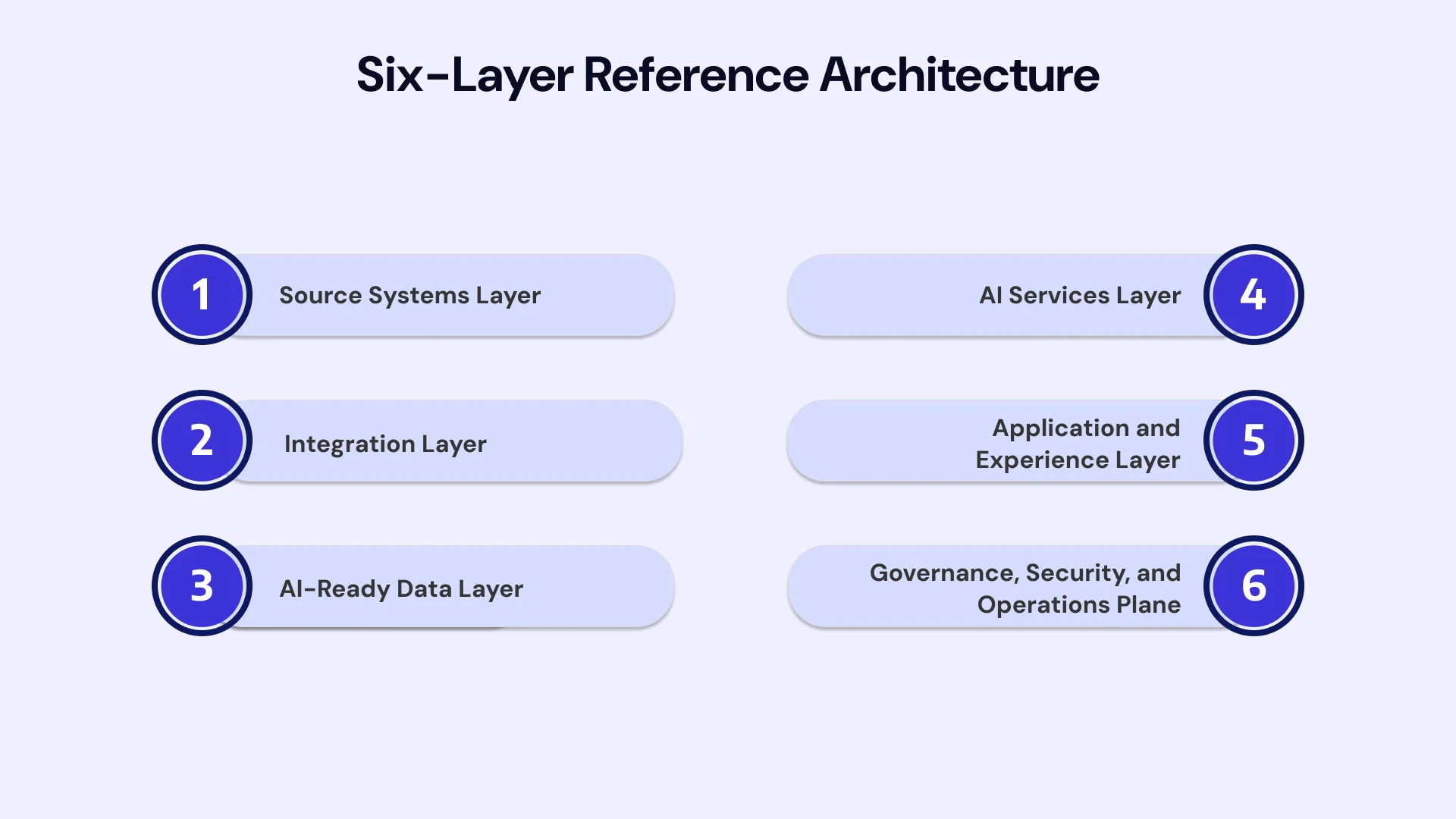
1. Source Systems Layer
- What it includes: ERP, CRM, HR, finance platforms, content repositories, operational databases, and external feeds.
- Architectural role: These remain your immutable systems of record; the foundational truth from which AI draws context without disrupting core business operations.
2. Integration Layer
- What it includes: APIs, event streaming, change data capture (CDC), message queues, and enterprise middleware.
- Architectural role: Moves data and triggers downstream actions reliably. Rely on idempotent operations and queuing to manage retries and rate limits, strictly avoiding brittle point-to-point connections.
3. AI-Ready Data Layer
- What it includes: Data lakehouses/warehouses (structured data), object storage (unstructured documents), vector databases (semantic retrieval), data catalogs, and lineage trackers.
- Architectural role: Prepares, indexes, and contextualizes raw data. A unified semantic layer defines business metrics and terms once, ensuring every model and report speaks the same language.
4. AI Services Layer
- What it includes: Model gateways, Retrieval-Augmented Generation (RAG) pipelines, agent orchestration engines, and automated evaluation tooling.
- Architectural role: Serves as the intelligence hub. Routing traffic through a centralized model gateway abstracts underlying LLM providers, letting you swap models, enforce rate/cost controls, and log every prompt and response.
5. Application and Experience Layer
- What it includes: Conversational interfaces, role-specific copilots, background workflow automation, and AI features embedded directly inside existing enterprise apps.
- Architectural role: Delivers value directly inside daily workflows, meeting employees where they already work rather than forcing them into standalone tools.
6. Governance, Security, and Operations Plane
- What it includes: Identity and access management (IAM), policy guardrails, audit logging, drift monitoring, red-teaming/evaluation, incident response, and FinOps cost tracking.
- Architectural role: A cross-cutting control plane spanning layers 1 through 5 to guarantee every AI interaction remains secure, compliant, observable, and cost-effective.
Architecture Principles
- Decouple models from applications through a gateway and stable APIs.
- Make retrieval permission-aware so users only get answers from data they may see.
- Log everything needed for audit: prompts, retrieved sources, outputs, and actions.
- Design for human oversight where decisions carry risk.
- Standardize patterns such as RAG, agent tool use, and approval workflows so teams reuse them.
Business Context AI Systems Integration
Raw data isn't enough. Business context AI systems integration supplies the meaning around data: glossaries, entity definitions, relationships, business rules, and policies. A model that doesn't know whether "customer" means an account, a contact, or a household will give confident, wrong answers. Capture context in a semantic layer and knowledge graph or curated knowledge base, and let retrieval pull it alongside the data.
AI Compliance Workflow Software Enterprise Integration
Governance works best inside the tools compliance teams already use. AI compliance workflow software enterprise integration connects AI systems to governance, risk, and compliance (GRC) platforms, model inventories, ticketing, and approval workflows, so that risk assessments, approvals, exceptions, and audit evidence are captured automatically rather than in spreadsheets. Integrate model registration, risk tier, test results, and monitoring alerts into those workflows from the start.
Data Readiness for Enterprise AI
Enterprise AI data readiness is the most common gating factor between a successful pilot and a production system.
What Does AI-Ready Enterprise Data Mean?
Enterprise AI data readiness means your data can support the intended AI use case reliably, securely, and repeatably. AI-ready data is:
- Accessible: discoverable and reachable through governed interfaces
- High quality: accurate, complete, consistent, and timely for the use case
- Documented: with metadata, definitions, owners, and lineage
- Permission-aware: access controls travel with the data into AI pipelines
- Compliant: privacy, consent, retention, and residency rules applied
- Representative: free of gaps and bias that would distort outcomes
- Structured for use: unstructured content cleaned, chunked, and indexed where needed
AI-Ready Data Architecture
AI-ready data architecture combines the data layer above with disciplined practices: a single catalog of data products, quality checks at ingestion, standardized identifiers for entity resolution, versioned datasets for reproducibility, and separation of sensitive data through masking or tokenization. Treat data as a product with an owner, an SLA, and documentation, rather than a by-product of applications.
How to Run an AI Data Readiness Assessment
An AI data readiness assessment evaluates data against a specific use case, not data in general.
- Pick the use case and list the data it needs.
- Locate the sources and owners and map access paths.
- Profile quality: completeness, accuracy, duplication, freshness, and consistency.
- Check semantics: are definitions agreed and documented?
- Review security and privacy: classification, consent, residency, and access controls.
- Assess lineage and provenance: can you explain where each field came from?
- Evaluate infrastructure: latency, volume, formats, and integration paths.
- Score and prioritize remediation by impact on the use case.
Dimension | Not Ready | Ready |
| Access | Manual extracts, tribal knowledge | Governed APIs and catalog entries |
| Quality | Unknown, inconsistent | Measured, monitored, with thresholds |
| Semantics | Conflicting definitions | Shared glossary and semantic layer |
| Governance | Unclear ownership | Named owner, policies, stewardship |
| Security | Broad access, no classification | Classified, least-privilege, audited |
| Lineage | Unknown | Documented and traceable |
Enterprise AI Governance Framework
An enterprise AI governance framework is the set of roles, policies, processes, and controls that guide how AI is selected, built, deployed, and monitored. A responsible AI governance framework adds explicit principles such as fairness, transparency, privacy, safety, and accountability, and turns them into checkable requirements.
Core Components
| Component | What It Establishes | Key Elements |
| Structure | Clear accountability and decision rights | AI governance council, named model owners, escalation paths |
| Inventory | Full visibility across the AI footprint | Centralized register of systems, purposes, data, owners, and risk tiers |
| Risk Tiering | Oversight proportional to real-world impact | Scaling from low-risk internal tools to high-risk customer/employee systems |
| Policies | Baseline rules and operational guardrails | Acceptable use, data governance, vendor review, human oversight, incident response |
| Lifecycle Controls | End-to-end quality and safety gates | Intake, risk/data approval, testing, release sign-off, monitoring, retirement |
| Metrics & Reporting | Ongoing transparency for leadership | Tracking accuracy, model drift, incidents, adoption, and cost |
Risk Tiering in Practice
Tier | Example | Typical Controls |
| Low | Internal drafting assistant | Usage policy, basic logging |
| Medium | Customer-facing chatbot with approved content | Evaluation suite, human escalation, monitoring |
| High | Credit, hiring, or clinical decision support | Formal review, bias testing, human decision-maker, audit trail, regulator alignment |
Data Governance for AI
Data governance for AI extends traditional governance in four ways: it tracks which data feeds which models, enforces consent and purpose limits, manages rights to use data for training or retrieval, and monitors data quality continuously, since degraded data degrades outputs. Data governance supports responsible AI by making it possible to explain where an output came from, prove that sensitive data was handled properly, and correct problems at the source.
US Standards and Regulation
US enterprises commonly align governance to the NIST AI Risk Management Framework and, increasingly, ISO/IEC 42001. Sector rules also apply: HIPAA for health data, GLBA and model risk guidance for financial institutions, and FTC expectations on truthful, fair AI use. State privacy and AI laws, including California and Colorado, are evolving, so confirm current requirements with legal counsel. This is a starting point, not legal advice.
How to Integrate AI with Existing Enterprise Systems
Integrating AI into legacy enterprise architectures requires a structured, risk-managed approach. Rather than treating AI as a standalone application, successful AI integration services weaves intelligence directly into existing operational workflows through a phased sequence:
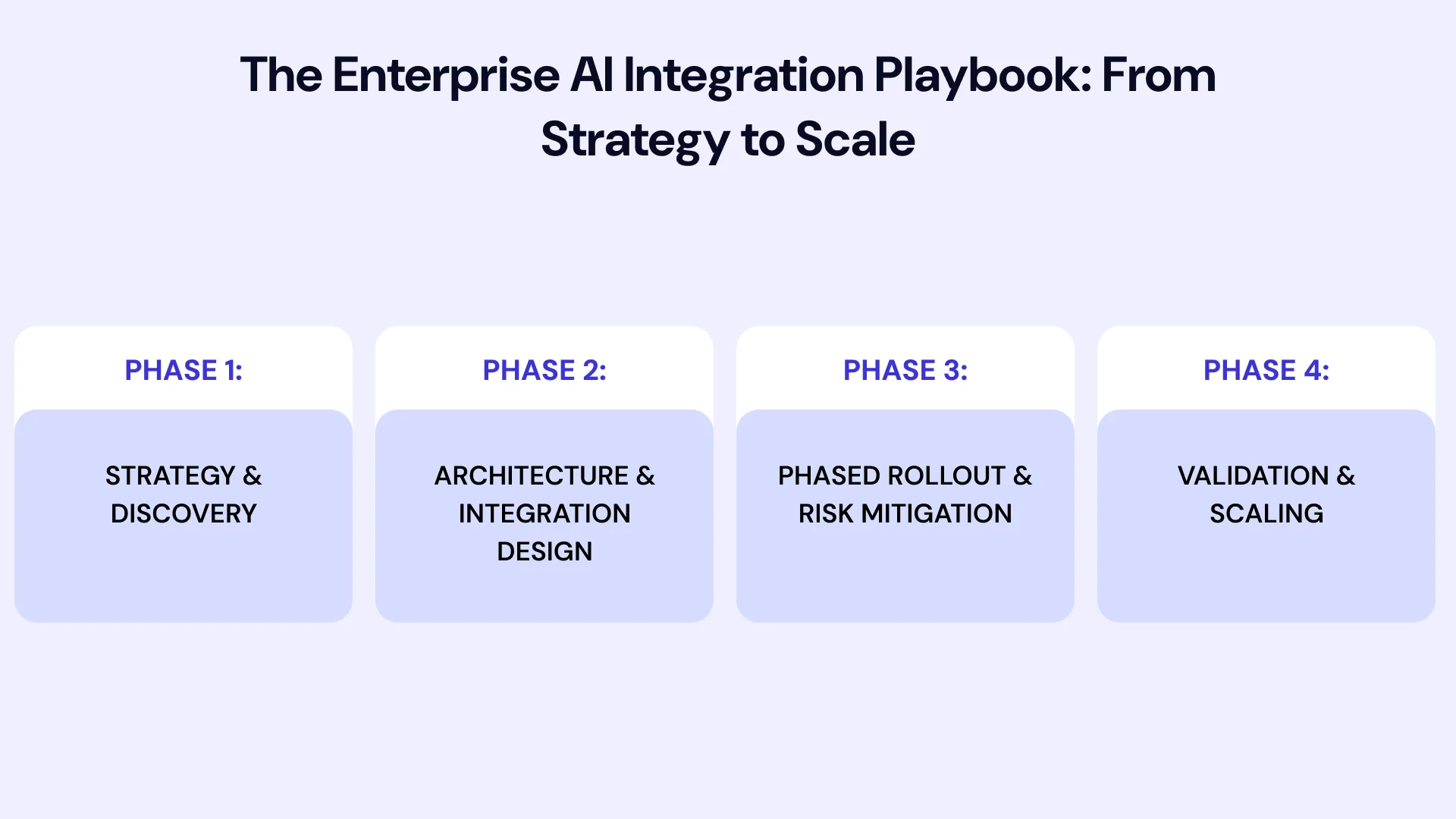
Phase 1: Strategy & Discovery
- Prioritize Use Cases by Value, Feasibility, and Risk Tier
Score candidates using a matrix evaluating business impact (ROI, efficiency), data accessibility, and regulatory/risk exposure. Focus early wins on high-value, low-risk operational areas. - Conduct a Data Readiness Assessment
Audit your top candidates for data quality, lineage, freshness, and accessibility. Identify and resolve permission boundaries, silos, or compliance gaps (e.g., GDPR/PII) before model training or connection.
Phase 2: Architecture & Integration Design
- Establish a Reference Architecture
Standardize your integration patterns. Implement a Central Model Gateway to handle routing, rate limiting, token tracking, fallback mechanisms, and prompt/response logging uniformly across all apps. - Enforce Clean Integration Boundaries
Integrate strictly through modern APIs, message queues, and event streams (e.g., Kafka); never via direct database back doors. For brittle legacy systems, build modern API facades or middleware adapters to abstract the underlying complexity.
Phase 3: Phased Rollout & Risk Mitigation
- Progressive Autonomy (Read-Only to Write-Back)
- Stage 1 (Read-Only): Use the AI strictly for insights, summarization, or recommendations without modifying system state.
- Stage 2 (Human-in-the-Loop): Provide suggested actions that require explicit human approval before execution.
- Stage 3 (Controlled Write-Back): Enable autonomous actions strictly within pre-defined guardrails and confidence thresholds.
- Bake Governance in from Intake
Register every AI integration in your enterprise asset registry. Assign a risk tier, define distinct evaluation metrics (e.g., accuracy, latency, hallucination rates), and mandate security reviews.
Phase 4: Validation & Scaling
- Pilot Narrowly and Benchmark
Deploy to a single department or controlled user group. Measure performance against a strict baseline (e.g., time-to-resolution, error rates) and remediate bottlenecks before wider rollout. - Operationalize Core Management
Establish robust Day-2 operations: real-time performance monitoring, automated incident response for model drift or API failures, cost tracking (token usage/compute spend), and continuous evaluation pipelines. - Scale Through Platform Reuse
Transition successful point-solutions into shared enterprise platform services (reusable modules for authentication, guardrails, vector databases, and retrieval-augmented generation) to accelerate future deployments.
Choosing Enterprise AI Solutions and Partners
Navigating the enterprise AI market requires a rigorous evaluation framework that balances innovation speed with strict risk management. Solutions typically span a spectrum from pre-built commercial vendor platforms to bespoke, custom-built models.
When assessing a vendor’s offering, look beyond flashy feature sets and interrogate the core architecture:
- Architectural Fit: Does the solution plug cleanly into your established reference architecture, or does it force brittle workarounds?
- Identity & Access Management (IAM): Does it natively integrate with your enterprise identity providers (e.g., Azure AD, Okta) and support fine-grained role-based access control (RBAC)?
- Observability & Auditability: Does it expose comprehensive audit logs for every prompt, response, and tool invocation to satisfy compliance and security teams?
- Data Privacy & Ownership: Does the vendor explicitly prohibit using your proprietary data for model training, and do you retain full ownership of your data lifecycle?
When evaluating a potential systems integration partner, scrutinize their track record across four critical dimensions: proven integration experience with legacy enterprise stacks, depth in data engineering and governance, robust cybersecurity credentials (such as SOC 2 compliance and data encryption standards), and a commitment to a pilot-first, risk-mitigated approach. For a deeper dive into vetting criteria, read our complete AI Integration Services Partner Guide.
Leverage Our Expertise for Enterprise AI Integration
Navigating architectural complexity, data silos, and governance hurdles on your own can slow down your roadmap. VLink’s specialized team helps US enterprises bridge the gap between legacy infrastructure and cutting-edge intelligence by designing secure reference architectures, conducting thorough data readiness assessments, and establishing scalable governance frameworks.
Through our specialized AI Integration Services, we seamlessly connect foundational models and AI capabilities to your existing enterprise software, databases, and event streams. If you need bespoke solutions, our AI Development Services build custom models, specialized applications, and scalable backend infrastructure tailored to your exact business logic.
Furthermore, we leverage our AI Agent Development Services to deploy governed, autonomous agents capable of safely reasoning and acting across your multi-system workflows. Explore our core service offerings to see how we can accelerate your AI journey:
- Enterprise Connectivity: Seamlessly connect foundational models and AI capabilities to your existing enterprise software, databases, and event streams.
- Custom Engineering: Build custom models, specialized applications, and scalable backend infrastructure tailored to your exact business logic.
- Autonomous Workflows: Deploy governed, autonomous agents capable of safely reasoning and acting across your multi-system workflows.
Conclusion
Enterprise AI integration is fundamentally an architecture, data, and governance program, with the underlying models serving as just one component of a much larger system. Long-term success relies on establishing a responsible AI governance framework that ensures trustworthiness at scale. A reusable reference architecture keeps integrations consistent across departments, targeted data readiness assessments focus remediation efforts where they matter most, and a risk-tiered governance model keeps operations secure without grinding innovation to a halt.
The most effective way to begin is to start small: select one high-value use case, assess its underlying data, apply your reference architecture, and register it under your governance process. That initial pilot will yield more practical insights than any strategy document, laying a rock-solid foundation for every project that follows.
Ready to accelerate your enterprise AI roadmap? Contact our team of experts today to discuss your integration challenges, schedule a data readiness assessment, or explore how we can help you build secure, scalable AI systems tailored to your business.

Vice President, Strategy – VLink Inc.
Sambhavi Gopalakrishnan is the Vice President of Strategy at VLink Inc., bringing over a decade of experience in IT leadership, project implementation, and strategic growth. She possesses a strong foundation in technical project management and pre-sales, driving innovation and business transformation at VLink.

 Shivisha Patel