


Canadian manufacturing is under pressure. 73% of manufacturers struggle to find skilled operators. Energy costs are climbing. Supply chains remain unpredictable. And global competitors are moving faster than ever.
This blog gives you a plant-level roadmap — not theory. We cover high-impact AI use cases, a practical maturity model, a 90–180 day implementation plan, and honest answers to the toughest challenges. Whether you manage one facility or ten, this is what you need to know about AI for manufacturing right now.

Why AI Matters Now for Canadian Manufacturing Plants
Canadian plant managers are no longer just optimizing; they are fighting a multi-front war against labor scarcity, rising input costs, and global price competition. Here is how AI has become the primary defensive and offensive lever.
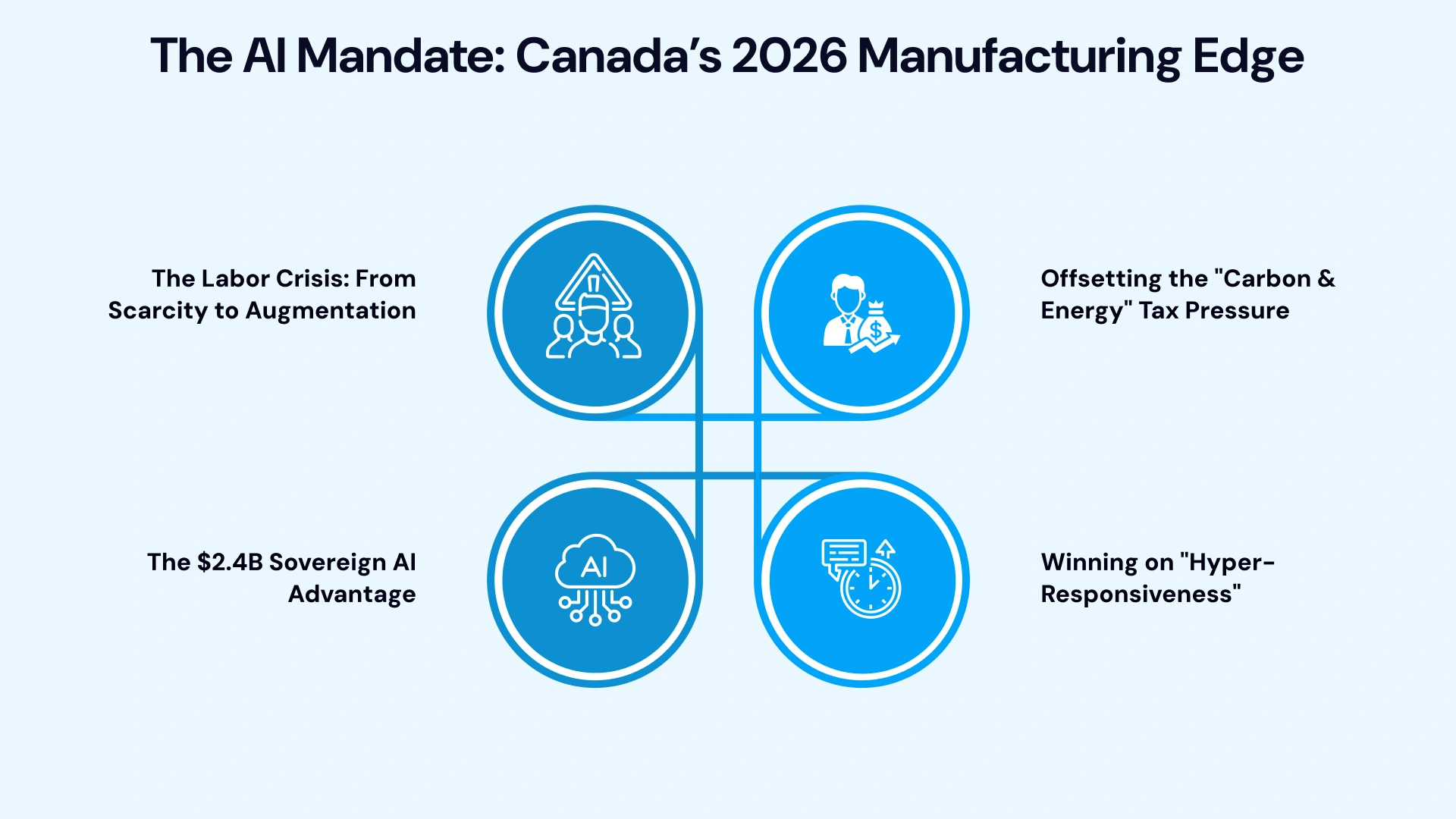
1. The Labor Crisis: From Scarcity to Augmentation
The Conference Board of Canada was correct in its projections: we are currently facing a gap of roughly 60,000 unfilled skilled manufacturing roles.
- The Reality: You cannot "hire your way out" of this problem anymore.
- The AI Pivot: Plants are using AI to "de-skill" complex tasks. By using AI-guided visual overlays and real-time step-by-step diagnostics, a junior technician can now perform the work that previously required a specialist with 20 years of experience.
2. Offsetting the "Carbon & Energy" Tax Pressure
With the federal carbon tax and rising energy costs creating significant overhead for process-intensive operations (like smelting, chemical processing, and food production), margins are under threat.
- Hyper-Efficiency: NGen (Next Generation Manufacturing Canada) now frames AI as a "sustainability engine."
- Energy Yield Optimization: AI algorithms are being used to time-shift high-energy processes to off-peak hours and optimize thermal loads in real-time, often cutting energy waste by 12–15%—directly offsetting the cost of carbon pricing.
3. The $2.4B Sovereign AI Advantage
One of the biggest hurdles used to be Data Residency. Plant managers were hesitant to send sensitive proprietary floor data to servers in the U.S. or Europe.
- National AI Compute Strategy: The federal government’s $2.4 billion investment has finally matured, providing locally-hosted, high-performance compute clusters.
- Regulated Security: This allows Canadian manufacturers to build "Sovereign AI" models—keeping intellectual property and operational data strictly within Canadian borders while accessing world-class processing power.
4. Winning on "Hyper-Responsiveness"
Canada cannot win a "race to the bottom" on labor costs against lower-wage jurisdictions.
- The Shift: As NGen highlights, the winning strategy is Precision and Speed.
- The Result: By using AI for predictive quality and automated supply chain adjustments, Canadian plants are becoming "High-Frequency Manufacturers"—able to switch production lines and fulfill custom orders faster than overseas competitors can even ship the raw materials.
Comparison: The Competitive Gap
| Factor | Traditional Approach | AI-Enabled Approach (2026) |
| Labor | Struggle to find 60k specialized staff. | AI augments existing staff; 2x productivity. |
| Costs | Absorb carbon tax/energy price spikes. | AI optimizes energy use to neutralize tax impact. |
| Data | Residency concerns (Cloud hesitancy). | Sovereign AI (Secure, local infrastructure). |
| Strategy | Compete on volume/price. | Compete on Hyper-Efficiency and Quality. |
In a thin-margin industry, a 5–10% improvement in OEE (Overall Equipment Effectiveness) is no longer a "bonus"—it is the difference between staying operational or being priced out of the global market.
What Is AI in Manufacturing?
Think of artificial intelligence in manufacturing as the nervous system of your facility. Sensors collect data from machines, lines, and processes. AI models analyze that data in real time. Insights and recommended actions flow back to operators, supervisors, and systems — often automatically. AI optimizes production—AI in manufacturing operations for quality and efficiency.
The loop is simple: data in, insight out, action taken. What makes AI different from traditional automation is that it learns from patterns over time. It gets better as more data flows through it.
Common Examples You Already Recognize
- Predictive maintenance: Sensors on a CNC machine detect vibration anomalies and alert your maintenance team 72 hours before a likely failure
- AI vision inspection: Cameras on a packaging line catch label defects at 1,200 units per minute — faster and more consistently than any human inspector
- Production scheduling optimization: AI adjusts the daily production schedule in real time based on machine availability, material stock, and order priorities
- Energy optimization: AI monitors power consumption across the facility and shifts non-critical loads to off-peak hours, cutting energy costs without disrupting throughput
These are not science fiction use cases. They are running in North American and Canadian plants today. And they are among the most accessible starting points for how AI is used in manufacturing.
High-Impact AI Use Cases Mapped to Plant KPIs
The most effective way to evaluate AI applications in manufacturing is by connecting each use case to the KPIs you already track. Here is how the highest-ROI applications map to plant-level outcomes.
| Use Case | Technology | KPI Impact | Typical Gain |
| Predictive Maintenance | ML on sensor data | Unplanned downtime | 30–50% reduction |
| AI Vision Inspection | Computer vision / Deep learning | Scrap & defect rate | Up to 99% defect detection |
| Production Scheduling | Optimization AI | OEE / throughput | 5–15% OEE improvement |
| AI Energy Management | Predictive analytics | Energy cost per unit | 10–20% cost reduction |
| AI Copilot (GenAI) | LLM + plant data | Labor productivity | 1+ hour/day saved per worker |
| Cobot Integration | Robotics + vision AI | Safety incidents/cycle time | 20–40% cycle time reduction |
The core impact can be broken down into four strategic pillars:
Throughput and Uptime Optimization
Unplanned downtime is the single biggest cost driver in most facilities. AI-powered predictive maintenance services reduce it by 30–50% and extend equipment life by up to 40%. Combined with bottleneck detection models that flag where throughput is being lost in real time, plants can move from reactive fire-fighting to proactive management.
Quality and Scrap Reduction
AI for manufacturing quality control using computer vision systems inspect 100% of output — not statistical samples. Deep learning in manufacturing enables these systems to detect micro-defects invisible to the human eye. Canadian automotive suppliers using AI vision report scrap rate reductions of 60–80% within 12 months of deployment.
Labor Productivity and Safety
AI copilots for manufacturing act as always-on assistants for supervisors and operators. They surface the right information at the right time — maintenance history, shift targets, quality alerts — without requiring workers to dig through systems. SMEs using generative AI for manufacturing report saving an average of 1.08 hours per day per worker (CFIB 2025). Scaled across a 200-person plant, that is roughly $1.8 million in recovered productive time annually.
Energy and Cost Optimization
AI-driven energy management systems analyze consumption data across every machine and process. They identify waste, recommend schedule changes, and in some cases automatically adjust load profiles. For Canadian plants paying carbon tax, this is increasingly a margin-protection strategy, not just a sustainability initiative.
Note: Businesses evaluating Throughput and Uptime Optimization should also consider AI predictive maintenance ROI calculator to improve execution quality, scalability, and long-term operational resilience.
AI Trends in Manufacturing: 2026 Outlook for Canada
For 2026, the Canadian manufacturing sector is entering a "Great Realignment." While Canada remains a global powerhouse in AI research, the focus has shifted toward closing the "adoption gap" to solve the country’s persistent productivity challenges.
Here is the 2026 outlook for AI in Canadian manufacturing:
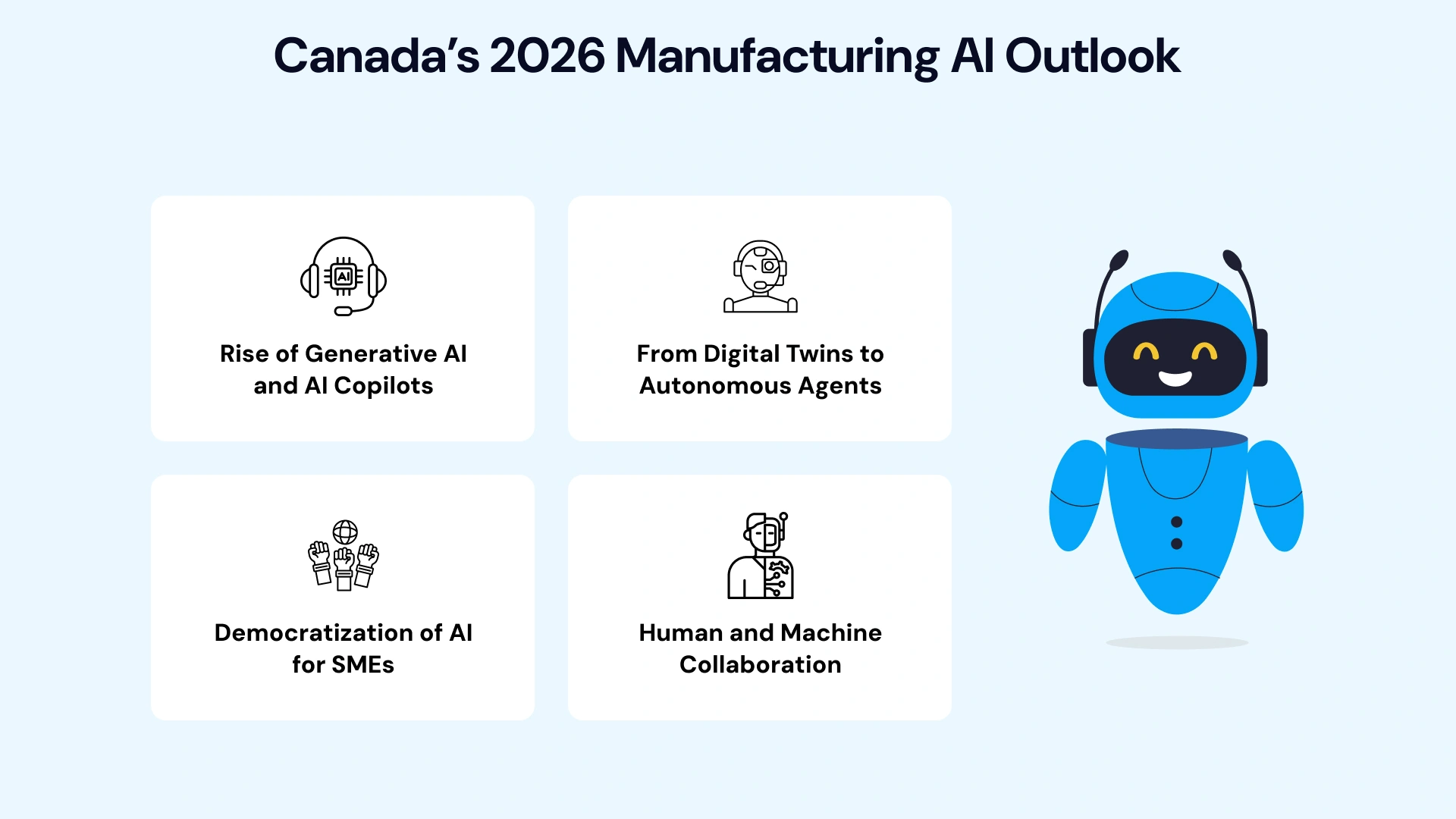
Rise of Generative AI and AI Copilots
The most significant shift in AI trends in manufacturing in 2025 is the arrival of generative AI at the shop floor level. Supervisors are using AI Copilot for manufacturing tools to generate shift summaries, draft maintenance work orders, and run root-cause analysis on quality escapes — in plain language, without needing a data science background.
This is the "democratization" moment for AI in production. Capabilities that previously required expensive specialists are now accessible through a chat interface connected to your plant data.
From Digital Twins to Autonomous Agents
Digital twins — virtual models of physical assets — are evolving. In 2026, the leading plants are deploying agentic AI systems that don't just mirror the facility; they actively manage it. These agents negotiate with supplier systems, adjust production schedules autonomously, and optimize across the entire value chain without waiting for human input.
This is the transition from "AI-assisted" to "AI-orchestrated" manufacturing operations. It is early for most Canadian SMEs, but the trajectory is clear.
Democratization of AI for SMEs
The cost barrier for AI manufacturing solutions is falling fast. Robots-as-a-Service (RaaS) models allow smaller plants to deploy collaborative robots without the $250,000+ capital investment of traditional automation.
Cloud-based AI platforms from vendors including Siemens, Rockwell, and Canadian-born startups allow SMEs to deploy machine learning for manufacturing on a subscription basis.
Human and Machine Collaboration
The narrative around AI replacing workers is giving way to a more accurate picture: AI augmenting workers. Cobots handle hazardous, repetitive, or ergonomically risky tasks while human operators focus on judgment-intensive work.
This matters for workforce retention in a tight labor market — and for attracting Gen Z workers who expect modern, technology-forward environments.
AI Implementation Maturity Model for Plant Managers
Before choosing a use case, it helps to understand where your plant sits on the AI maturity spectrum. This model guides Canadian plant managers from zero to smart factory — step by step.
| Stage | Description | Typical Activities | Readiness Signal |
| Stage 0–1: Data Visibility | Basic data collection and reporting | Connect ERP, MES, SCADA; fix data gaps; dashboards | You can answer: What happened yesterday? |
| Stage 2: Pilot Use Cases | First AI model on a specific asset or line | Predictive maintenance on 1–2 machines; vision inspection on 1 line | You can answer: What will happen next? |
| Stage 3: Scale Across Operations | AI integrated across multiple lines or plants | Multi-line integration; AI in scheduling; ERP/MES data loops | You can answer: How do we optimize the whole plant? |
| Stage 4: Smart Factory | Autonomous optimization and agentic AI | AI agents adjust parameters, schedules, and supplier orders autonomously | You can answer: the plant optimizes itself |
Most Canadian SME manufacturers are at Stage 0–1. The immediate priority is data visibility — not deploying sophisticated AI models. You cannot feed an AI system data that does not exist, is inconsistent, or is trapped in disconnected silos.
Legacy System Modernization Services in Canada — which involve wrapping older PLCs and equipment with IoT sensor layers and API gateways — are the most common first step for plants with aging infrastructure. You do not need to replace a 20-year-old machine. You just need to make it talk.
From Pilot to Profit: A 180-Day AI Roadmap for Your Plant
To transition an industrial plant from a scattered AI pilot phase to a profitable, scaled operation, you need a strategy that balances quick wins with long-term infrastructure. Here is a 180-day roadmap designed to move your facility from "proof of concept" to "bottom-line impact."
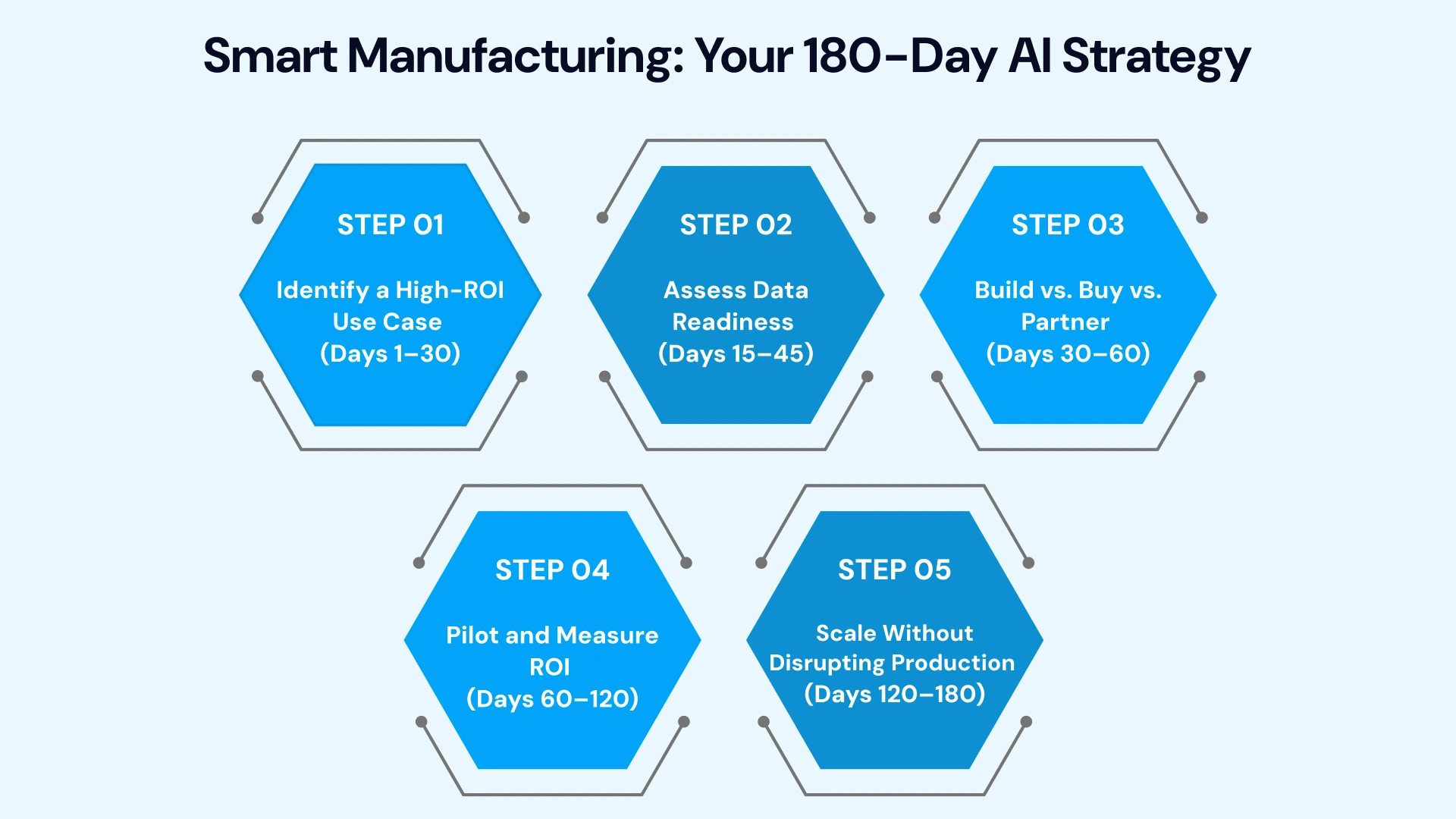
Step 1: Identify a High-ROI Use Case (Days 1–30)
Start with your biggest pain point. Where does unplanned downtime cost you the most? Where is the scrap rate highest? Where do shift changes create quality variability? The answer to those questions points directly to your first AI pilot.
Use a simple 2x2 framework: plot potential use cases by implementation complexity vs. plant impact. The bottom-right quadrant (high impact, lower complexity) is your starting zone. Predictive maintenance on a critical bottleneck asset almost always lands there.
Step 2: Assess Data Readiness (Days 15–45)
Run a data audit against three layers. First, connectivity: do your target machines have sensors or PLC data outputs? Second, history: Do you have at least 12–18 months of operational data for the asset or process? Third, quality: Is the data timestamped, consistent, and accessible via API or historian?
If the answer to any of these is no, address it before building models. An AI that learns from bad data delivers bad decisions.
Step 3: Build vs. Buy vs. Partner (Days 30–60)
- Buy off-the-shelf: fastest to deploy, limited customization — good for standard use cases like vision inspection or scheduling
- Build internally: maximum flexibility, requires data science talent — rarely practical for most Canadian SMEs
- Partner with an ideal expert: Partner with a top AI Development Company in Canada for custom-built solutions designed for your specific needs—giving you the technical edge of a dedicated team with none of the internal overhead
The partner route is the most common for mid-market Canadian manufacturers. An experienced AI Development Company in Toronto or nationally can overlay AI on existing systems, manage integration complexity, and deliver pilots within 60–90 days.
Step 4: Pilot and Measure ROI (Days 60–120)
Define success metrics before you deploy. What is baseline downtime on this machine? What is the current scrap rate on this line? These are your before-state measurements. After 60 days of live AI operation, measure again. A well-scoped pilot should show measurable ROI within 90 days.
Involve your maintenance lead, quality manager, and floor supervisors in the pilot design. Their buy-in determines whether the AI insight gets acted on — or ignored.
Step 5: Scale Without Disrupting Production (Days 120–180)
Pilots that show ROI earn the right to scale. Move from one machine to a full line. Then, from one line to plant-wide deployment. Each phase should be planned to avoid production disruption. Phased rollouts with parallel operation (AI recommendation vs. human decision) are the safest path.
At this stage, connect your AI systems to manufacturing software development services that integrate with your ERP and MES — so AI insights flow into work orders, inventory adjustments, and scheduling systems automatically.
Challenges of AI in Manufacturing — And How to De-Risk Them
The challenges of AI in manufacturing are real, but none of them are blockers — they are sequencing problems. Most failures happen when plants try to skip the foundation. Fix data first. Pilot small. Scale proven wins.
| Challenge | Root Cause | De-Risk Approach |
| Legacy systems and data silos | Equipment lacks native connectivity; data in disconnected ERP/MES systems | IoT sensor overlays + API integration; Legacy System Modernization Services in Canada |
| Workforce resistance | Fear of job loss; distrust of AI recommendations; change fatigue | Involve workers in pilot design; frame AI as a tool that removes dangerous/repetitive tasks |
| Cybersecurity and OT/IT risk | AI systems connect OT networks to cloud; creates new attack surfaces | Strict OT/IT segmentation; use Canadian-hosted AI infrastructure where possible |
| ROI uncertainty and budget risk | Difficulty quantifying upside; leadership skepticism | Pilot-first approach with predefined KPIs; start with highest-certainty use cases |
| Data quality problems | Inconsistent timestamps; sensor calibration drift; missing data | Data audit before model build; invest in data governance infrastructure |
Real AI in Manufacturing Examples: North America and Canada
Here are real-world examples from 2025 and 2026:
1. Automotive: Magna International
Magna International uses AI vision systems across multiple facilities to inspect weld quality and surface finish on structural components. The AI models learn "normal" appearance patterns and flag deviations in real time — eliminating end-of-line inspection delays. AI enables proactive maintenance—AI-powered predictive maintenance solutions for asset optimization.
Combined with predictive maintenance on stamping presses, Magna has cut unplanned downtime by over 35% in participating plants. This is an AI in manufacturing case study that illustrates how Tier 1 suppliers are embedding AI directly into quality and uptime management.
2. SME Robotics: Maple Advanced Robotics Inc. (MARI)
Richmond Hill-based Maple Advanced Robotics developed AI-powered robots that autonomously sand and polish automotive components. Their Robots-as-a-Service model means SME suppliers access advanced AI for factory automation without upfront capital expenditure.
Plants using MARI's systems report cycle time reductions of 25–40% on finishing operations, and significant safety improvements by removing workers from repetitive ergonomic-risk tasks. This is a strong AI in manufacturing example for mid-market Canadian plants evaluating entry-level automation.
3. Process Industry: AI-Powered Sensor Network
A rural Quebec maple syrup producer partnered with Cisco to install 30 AI-enabled sensors across four square miles of production infrastructure. The AI tracks sap pressure, tank levels, and flow rates — replacing manual rounds entirely. The system flags blockages and anomalies before production losses occur.
While this is a food and beverage application, the architecture — IoT sensors feeding an AI layer that provides prescriptive alerts — is directly transferable to most process manufacturing environments in Canada.
AI Copilots for Plant Managers: The Next Frontier
The most underused application of generative AI for manufacturing is the AI copilot for plant managers and supervisors. This is not a chatbot. It is a decision-support layer that sits on top of your plant data and answers the questions your team asks every day.
- "What caused the quality spike on Line 3 last Tuesday?" → The copilot surfaces relevant sensor readings, maintenance logs, and material batch data — in plain language
- "Generate a maintenance work order for the hydraulic press based on last night's vibration data" → The copilot drafts the work order and assigns it to the right technician
- "What is my OEE forecast for this week, given current machine availability?" → The copilot synthesizes scheduling, maintenance, and historical performance data into a projection
This is not a future-state. Early-adopter Canadian plants are running AI Copilot for manufacturing tools today. The impact is clearest in reducing the cognitive load on experienced supervisors — giving them more time for floor presence and problem-solving rather than data aggregation.
AI-powered production optimization through copilot interfaces is the fastest-growing segment of AI adoption in manufacturing. For plant managers already stretched thin, it is the highest-leverage starting point with the fastest visible ROI.
Driving Manufacturing Excellence with VLink's Specialized AI Solutions
Most AI vendors sell platforms. VLink builds solutions designed for the operational realities of Canadian and North American manufacturing plants — from legacy OT environments to fully integrated smart factory programs.
Our AI development services are built around one principle: every AI initiative must produce measurable plant-floor impact within 90 days. Here is what that looks like in practice:
- AI Predictive Maintenance Services in Canada: Sensor-to-insight pipelines that reduce unplanned downtime by 30–50% on your most critical assets
- Legacy System Modernization Services in Canada: IoT overlays and API integration layers that make 20-year-old equipment AI-ready — without a rip-and-replace capital program
- Manufacturing software development services: Custom MES, ERP integration, and production scheduling tools that close the loop between AI insights and operational action
- AI Development Company in Canada: End-to-End AI strategy, piloting, and scaling — with a team that understands Canadian manufacturing constraints, including unionized environments, provincial regulations, and sovereign data requirements
- Local Partner for AI Development: By positioning ourselves as the go-to AI Development Company in Ontario and Toronto, we combine this regional expertise with a robust national delivery infrastructure to serve manufacturers in every province across Canada.
Whether you are at Stage 0 (building your data foundation) or Stage 3 (scaling AI across multiple lines), VLink's dedicated team can accelerate your roadmap and reduce implementation risk. We have delivered AI pilots that go live in 60 days and scale programs that span multiple facilities — always with clear ROI milestones and executive-level reporting.
Conclusion: From Experimentation to Operational AI
AI in manufacturing has crossed the threshold from experimental to essential. Canadian plant managers who treat AI as optional are taking on competitive risk that compounds every quarter. Those who act now — with focused pilots, clear KPIs, and the right partners — are building manufacturing operations that can win on efficiency, quality, and responsiveness regardless of labor market conditions.
The path forward is not complicated. Assess your data readiness. Identify your highest-impact use case. Run a 90-day pilot. Measure ROI. Scale. The technology is ready. The business case is proven. The question is no longer whether to adopt AI for manufacturing — it is how fast you move.
Ready to accelerate your digital transformation? Contact us today to secure your consultation and lead your industry tomorrow.

Vice President, Strategy – VLink Inc.
Sambhavi Gopalakrishnan is the Vice President of Strategy at VLink Inc., bringing over a decade of experience in IT leadership, project implementation, and strategic growth. She possesses a strong foundation in technical project management and pre-sales, driving innovation and business transformation at VLink.

 Shivisha Patel