

Dubai's AI healthcare market is growing at a projected 34.6% CAGR, reaching USD 138 million by 2030 (AppInventiv, 2026). Yet across hospital networks from Abu Dhabi to Ras Al Khaimah, front desks remain flooded with calls, administrative staff spend hours on repetitive queries, and patients wait too long for routine updates.
That gap is not a staffing problem. It is a deployment problem. The AI chatbot for healthcare has matured from a pilot concept into a production-grade tool that UAE hospitals are integrating into daily clinical workflows.
This guide is written specifically for CTOs, GMs of IT, and VPs of Engineering in UAE healthcare. It covers the regulatory landscape across DHA, DOH, and MOHAP jurisdictions; a five-phase implementation framework; a structured ROI calculator; and a multilingual design standard for Arabic and English patient populations.
The goal is precise: deploy a conversational AI chatbot that reduces administrative load, improves patient engagement, and delivers measurable return within 12 months — without compromising data governance or clinical safety.
Why UAE Healthcare Needs AI Chatbots Now
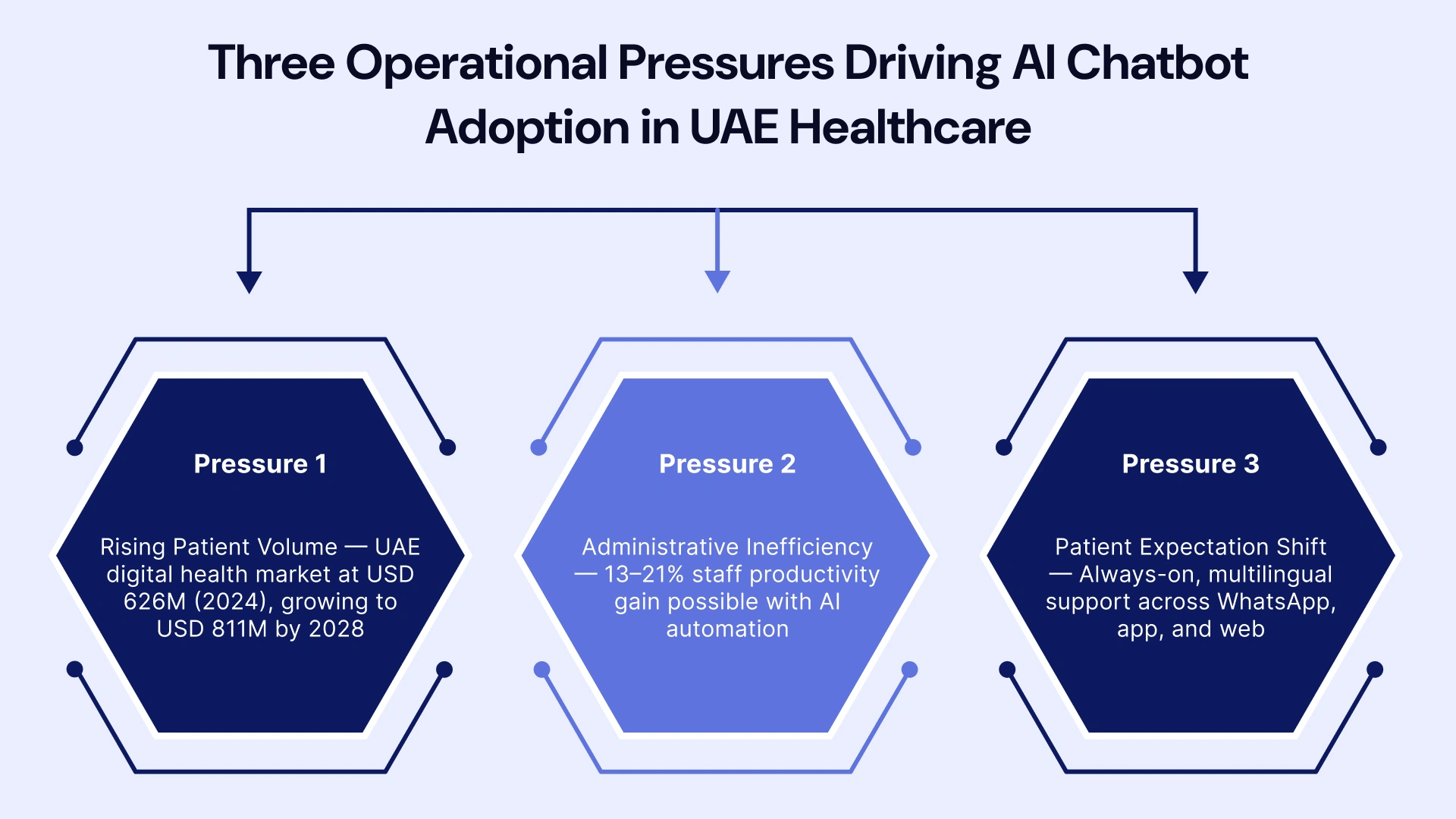
UAE hospitals face three converging operational pressures that make chatbot deployment a business-level decision, not a technology experiment.
Rising Patient Volume Without Proportionate Staff Growth
The Cost of Administrative Inefficiency
Healthcare organizations that implement AI agents for administrative automation report 13–21% increases in staff productivity, with many achieving measurable ROI within the first quarter (Thoughtful AI, 2025). For UAE hospital groups managing multi-site operations, the compound savings from automated scheduling, appointment reminders, and triage routing are material.
Patient Expectations Have Shifted
In Dubai and Abu Dhabi, patients expect multilingual, always-on service across WhatsApp, apps, and web interfaces. Medcare Hospital Al Safa has demonstrated this with chatbots Leo and Mira, which handle patient queries around the clock. Manual support models cannot meet that standard cost-effectively.
UAE Regulatory Landscape: DHA, DOH, MOHAP, and the Health Data Law
Any AI chatbot for healthcare UAE deployment must be architected around the three-authority regulatory structure from day one. Compliance is not an afterthought — it is a design constraint that determines data residency, access controls, and audit architecture.
UAE Healthcare AI Regulatory Authority by Emirate
| Authority | Jurisdiction | Key AI/Digital Health Mandate |
| MOHAP (Ministry of Health and Prevention) | Northern Emirates: Sharjah, Ajman, UAQ, Ras Al Khaimah, Fujairah | Federal supervision of AI use in healthcare; SaMD registration via Drug Control Department |
| DOH (Dept of Health, Abu Dhabi) | Abu Dhabi | AI Policy in Healthcare Sector (2018) — first in the region; governs AI deployment in Abu Dhabi facilities |
| DHA (Dubai Health Authority) | Dubai and most free zones | Governs data compliance, NLP deployment in contact centers; active AI-integration mandate |
The Health Data Law and Patient Consent
Data must reside on UAE-based servers. Access must be role-controlled and auditable. Sensitive patient interactions require consent logging. These are build requirements, not post-launch configurations.
National Health Data Infrastructure: Riayah, Malaffi, NABIDH
Integrating via Malaffi (Abu Dhabi's health information exchange) or NABIDH (Dubai) is the architecture-level decision that separates a functional chatbot from a clinically useful one.
AI Chatbot Use Cases in UAE Hospitals and Clinics
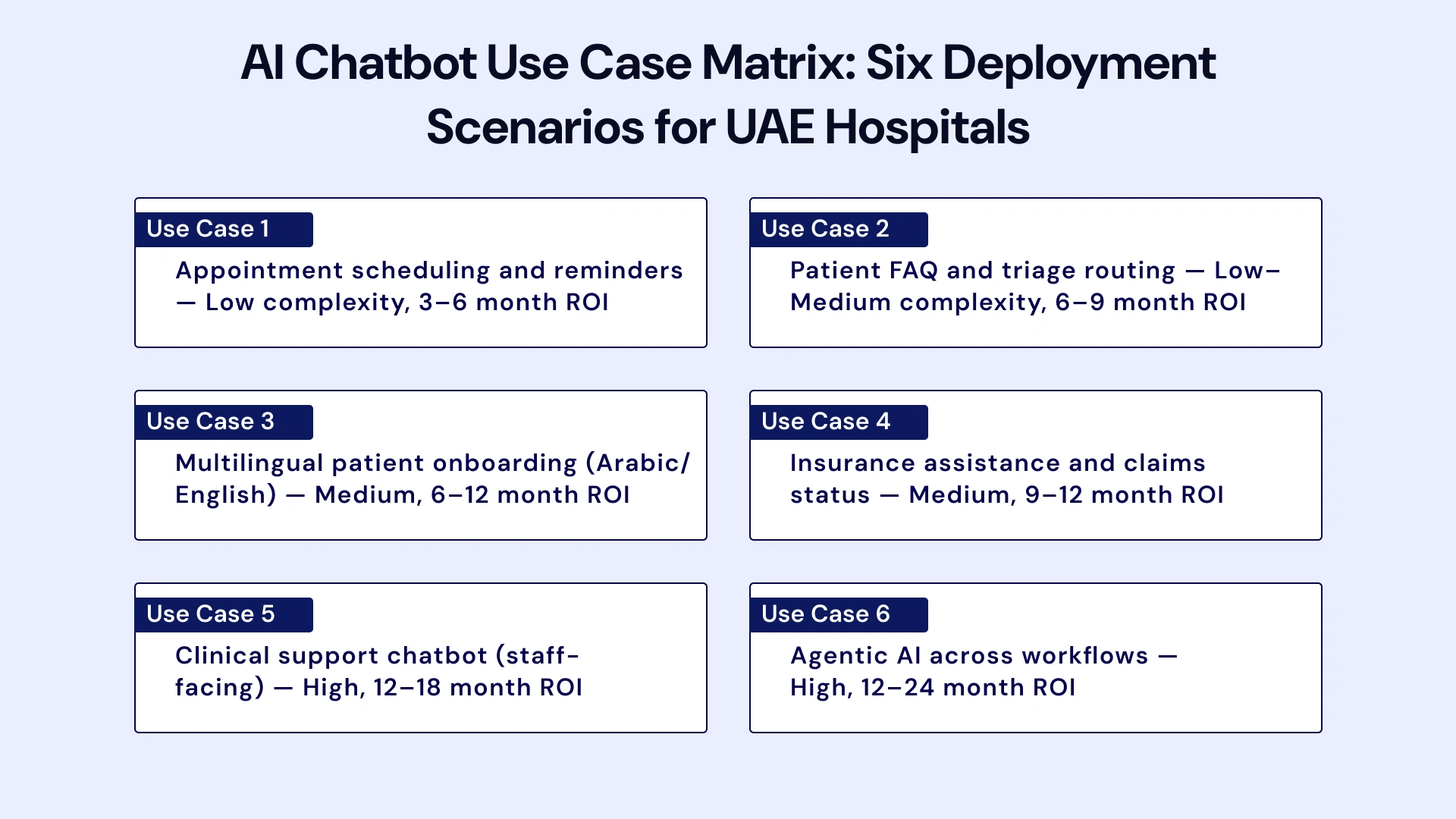
UAE hospitals generally start with one or two lower-complexity use cases and scale following validated performance. The following use cases reflect the deployment patterns observed across hospitals in Dubai, Abu Dhabi, and the Northern Emirates.
AI Chatbot Use Cases by Complexity and ROI Timeline in UAE Healthcare
| Use Case | Complexity | Primary Value | Typical ROI Timeframe |
| Appointment scheduling and reminders | Low | 35% reduction in no-show rates; 30% admin time saving | 3–6 months |
| Patient FAQ and triage routing | Low–Medium | Reduced front-desk call volume; faster care routing | 6–9 months |
| Multilingual patient onboarding (Arabic/English) | Medium | Improved patient intake completion; reduced data errors | 6–12 months |
| Insurance assistance and claims status | Medium | Reduced administrative workload; faster patient resolution | 9–12 months |
| Clinical support chatbot (staff-facing) | High | Faster clinical guideline access; reduced documentation time | 12–18 months |
| Agentic AI chatbot across workflows | High | 25–50% administrative cost reduction across scheduling, auth, billing | 12–24 months |
Houston Methodist's 2025 implementation of an agentic AI chatbot targeting scheduling, revenue cycle, and prior authorization projected 25–50% cost reduction in those administrative functions (TechAhead, 2026). UAE hospital groups running multi-specialty, multi-site operations face the same cost structure.
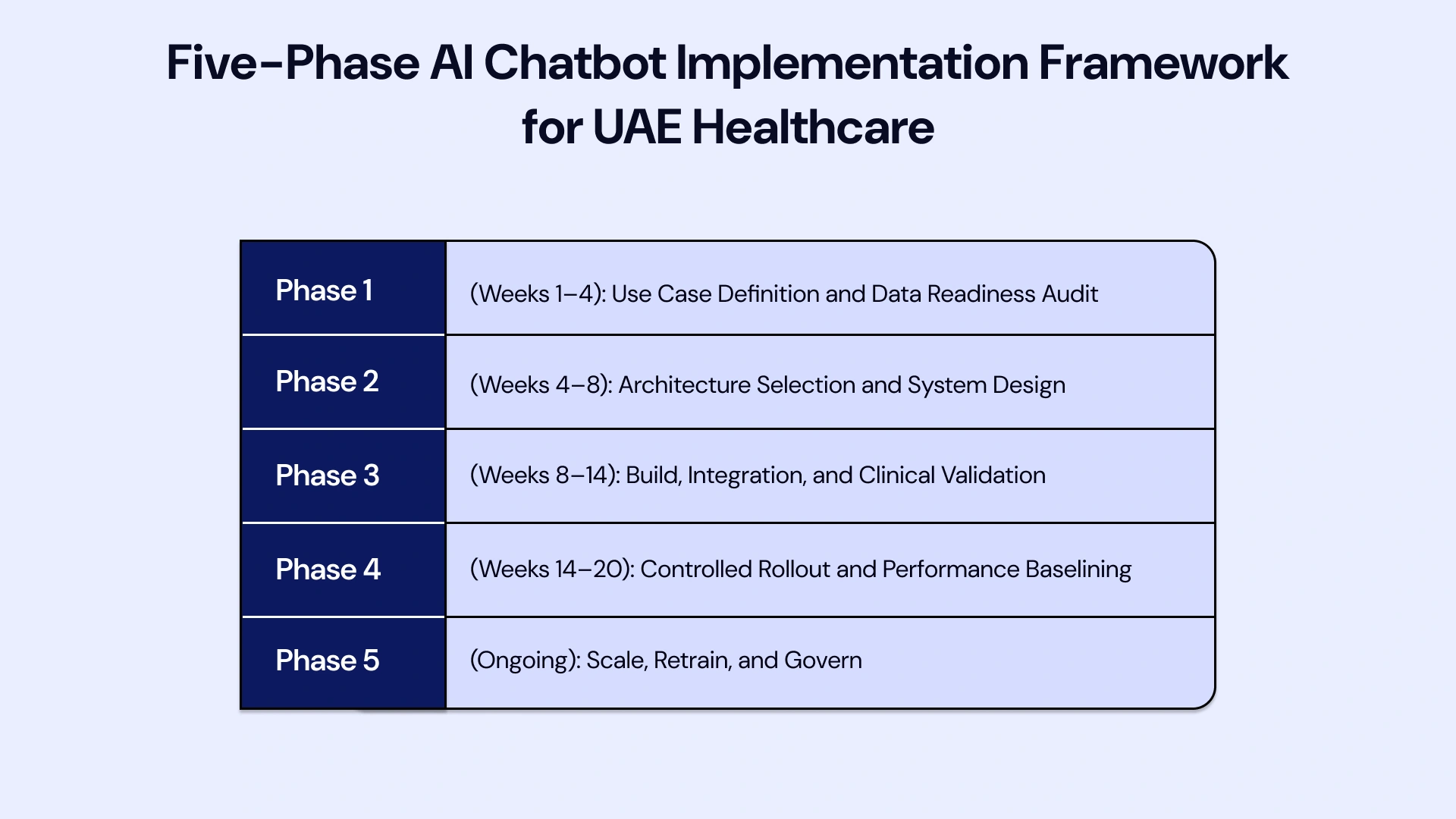
How to Implement an AI Chatbot for Healthcare in the UAE: A 5-Phase Framework
This implementation framework is designed for UAE hospital CTO and digital health teams managing deployments under DHA, DOH, or MOHAP jurisdiction. Each phase has defined deliverables, compliance checkpoints, and a risk posture.
Phase 1 (Weeks 1–4): Use Case Definition and Data Readiness Audit
- Map patient journeys and identify the highest-volume, highest-friction touchpoints.
- Conduct a data readiness audit: what structured and unstructured data is available for training and grounding?
- Align use case scope with the applicable regulatory authority — DHA, DOH, or MOHAP — from day one.
- Define success KPIs: resolution rate, no-show reduction, average handle time, patient satisfaction score.
Risk Level: Low. Budget Posture: Diagnostic. Output: Validated use case roadmap and compliance brief.
Phase 2 (Weeks 4–8): Architecture Selection and System Design
- Choose between rule-based (controlled, low-risk queries), LLM-based (open-ended clinical conversation), or hybrid architecture.
- Design FHIR-compliant integration with hospital management system, EMR/EHR platform, and national health platforms (Malaffi, NABIDH) as applicable.
- Define multilingual NLP pipeline: Arabic and English must be treated as separate processing paths — not translation layers.
- Plan data residency: all patient data must remain on UAE-hosted infrastructure.
Risk Level: Low–Medium. Budget Posture: Architecture investment. Output: Technical architecture document and compliance sign-off.
Phase 3 (Weeks 8–14): Build, Integration, and Clinical Validation
- Build or configure the conversational AI chatbot against validated clinical scenarios.
- Integrate with hospital systems via secure APIs and authenticated access layers.
- Clinical teams review chatbot responses against real patient scenarios — this step is non-negotiable in the UAE regulatory context.
- Conduct adversarial testing: push the system beyond its intended scope to identify unsafe response patterns before go-live.
Risk Level: Medium. Budget Posture: Development and testing. Output: Validated, compliance-cleared chatbot build.
Phase 4 (Weeks 14–20): Controlled Rollout and Performance Baselining
- Deploy to a controlled patient subset — one department or one channel (e.g., WhatsApp only).
- Track KPIs daily against baseline: resolution rate without human handoff (target: 60–70%), patient satisfaction, average handle time reduction.
- Conduct staff training and change management — clinical adoption is the primary ROI lever at this phase.
Risk Level: Medium. Budget Posture: Go-live operational. Output: Performance baseline and rollout decision point.
Phase 5 (Ongoing): Scale, Retrain, and Govern
- Scale to additional departments, languages, and channels based on Phase 4 performance data.
- Implement MLOps: set a retraining and model drift detection cadence to maintain accuracy as patient language patterns evolve.
- Establish a compliance review cycle aligned with DHA, DOH, or MOHAP guidelines — at minimum annually or following any regulatory update.
Risk Level: Low–Medium. Budget Posture: Optimization and governance. Output: Compound ROI through continuous improvement.
Multilingual AI Chatbot Design for Arabic and English Patients
Multilingual AI chatbot development for Arabic patients is one of the most technically underestimated requirements in UAE healthcare deployments. Direct translation between Arabic and English is not sufficient — and in clinical settings, it is a patient safety risk.
Why Arabic NLP Requires Dedicated Engineering
Arabic is morphologically rich and contextually complex. Gulf dialect (Khaleeji), Modern Standard Arabic, and mixed Arabic-English conversation — colloquially known as code-switching — are all common in UAE patient interactions. A system trained only on formal Arabic will fail in real hospital conversations.
The standard approach for UAE deployments is to treat Arabic and English as separate NLP processing paths — separate intent classifiers, separate entity extractors, and separate response generators — rather than relying on a translation middleware layer. Medical terminology must be aligned to ICD or SNOMED standards in both languages independently.
Practical Architecture for Multilingual Healthcare Chatbots
- Use a language detection module at session start to route to the correct NLP pipeline.
- For code-switching conversations (mixed Arabic-English), implement a hybrid classifier trained on UAE-specific clinical dialogue data.
- Apply strict output guardrails on the LLM layer: randomness parameters must be tuned low in clinical settings to prevent unsafe response variation.
- Validate multilingual responses against clinically trained reviewers — not just bilingual QA staff.
Hospitals in Sharjah and Fujairah, where patient populations include large non-English-speaking communities, report that multilingual accuracy directly drives patient adoption rates. A chatbot that fails in Arabic at the first interaction does not get a second chance.
AI Chatbot ROI Calculator: Metrics That Matter for UAE Health Systems
ROI calculation for an AI chatbot in healthcare must account for both direct cost avoidance and indirect revenue protection. The framework below is designed for UAE CTOs presenting a business case to hospital group leadership or board.
AI Chatbot ROI Calculation Framework for UAE Healthcare Deployments
| ROI Category | Metric | Typical Impact Range | Evidence Base |
| Administrative Cost Reduction | Staff time saved on scheduling, FAQ, triage routing | 30–40% reduction in routine admin workload | McKinsey Global AI Survey, 2024 |
| No-Show Rate Reduction | Appointment no-shows prevented via automated reminders | 20–35% reduction | Hyperleap AI, 2026 |
| Patient Intake Efficiency | Minutes saved per appointment via AI intake automation | 15 minutes per appointment on average | TechAhead, 2026 |
| Staff Productivity | Increase in staff output per FTE through AI-assisted workflows | 13–21% productivity improvement | Thoughtful AI, 2025 |
| Revenue Cycle Acceleration | Faster authorization, billing, and claims routing | Measurable ROI within first quarter possible | Thoughtful AI, 2025 |
| Overall Healthcare AI ROI | Return per $1 invested across AI initiatives | $3.20 return per $1 spent, typically within 14 months | LITSLink AI Statistics, 2025 |
ROI Calculation Formula for UAE Hospital CTOs
Net Annual Savings = (Staff Hours Saved × Hourly Cost) + (No-Shows Prevented × Average Appointment Revenue) + (Admin Cost Reduction per Patient × Annual Patient Volume)
For a mid-sized UAE hospital with 200 daily consultations, a 30% reduction in administrative call volume and a 25% improvement in no-show rates can generate annual savings in excess of AED 800,000 — before accounting for revenue cycle improvements. UAE health systems benchmarking against broader healthcare automation ROI UAE programmes — including RPA deployments — typically see compound savings that accelerate further as AI workflows scale across departments.
Development costs for a UAE-compliant healthcare AI chatbot typically range from AED 147,000 to AED 1,470,000+ depending on clinical complexity, system integration depth, and multilingual requirements (AppInventiv, 2026). Most UAE hospitals see ROI within 6–12 months for well-scoped deployments.
Build vs. Buy: Selecting Your AI Chatbot Development Approach
UAE hospital technology leaders face a binary that is not actually binary. The question is not simply build versus buy — it is which configuration of custom development, platform customisation, and vendor integration best matches your clinical use case complexity, compliance requirements, and timeline.
Build vs. Buy Decision Matrix for AI Chatbot for Healthcare UAE
| Dimension | Off-the-Shelf Platform | Custom Development | Hybrid (Platform + Custom Integration) |
| DHA/DOH/MOHAP Compliance Control | Limited — vendor-dependent | Full control — built to specification | Partial — depends on platform's compliance posture |
| Arabic NLP Accuracy | Generic — often inadequate for clinical Gulf dialect | Purpose-built for UAE patient population | Good if platform supports Arabic NLP extension |
| EHR/FHIR Integration | Standard connectors only | Full API integration to any clinical system | Platform connectors supplemented by custom APIs |
| Time to Deploy | 6–10 weeks (basic functionality) | 16–30 weeks (full clinical deployment) | 10–20 weeks |
| Total Cost | Lower upfront; higher long-term licensing | Higher upfront; lower per-patient cost at scale | Moderate upfront and ongoing |
| Scalability Across Use Cases | Hits limits quickly in clinical environments | Scales with hospital needs | Scalable within platform constraints |
Unless your health system has an existing AI engineering capability, building in-house typically costs 2–3 times more and takes twice as long compared to engaging a specialist healthcare AI development partner (TechAhead, 2026). The healthcare chatbot integration challenge — FHIR standards, clinical safety guardrails, compliance architecture — requires deep domain experience that general software teams rarely have.
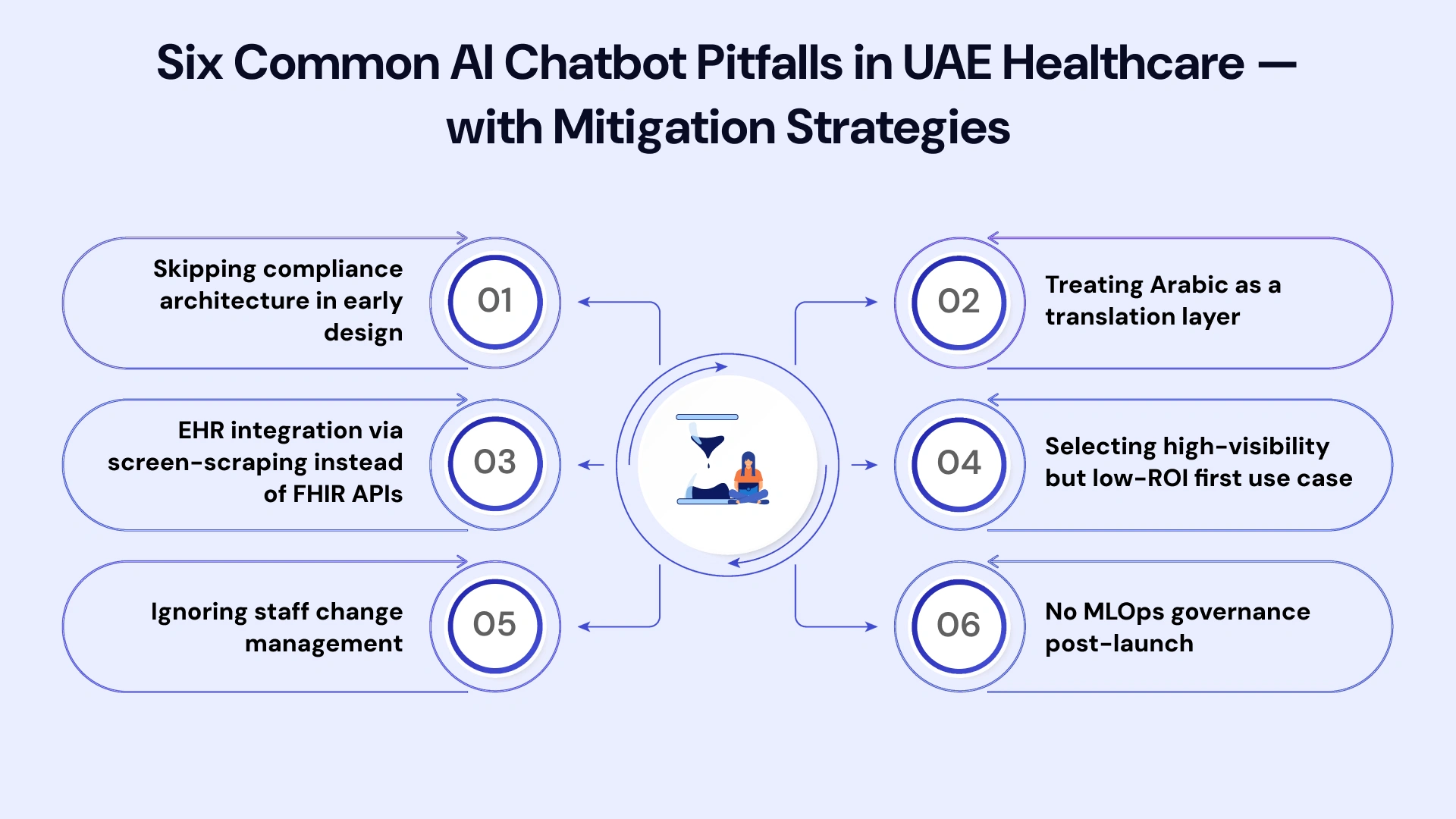
Common Implementation Pitfalls - and How UAE Hospitals Avoid Them
The majority of AI chatbot deployments that fail in healthcare do so not because the technology is inadequate, but because the implementation was not architected for clinical realities. The following pitfalls appear consistently across UAE and regional deployments.
Common AI Chatbot Implementation Pitfalls in UAE Healthcare and Mitigation Strategies
| Pitfall | Business Impact | Mitigation |
| Skipping compliance architecture in early design | Costly rework post-deployment; potential regulatory exposure | Engage DHA/DOH/MOHAP regulatory counsel before build starts |
| Treating Arabic as a translation layer | Low patient adoption; clinical miscommunication risk | Build Arabic NLP as a primary pipeline, not a secondary translation step |
| Integrating with EHR via screen-scraping instead of FHIR APIs | Fragile integrations; data sync failures; audit trail gaps | Mandate FHIR-compliant API integration in the technical specification |
| Selecting high-visibility but low-ROI first use case | Erodes organizational confidence and funding appetite | Start with appointment scheduling or FAQ automation — data-ready, fast ROI |
| Ignoring staff change management | Low utilisation despite technically sound deployment | Treat clinical staff adoption as a programme workstream, not a training session |
| No MLOps governance post-launch | Model drift degrades accuracy over months; patient safety risk | Define retraining cadence, drift detection thresholds, and clinical review triggers at go-live |
VLink: AI Software Development for UAE Healthcare
VLink's AI software development practice in Dubai supports healthcare providers across the UAE with end-to-end conversational AI development — from use case scoping and FHIR-compliant integration design through Arabic NLP build, clinical validation, and post-deployment MLOps governance. VLink has delivered healthcare AI solutions for clients managing chronic conditions including hypertension and obesity, demonstrating applied expertise in clinical workflow integration and patient-facing digital product development.
For UAE health systems operating under DHA, DOH, or MOHAP jurisdiction, VLink's delivery team brings specific experience across UAE compliance architecture, Arabic language AI, and multi-site hospital system integration. VLink offers flexible engagement models — from staff augmentation for in-house digital health teams to full-cycle project delivery — tailored to the timeline and budget realities of UAE healthcare groups.
Key capabilities include: custom AI chatbot development services with clinical safety guardrails; FHIR-compliant EHR and hospital management system integration; multilingual NLP for Arabic and English patient populations; compliance-aware deployment architecture for DHA, DOH, and MOHAP environments; and MLOps governance for ongoing model performance management.
To scope an AI chatbot for healthcare UAE deployment aligned with your facility's regulatory jurisdiction and clinical priorities, engage VLink's UAE digital health advisory team.
Conclusion: From Pilot to Production in UAE Healthcare
The UAE has positioned itself as a global leader in healthcare AI — with the National Strategy for Artificial Intelligence 2031, the Riayah national health data platform, and active AI deployment mandates from DHA, DOH, and MOHAP all creating a regulatory and infrastructure environment that is ready for production-grade chatbot deployment.
For CTOs and digital health leaders, the question is no longer whether to deploy an AI chatbot for healthcare — it is how to deploy one that meets the UAE's three-authority compliance structure, serves a genuinely multilingual patient population, and delivers measurable ROI within a defined budget and timeline.
The five-phase framework, ROI calculator, and build-versus-buy analysis in this guide provide the decision-making architecture your team needs to move from business case to go-live. To commission a UAE-compliant healthcare chatbot scoping engagement, contact VLink's advisory team.

Vice President, Strategy – VLink Inc.
Sambhavi Gopalakrishnan is the Vice President of Strategy at VLink Inc., bringing over a decade of experience in IT leadership, project implementation, and strategic growth. She possesses a strong foundation in technical project management and pre-sales, driving innovation and business transformation at VLink.

 Shivisha Patel